
Have you ever felt that deep pull towards midwifery—a career that feels more like a calling than just a job? The thought of supporting families during one of life’s most amazing moments is a powerful one. But for many of us, that dream gets put on a shelf.
Maybe school wasn’t your thing, or you started a family, or your career just went in a different direction. It’s easy to think that your chance has passed. I’m here to tell you it absolutely hasn’t. The Access to Higher Education Diploma in Midwifery was created for people just like you.
A Second Chance at Your First-Choice Career
Let’s be honest, the old-fashioned way of going to university isn’t built for adults with bills to pay, children to look after, and a life already in full swing. That’s what makes the Access to HE Diploma so special. It’s not about trying to squeeze your life into a strict timetable; it’s a qualification designed to fit around you.
This nationally recognised diploma is the key that unlocks a university-level midwifery degree. It’s a respected pathway designed specifically for adults who have valuable life experience but not the A-levels that universities usually ask for.
This isn’t about going back to school; it’s about moving forward into the career you were always meant for. It’s a chance to build on your life skills and turn your passion into a professional qualification that will make you and your family incredibly proud.
Think about what this step means. You’re not just chasing a personal dream; you’re showing your children and everyone around you what’s possible when you believe in yourself. You’re proving that dedication and hard work can open doors at any age, becoming an amazing role model for your family.
More Than Just a Calling
While midwifery is driven by passion, it also needs to be a practical career choice. The good news is, it offers real security and the potential for higher earnings. Once qualified, midwives in the NHS typically start on a Band 5 salary, which is currently around £28,407 a year. With experience, there are clear pathways to progress and earn more, giving your family greater financial stability.
This career offers that rare combination of deep emotional fulfilment and the security to support your family. Your life experience isn’t a drawback here—it’s your greatest asset. Forget any old doubts you might have about exams or essays. This is a fresh start, and it begins now.
What Is an Access to HE Diploma in Midwifery?
It’s a common myth that if you didn’t get the right qualifications at school, the door to a career like midwifery is shut forever. Life happens—perhaps your A-Levels didn’t go to plan, or you chose a different path. But what if there was a way to get back on track?
That’s exactly what the Access to Higher Education Diploma in Midwifery is for.
In simple terms, it’s the most direct route back into education for aspiring midwives. This nationally recognised qualification is your key to getting into a university degree course. It carries the same weight as three A-Levels in the eyes of universities across the UK.
A Focused Path to Your Dream Career
So, how is it different from A-Levels? While A-Levels cover broad subjects, an Access to HE Diploma is built specifically for adult learners aiming for a particular degree. The entire course is designed to give you the exact knowledge and study skills you need to do well on a demanding midwifery degree programme.
Think of it less like a general workout and more like a focused training camp for a specific event. Every module, every assignment is geared towards one goal: preparing you for university and your future as a midwife. It cuts out the noise and focuses on what truly matters.
This path is about taking a direct, purposeful step from where you are now towards a fulfilling and well-paid career.
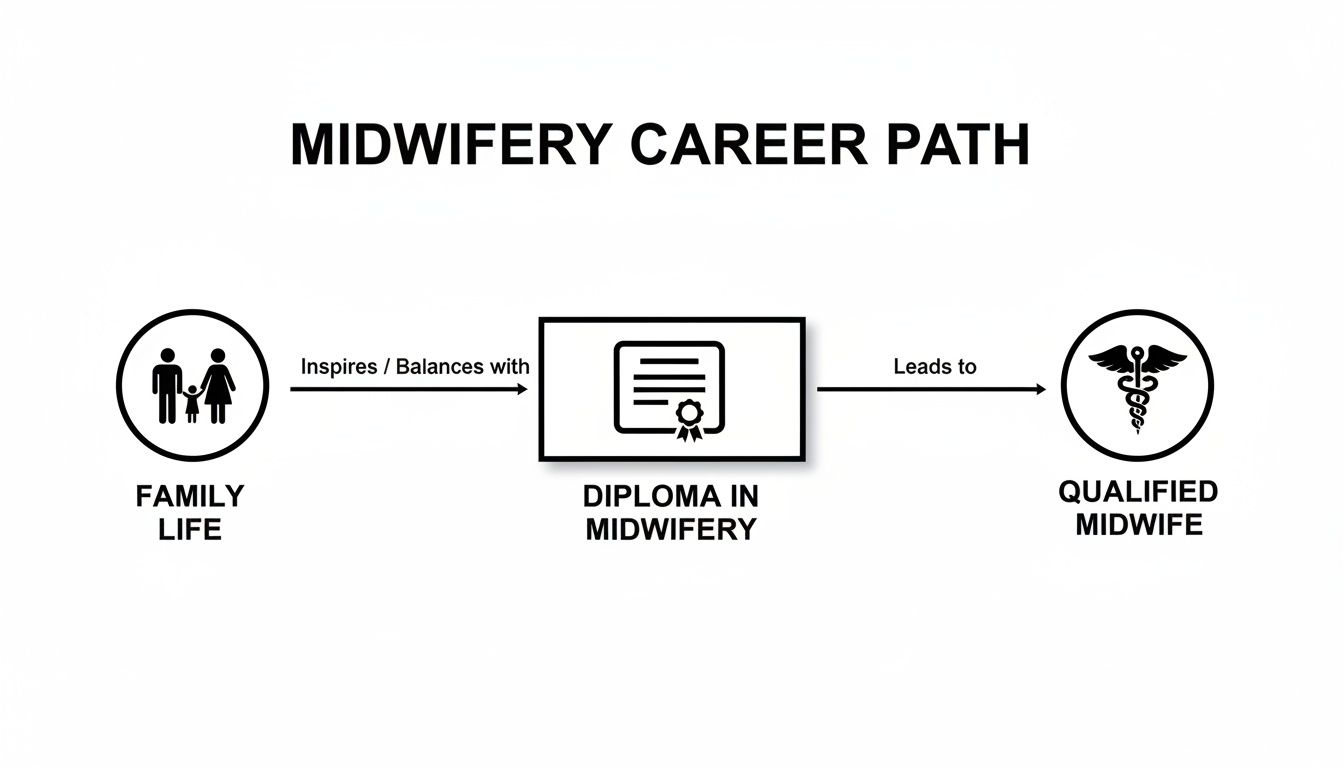
As you can see, no matter your starting point—even if you’re juggling a busy family life—the diploma acts as the vital bridge to becoming a qualified, registered midwife.
To make it clearer, let’s look at how the two main paths compare for someone returning to education.
Access to HE Diploma vs Traditional A-Levels
| Feature | Access to HE Diploma (Midwifery) | Traditional A-Levels |
|---|---|---|
| Timeframe | Typically completed in 9-12 months. | Usually takes 2 years to complete three subjects. |
| Focus | Highly specialised, focusing on subjects directly relevant to midwifery (e.g., Biology, Health Studies, Psychology). | Broad academic subjects (e.g., Maths, English, History) that may or may not be relevant. |
| Target Audience | Specifically designed for adults (19+) returning to education. | Primarily aimed at 16-18 year olds in a school or college setting. |
| Skills Development | Includes dedicated units on academic writing, research, and study skills for university. | Focus is on subject knowledge; academic skills are developed more generally. |
| Assessment | Assessed through coursework, essays, and reports. No final exams. | Primarily assessed through end-of-course exams. |
For most adults, the Access to HE Diploma is a much more efficient and relevant route. It’s built with the understanding that you don’t have two years to spare and need a qualification that speaks directly to your career goals.
Designed for Adult Learners Like You
One of the biggest strengths of the Access to HE pathway is that it genuinely values your life experience. Universities know that mature students bring a level of focus, resilience, and real-world understanding that is priceless on a course like midwifery.
This isn’t just about revisiting biology. It’s about building the confidence and practical academic skills you’ll need from day one at university. You’ll learn how to structure a great essay, reference your sources correctly, and manage your study time—giving you a real head start.
An Access to HE Diploma in Midwifery is more than just a qualification; it’s a statement to universities that you are prepared, motivated, and ready for a degree.
Completing this diploma is a powerful step towards a respected and rewarding profession. Starting salaries for newly qualified NHS midwives are around £28,407, with a clear structure for career progression and higher earnings. More than that, imagine the pride your family will feel watching you achieve your goal—you won’t just be transforming your own life, you’ll be an inspiration for theirs.
Overcoming Challenges in Modern Midwifery Education
Let’s be clear about what it takes to become a midwife. The dream is a beautiful one, but it’s important to go in with your eyes open to the road ahead. The truth is, while more people than ever want to train, not everyone who starts a midwifery degree makes it to the finish line. This is rarely because they lack passion; it’s almost always down to real-world pressures.
The numbers tell a story. While demand for access to higher education in midwifery has gone up, this has created its own challenges. In fact, a recent report showed that while student numbers in midwifery have grown by a huge 68% over the last decade, the number of students leaving their courses early has also climbed. A major reason for this is often financial pressure. You can read the full findings in the Royal College of Midwives’ 2023 report.
This is precisely where you, as an adult making a deliberate choice to return to learning, have a real head start. You can prepare for these challenges before you even begin.
Your Life Experience Is Your Superpower
As an adult learner, you’re bringing something to the table that many younger students are still developing: resilience. You’ve probably juggled a budget, managed a household, and learned to handle life’s curveballs. These aren’t just ‘life skills’; they are the very skills that will get you through higher education.
But resilience alone isn’t enough. The secret is pairing that strength with the right support system from day one. This is why choosing a flexible, supportive route like an online Access to HE course can be such a game-changer. It’s built specifically to tackle the very things that cause students to struggle.
By making a smart choice now, you are building a foundation for success. You’re not just hoping you’ll make it through; you’re putting a structure in place that will carry you through to graduation and beyond.
Imagine having a personal tutor who knows you and understands your goals, providing one-to-one advice. Think about having a support team ready to help you manage stress and stay on track. This is the kind of environment that helps you thrive, not just survive the journey.
Building Your Support System Early
An Access to HE Diploma, particularly one studied online, is much more than just a stepping stone. Think of it as your training ground for the demands of university. It gives you the space to build your academic confidence and study habits in a structured, supported way before you even set foot on campus.
Here’s how a well-chosen Access course directly helps you overcome those common hurdles:
- Financial Pressure: Flexible online study means you can often keep working, either part-time or full-time. Many providers also offer manageable payment plans, taking a huge weight off your shoulders.
- Lack of Support: The best providers give you dedicated personal tutors and support teams. They’re there to answer your questions, help you get past stumbling blocks, and cheer you on.
- Feeling Overwhelmed: The course is structured in manageable chunks. This step-by-step approach stops you from feeling swamped and builds your confidence with every unit you complete.
Your success isn’t just a personal victory. The NHS is in desperate need of dedicated, qualified midwives who have the grit and determination to see their training through. When you succeed, you become a vital part of our healthcare system.
You aren’t just aiming for a qualification; you’re building a new future for yourself and your family. A future with a career that offers higher earning potential, where your children see you achieving something incredible. This journey will make your family so proud, and you’ll be an amazing role model for them.
What You’ll Learn on an Access to Midwifery Course
Starting an Access to HE Diploma is a massive, exciting leap. You’re probably wondering what you’ll actually be studying. This isn’t like being back at school learning a bit of everything; this course is designed with one purpose: to give you the solid foundation you need to thrive in your midwifery degree.
Think of it as your pre-university training ground. Every module is a crucial piece of the puzzle, carefully chosen to give you the scientific knowledge and practical study skills that universities really value. You’re not just memorising facts for an exam. You’re learning how to learn at a higher level.
This is your chance to build unshakeable confidence in your own abilities. When you finish, you’ll feel completely prepared to tackle a degree, knowing you have everything you need to succeed.
Core Subjects: The Foundations of Midwifery
The heart of your diploma is the modules directly linked to a career in healthcare. These are the units that give you a real taste of a midwifery degree and get you ready for the scientific detail of university-level study.
You’ll find the subjects fascinating, and they’re all deeply connected to the work you’ll be doing one day. It’s here that your new career path starts to feel very real and exciting.
Typical core subjects you can expect to dive into include:
- Human Biology: This is where you’ll explore the incredible science of the human body. You’ll cover everything from cells and tissues to the nervous system and, most importantly, the human reproductive system. A deep understanding here is essential for supporting a person through pregnancy, labour, and birth.
- Health Studies: This module zooms out to look at the bigger picture. You’ll look at public health in the UK, the ethical questions in healthcare, and how society affects people’s wellbeing. This gives you vital knowledge for the communities and families you will eventually serve.
- Psychology: Midwifery is just as much about providing emotional support as it is about clinical skill. This unit offers amazing insights into human behaviour, relationships, and the deep emotional journey of pregnancy and early parenthood. It’s key to developing the kind, person-centred approach that makes a great midwife.
Developing Your Academic Skills
Worried about writing essays or finding research papers after a long break from education? You’re not alone, but you really don’t need to be. The Access to HE Diploma is specifically designed to get you up to speed with these skills, building your self-esteem with every assignment you complete.
These skills are a central part of the qualification and something universities look for. This is what proves you’re ready for degree-level work.
This course isn’t just about teaching you the science of midwifery; it’s teaching you how to be a successful student. These study skills are your passport to confidence and a strong performance at university.
You will learn essential skills such as:
- Academic Writing: Discover how to structure a powerful essay, build a clear argument, and write in a professional, academic style.
- Research Skills: Learn how to find trustworthy sources, understand scientific papers, and use evidence to back up your points.
- Referencing: Finally master the art of citing your sources correctly—a vital skill for university that many first-year students struggle with.
By getting a handle on these skills now, you’re putting yourself miles ahead. You’ll walk onto campus feeling prepared and capable, ready to focus on your midwifery studies from day one. This positive approach to learning is a huge part of what makes access to higher education in midwifery such a successful route for adults.
Your family will be incredibly proud to see you not just learning new subjects, but transforming into a confident, capable student. This journey will lead to a fulfilling career and also make you a fantastic role model for others.
How to Choose the Right Course Provider
Deciding where to study your Access to HE Diploma is a huge step. In fact, it might be even more important than choosing your university later on. Why? Because this is your foundation. Get this choice right, and you’re not just earning a qualification; you’re building the confidence, knowledge, and study habits that will help you shine once you get to your degree course.
This isn’t like picking a college at 16. As an adult learner, your life is different. You have responsibilities, bills to pay, and a family that needs you. You need a provider that understands that—a place that is genuinely committed to helping you succeed, not just focused on getting you signed up.
This is the first major investment in your future career. Let’s make sure it’s a solid one.
Look for Flexibility and Support
Forget the rigid, 9-to-3 timetables of the past. For anyone trying to fit study around work, kids, and everything else, online learning is a game-changer. It gives you the freedom to learn on your own terms, whether that’s late at night after everyone’s asleep or during your lunch breaks.
But here’s the crucial part: not all online courses are the same. The best ones offer more than just a login and a pile of files. They provide real, human support, so you never feel like you’re on your own.
True flexibility isn’t just about studying whenever you want. It’s about having a strong support system that adapts to your life and helps you succeed. It’s the difference between being left to figure it all out yourself and being guided every step of the way.
A great provider will offer this powerful mix of self-paced learning and personal guidance. This is exactly what you need to successfully gain access to higher education in midwifery.
What to Look for in a Provider
So, what does that amazing support actually look like? When you’re comparing providers, treat this as your essential checklist.
- Dedicated One-to-One Tutor Support: You need a named tutor, someone who knows you and understands your goals. They should be your go-to expert for feedback, questions, and guidance through the coursework.
- Pastoral Care and Wellbeing Support: Let’s be honest, life happens. A quality provider has a team ready to help you manage stress, stay motivated, and deal with any personal challenges that might come up.
- Flexible Payment Options: The cost of education is a very real worry for many adults. Look for providers that offer manageable payment plans to ease the financial pressure.
This kind of personal support is more important than ever. Recent figures from the Royal College of Midwives’ report on midwife numbers revealed a shocking 12.5% drop in UK-educated midwives joining the register. A key reason given was financial strain forcing students to leave their training.
By choosing a flexible course with a strong support network from day one, you’re setting yourself up to beat those odds. A provider that offers this level of care gives you the best possible chance to overcome hurdles and walk onto that university campus with confidence, ready to become the midwife you’ve always wanted to be.
You can explore a range of supported Access to Higher Education courses to get a feel for what a great provider should offer.
So, What Are Your Next Steps to Becoming a Midwife?
Feeling fired up and ready to make this happen? That’s fantastic! Hold onto that feeling. It’s the energy that will get you through the late-night study sessions and towards a career that’s more than just a job—it’s a true calling.
You’ve already got the passion and life experience. Now, it’s just about taking a few simple, practical steps to get the ball rolling. Let’s push aside any feeling of being overwhelmed and focus on a clear, simple plan for what to do next.
Your Action Plan, Made Simple
Let’s break this down into a really straightforward checklist. Your journey to access to higher education in midwifery starts right here. Don’t feel you have to do everything at once. Just start with number one and go from there.
-
Do Some University Research: First, have a look at a few universities you’d like to go to. Find the Midwifery BSc degree page on their websites and look for “entry requirements.” You’ll notice most ask for an Access to HE Diploma, along with GCSEs in Maths and English at grade 4 (or C) or above. This simple search gives you a clear goal to aim for.
-
Find Some Relevant Experience (If Needed): Universities love to see experience in a caring role. And no, it doesn’t have to be in a hospital! Volunteering at a local community centre, helping out in a care home, or even working with a family support charity all show your commitment and kindness brilliantly.
-
Choose and Apply for Your Access Diploma: Once you know what you need, it’s time to find the right Access to HE (Midwifery) course. A key thing to look for is a provider who offers genuine, one-to-one support—it makes all the difference. The application is usually just a simple online form.
This whole process is a journey, not a race. Every little thing you do, from a quick internet search to sending an email, is a step forward. It’s real progress, so be proud of it.
Writing a Personal Statement That Shines
When you apply for your Access course, and later for university, the personal statement is where you get to tell your story. This is the moment your life experience becomes your greatest strength. Don’t waste a second worrying about not having A-Levels; focus on everything you do have.
- Tell your story: Why midwifery? What moments in your life have pointed you in this direction? Be personal and honest.
- Show off your skills: Think about how you’ve managed a family budget, juggled schedules, or handled a tough situation. These are real-world examples of resilience, organisation, and communication—exactly the skills universities are desperate to see.
That dream of becoming a midwife is absolutely within your grasp. This isn’t just about starting a fulfilling career with higher earning potential; it’s about becoming an incredible role model for your family and friends. Can you imagine how proud they will be when they see you graduate? You can do this.
If you want more tips on the university application stage, we’ve put together a really helpful guide on how to get into university that walks you through it.
Frequently Asked Questions
It’s completely normal to have questions when you’re thinking about a career as important as midwifery. Deciding to start an Access to HE Diploma is a big, exciting step, so let’s answer some of the questions we hear most often from adult learners just like you.
Getting clear, straightforward answers is key. We’ve seen so many students in your exact position go on to succeed, and it all starts with having the right information and feeling confident.
Do I Need GCSEs to Start an Access to Midwifery Course?
This is probably the most common question we get, and for good reason. The short answer is: you don’t always need them to start the Access course, but you will almost certainly need them to get into university.
Most universities require GCSE Maths and English at a grade 4/C or higher for their midwifery degrees. The good news is that many course providers understand this. They have set things up so you can study for your GCSEs at the same time as your diploma, ticking both boxes at once. This makes the whole process much simpler and less stressful.
How Long Does the Online Access Course Take?
One of the best things about a modern online Access course is that it’s designed to fit around a busy adult life, not the other way around. There’s no strict, one-size-fits-all schedule.
You are in control of the timeline. The course is designed to be completed at a pace that works for you, fitting around family, work, and life’s other demands. It’s about building your skills and confidence, not racing to a finish line.
Most students finish their diploma in 9 to 12 months of part-time study. However, you generally have up to two years if you need it. This flexibility is brilliant – it lets you really understand the topics and prepare for university without the stress of an impossible deadline.
Is an Online Access to HE Diploma Accepted by Universities?
Yes, absolutely. An Access to Higher Education Diploma is a nationally recognised qualification in the UK, fully regulated by the Quality Assurance Agency for Higher Education (QAA). It was specifically created to provide a route to university for adults.
Universities across the UK not only accept the qualification for midwifery degrees, but they also value it. They know that Access students arrive with strong study skills, motivation, and a real commitment to their chosen career. That said, it’s always a smart idea to check the specific entry requirements on the websites of the universities you’re interested in, just to be sure.
Your goal of becoming a midwife is well within reach. At Next Level Online College, we specialise in the flexible, supportive online courses that help adults achieve their ambitions. Find out more about how we can help you get started. Learn more about our courses.