Thinking about going to university as an adult can feel like a huge, impossible mountain to climb. You might be picturing telling your children and family and seeing the pride on their faces, but right now, that dream probably feels a million miles away.
If you’ve been out of a classroom for a while, the whole idea of how to get into universities can feel overwhelming. It's like trying to solve a puzzle when you’re not even sure you have all the pieces. Worries about old school grades, how to afford it, or how on earth you'd fit it all in around work and family life are completely normal.
You Are Not Alone on This Journey
Let me tell you something important: you are not the only one feeling this way. Thousands of adults across the UK take this exact step every single year, and they all start with the same questions and doubts you have right now. You are more than capable of doing this.
The good news is the system is no longer just for school leavers. It has changed to be far more flexible, with clear pathways designed specifically for people just like you. This guide isn't a stuffy textbook; it’s a friendly chat to show you there’s a clear path forward, whatever your age or background.
This isn't just about getting a degree. It's about proving to yourself what you’re truly capable of, creating a better future, and becoming the amazing role model you want to be for your children.
A New Chapter Full of Amazing Possibilities
It’s time to swap that feeling of doubt for a feeling of excitement. Going back to education is a powerful step towards a more fulfilling, better-paid career. It opens doors you might have thought were locked for good and allows you to make a real difference.
Just think about the incredible impact this decision could have on your life:
- Inspire Your Family: You will show your children that it’s never too late to chase a dream. Your determination will be one of the most powerful lessons you can ever teach them, making them so proud.
- Boost Your Career and Earnings: A degree can unlock promotions, help you find a job you’re truly passionate about, and lead to you making more money to support your family.
- Build Unshakeable Confidence: Succeeding in your studies builds a type of self-belief that will lift you up in every single area of your life.
This guide is here to walk with you through the entire process, step-by-step. We'll break down everything you need to know about getting into university, turning that distant dream into a realistic, achievable plan. Let’s get started on your amazing new journey.
Choosing Your Pathway to University
Thinking about getting into university as an adult can feel like staring at a map with a dozen different routes and no signposts. It’s easy to feel overwhelmed, but here’s the good news: there isn’t just one path. This is a huge advantage, as it means you can find a route that genuinely fits around your life, your family, and your dreams.
It’s not about finding the 'right' way, but the right way for you. Let's break down the options so you can move forward with a clear, confident plan. This is your journey, and it should start from a point that feels right and exciting for you.
This visual guide is designed to help you turn that feeling of being overwhelmed into an empowered plan for getting to university.
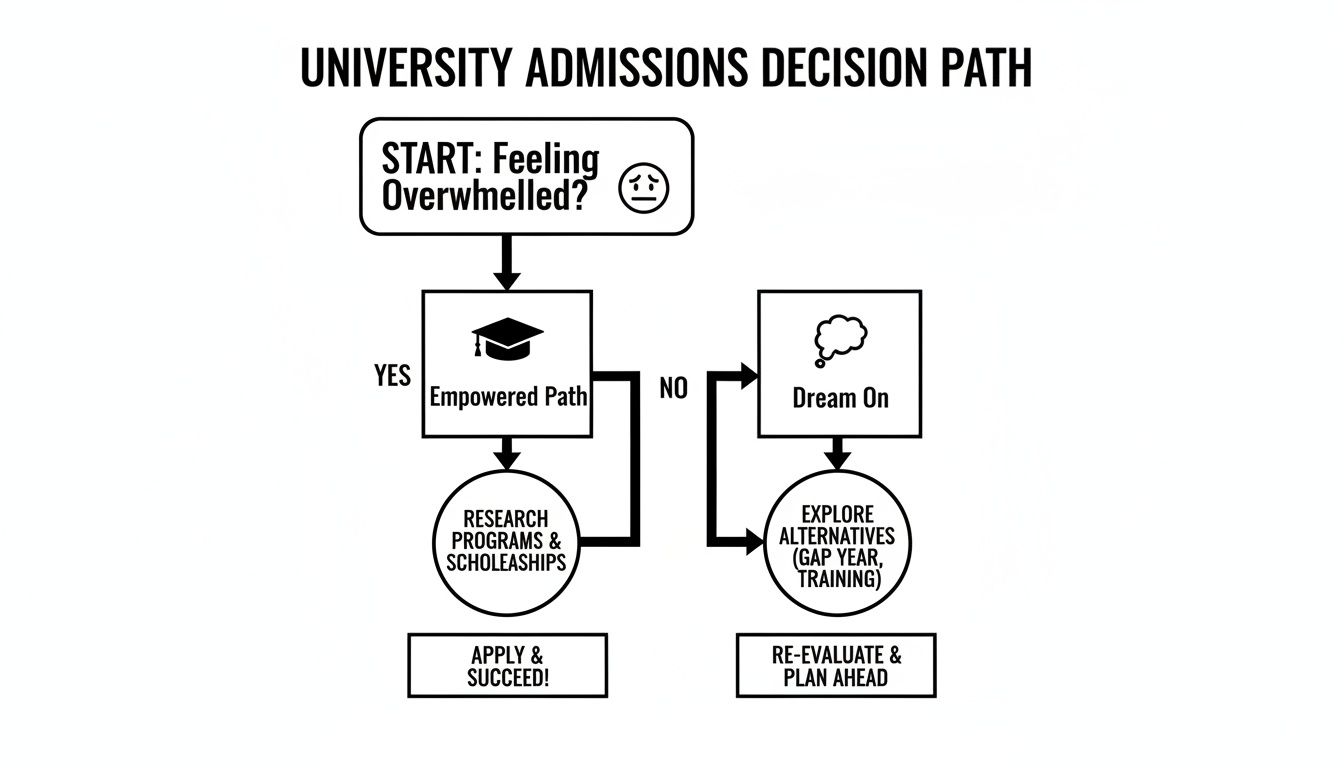
As you can see, the most important first step is deciding to take action. This is how you transform doubt into a structured and empowered journey toward your goals.
Your University Entry Qualification Options
So, what are the main qualifications that can get you into university? To help you find the best fit for your ambitions, this table compares the common options for adult learners.
| Qualification | Who It's For | Key Benefit | Typical Timescale |
|---|---|---|---|
| Functional Skills | Adults wanting to build confidence in core English and maths skills. | A quick, practical way to gain a foundational qualification. | 3-6 months |
| GCSEs | Those needing specific grades (e.g., a grade 4/C) for certain degree courses. | The standard academic benchmark recognised by all universities. | Up to 1 year per subject |
| A-Levels | Learners needing very specific subjects for competitive degrees like medicine. | The traditional, in-depth academic route into higher education. | 1-2 years |
| Access to HE Diploma | Adults who have been out of education and want a direct, one-year route to university. | An all-in-one qualification designed specifically for adult learners. | 9-12 months |
Each of these pathways is a respected route to university. The right choice for you will depend on where you're starting from and where you want to go. Let's dig into what each one really involves.
Building Your Foundation: Functional Skills and GCSEs
If the idea of studying feels a bit scary after a long break, Functional Skills in English and maths is the perfect place to start. These courses focus on practical, real-world skills, helping you build a solid foundation and gain essential qualifications without feeling overwhelmed. They are a brilliant way to ease back into learning and boost your confidence.
GCSEs are the next step up. Many university courses, especially in fields like teaching or healthcare, list a Grade 4/C or above in GCSE English and maths as an entry requirement. If you didn't get these grades at school, tackling them as an adult is a clear, respected route that shows universities you have the core academic skills for degree-level study.
The Direct Route: A-Levels
A-Levels are the traditional path for school leavers, but they’re also a fantastic option for adults who need specific subjects for a competitive degree. If you've set your sights on a career in medicine or engineering, for example, taking one or two A-Levels online can be the most direct way to meet those very precise entry requirements.
The Access to HE Diploma: A Game-Changer for Adults
For thousands of adult learners, the Access to Higher Education (HE) Diploma is the single most effective route to university. It’s a qualification specifically designed for people who have been out of the classroom for a while.
Think of the Access to HE Diploma as an academic bridge. It’s designed to take you from where you are now directly to being university-ready, all in just one year of study.
Universities across the UK don’t just recognise this diploma—they truly value it. Why? Because it proves you have the recent study skills, subject knowledge, and sheer determination to succeed. It shows them you're a serious, motivated candidate, ready to achieve great things.
Imagine you want to become a social worker but left school with few qualifications. An Access to HE Diploma in Social Science would cover psychology, sociology, and other relevant topics, preparing you perfectly for the degree. You can learn more about how an Access to Higher Education course could be your ideal next step to transform your life.
Which Path Is Right for You?
Choosing your pathway comes down to your personal goals, your existing qualifications, and how you feel about returning to study.
Consider this real-world scenario: Sarah is a 35-year-old mum of two who works part-time. She dreams of becoming a nurse but left school with few qualifications and feels her maths isn't strong enough. A great plan for Sarah would be to start with a Functional Skills maths course online to build her confidence. After that, she could enrol on an Access to HE Diploma in Nursing, which would give her all the entry requirements she needs for her dream career.
Each step you take is a victory. Every certificate you earn is proof—to yourself and your family—that you're building a new, better future. This isn't just about qualifications; it's about reclaiming your ambition and becoming the person you know you can be.
Creating an Application That Tells Your Amazing Story

This is your moment. Your university application isn’t just about grades and forms; it’s your chance to show the admissions tutors the real, amazing person behind the paperwork. I know that this part of the process, especially writing the personal statement, can feel incredibly scary.
But let’s look at it differently. Think of this as your opportunity to talk about your life, your journey, and why you’re so excited to do this now. This isn’t a test; it’s a conversation where you get to show them your passion and strength with pride.
Your Personal Statement Is Your Superpower
As an adult learner, you have something that school leavers simply don't: a rich life full of experience. You’ve likely managed budgets, raised a family, overcome challenges, or picked up incredible skills at work. These aren't just things that happened to you; they are powerful proof of your maturity, determination, and ability to manage your time.
Your personal statement is where you share these experiences and connect them directly to your chosen course. Never, ever feel like you have nothing to write about. Your journey is your greatest strength.
A great personal statement isn't about being a perfect student in the past. It's about showing you have the passion, maturity, and drive to be a brilliant student in the future.
For example, if you're applying for a business degree, don't just say you're interested in business. Talk about how juggling your household budget taught you financial planning, or how coordinating your family's busy schedule was a masterclass in project management. Connect your life to your learning.
A Simple Structure to Tell Your Story
Feeling stuck on where to even begin? Let’s break it down into three simple parts. This structure will help you organise your thoughts and build a story that flows naturally and powerfully.
- The Why: Start with your motivation. Why this specific course, and why now? What sparked your interest? Maybe it was a life event, a desire to build a better future for your children, or a long-held passion you're ready to turn into a career. Be honest and personal.
- The How: This is where you bring in your experience. How have your previous jobs, family life, or recent studies prepared you for this challenge? If you're currently studying for GCSEs for adults online, mention how it has reignited your love of learning and proven your commitment.
- The What: Finish by looking to the future. What are your ambitions? How will this degree help you get there and make a difference? Show the university you have a clear plan and that their course is a vital part of it.
This structure helps you tell a clear and powerful story—the story of you. It moves from your inspiration to your preparation, and finally, to your ambition for a better life.
Choosing Your Five University Courses on UCAS
When you apply through UCAS, you get to choose up to five courses. This is a great opportunity to give yourself a mix of options, taking some of the pressure off. It’s always smart to include:
- Your dream choices: The courses and universities you'd absolutely love to get into.
- A solid backup: A course with slightly lower entry requirements that you would still be very happy to attend.
This balanced approach gives you a fantastic safety net and increases your chances of getting an offer you’re excited about. Make sure you research each course thoroughly to be sure it aligns with your career goals.
Getting a Glowing Reference
Asking someone for a reference can feel awkward, especially if you’ve been out of a formal education or work setting for a while. But don't worry, you have some great options.
If you’re currently taking a course like an Access to HE Diploma, your online tutor is the perfect person to ask. They’ve seen your hard work, commitment, and academic progress up close and can write a brilliant reference about your dedication as a student.
If you aren’t studying right now, a manager from a recent job is another excellent choice. They can talk about your reliability, work ethic, and ability to learn new skills—all qualities that universities love to see.
The competition for university places has grown hugely over the years. Back in 1994, just 405,000 people in the UK applied to university. By 2026, this number could soar to over 752,000. While entry rates for younger students have hit record highs, the number of mature students has dipped, making your application a real chance to stand out. You can explore more about these trends on Statista.com. Your unique story is what will make you memorable and successful.
Balancing Study with Family Life and Money

Let’s be honest: thinking about how to get into universities is one thing, but figuring out how to make it work alongside your family, your job, and your budget is the real challenge. The thought of being on campus from nine to five just isn't realistic for most adults, and that’s completely okay.
The great news is that education has changed. It's no longer a world built just for school leavers. Today, you’ll find flexible, supportive options designed specifically for people like you, who are juggling a million things at once. This part of the journey is about finding a path that fits into your real life, not forcing your life to fit a rigid timetable.
The Power of Flexible Online Learning
Imagine being able to get your studying done after the kids are in bed, during your lunch break, or on a quiet Sunday morning. This is the power of online learning. It puts you in charge, letting you build a study schedule around your existing commitments.
You don't have to worry about a stressful commute or missing out on family moments. With an online course, your classroom is wherever you are, whenever you have a moment to spare. It’s this very flexibility that makes a university dream possible for so many adult learners today.
This is how you invest in your future without sacrificing your present. You can still be there for the school run, help with homework, and manage your job, all while taking real, powerful steps towards a new career that will make your family proud.
You Will Have a Supportive Team Behind You
One of the biggest worries we hear from adult learners is the fear of feeling lonely while studying from home. But a good online college will make sure you have a strong support network from day one. You’ll get a dedicated personal tutor who understands your goals and the challenges you’re facing.
These tutors aren't just there to mark your work; they are your mentors who will offer encouragement, answer your questions, and guide you every step of the way. You’ll have someone in your corner, cheering you on and helping you stay motivated when life gets busy. This is what turns a personal goal into a team victory.
Remember, choosing a flexible path doesn’t mean you’re choosing to do it alone. It means you’re choosing a smarter, more modern way to learn, with a support team built in to help you succeed.
For many returning adults, this is a chance to create new opportunities. Recent UK government social mobility data/entry_to_higher_education) shows that 46% of 18-20-year-olds from higher professional backgrounds enter higher education, a figure that is much lower for those from working-class backgrounds. Flexible online courses are a powerful tool to close this gap, offering a direct and accessible route designed for real life, helping you achieve success no matter your background.
Making Your University Dream Affordable
Now for the big question: money. The thought of tuition fees can be enough to make anyone feel worried, but there’s a lot of financial support available in the UK, created specifically for adult learners. You do not have to pay for your course fees upfront.
Here’s how it usually works for eligible students in England:
- Tuition Fee Loan: This loan covers the entire cost of your university course fees. It’s paid directly to the university, so you don't have to worry about finding that money yourself.
- Maintenance Loan: This is a separate loan to help with your living costs—things like bills, food, and childcare. The amount you can get depends on your household income and where you live.
The best part? You only start repaying these loans once you've graduated and are earning above a certain amount of money—currently £25,000 a year in England. The repayments are taken automatically from your pay like a tax, and the amount is just a small percentage of what you earn above that level. If your income drops, your repayments stop.
This system is designed to make higher education possible for everyone, regardless of their bank balance. To get a clearer idea of what might be available for you, you can explore our guide on financing your education. It's an investment in your future earning potential, funded in a way that is manageable and fair. Your dream of a degree is so much more financially possible than you might think.
Preparing for University Interviews and Offers
You’ve done it. You’ve poured everything into your application and finally clicked ‘submit’. Take a proper moment to feel proud of yourself, because that’s a huge step. So, what happens next? This is where your journey really starts to get exciting.
For many courses, especially the more competitive ones, you might get an email inviting you to an interview. If your first thought is a wave of panic, take a breath. An interview isn't a test; it’s a brilliant sign. It means the university has read your personal statement, they’re genuinely interested, and now they want to hear more of your amazing story.
This is your chance to show them the person behind the application. They want to see the passion and determination that brought you here in the first place.
Turning Interview Nerves into Confidence
It’s completely normal to feel nervous about an interview, but remember, you have a massive advantage: your life experience. Unlike a school leaver, you can draw on years of real-world situations to give honest, powerful answers.
Admissions tutors aren't trying to catch you out. They just want to have a friendly conversation and get a sense of who you are. Here are some common questions they might ask and how you can prepare:
- Why do you want to study this course? Go back to your 'why'. Talk about the moment that sparked your interest and connect it to the better future you want to build.
- Why did you choose our university? Do a little research. Mention something specific, like a particular module you’re excited about or a tutor whose work you admire.
- How will you handle the demands of study? This is where you can shine. Talk about how you already juggle family, work, or other commitments. It’s proof you have excellent time management skills.
Your interview isn’t about memorising perfect answers. It’s about sharing your enthusiasm with honesty and confidence. Let your personality and your unique journey be the stars of the show.
Stepping back into education after years away is a bold move. UCAS data shows a 31% drop in accepted History applicants aged 20+ from 1,385 in 2020 to just 955 recently. While mature student placements have fallen across the board, this just highlights a golden opportunity. With the right preparation, you can stand out as a truly dedicated and inspiring candidate. You can read more about these university application trends and what they mean for you.
Understanding Your University Offers
After the interviews, the offers will start to arrive through UCAS. This is a thrilling time! You’ll generally see one of two types, and it’s important to understand what they mean so you can make the best choice.
Conditional Offer: This is the most common type of offer. It means the university will give you a place if you meet certain conditions. For most adult learners, this will be achieving specific grades on your Access to HE Diploma or A-Levels.
Unconditional Offer: This means you already have a place secured! You've met all the academic requirements, and the university is offering you a spot with no strings attached.
What Happens on Results Day
Results day is the final hurdle—the day you find out if you've met the conditions of your offer. When you get the grades you need, your UCAS Hub will update to show your place is confirmed. This is the moment your hard work pays off and your dream becomes a reality.
But what if you don't get the grades? Don’t panic. You still have excellent options. Many universities can be flexible, and you can also use a process called Clearing to find a place on another course. Your journey doesn't end here; there is always a path forward.
Your University Questions Answered
Thinking about going back to education, especially to university, can bring up a lot of questions. We understand. Every adult learner we talk to shares similar worries, so we’ve put together some simple, honest answers to the most common queries. This is about giving you the clarity and confidence to take that exciting next step.
Am I Too Old to Go to University?
Let’s get this one out of the way immediately: absolutely not. There is no upper age limit on learning, and universities don’t just accept adult learners—they actively value them. Your maturity, life experience, and powerful motivation are seen as huge strengths in a university classroom.
Think of it this way: your unique perspective enriches class discussions, bringing a level of understanding that younger students simply haven’t had the chance to develop yet. People return to education at all ages to change careers, follow a lifelong passion, or become a powerful role model for their children. The year you were born doesn’t matter at all; your readiness to learn is what truly matters.
What if My Old School Grades Aren't Good Enough?
This is a really common worry, but it doesn't have to stop you. The grades you got years ago don’t define your potential today. The person you are now is not the same person you were at sixteen. You are stronger, wiser, and more determined.
That’s exactly why qualifications like the Access to Higher Education (HE) Diploma exist. They are designed for adults who have been out of the classroom for some time. UK universities accept them because they prove your current academic ability and show that you are completely ready for a degree course. It tells them everything they need to know about your commitment today.
How Can I Study While Working and Raising a Family?
This is often the biggest practical challenge, but modern education has been built for people with busy lives. You don’t have to choose between your family and your future. Flexible online courses are designed to fit around your commitments, not the other way around.
Imagine completing your assignments after the kids are in bed, or catching up on lectures during your lunch break. That’s exactly how it works. You study when and where it makes sense for you.
Making it work comes down to two things:
- Finding a course provider that genuinely understands the pressures of adult life and supports you.
- Getting good at time management, finding small, steady pockets of time to dedicate to your studies.
It’s all about making small, manageable steps towards a huge and wonderful goal. Thousands of parents and full-time workers achieve this every single year, and you absolutely can too.
Your life experience isn't a disadvantage; it's your superpower. Juggling work and family has already taught you incredible time management and prioritisation skills—qualities that are essential for university success.
Will I Genuinely Be Able to Afford It?
The cost of university can feel incredibly scary, but you are not expected to find thousands of pounds upfront. There is great financial support available in the UK to make higher education possible for everyone.
For most eligible adult learners, a Tuition Fee Loan will cover the entire cost of your course fees, and it’s paid directly to the university, so you don’t have to worry about it. You may also be able to get a Maintenance Loan to help with your living costs.
Crucially, you only start repaying these loans once you've graduated and are earning over a certain amount (currently £25,000 a year in England). The repayments are just a small, manageable percentage of your earnings above that line. If your income ever drops, your repayments pause. It’s a system designed to be an investment in your future, not a burden on your present.
At Next Level Online College, we see incredible people just like you transform their lives every single day. We are here to support you at every stage of your journey, providing the flexible courses and dedicated guidance you need to make your university dream a reality. Start your new chapter today by exploring our recognised online qualifications at https://nextlevelonlinecollege.com.