You might be reading this with a knot in your stomach. Maybe school never felt like your place. Maybe speaking in front of other people makes your hands shake. Maybe you're returning to education after years of putting work, children, and everyone else first.
If that sounds like you, take a breath. The GCSE English speaking exam is not there to catch you out. It can become one of the most powerful parts of your learning journey, because it asks you to do something profoundly human. Speak clearly, share an idea that matters to you, and show that your voice deserves to be heard.
For many adult learners, that matters far beyond one qualification. It can help you feel stronger in job interviews, more confident in meetings, better able to support your children with school, and more ready to take the next step towards college or university. When you stand up and speak with purpose, you're not only preparing for an assessment. You're showing your family what growth looks like.
Your Chance to Find Your Voice and Shine
A lot of adults hear the words GCSE English speaking exam and instantly go back to old classroom memories. Being judged. Getting stuck. Feeling embarrassed. It's no wonder this part can sound frightening at first.
But the actual experience can be very different.
This is one part of English where your life experience can help you. You may have raised children, dealt with bills, managed work pressure, cared for relatives, or rebuilt your confidence after setbacks. That means you already know how to explain, persuade, reflect, and speak with feeling. Those are real strengths.
Think about two learners. One picks a topic because it sounds clever, but they don't care about it. The other chooses a topic that means something to them, such as why adults should return to education, why communities need safer streets, or how social media affects young people. The second learner often sounds more natural, more convincing, and more memorable because they mean what they say.
You do not need to sound like someone else. You need to sound like yourself at your best.
That's why I encourage nervous adult learners to see this as a moment of ownership. You get to choose your topic. You get to decide what message you want to leave with your audience. You get to prove that your ideas matter.
Why this matters beyond the classroom
The confidence you build here doesn't stay in the room. It travels with you.
- For your family: Your children see that learning doesn't stop when life gets hard.
- For your future: Clear speaking helps in interviews, training, and further study.
- For your self-worth: Each time you speak up, you weaken the old voice that says you can't.
Many adult learners aren't trying to be perfect. They're trying to build a better life. That makes this assessment more than a school task. It becomes practice for the future you want.
What Is the GCSE Speaking Exam Really
You walk into the room carrying notes you have practised with at the kitchen table. Your stomach is tight. Then someone explains what this assessment entails, and the pressure changes shape. You are being asked to present an idea, speak clearly about something that matters to you, and answer a few questions. For many adult learners, that sounds far more manageable than the phrase "exam" suggests.
The formal name is the Spoken Language Endorsement. It sits alongside GCSE English Language, rather than adding marks to your written papers. You receive a separate outcome of Pass, Merit, Distinction, or Not Classified, as explained in Save My Exams' guide to the Spoken Language Endorsement.

That separate result matters. It means one shaky moment in a presentation does not drag down your written GCSE grade. If you have been carrying the fear that speaking in front of others could undo months of effort, you can set that fear down.
A useful way to see it is this. The written exam measures what you can do on paper. The spoken endorsement measures how well you can get an idea across aloud in a formal setting. Those are connected skills, but they are not the same thing. If you want a clearer picture of how this sits beside the rest of your qualification, this guide to what GCSE grades mean and how separate outcomes fit together can help.
What you actually do
The task itself is straightforward once you break it into parts.
You will usually:
- give a short formal presentation on a topic you choose
- speak in your own words, using notes rather than reading a full script
- answer questions from the teacher and, in many centres, other learners
Your teacher assesses the presentation in school or college and sends the outcome to the exam board. So the setting is usually familiar. That can make a real difference if formal exams have felt intimidating in the past.
What the exam is really testing
This assessment is checking whether you can shape your thoughts and communicate them clearly. A good comparison is a workplace briefing or a parents' meeting at school. You need a clear point, a sensible structure, and the confidence to respond when someone asks, "Can you explain that a bit more?"
For adult learners, that makes the task more meaningful than it first appears. You are practising the kind of speaking that helps in interviews, training courses, meetings, and everyday situations where being heard matters.
What assessors are listening for
Assessors want evidence that you can communicate with purpose in spoken Standard English. In practice, that means they are listening for a few clear strengths:
- clarity, so people can follow your message
- organisation, so your ideas build in a sensible order
- engagement, so your talk holds attention
- response to questions, so you show understanding and flexibility
A strong presentation usually sounds like a guided conversation with a clear destination. It begins with a main idea, develops that idea with reasons or examples, and ends by leaving the audience with something to remember.
If you have ever explained a problem at work, stood up for your child, or talked someone through a difficult decision, you have already used the foundations of this skill. The exam gives you a formal space to show it. That is why many adult learners do better once they stop treating it as a performance and start treating it as practice for the future they want.
How Your Spoken Performance Is Graded
The grading can look mysterious until you translate it into everyday language. Once you do that, the ladder from Pass to Distinction becomes much easier to climb.
The official guidance says that for a Pass, a learner must be audible and intelligible. For a Merit, they need to express challenging ideas with varied vocabulary and clear structure. For a Distinction, they need advanced vocabulary and strategies to engage the audience, respond perceptively to questions, and develop ideas further, as set out in Eduqas guidance on assessing spoken language.
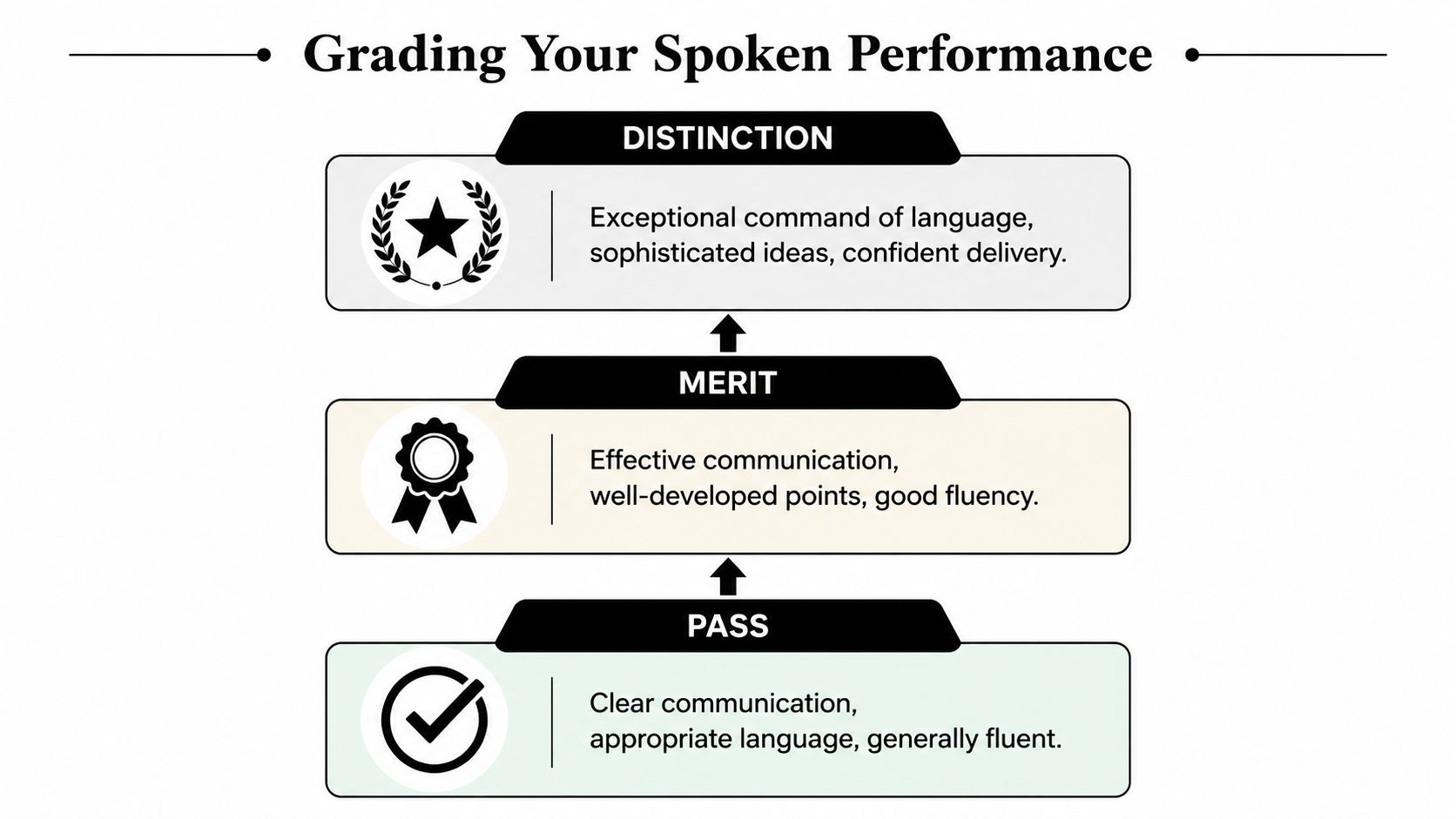
If GCSE grading has ever felt confusing, a broader explanation of outcomes can help too. This guide on what GCSE grades mean is useful for seeing where different results fit into the wider picture.
What a Pass looks like in real life
A Pass is not “brilliant speaker or fail”. It is a solid starting point.
A learner working at Pass level can be heard and understood. They use spoken Standard English in a way that suits a formal setting. Their ideas may be simple, but the audience can follow them.
For example, if you speak on why adults should keep learning, a Pass response might explain your reasons clearly, using everyday language and a steady pace. You don't need fancy words if your meaning is easy to understand.
What lifts a speech to Merit
Merit is where the speech starts to feel more shaped and thoughtful.
You begin to hear:
- more developed points, not just quick statements
- better structure, with a clear beginning, middle, and end
- more varied language, chosen to fit the topic
- more detailed answers in the question part
A Merit speaker doesn't just say, “Education is good.” They explain why, perhaps by discussing confidence, career chances, or setting an example for children. They sound prepared rather than random.
| Grade | What it sounds like |
|---|---|
| Pass | Clear and understandable |
| Merit | Clear, organised, and developed |
| Distinction | Confident, engaging, and thoughtful under questions |
What pushes you towards Distinction
Distinction is not about sounding unnatural or stuffing every sentence with long words. It is about control.
A Distinction-level performance often includes:
- a strong sense of purpose
- vocabulary that feels precise rather than forced
- a style that keeps listeners interested
- thoughtful answers that go beyond the obvious
If your topic is vaping among teenagers, for instance, a Distinction speaker might present a balanced argument, guide the audience through the issue, and then give a clear judgement. When questioned, they wouldn't stop at yes or no. They would explain why they think that way and what the wider effects could be.
Distinction often sounds calm and deliberate. It doesn't sound rushed, memorised, or desperate to impress.
A simpler way to think about the grades
You can think of the grades as three layers of growth.
- Pass says: I can speak clearly enough to be understood.
- Merit says: I can organise and develop my ideas well.
- Distinction says: I can hold an audience and think thoughtfully in the moment.
That should encourage you. You do not leap from fear to Distinction in one jump. You build one skill at a time. Speak clearly first. Then shape your ideas better. Then learn how to engage and respond with confidence.
That's a process adult learners are often very good at, because you already know what it means to improve step by step.
Your Step by Step Preparation Plan
Good preparation doesn't mean turning yourself into someone else. It means building a speech that sounds like you, only clearer, stronger, and more confident.
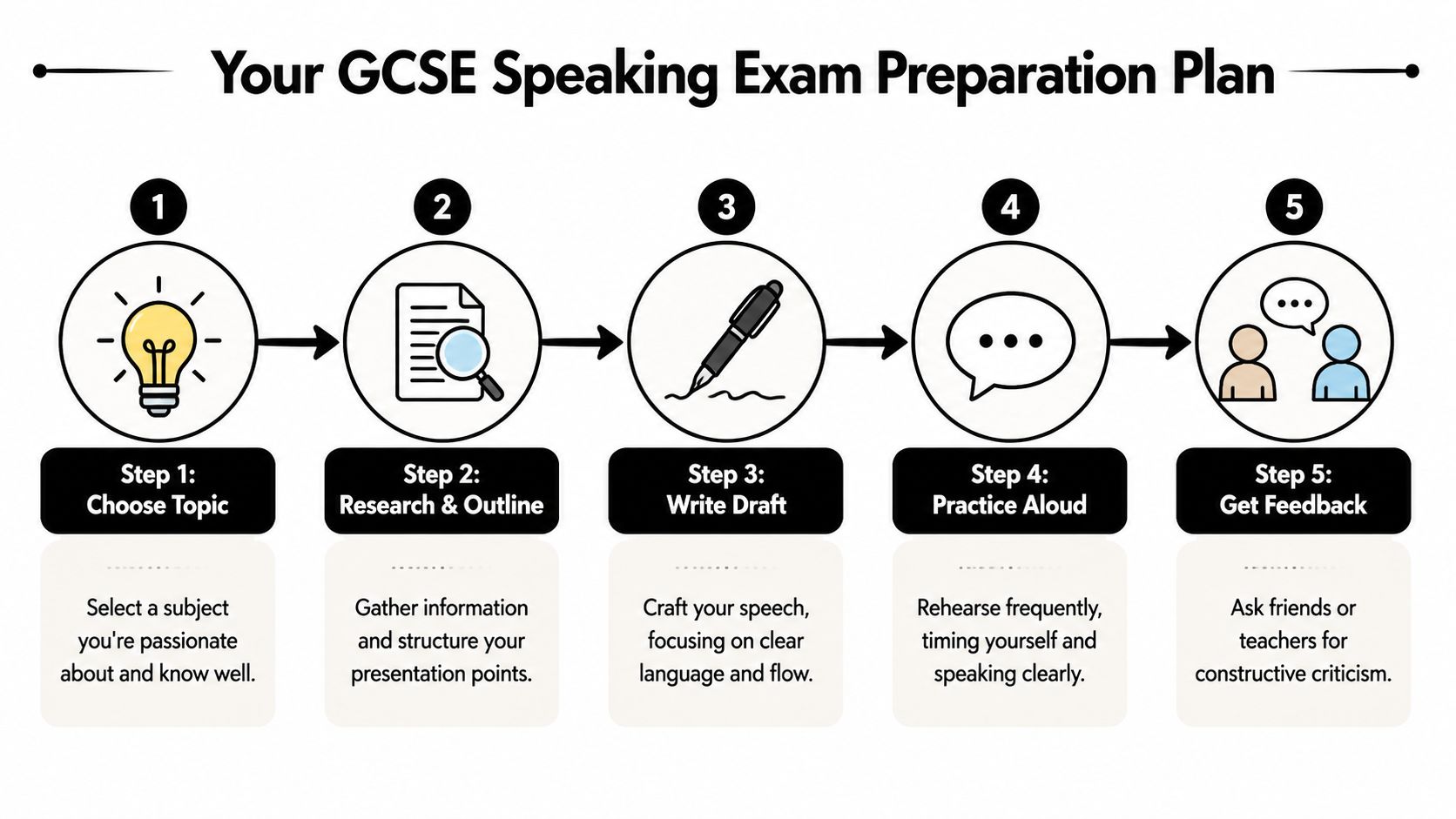
If you're studying from home or fitting learning around work and children, flexible support can make a real difference. Many adult learners look for options such as studying GCSE English online so they can prepare in a way that fits real life.
Start with a topic you care about
This choice matters more than people think. A topic you care about is easier to remember, easier to explain, and easier to speak about with energy.
Strong topic ideas for adult learners often come from real life:
- Returning to education as an adult
- How social media affects young people
- The risks of AI deepfakes
- Whether vaping among teenagers should face stronger action
- The pressure of the cost of living on families
- Why mental health support matters
Choose something you can talk about with honesty. Passion gives your voice warmth. It also helps when the questions come.
Build a simple shape
A strong speech usually has three parts.
Opening
Your opening tells the audience what your topic is and why it matters. Keep it focused. Give them a reason to care.
Middle
Your main points reside here. Pick your strongest ideas and develop them. Don't scatter lots of weak points across the speech.
Ending
Your ending should bring your message home. It can be a judgement, a call to think differently, or a clear final thought.
Here's a plain structure you can borrow:
- Opening: Introduce the issue and your view
- Point one: Explain your first main reason
- Point two: Add another strong reason or another side of the issue
- Point three: Develop your most important argument
- Conclusion: Sum up and leave a final message
Use cue cards, not a full script
This is one of the biggest turning points for many learners. Reading a script can feel safer, but it often makes the speech sound flat and stops real connection.
According to Save My Exams' speech model guidance, 40% of lower grades (Pass or Merit) are linked to over-reliance on reading cue cards or scripts, because it reduces eye contact, enthusiasm, and engagement. The same guidance also notes that learners who don't prepare properly for the question section are less likely to achieve Distinction.
That tells us something important. Your notes should support you, not control you.
A good cue card might include:
- key words
- short phrases
- one quote or fact if needed
- reminders like “pause” or “look up”
A poor cue card is a tiny essay written in full sentences.
If your eyes are always on the card, your audience disappears. If your card only guides you, your personality can come through.
To see examples of spoken language advice in action, this short video can help you picture what effective preparation looks like.
Practise in ways that build confidence
Many adults make the mistake of “practising” by reading without speaking aloud. That doesn't prepare your voice.
Try this instead:
- Speak it aloud alone so you get used to hearing your own voice.
- Time yourself so you know whether you're too short or too long.
- Record yourself on your phone and listen back kindly, not harshly.
- Practise with one trusted person who can ask you questions.
- Repeat until it feels familiar, not memorised.
Prepare for the questions
The question part often worries learners, but it does help you. It gives you a chance to show real understanding.
Write down a few questions you might be asked. Then plan fuller answers.
For example, if your topic is adult education, someone might ask:
- Why do adults stop studying in the first place?
- What are the biggest barriers to returning?
- How does education change family life?
Notice how these questions invite reflection. They reward thinking, not perfection.
Top Tips for Exam Day Confidence
By the day of your assessment, the hard work has already happened. Exam day is about helping your preparation come through clearly.
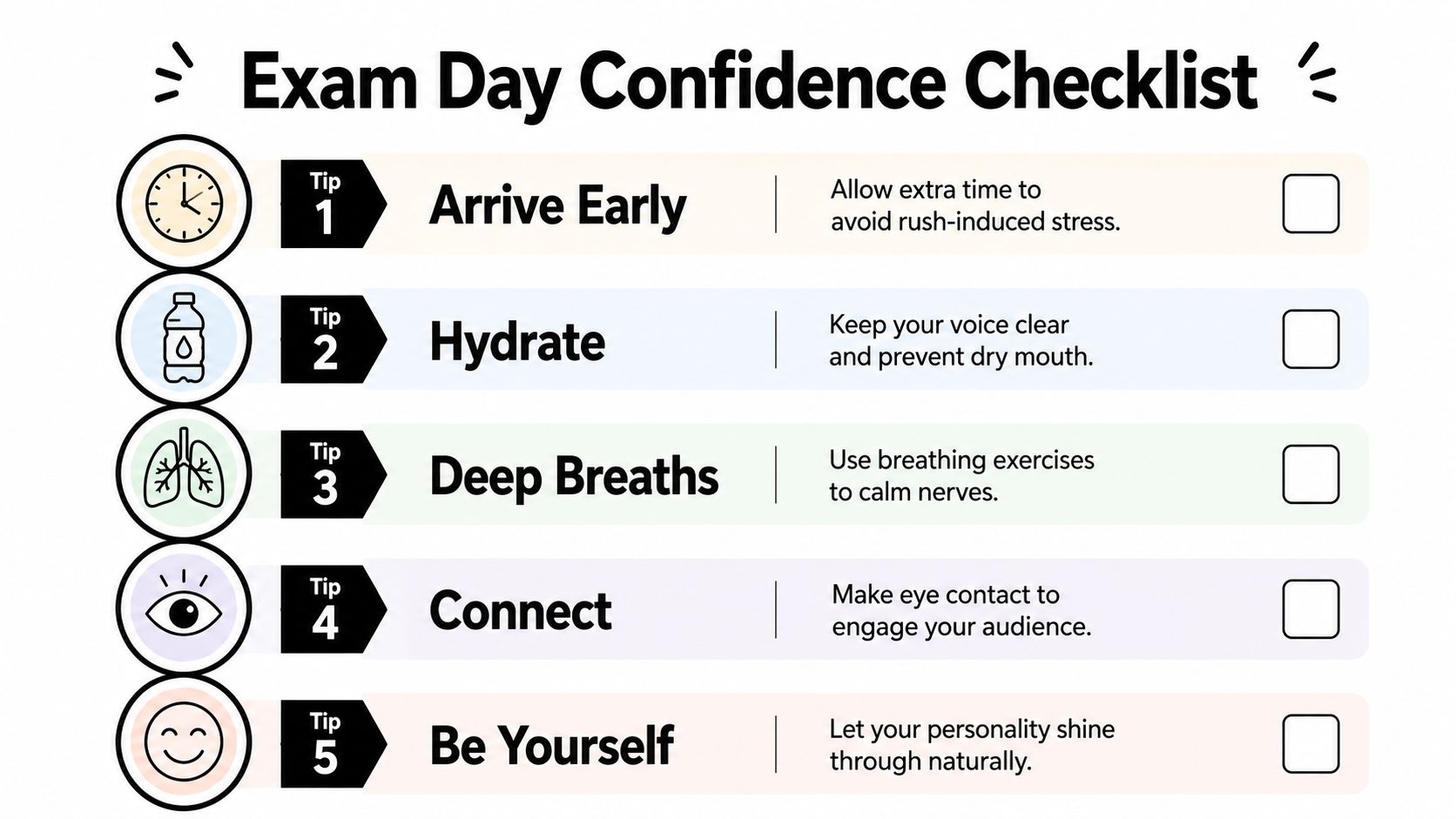
If nerves affect your confidence in lots of areas, not only study, structured support like these courses to improve confidence can help you build skills that carry into learning, work, and everyday life.
Use the time limit to your advantage
The timing matters. The AQA guidance says there is a strict 4 to 5 minute time limit, and that students who don't structure their speech within that window can lose marks for organisation and fluency. It also gives a useful split: 10 to 15% for the introduction, 70% for the main body, and 15 to 20% for the conclusion, according to AQA's non-exam assessment guide for the Spoken Language Endorsement.
That sounds technical, but it's reassuring. It gives you a map.
A practical version looks like this:
- Beginning: short and clear
- Middle: most of your evidence and explanation
- Ending: brief but memorable
If you rush the end, the speech can feel unfinished. If you spend too long introducing the topic, you won't have room for your best points.
Calm your body first
Nerves often show up physically before they show up mentally. Dry mouth. Fast breathing. Shaky hands.
Try this just before you begin:
- Breathe in slowly
- Pause for a moment
- Breathe out longer than you breathed in
- Repeat a few times
This slows your body down. When your breathing settles, your voice usually settles too.
Let your body language help you
Confidence is not only a feeling. It is also something you can practise physically.
A few small actions make a difference:
| Action | Why it helps |
|---|---|
| Stand tall | Helps you breathe and sound clearer |
| Look up regularly | Builds connection with listeners |
| Pause between points | Makes you sound more in control |
| Smile naturally when suitable | Softens nerves and warms your tone |
You do not need to move around dramatically. Calm, steady delivery often feels strongest.
Some of the best speakers still feel nervous. The difference is that they keep going anyway.
Check your setup if you're presenting online
If your assessment is recorded or done online, keep things simple.
- Choose a quiet room: reduce background noise where possible.
- Place your device carefully: your face should be visible and your voice easy to hear.
- Keep your notes nearby but low: this helps you avoid staring away constantly.
- Test before starting: don't wait until the last minute to check sound and camera.
Give yourself one final message
Before you begin, replace “I hope I don't mess this up” with something steadier.
Try one of these:
- I know this topic.
- I have prepared for this.
- I only need to speak clearly and calmly.
- My voice matters.
That's not empty positive thinking. It is a fair reminder of the truth.
Your Questions Answered
For many adult learners, this part brings up the heaviest worries. You might be thinking about school memories, past setbacks, or the fear of speaking while people listen closely. Those feelings are real, and they do not mean you are incapable. They usually mean this matters to you.
What if I'm shy or anxious
You can still give a strong presentation.
A calm, quiet speaker can be very effective because listeners often trust someone who sounds thoughtful and genuine. The goal is not to sound like a television presenter. The goal is to speak clearly enough for your ideas to come through.
If anxiety is affecting you, tell your teacher as early as you can. Support may be available, and even small adjustments in how you prepare can help. A speaking exam works a bit like driving on a new road. The first time feels tense because your mind is watching everything at once. Practice reduces that strain, so more of your attention can go into the message you want to share.
Does this help if it doesn't change my main GCSE grade
Yes, it can still matter.
The Spoken Language Endorsement is separate from your final GCSE English Language grade, but it shows that you can plan, present, and respond aloud in a formal setting. Those are useful skills for further study, interviews, training, and work. If university is part of your plan, it may be worth checking the entry expectations for the courses you are interested in rather than assuming this result will or will not be used.
For an adult learner, that wider value matters. You are building more than a qualification. You are building proof for yourself, and for other people, that you can speak with clarity and purpose.
What if I freeze during the questions
Start smaller than you think.
Take one breath, then answer with one simple sentence. You can add detail after that. A pause is normal. In fact, a short pause often makes you sound careful and in control.
Questions are not there to catch you out. They are a chance to show that you understand your topic well enough to talk about it in real time. That is a skill you will use far beyond this assessment, whether you are speaking to a tutor, a manager, a colleague, or your own child about why sticking with learning matters.
What if I get Not Classified
It can feel disappointing, especially if you have worked hard to get yourself back into education.
A Not Classified result means the performance did not meet the standard on that occasion. It does not measure your intelligence, your effort, or your future. Very often, the issue is something specific and fixable, such as relying too heavily on a script, giving too little development, or not showing enough clear spoken communication.
Talk to your teacher and find out exactly what held the performance back. That conversation can give you a much clearer path than self-criticism ever will.
I'm an adult. Am I too old to worry about this
No.
Adult learners often bring the strongest material into the room because they have lived through real responsibilities, setbacks, and change. You may have more to say than you realise. You may also be more invested in where education could lead next.
That changes the meaning of the exam. It becomes a moment to practise using your voice with confidence, especially if your goals include university, a better job, greater stability, or being a stronger example for your family. Each time you speak with preparation and self-respect, you strengthen the version of yourself that refused to give up.
If you're ready to turn self-doubt into progress, Next Level Online College offers flexible online courses designed for adult learners who are balancing study with work, family, and everyday life. With supportive teaching, recognised qualifications, and guidance that builds confidence as well as skills, it can be a strong next step towards university, a better career, and a future your family can feel proud of.