
You might be reading this after a long day of work, with school runs, laundry, bills, and a quiet worry that you've left education too late. Maybe you've told yourself that A levels are for younger people, or that your confidence isn't where it needs to be yet. The truth is simpler, and kinder. Distance learning for A levels can fit around real life, and it can give you a proper route back into education without asking you to stop being a parent, worker, carer, or all three at once.
That matters because adult learners often carry more than the course books. They carry self-doubt, tiredness, and the fear of looking foolish after a break from study. They also carry hope, the hope of making their children proud, getting into university, changing careers, and building a life that feels bigger than survival. A flexible A level route can be the point where that hope turns into action, one small piece of work at a time. If you want a simple starting point, a useful overview of flexible study options is available through Next Level Online College's distance learning courses.
Why Distance Learning for A Levels Changes Everything
A learner usually comes to online study because life is already full. A parent finishes a shift, checks homework, and then opens a laptop at the kitchen table. Another learner studies after a night shift, while someone else uses quiet pockets of time between caring duties. Distance learning for A levels fits into that reality, because it lets people keep the roles that matter to them while they work towards a qualification.
The strongest thing about this route is that it does not create a separate, watered-down qualification. In the UK, distance-learning A level provision has long followed the same exam specifications and assessment structure as school-based routes, and online learners still sit the same public examinations and work towards the same A level standard, with providers commonly mapping courses to full AQA, Edexcel, or Cambridge specifications (Royal Statistical Society distance-learning materials). That means the qualification sits on the same ladder as the one school students take.
Practical truth: the format changes, the standard does not.
For many adults, that changes how they see themselves. A person who has felt “out of the game” for years can start to feel like a learner again, not because the work is easy, but because the path is clear. The course becomes a structured way back into confidence, one assignment, one topic, one small success at a time. It also gives parents a powerful message to model at home, effort still matters, and it is never too late to begin.
The same UK distance-learning tradition also shows why this route fits adult life so well. Providers typically offer around 700 guided learning hours for A level Mathematics with Statistics and support windows of about 12 months to 2 years. That kind of shape matters because adults do not need another promise. They need something realistic, steady, and strong enough to hold together through busy weeks. If you want a simple place to start, Next Level Online College's distance learning courses give a clear sense of how flexible study can be arranged.
Understanding Your Study Options and Learning Styles
Different learners need different rhythms. Some people want full control, some want live teaching, and some want a bit of both. The good news is that distance learning for A levels isn't one fixed model, so you can choose the version that suits your energy, your work pattern, and the way your brain likes to learn.
Self-study with tutor support
Self-study gives you the most freedom. You work through course materials in your own time, then ask for help when you need it. That works well for shift workers, carers, and anyone whose week changes often. One adult may read a chapter on a lunch break, finish an assignment after the children go to bed, and send a question to a tutor on Sunday evening. If you want to understand how your own learning style shapes that kind of study, this guide to learning styles and Honey and Mumford can help you think it through in a practical way.
Tutored online courses
Tutored online courses are more structured. You join live sessions, hear explanations from a subject specialist, and can often ask questions in real time. That helps learners who want routine and a bit more external accountability. If you've ever said, “I need someone to keep me on track,” this model can feel safer because the timetable helps you build momentum.
Blended learning
Blended approaches combine independent study with live teaching and feedback. They suit adults who like flexibility but also need regular contact to stay confident. A learner might do reading during the week, then use a live session to clear up confusion before the weekend. That mix can feel especially useful when life is busy, because it gives you structure without making you feel trapped by it.
The UK A level structure is split into AS level and A2 level components, and distance-learning providers commonly cover both parts of the award rather than a short taster course (educations.com). For many adults, that is reassuring because it turns a huge goal into a sequence of manageable stages.
The Practical Details That Matter Most
The practical questions are often the ones that keep people awake at night. Is this a real qualification? How do I sit the exams? How long will it take? What happens if my internet cuts out halfway through a lesson? Adults usually do not need vague reassurance. They need clear facts and a plan they can use.
Accreditation and exam entry
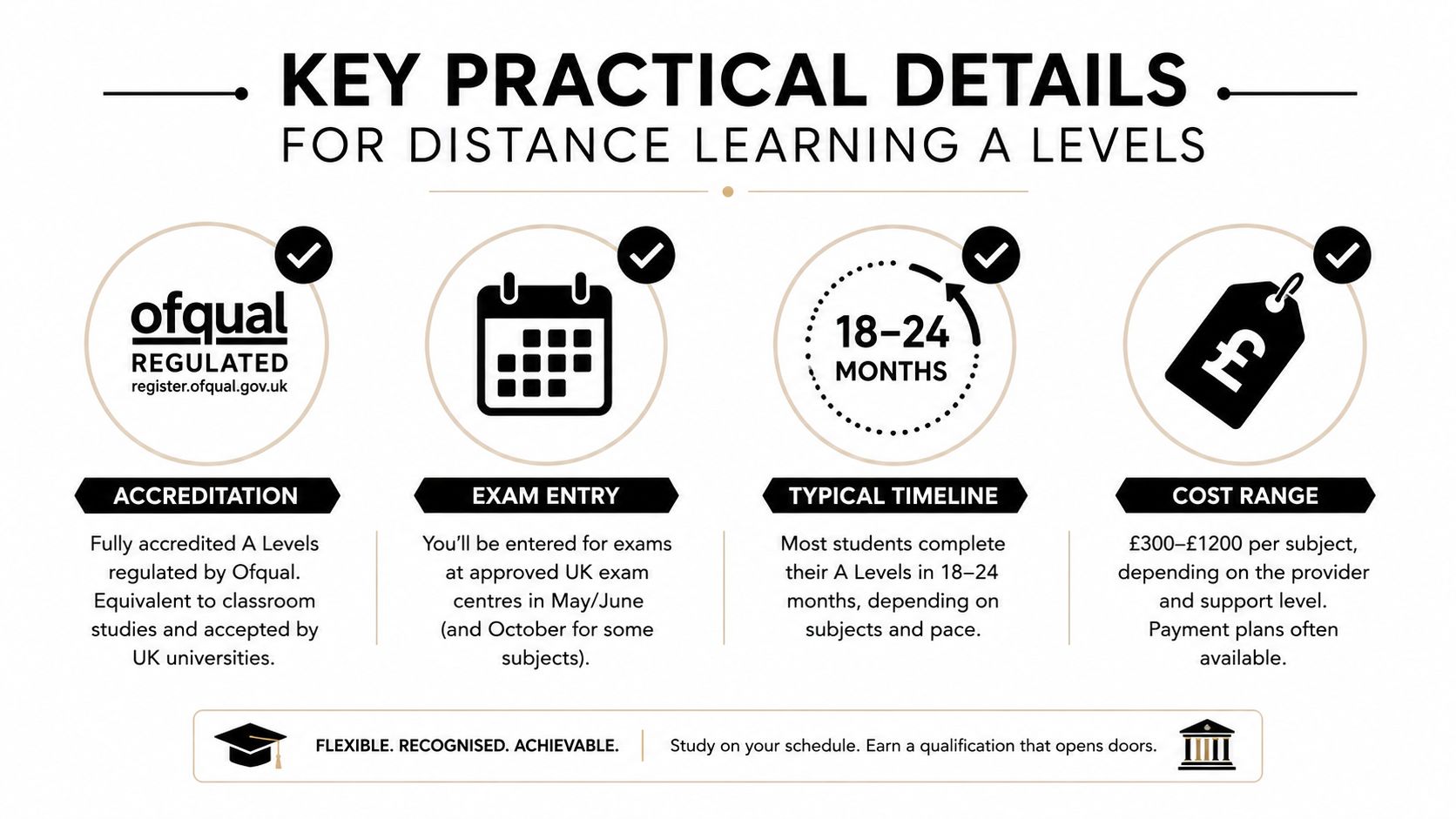
Distance-learning A levels in the UK lead to the same qualification as school-based A levels, with providers commonly matching full specifications from awarding bodies such as AQA, Edexcel, or Cambridge. The key point is to check that the course is built around the exact exam board and specification you will sit, because that is what keeps your study time focused and your revision targeted. Exam entry usually happens through private-candidate arrangements, and the provider should help you understand where and when to register. If you want a simple place to check course recognition and how online provision is described, see the accreditation guide for online courses.
Check the exam board first, then check the support around it. That order saves a lot of stress later.
Timelines and workload
The timing is more manageable than many adults fear, but it does ask for commitment. A full UK A level is typically studied over 2 years, and one independent education source says an AS level usually takes 9-12 months with about 150 learning hours plus assignment time, which means the full A level is roughly 300 learning hours across both parts (Distance Learning Curriculum 2018). For some learners, that can feel like carrying a full backpack up a long hill, except the load becomes easier once you break it into smaller stages and keep moving steadily. That longer runway often feels kinder for adults because it leaves room for bad weeks, work pressure, and family illness without throwing the whole plan off course.
Digital access and study space
Online study depends on more than motivation. UK research from the Department for Education found that schools and colleges reported EdTech worked less well where learners faced device shortages, internet connectivity issues, and Wi‑Fi dropouts that were not strong enough to stream live lessons, and remote delivery was also weaker when learners lacked a suitable study space (DfE remote teaching research report). Parliament's POSTnote also points to the digital divide as a major barrier and notes that teachers lack confidence and time to master new digital technologies and distance-learning methods (POSTnote 639). For adult learners, that means a good course should feel easy to access, with clear logins, browser-friendly materials, and backup ways to learn if live sessions drop out. Strong support also includes reliable tutor contact, because a quick answer can stop a small tech problem from turning into a lost study session.
Honest Pros and Cons for Adult Learners
Adult learners often want honesty more than hype, and they deserve it. Distance learning can be life-changing, but it is not magic. It works best when the course, the tutor support, and your own routines all pull in the same direction.
The upsides that really matter
The biggest advantage is flexibility. You can study around work, family, and everything else that fills a week. You also avoid commuting, which can make a surprising difference when time and energy are already stretched. Then there is the quiet confidence that grows when you complete work on your own, because every assignment becomes proof that you can still learn hard things.
Some adults also find they learn better outside a classroom. They can pause, reread, highlight, and go back over a topic without feeling embarrassed. That can be powerful for anyone who has spent years believing they were “bad at school”.
Support changes the experience. A strong tutor, steady feedback, and a sensible study plan can turn a frightening subject into something you can handle.
The real challenges
Self-discipline matters. If you keep waiting for the perfect mood, the work piles up. Some learners also miss face-to-face contact, and that can feel lonely at first. A few subjects may need extra care because they involve technical content or specific exam techniques, so you can't just skim through and hope for the best.
The answer isn't pretending those difficulties don't exist. It's choosing a provider that helps you work around them. Good courses use structured plans, regular feedback, and pastoral support so you don't vanish into a pile of PDFs and good intentions.
A balanced way to decide
Ask yourself three plain questions.
- Can I protect regular study time? Even short, steady sessions can work if they happen often.
- Do I want live contact, or do I prefer working independently first? Your answer helps you choose the right delivery model.
- Will I feel supported when I get stuck? If the answer is no, keep looking.
A mature learner does not need to be fearless. They need enough support to keep going on the days when confidence dips. That is often the difference between giving up and becoming the person your children already think you are.
How to Choose the Right Provider for Your Journey
Choosing a provider is not about finding the flashiest website. It's about finding the one that makes hard work feel possible. Adult learners need courses that respect the reality of work, family, and tired brains.
What to look for first
Start with recognition. A proper provider should be clear about its awarding partners, such as AQA, Edexcel, or OCR, and about how the course maps to the A level specification. Then look at the teaching team. Subject specialists matter because they know where learners usually get stuck, and that saves time.
Next, check support. Adults often need more than subject teaching. They need help with planning, motivation, and confidence after a long break from study. A provider that offers academic support without pastoral care can leave you feeling like a number.
Questions worth asking before you enrol
A quick check can tell you a lot.
- How do you help with exam entry? Private candidates need clear guidance.
- What happens if I fall behind? Real life happens, so the course should have a plan.
- Do you support adult returners specifically? School-focused wording is a warning sign if you're balancing work and family.
- Are payment options clear? Financial clarity matters when you're already making a big decision.
One option in this space is Next Level Online College, which offers structured online A levels for adult learners alongside pastoral and academic support. It sits within a wider provision that also includes Functional Skills, GCSEs, and Access to Higher Education diplomas, so the route can be matched to the learner's starting point and long-term goal.
Red flags to avoid
Be careful with providers that promise unrealistically fast results. A level work needs time, practice, and proper assessment preparation. Be wary of vague course pages that never name the exam board, never mention exam entry, and never explain how adults are supported week to week. Those gaps often tell you more than the sales copy does.
The right provider should make you feel more capable after reading the course page, not more confused. That's the standard to hold.
Study Strategies That Build Confidence and Results
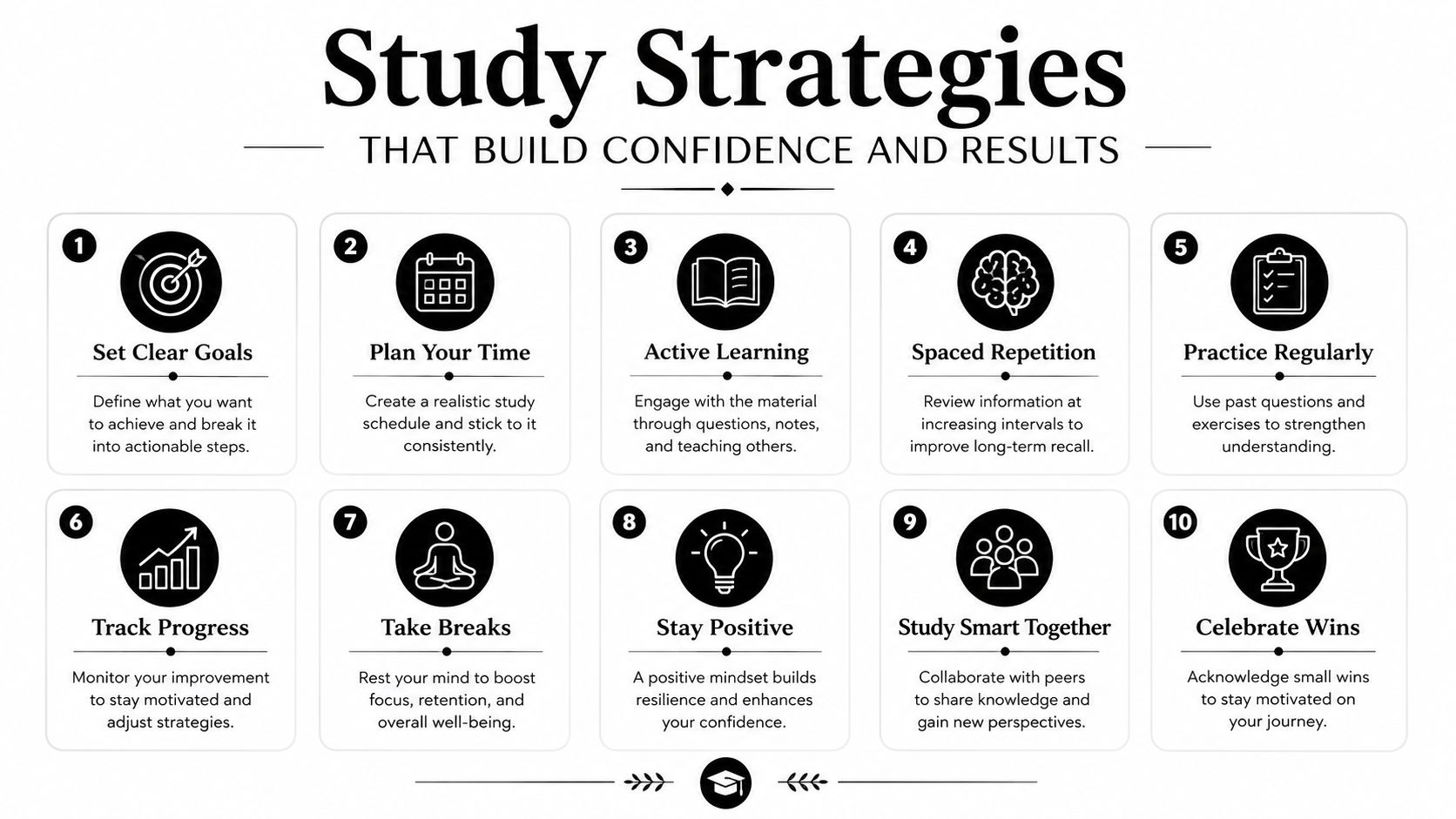
Confidence usually grows after action, not before it. A lot of adult learners wait to “feel ready”, then discover that readiness arrives after they begin. That's why study habits matter so much, because habits carry you through the days when motivation is thin.
Build a routine that fits your real life
Start small. Pick a regular time, even if it's only a short one, and protect it. A learner who studies three evenings a week often does better than someone who aims for a perfect weekend and then misses it twice a month. Put your course book, notebook, pens, and charger in one place so starting feels easy.
A study space does not need to be fancy. A corner of the dining table can work if it's quiet enough and you can return to it often. The point is to create a signal for your brain, this is the place where I do my learning.
Use active learning, not passive reading
Passive reading feels comforting, but it often slips away quickly. Active learning sticks better because you have to do something with the information. Try rewriting a topic in simple words, teaching it aloud to yourself, or answering practice questions without checking notes first.
Write less, recall more. That one habit can change how well facts stay in your head.
For harder subjects, break a topic into smaller pieces and learn one piece at a time. If a question looks impossible, start by spotting what it is asking. Adults often lose marks because they panic, not because they know nothing.
Protect your confidence
Low confidence loves silence. It tells you that one bad quiz means you're not clever enough. Don't accept that lie. A bad attempt is just evidence that you've found a gap, and gaps can be filled.
Keep a small record of what you've done well each week. Finished a reading task? Note it. Sent in an assignment? Note it. Understood one difficult idea that was confusing yesterday? That counts too.
The most useful mindset is simple. You do not need to be perfect. You need to keep turning up, even when the work feels awkward, because awkward is where learning usually begins.
Your Pathway to University and Beyond
A level study is rarely just about one exam cycle. For many adults, it is the bridge to a new chapter, university, a better job, or the kind of qualification that changes how they see themselves. A parent who once doubted they could return to education can finish an A level and realise they've already become a different person.
Mature students often apply to university through the same core admissions route as everyone else, and universities regularly welcome applicants who return to study later in life. The process can feel daunting at first, especially if you've been away from classrooms for years, but the point is not to sound like a teenager. The point is to show readiness, purpose, and commitment.
Some learners take A levels because they want a direct route into degree study. Others use them to move into professional qualifications or to strengthen career options in a field they already know. There is also the Access to Higher Education route, which can suit different starting points and timelines, so the right choice depends on your goal and where you're beginning from.
What often changes most is not only the CV, but the person holding it. A learner who once felt invisible starts to stand taller at parents' evening. Another begins to speak about future plans with certainty instead of apology. That shift matters because children notice it. They see effort, patience, and follow-through, and those lessons stay with them.
Distance learning for A levels can open academic doors, but it can also do something more personal. It can help you build self-respect from the ground up. That is a powerful thing to pass on to your family, because when your children see you learn, they learn that growth is still possible for them too.
If you're ready to take the next step, Next Level Online College offers structured online courses for adult learners, with support designed around real life, not perfect life. Explore the course options, ask the questions that matter to you, and take the first step towards the qualification, confidence, and future you've been wanting.