
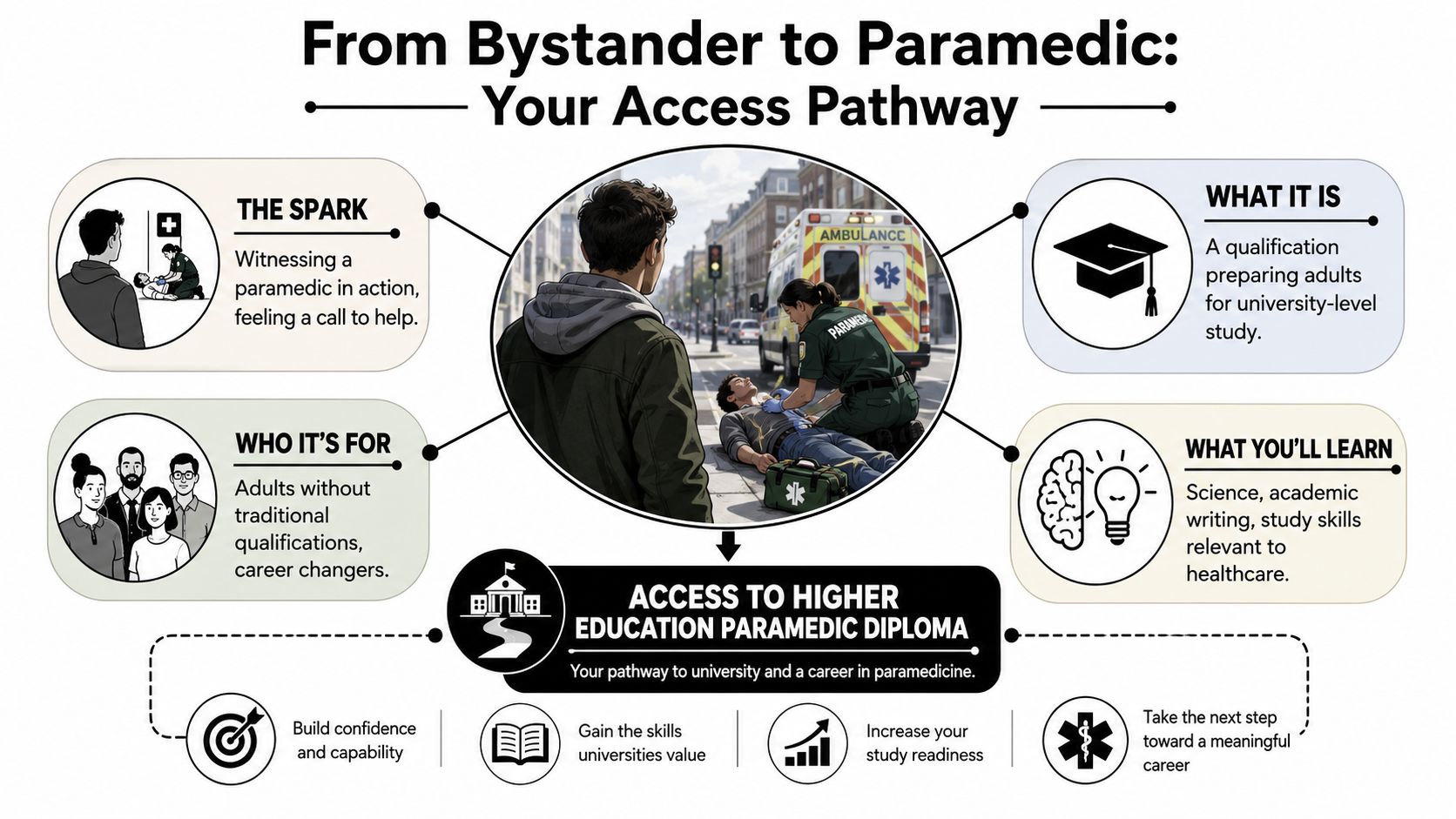
You can be the person who walks past a paramedic callout one day, sees the calm way they help, and thinks, “I could do that.” If you're an adult learner with family responsibilities, a patchy school history, or a confidence wobble that's lasted longer than it should have, an Access to Higher Education Paramedic route can feel like a proper second chance, not a dead end.
This kind of course is built for people who are ready to start again with purpose. It gives you a way into university study, and for many learners it also becomes something bigger, a chance to show your children that study is still possible, to build a steadier income, and to move towards work that matters to other people every single day.
What an Access to Higher Education Paramedic Diploma Is
A woman is standing by the pavement with her shopping bags when an ambulance crew arrive. One paramedic speaks gently, one works quickly, and the whole scene has that steady, focused energy that makes some people pause and think, “Could I learn to do that?”
A stepping stone, not a wall
An Access to Higher Education Paramedic diploma is a Level 3 qualification for adults who do not yet have the usual grades to go straight into university. A simple way to understand it is as a stepping stone across a stream, it gets you from one side to the other without asking you to leap the whole gap at once.
The UK higher education route into paramedicine has a clear history. The university pathway was first introduced by the University of Hertfordshire in 1991, which marked the move away from vocational ambulance training and towards degree-level entry for the profession (HEE PEEP report). Since then, the route has become more academic, with workforce survey data showing a rise in degree-level qualifications among EMS personnel over time. If you want to see how a provider frames that sort of progression for adult learners, this Access to HE health professions course shows the kind of route many people use before applying to university.
That does not mean you need to begin as a straight-A student. It means the course is designed to help adults build the study habits, writing skills, and subject knowledge needed for a paramedic science degree.
Why it feels different from school
This is not the same as GCSEs or A Levels. Access courses are built around adult lives, so they speak to people who may be working, parenting, caring, or coming back after years away from education. You are not being measured on whether school still feels fresh in your mind. You are being supported to grow into university learning now.
That matters because many adults start with very little recent study experience and still do well when the course matches their pace and support needs. If you have been telling yourself that it is too late, that thought belongs to fear, not fact.
Practical rule: if you can keep to steady effort, ask for help when you need it, and keep going through a full study year, you are already closer to university readiness than you may think.
For adult learners, this diploma can also feel like more than an academic route. It can be a confidence builder, a way to show your children or younger relatives that returning to study is possible, and a practical step towards work that matters to other people every single day.
Who the Paramedic Access Diploma Suits and What You Need to Join
If you're a parent who's been out of education for years, a retail worker who's ready for something more meaningful, or someone who left school early and has always wondered what might have happened if life had gone differently, this route can suit you well. It's especially helpful for adults who've got real-world resilience but need a formal bridge into university.
The kind of learner who tends to thrive
The people who do well on this route are often not the ones who think they're “the cleverest”. They're the ones who can keep showing up, even on tired days. Motivation, life experience, and the ability to organise your time matter a lot, because adult study is really about consistency, not showing off.
You'll also find this route useful if you need a clear path after a break in education. Some learners come back after years of work or caring. Others have had to rebuild confidence after school felt discouraging the first time around. Either way, the diploma gives structure to that fresh start.
What you normally need before joining
Most providers expect you to be 19 or over, living in the UK, and able to work at a reasonable level in English and maths. The exact entry checks vary, but the idea is simple. You need enough study readiness to cope with written assignments and enough determination to keep developing once the course starts.
If your confidence is low, try not to turn one weak spell in your life into a verdict on your future. Being “too old” is not the issue. The key question is whether you can commit to one focused year and use the support around you.
You don't need to arrive polished. You need to arrive willing.
A useful way to judge fit is to ask yourself three plain questions:
- Can I make study time regular? The course asks for steady effort, not perfect conditions.
- Am I ready to write, reflect, and improve? Coursework matters more than one-off memory tests.
- Do I want a route into healthcare that rewards persistence? If yes, this may be a strong match.
If the answer is mostly yes, you may already have enough to begin. The missing pieces can be built.
Modules, Credits and How the Study Year Works
An Access to HE Paramedic course feels less like “going back to school” and more like learning in a structured, adult way. You work through units, build credits, and complete assignments across the year instead of banking everything on one final exam.
What you'll study
The exact module titles vary by provider, but common areas usually include human biology, psychology, health studies, and academic study skills. That mix makes sense for paramedic science, because you're not only learning how the body works, you're also learning how people behave under pressure and how to write clearly about what you've learned.
The workload is intense enough to matter but still designed for adult life. Paramedic-specific Access courses typically compress into 1 academic year with around 340 to 600 guided study hours, depending on the provider's delivery model (Blackpool College course page). That's a lot of learning, but it's spread over time, not dumped on you all at once.
How the assessment works
Most of the work is graded coursework at Level 3, which means your assignments, essays, and research tasks matter far more than a single high-stakes exam. That can feel kinder to adults, because it lets you show progress in stages. A quiet week at home can become a strong assignment, and a strong assignment can restore confidence.
You can think of the year like a part-time job of studying. The hours are real, the deadlines are real, but the rhythm is manageable if you plan it properly around work, children, and caring responsibilities.
| What the year includes | What it usually feels like |
|---|---|
| Units and credits | Small blocks of learning that build towards the full diploma |
| Coursework | Essays, written tasks, and study evidence over time |
| Guided study | Structured learning hours spread across the academic year |
| Level 3 standard | A university-preparation level, not a casual taster course |
The structure is there to make you university-ready, not to catch you out. If you like clear steps and visible progress, this format can work very well.
How the Diploma Maps to a Paramedic Degree
Once you've got the diploma, the next step is not mysterious. Universities use Access to HE as a recognised entry route for degree study, so the course becomes your bridge into paramedic science rather than a qualification that ends in a drawer.
From diploma to offer
The basic path is straightforward. You complete the diploma, apply to university, and show admissions tutors that you're ready for a degree-level health course. Many universities accept Access learners because they understand these applicants are often returning adults with valuable life experience, not teenagers fresh from school.
The route normally runs through UCAS, where you submit your application, personal statement, and supporting details. Your statement should be honest and personal. If you've worked with the public, raised children, cared for relatives, or handled stressful situations at work, those experiences can help you explain why paramedicine suits you.
The admissions process may also include an interview, along with DBS checks and health assessments where required. Those checks aren't there to trip you up, they're there because paramedic work is hands-on, public-facing, and safety-critical.
What the university wants to see
Universities typically look for evidence that you can handle academic study and that you understand the demands of the role. If you've completed an Access diploma, you already have proof that you can sustain study over time, which carries significant weight.
Useful way to think about it: the diploma doesn't just open a door, it shows you can walk through it and keep going.
You may also find it helpful to look at a provider that explains how adults move into university study without traditional qualifications, such as this guide to getting into university without A levels. That kind of support can make the application process feel much less intimidating.
Why Access learners are taken seriously
Admissions teams know that adult learners often bring something younger applicants haven't had time to develop yet, perspective. You may not have a perfect school record, but you may have patience, communication skills, and the ability to stay calm under pressure. Those qualities matter in healthcare, and they come through clearly in a good application.
A diploma year therefore becomes more than study. It becomes evidence that you can handle the next stage.
Funding, Advanced Learner Loans and the Actual Timeline
Money worries can stop people before they even begin, so it helps to be clear from the start. For an access to higher education paramedic course, the funding picture depends on where you live, your age, your previous qualifications, and the route that applies to you.
What funding can look like
For eligible learners in England, an Advanced Learner Loan can help cover the cost of the diploma. Repayment only begins once you've moved on and your earnings cross the relevant threshold after higher education study. The Access to HE Diploma (Paramedic Science) is an approved Level 3 qualification awarded by Open College Network London Region, with Advanced Learner Loan funding approval listed from 01/08/2024 to 31/07/2026 (qualification listing).
Learners in Scotland, Wales, and Northern Ireland often need to self-fund because remission rules differ, so it is important to check the position for your location before you enrol. Age and prior qualification rules can also affect eligibility, which is why careful checking at the start saves stress later.
A simple timeline to keep in mind
The course usually runs across one academic year, so you are looking at a focused short-term commitment rather than a long stretch that drifts on. After that, if your results meet university conditions, you can move into the degree stage.
| Typical Access to HE Paramedic Year at a Glance | Typical Range |
|---|---|
| Study length | 1 academic year |
| Guided study hours | Around 340 to 600 hours |
| Main assessment style | Coursework at Level 3 |
| Funding option in England for eligible learners | Advanced Learner Loan |
That amount of study time means you will need a realistic plan, especially if you are juggling work or children. But one year is still a clear, finite stretch, and many adults find that having an end point makes the work feel more manageable. It can also feel bigger than it is when you first look at the calendar, the same way a long walk feels tiring before you set out, then steadier once you begin.
If you want a more detailed look at funding routes, this page on Advanced Learner Loans is a useful place to start.
A useful way to consider it: the diploma does not just lead to a qualification, it can mark a turning point in how you see yourself. For many adult learners, that matters just as much as the course itself.
Tips to Prepare, Stay Confident and Actually Succeed
The adults who finish strong usually do a few simple things well. They prepare early, ask for support, and stop expecting confidence to appear before action. Confidence usually comes after you start, not before.
Start small and stay steady
Brush up on your English and maths before the course begins if you can. That might mean reading aloud, practising short written answers, or doing a few sums each week. You do not need to become perfect. You just need to warm up the parts of your brain you'll use most.
Set up one place at home that means “study time”. It could be a kitchen corner, a spare table, or the end of the sofa with a notebook and charger ready. A proper space reduces friction, and friction is often what makes tired adults give up.
Tell your family what study time means. Children usually cope better when they know why the door is shut for an hour and when it opens again. Clear boundaries are kinder than constant apology.
Build confidence like a habit
Imposter syndrome can be loud at first. It may tell you that everyone else knows more, writes better, or learns faster. Don't argue with it for hours, just keep working while it talks. Action is often the best reply.
Try this weekly rhythm:
- Review your notes twice: A short revisit helps ideas stick.
- Plan one assignment chunk: Breaking work into smaller parts stops panic.
- Check your timetable every Sunday: A quick look ahead makes the week feel less chaotic.
- Ask one question early: Support works best before confusion grows.
- Rest properly: Tired brains misread easy work as impossible.
Use tutor support, feedback, and wellbeing help when things feel hard. Asking for help isn't weakness, it's how adults succeed in demanding courses.
A provider like Next Level Online College can be one option for learners who want structured online study with academic and pastoral support, especially when family and work commitments are already full. That kind of setup matters because many adults don't need more pressure, they need a course that helps them stay in the race.
When your child sees you studying, they learn that learning is for life, not just for school. That example can be more powerful than any speech.
Your Next Steps From Application to Career
Start with three practical moves. First, choose a provider that offers a recognised Access route into health professions and check exactly what the course expects from you. Second, confirm your funding position, especially if you want to use an Advanced Learner Loan or you live outside England. Third, gather your UCAS material and think carefully about your personal statement, because your life experience is part of your story, not something to hide.
Once your diploma is complete, the next step is a paramedic science degree, followed by professional registration with the Health and Care Professions Council once you qualify. After that, your career can move into NHS ambulance services or private providers, depending on the role and location that suit you.
A reward is bigger than a certificate. It's walking into work with purpose, showing your children that hard things can still be finished, and building a future that feels more secure for your family and more useful to your community.
If you're ready to stop wondering and start moving, take one small step today by comparing providers, checking your eligibility, and building your plan around your real life, not a perfect one.