
An Access to Higher Education Diploma is a one-year, Level 3 qualification for adults aged 19+ who want to go to university but don't have traditional qualifications like A-levels. It's a practical route back into learning, and for many people it becomes the point where self-doubt starts turning into real confidence.
You might be reading this after a long day at work, with children to feed, laundry to finish, and a quiet worry in the back of your mind that university is for other people. It isn't. The access route was built for adults who need a fresh start, a clear path, and a qualification that can open the door to higher education without asking them to pretend life is on pause.
Why an Access Course Could Change Your Life
A lot of adults come to study carrying more than books. They carry work shifts, childcare, bills, and the fear that they left education too late. That fear is heavy, especially when you want your children to see you do something brave and finish something meaningful.

An Access to Higher Education Diploma gives that kind of learner a real route forward. It is a nationally recognised Level 3 qualification created for adults who do not have traditional entry qualifications, and it exists to help them progress into university study, not to make them sit in a classroom with school leavers who are starting from scratch. The route is also unusually well measured for a non-school pathway into higher education, because QAA publishes annual data on Access to HE students through its statistics work QAA Access to HE statistics.
A path built for adult lives
That matters because adult learners need something that fits around real life. Access courses are not a vague promise or a second-best option, they are a structured bridge between where someone is now and the degree they want next. In UK higher education policy, an access course has long been treated as a preparatory programme for people without standard entry qualifications, usually as an alternative to A-levels for mature learners aiming for university entry UK access course definition.
For many parents, that's the emotional turning point. They are not just signing up to study, they're showing their children that learning doesn't stop when you become an adult. They're also building a path towards stronger job options, more confidence, and the kind of future they may have once thought had passed them by.
Practical rule: if you want university but your life looks nothing like a school timetable, an Access course is designed with that reality in mind.
How Access Courses Are Structured and Assessed
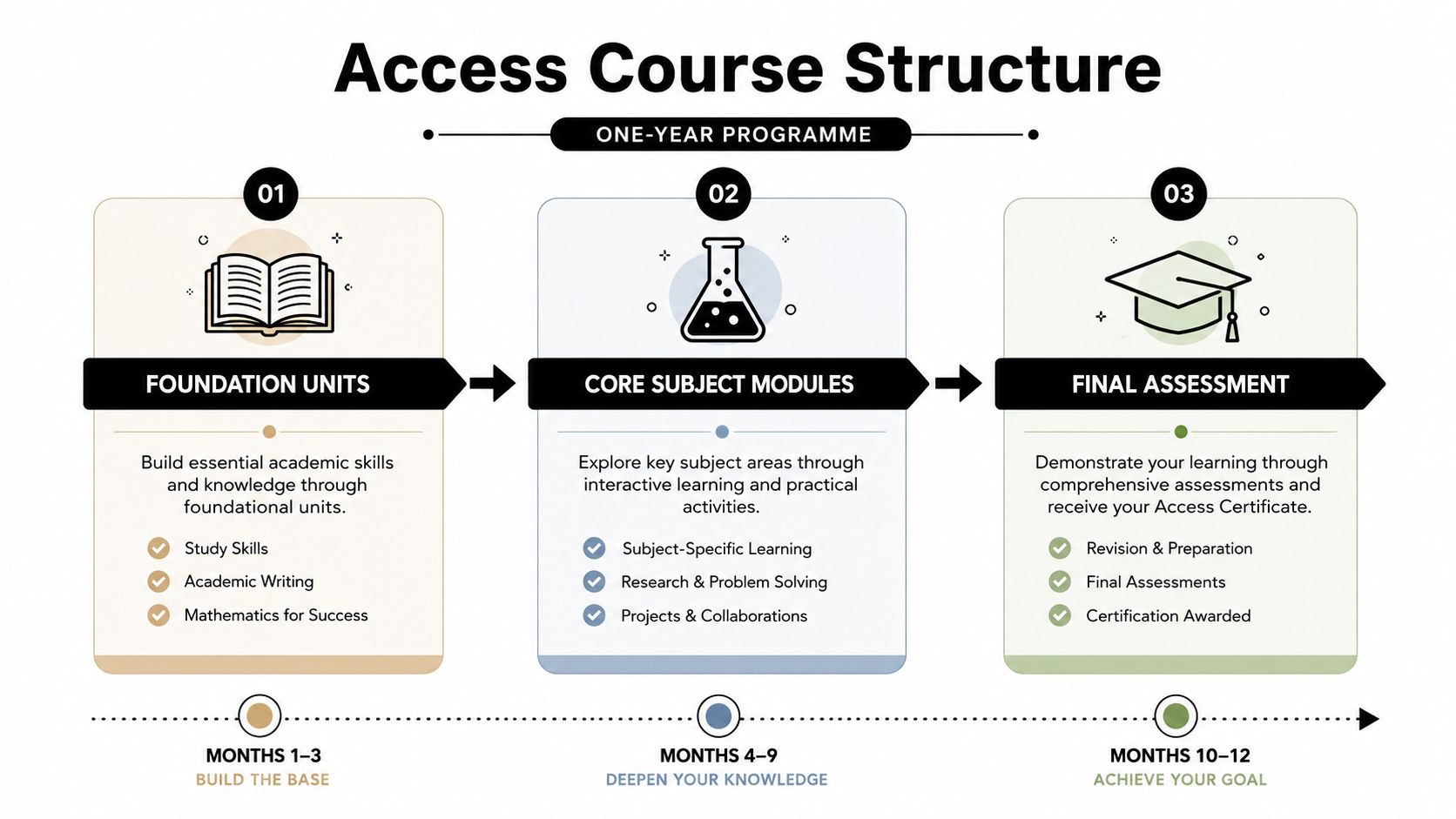
An Access course is usually a one-year programme, and that short time frame is one of its biggest strengths. Instead of spreading study thinly over several years, it gives adults a focused route with a clear end point and a final Access to Higher Education Certificate programme structure and award.
Building a house starts with foundations, then walls, then the rooms that make it useful. An Access course works in a similar way, because each unit is meant to support the next one, so you're not thrown into advanced study before you've got the basics in place.
What you actually study
Access pathways are matched to the degree you want to do. That means someone aiming for nursing won't be studying the same mix as someone who wants law or engineering, and that's a good thing because it keeps the course focused on your goal tailored pathways and subject focus. Official guidance also notes that colleges in England and Wales deliver courses across subjects such as nursing, social studies, law, and art and design subject areas.
That flexibility helps learners feel less lost. You're not choosing from endless random options, you're choosing the route that points towards the career or degree you want.
How assessment usually works
Assessment is usually based on coursework, essays, presentations, and other practical tasks, rather than relying only on high-pressure exam halls. That suits many adult learners because it rewards steady effort, organisation, and the ability to explain ideas clearly.
- Foundation Units: these help you get used to academic writing and study habits.
- Core Subject Modules: these build the knowledge you need for your chosen degree.
- Final Assessment: this brings the units together and leads towards the certificate.
An NHS Wales guide notes that Access courses are usually about 16 hours of contact time per week over one year, with homework on top, which gives a realistic sense of the weekly rhythm time commitment. That's enough to feel serious, but still manageable for many adults who need structure without losing control of family life.
Who Takes Access Courses and Why They Succeed
The people on Access courses are often far more like your neighbours, colleagues, and friends than many learners expect. They are adults returning to education, people changing direction, and parents trying to build a better future for their families. The route is especially strong for learners who've been underrepresented in higher education and need a more practical bridge into university.
The data shows a distinct learner profile
In the 2021-22 Access to HE data, 77% of students entering higher education with an Access to HE Diploma were female, compared with 57% for other Level 3 qualifications Access to HE statistics. This demonstrates that this route reaches a different group of learners from the one commonly imagined when considering university entry.
The same dataset found that 24% of Access to HE entrants were from a disadvantaged area, compared with 11% for other Level 3 qualifications Access to HE statistics. That matters because it shows the diploma is not just about academic preparation, it also plays a real widening-participation role.
Why learners often stay and progress
Another striking point is that 77% of Access to HE students stayed in their local area to study in higher education Access to HE statistics. That suggests the route fits people who can't, or don't want to, move far away from home. Parents, carers, and working adults often need that kind of stability.
Many Access learners succeed because the course meets them where they are, not where a traditional school route expects them to be.
That is why the qualification is respected. It gives universities a clear signal that a learner has already handled focused study, subject knowledge, and adult responsibility. It also tells the learner something important, which is that their background does not cancel out their ability.
Access Courses Compared to A-Levels and Other Qualifications
A lot of confusion clears up once you compare the routes side by side. An Access course is not trying to be A-levels, and that's exactly why it works for so many adults. It is built for a different stage of life, with a different pace and a different purpose.
| Feature | Access to HE Diploma | A-Levels | Foundation Year |
|---|---|---|---|
| Main learner group | Adults aged 19+ without traditional Level 3 qualifications | Usually school leavers | Applicants who need extra preparation before degree study |
| Typical length | One year programme structure | Usually two years | Usually one year |
| Purpose | University entry for adults | University entry and further study | Preparation for a linked degree |
| Assessment style | Coursework, essays, presentations, some exams | Mostly exam-led with some coursework | Varies by provider and degree route |
| Fit for adult life | Often strong, because it is designed for returners | Usually less convenient for adults returning after a break | Can be useful, but may be tied to one university |
The key question is not which qualification is “better” in general. It's which one matches your life right now. If you're an adult with work, children, or a long gap in learning, an Access course often makes more sense than starting again with school-style study.
An Access Diploma is also treated as equivalent to 3 A-levels for university entry purposes, which is why many applicants use it when they want to prove they can study at the right level for degree entry AQA Access equivalence. That equivalence matters, but the value is practical. It gives you a focused route into a degree without asking you to rebuild your whole education history.
If you want a fuller guide to this route into higher education, this overview of getting into university without A-levels can help you see where Access fits alongside other choices.
Balancing Study with Work and Family Commitments
The biggest worry for most adults is simple. How will this fit around everything else? That worry is sensible, because Access study does take commitment, and the weekly workload is real. NHS Wales says these courses are usually about 16 hours of contact time per week over one year, plus homework, and that part-time study may be needed for people working during the day Access course time and flexibility.
What makes it manageable
The answer is not magic, it's planning. Adults do best when they treat study as a fixed part of the week, just like a shift, a school run, or a dentist appointment. A small, tidy study space at home helps too, because your brain learns that the desk, table, or corner of the sofa is where learning happens.
A few practical habits make a big difference:
- Block study time early: put it into the family calendar before the week fills up.
- Tell people at home why it matters: children usually cope better when they know the goal.
- Use short sessions well: 25 focused minutes can be more useful than an hour of half-working.
- Keep essentials together: notebook, charger, pens, and any printed material in one place.
Money and support
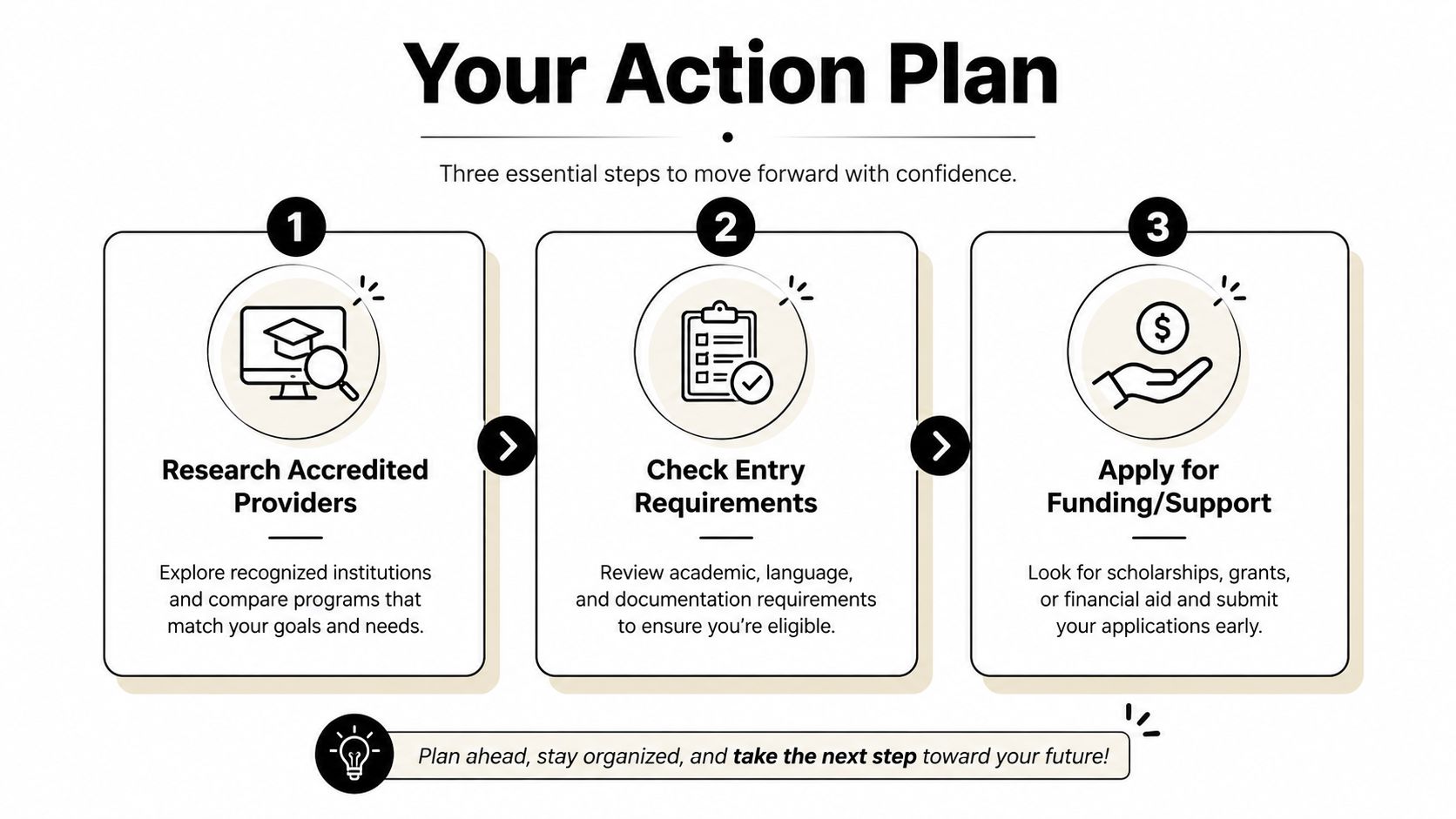
Funding matters just as much as time. Some learners use Advanced Learner Loans, and some may qualify for free tuition depending on their circumstances and provider arrangements. That means the financial side should be checked early, before worry becomes a reason to delay.
The most important point is this. You do not need perfect conditions to begin. You need a workable plan, a provider that understands adult life, and the confidence to ask for help when you need it.
Practical rule: if a provider cannot explain how study fits around work, childcare, or caring duties, keep looking.
Choosing the Right Provider and Getting Started
Good providers make the start feel less intimidating. They should be clear about validation, honest about entry requirements, and ready to support you if it has been years since you last studied. The best next step is to look for QAA-recognised validation, experienced tutors, pastoral support, flexible delivery, and a strong record of university progression.
What to check before you enrol
A strong provider will tell you what pathway suits your degree goal, rather than pushing you into a broad option that doesn't match your plans. They should also explain how you'll be assessed, what support you'll get, and how they help adults settle back into learning.
- Research accredited providers: check whether the course is properly recognised and validated.
- Check entry requirements: make sure the route matches your current qualifications and your university goal.
- Ask about support: look for guidance from tutors, mentors, and pastoral staff.
- Confirm the study format: online, flexible, or part-time options can make all the difference.
If you want an example of a flexible online Access route, Next Level Online College's Access to HE Diploma online page shows how an adult-focused provider can present the qualification in a way that fits around real life.
How the process usually begins
Most learners start with an enquiry, then a conversation about goals, subject fit, and available support. After that comes the application, funding checks, and a simple induction into the course. Good providers will not make you guess your way through the process, because first-time confidence is part of the journey too.
Next Level Online College is one option for adult learners, and it offers online Access to Higher Education courses alongside other regulated routes for returners to education, with support designed around work and family life.
Your Journey to University and a Fulfilling Career
An Access course can change how you see yourself as much as it changes your qualifications. Finishing it can mean a university offer, but it can also mean something deeper, a new sense that you can keep going, even after a hard chapter or a long break from study.
For many adults, the first real reward is the look on a child's face when they see a parent achieving something difficult. That moment matters. It tells them that effort counts, that learning is lifelong, and that ambition belongs in ordinary homes as much as in lecture halls.
The longer reward can be a degree, a stronger career, and work that feels more fulfilling. If your goal is a caring profession, a field like midwifery, health, law, teaching, or another path into society, an Access course can be the bridge that gets you there. You can also see how a pathway like Access to Higher Education in Midwifery links directly to a specific career aim.
What makes this route special is not just the certificate. It's the person you become while earning it. You learn to organise your time, trust your own mind again, and show your family that a new chapter is still possible.
If you're ready to take the next step, Next Level Online College offers flexible Access to Higher Education study for adult learners who need a route into university that fits around real life. Visit Next Level Online College to explore the options, ask questions, and start a conversation about the pathway that could help you build your future.