
The house is quiet. Your children are asleep, the washing-up is finally done, and a career spreadsheet is open on your laptop. You keep returning to the same problem: a missing GCSE Science qualification may be the one thing standing between you and university, a better-paid role, or a career that feels more meaningful.
You might worry that you're too old, that exams will be frightening, or that study won't fit around work and family life. You may also wonder whether you can afford a course. These concerns are real, but they don't mean you can't succeed. Science GCSE for adults is possible at any age, and a sensible plan can turn a large goal into small, manageable steps.
You Are Not Too Late to Start Science GCSE
At the kitchen table, an adult learner might write down every reason to wait. Work is busy. The children need attention. Money is tight. School feels like a distant memory, and the thought of sitting an exam again brings a tight feeling in the stomach.
Then another thought appears. Perhaps nursing, teaching, laboratory work, engineering, or a university course could become possible if that missing science qualification were no longer in the way.
That thought deserves attention. Adults in England and Wales can take GCSEs at any age because there's no upper age limit, as explained in this guide to getting GCSEs as an adult. Your age doesn't cancel your ability to learn. It means you bring life experience, responsibility, and a clearer reason for studying.
Science GCSE is also a well-established qualification, not an unusual route taken by only a few returners. JCQ's 2025 results table recorded 8,717 UK entries for GCSE Science and 989,264 UK entries for GCSE Science Double Award, showing how widely science qualifications are taken across the UK system (Cornwall College explains the science GCSE route).
Small steps are enough
You don't need to understand every topic before you enrol. You only need to begin with the next useful action:
- Check the entry requirement: Find out whether your chosen university, college, employer, or training provider wants single science or Double Award.
- Choose a workable timetable: A course you can attend or access consistently matters more than one that looks perfect on paper.
- Ask about support: Find out whether a tutor can mark work, explain difficult topics, and help you prepare for exams.
- Make a family plan: Tell the people at home when you'll study, then protect those times as carefully as possible.
A qualification doesn't expire because you earned it as an adult. It can sit on your record while your career develops. Every study session can rebuild confidence. Your children may see you revise after work, keep going after a difficult practice paper, and celebrate progress. That makes you a powerful role model.
You're not taking a reckless chance. You're investing in confidence, future choices, earning potential, and the example you set at home.
What GCSE Science Actually Means in 2026
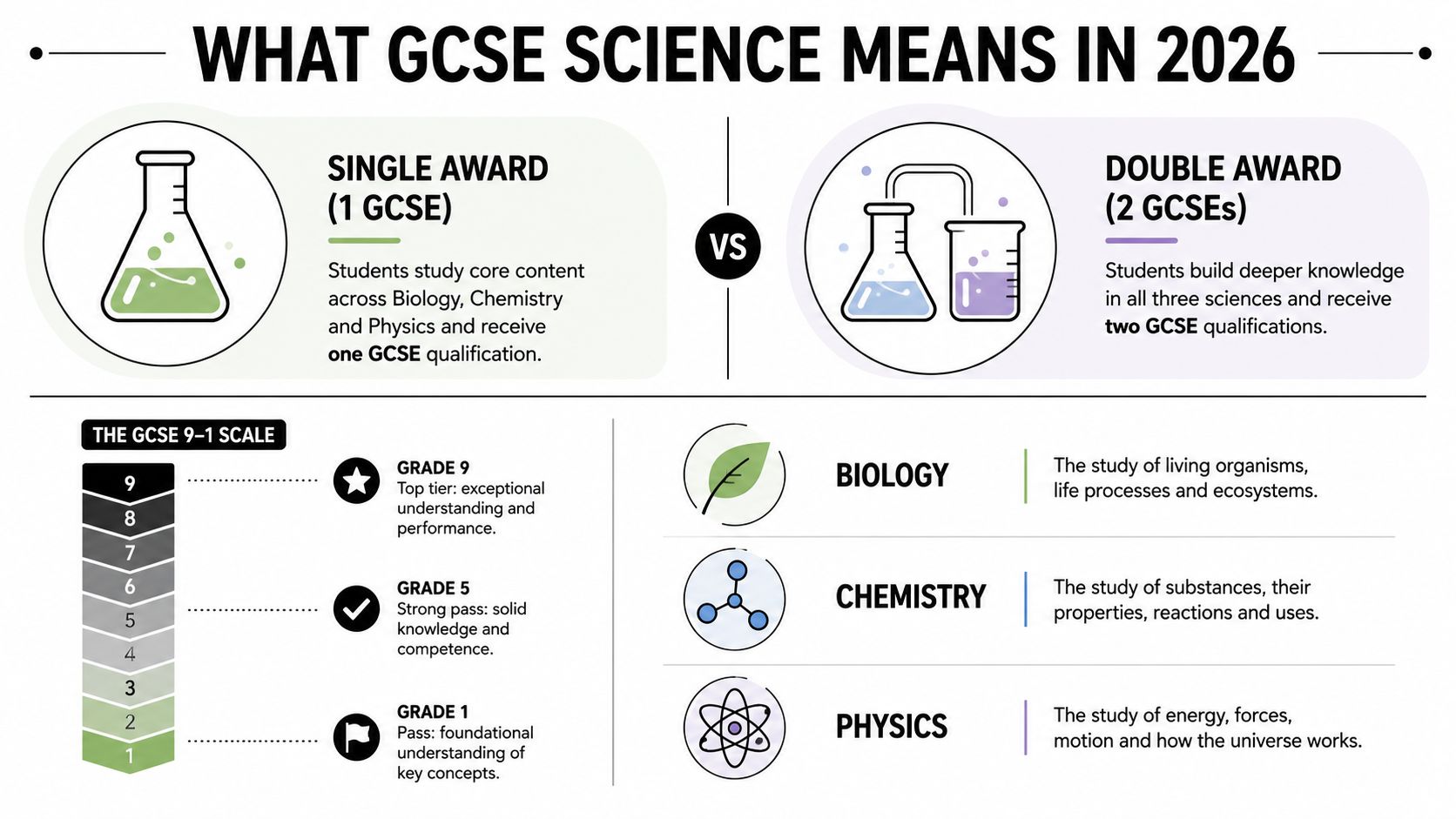
GCSE Science is a qualification about the world around you. It brings together three main areas:
- Biology: Living things, the human body, health, cells, ecosystems, and inheritance.
- Chemistry: Materials, reactions, particles, acids, energy changes, and the substances used in everyday life.
- Physics: Forces, energy, electricity, waves, radiation, and how the physical world works.
Think of these subjects as three windows in the same house. Biology looks at life, Chemistry examines what materials are made of and how they change, and Physics explores energy, forces, and patterns.
Single Science and Double Award
A single science GCSE focuses on one subject, such as Biology, Chemistry, or Physics. It gives you one GCSE grade and may suit a learner who already knows which scientific area they need.
Double Award Science, often called Combined Science, covers Biology, Chemistry, and Physics. You receive two GCSE grades rather than three. The University of Manchester entry requirements explain that universities can accept separate Biology, Chemistry, and Physics awards, or a Double Award where all three sciences are studied.
The right route depends on your next step. Some degrees ask for a particular single science. Others accept Double Award. Always check the exact course page before paying for a programme.
Understanding grades from 9 to 1
The modern GCSE scale runs from 9 to 1. Grade 9 is the highest level, while grade 1 is the lowest available grade. A grade 4 is commonly treated as a pass, and grade 5 is often described as a stronger pass. Grades 7 to 9 broadly cover the old A and A* territory, although the old and new systems aren't exact copies.
Many universities and training providers ask for grade 4 or 5, but requirements vary. The University of Hertfordshire says English Language and Mathematics are required for all its courses, while Science or Double Science is needed where the individual course page specifies it. It usually asks for grade 4, equivalent to the old grade C, and lists some Level 2 science alternatives for certain routes (see the university's GCSE equivalent requirements).
Don't assume you need the highest grade before checking. Your target should match your next destination.
Study Routes That Fit Around Real Life
The best study route is the one you can continue when life becomes noisy. A parent working shifts may need online access at unusual times. Someone who learns best through conversation may prefer an evening college. Another learner may have a very small budget but plenty of self-discipline.
Three common choices
Online study with tutor support gives you flexibility. You can study at home, revisit lessons, and fit work around school runs or changing shifts. It suits adults who need a course available beyond one fixed classroom timetable. A fully supported online GCSE Biology course can be useful if Biology is the specific subject required for your next step.
Evening classes at a further education college provide regular face-to-face structure. You'll have set sessions, classmates, and access to a tutor at a predictable time. This can help if you find it easier to study when someone else has created the timetable.
Self-study uses textbooks, past papers, revision websites, and free videos. It may cost less, but you'll need to organise the syllabus, find accurate materials, monitor your progress, and arrange exam entry yourself. It suits an independent learner who can protect study time without regular outside accountability.
| Route | Typical Hours per Week | Course Length | Cost Range | Best For |
|---|---|---|---|---|
| Online with tutor support | Depends on provider and personal plan | Often one academic year | Varies by provider | Parents, shift workers, and adults needing flexible access |
| Evening college | Set sessions plus home study | Often one academic year | Varies by college and funding | Learners who value classroom structure |
| Self-study | Decided by the learner | Depends on exam target | Materials and exam costs vary | Independent learners with a tight budget |
Course length and fees differ, so ask for a full breakdown before enrolling. Check whether tutor marking, exam preparation, practical guidance, and exam entry are included.
There's no wrong route. A simple course you'll follow is more valuable than an impressive plan you can't maintain.
How the Exams Work and What Is Really Tested
GCSE Science exams don't test memory alone. They ask you to understand ideas, use them in unfamiliar situations, handle information, and think about practical work.
UK single-science specifications use an assessment balance of 40% knowledge and understanding, 40% application of knowledge and understanding, and 20% analysis, evaluation, and experimental-design judgement (read the government's single-science subject guidance). In plain language, you need to know the science, use it, and explain whether evidence supports a conclusion.
The practical side is written
Reformed GCSE Science has no traditional coursework model in the usual sense. Practical work is largely assessed through written exam questions. Each individual science requires at least 8 practical activities, while Combined Science requires at least 16. The science reform regulations also set a minimum total assessment time of 3.5 hours and reserve 15% of marks for practical-work assessment (read the GCSE science reform regulations).
You may be asked how to plan an investigation, identify variables, improve a method, interpret results, or judge the reliability of evidence. This is like learning to cook without being asked to serve the meal. You still need to understand each step, but the examiner checks your understanding through questions.
Practical rule: Don't skip required practicals just because you aren't completing a coursework folder. Learn the method, the variables, the safety points, and the way results are evaluated.
| Component | Duration | Weighting | Tier Options |
|---|---|---|---|
| Written science papers | Set by the awarding specification | Covers knowledge, application, analysis, and practical assessment | Foundation or Higher, depending on specification |
| Required practical questions | Included in written papers | Practical work contributes to assessment | Foundation or Higher |
| Mathematical and data skills | Included in written papers | Applied across science topics | Foundation or Higher |
Check your awarding body's specification for the exact paper arrangement. Your tutor or exam centre should also explain what appears on each paper.
Choosing Foundation or Higher
Foundation tier normally allows grades 1 to 5. Higher tier normally allows grades 4 to 9, with grade 5 as the overlap. If you need a grade 6 or above, Higher is generally necessary, but it may contain more demanding questions.
Your choice should be based on your target grade, current practice-paper performance, and the entry requirements for your next course. A calm, informed decision is better than choosing a tier because someone else says it sounds more ambitious.
A Realistic Study Plan for Busy Adults
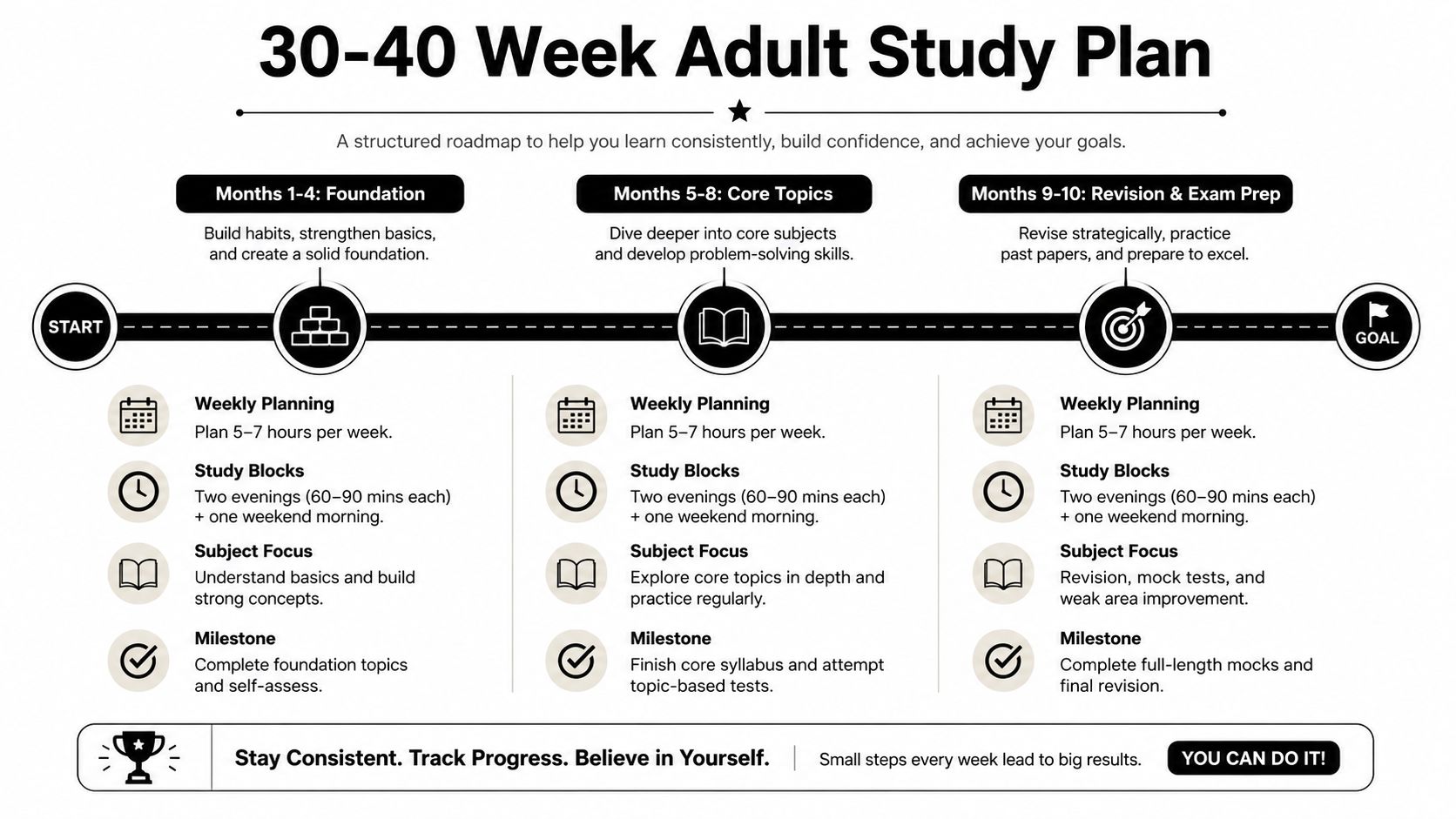
A one-year plan becomes less frightening when you divide it into a series of ordinary weeks. Aim for a 30 to 40 week roadmap, with around 5 to 7 hours of study each week. You don't need to sit for hours every night.
A practical rhythm might include:
- Two evening sessions: Study for 60 to 90 minutes after work or once the children are in bed.
- One weekend block: Use a weekend morning for a longer lesson, practical topic, or exam practice.
- Short daily reviews: Spend 15 minutes using flashcards or reviewing key words on your phone.
- One recovery space: Keep some spare time for illness, school events, family needs, or shift changes.
A seasonal roadmap
During autumn, build your Biology foundation. Learn cells, organisation, health, infection, bioenergetics, and the language used in exam questions. Focus on understanding before chasing speed.
During winter, move into Chemistry. Work through particles, reactions, equations, energy changes, and chemical analysis. Keep reviewing Biology so early topics don't fade.
During spring, study Physics. Give yourself time with equations, units, electricity, forces, energy, and waves. Maths can feel easier when you practise a little and often instead of leaving it until the end.
Late spring should focus on retrieval practice, practical questions, and past papers. Mark your work carefully. Write down repeated errors, then turn those errors into a small revision list.
This GCSE revision techniques guide can help you choose methods that involve recalling information, not just reading it again.
A wall calendar can make progress visible. Add a tick after each session, colour-code finished topics, and mark buffer weeks clearly. If you miss a day, move the task. You haven't failed. You've discovered that your plan needs to work with real life.
Costs, Fees and Free Funding Options
Money deserves a clear answer before you start. Adult science GCSE provision can range from free places to paid courses. One adult science GCSE course lists a full fee of £815, while explaining that some learners aged 24 or over may study without paying if they don't already hold a full Level 2 qualification or meet unemployment or low-income conditions (the adult education funding evidence is recorded in this government-linked results material).
That example shows why you shouldn't judge affordability from a headline price alone. Ask the provider to assess your eligibility before assuming you must pay the full amount.
Questions to ask about funding
- Eligibility: Do you qualify for free study because of your existing qualifications, age, employment situation, or income?
- Included services: Does the fee include tutor support, marked assignments, exam preparation, and practical guidance?
- Exam entry: Will the provider enter you for the exam, or must you pay an exam centre separately?
- Payment options: Can you spread the cost through an agreed payment plan?
- Extra materials: Will you need to buy a textbook, calculator, laboratory equipment, or other resources?
Funding rules can be complicated, and they can depend on the provider, qualification, and your personal circumstances. Get the answer in writing.
You may hear about an Advanced Learner Loan, but don't assume it covers GCSE study. Ask your college or provider which options apply to your course, and use this information about Advanced Learner Loans as a starting point for questions, not as a guarantee of eligibility.
Build a simple budget
Write down the course fee, exam entry, travel if you attend college, books, equipment, and possible resit costs. Then identify what you can pay monthly without putting household essentials at risk.
A local college may offer a bursary or fee support. Some employers may contribute if the qualification connects to your current role or a planned promotion. Asking early is sensible, not embarrassing.
Booking Exams, Tiers and Resits
Studying and booking are separate jobs. A course may teach the subject, but you still need to confirm who will enter you for the exam.
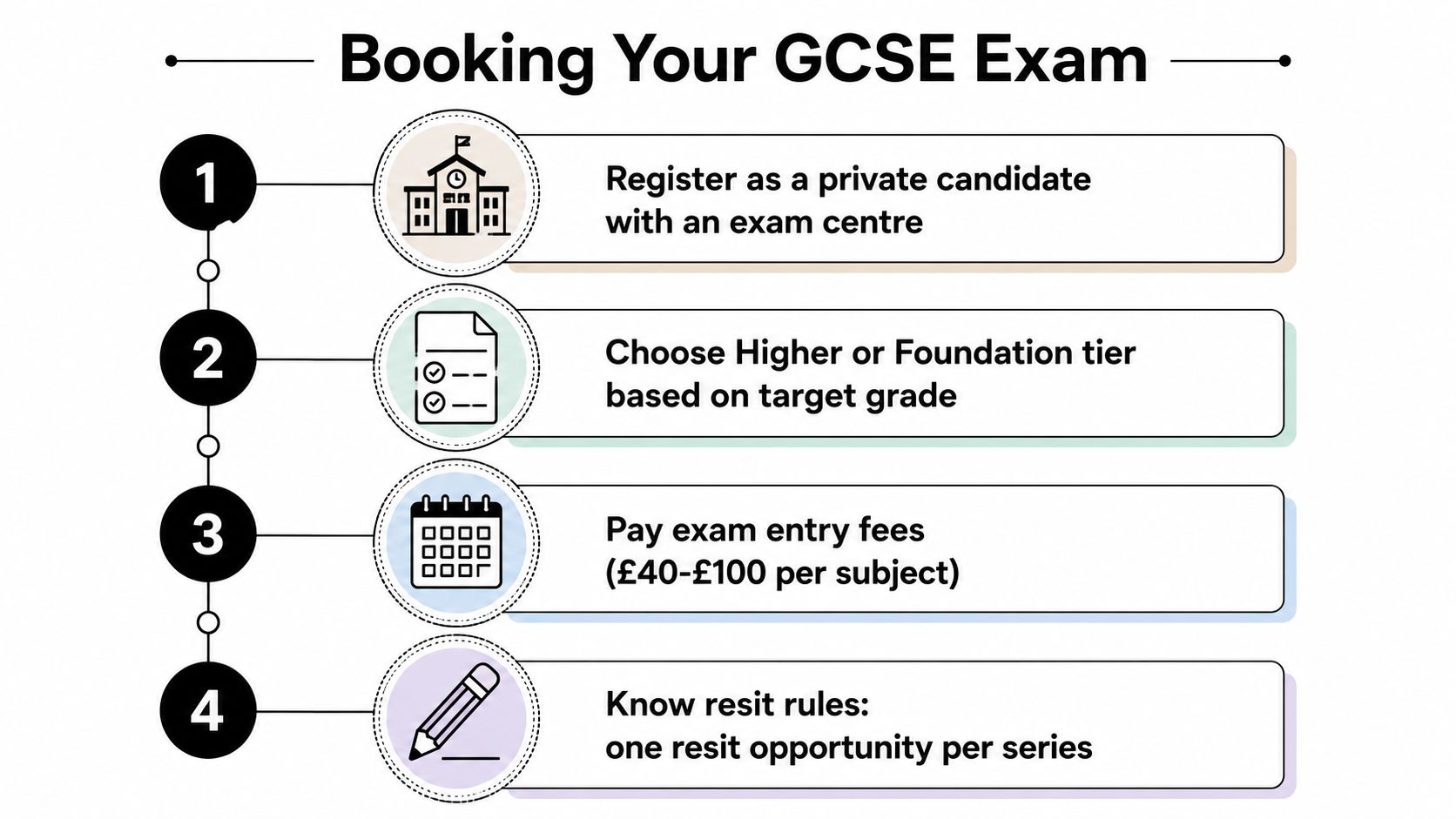
If you're studying independently or with a provider that doesn't handle entry, you'll usually need to register as a private candidate with an approved exam centre. The centre checks your awarding specification, subject, tier, identity details, fees, and practical arrangements. Start early because centres have their own capacity and deadlines.
A clear booking process
- Find an approved centre: Ask whether it accepts adult private candidates for your exact science specification.
- Confirm the tier: Use your target grade and practice-paper results. Foundation suits a target within grades 1 to 5, while Higher is used for grades 4 to 9.
- Check the exam series: Science exams are generally planned around the summer series. Unlike common English and maths resits, science isn't normally part of the November GCSE series. This timing point is highlighted in guidance for adults resitting GCSEs.
- Pay and confirm: Get written confirmation of the subject code, paper tier, exam dates, centre address, access arrangements, and payment.
The November series is effectively focused on English Language, English Literature, Maths, and Welsh-language variants. That means a science learner may need a longer preparation window than someone resitting a more commonly available subject.
If the first attempt doesn't go to plan
A resit is not a personal verdict. It tells you which areas need more work. Ask the centre and awarding body about the current resit rules, whether any marks can carry forward, and which exam series is available for your qualification.
Keep your results document and identification details safe. Your exam centre should tell you how to collect or receive results and what evidence you need. Don't book a resit until you've reviewed the original paper feedback, topic gaps, and tier choice. A planned second attempt is a new study project, not a repeat of the first one.
Where Science GCSE Can Take You Next
After months of fitting revision around shifts, family routines and tired evenings, passing Science GCSE can change what feels possible. It may lead towards university, technical training, a health profession, or work where scientific knowledge helps you support others.
First, check the entry requirements for the route you want. Some university courses ask for GCSE Science or Double Award. Others require science only for particular degrees. Some accept an equivalent Level 2 qualification. The University of Manchester admissions guidance explains why the qualification structure matters, including the way universities may treat separate science awards and Double Award routes.
Possible progression routes
After GCSE Science, you may consider:
- A levels: Biology, Chemistry or Physics can prepare you for further academic study, especially when a university course names a particular subject.
- BTEC or T Level study: Applied courses can connect science with health, engineering, environmental work or laboratory practice.
- Access to Higher Education: An Access course can help adults prepare for university after time away from formal education.
- Apprenticeships: Technical, engineering, health and laboratory apprenticeships may ask for science alongside English and Maths.
- Public service careers: Science can form part of the entry profile for some NHS, police, fire, environmental and technical roles. Check each employer's current requirements before applying.
A qualification does not promise a particular job or salary. It can remove an education barrier and give you more choices. Those choices might support a move into work that feels more secure, fulfilling or financially rewarding. For an adult learner, that can mean studying now to improve your options later, rather than trying to change everything at once.
Science also builds useful habits. You learn to question claims, examine evidence, spot patterns and explain your reasoning. These skills can help at work and at home, especially when you assess health advice, technology or information online.
Government data records a large adult learning base, with about 1.3 million adults participating in government-funded further education in 2024/25 (see the national further education statistics). Adult learners are rebuilding skills and changing direction. Starting again is a real route, not a sign that you have fallen behind.
Your children may remember the certificate, but they will also remember the evenings you kept going after work and family responsibilities. They will see that a difficult start does not decide the ending. You can show them that learning remains possible at any age.
Next Level Online College offers flexible, tutor-supported online GCSE courses for adults studying around work and family commitments. The courses include guidance for assessment preparation and progression. Visit Next Level Online College to explore the science study options and choose a route towards university, a career change or a more confident future.