
Red brick universities are the six historic civic universities in major English cities founded before the First World War: Birmingham, Liverpool, Leeds, Sheffield, Bristol and Manchester. They became known for practical education, research and service to their local communities.
You may have searched “what is red brick university” after seeing the phrase on a university website, in a course guide or during a conversation about higher education. Perhaps you're returning to study after caring for children, working for years or leaving school without the qualifications you wanted. University language can feel like a closed door, but this term has a clear and useful meaning.
A red brick university isn't any university with red buildings. It describes a historic type of civic institution created in growing industrial cities. These universities were closely connected to working communities and developed courses in subjects such as engineering, medicine and applied science. That history matters because it shows that higher education wasn't only designed for people from traditional academic backgrounds. It also grew to meet the needs of ordinary cities, employers and families.
Understanding What Are Red Brick Universities
You might be sitting at a kitchen table, looking at university choices and wondering whether a “red brick” institution is different from a modern university. The short answer is yes, but the difference is mainly historical rather than a simple measure of quality.
The term usually refers to the original six English civic universities. They are Birmingham, Liverpool, Leeds, Sheffield, Bristol and Manchester. Their university dates are Birmingham 1900, Liverpool 1903, Manchester 1903, Leeds 1904, Sheffield 1905 and Bristol 1909, as listed in this historical overview of red brick universities.
These institutions appeared in major industrial cities. Their founders wanted higher education to support local people and the changing economy. Instead of focusing only on classical learning, they built strong teaching and research in practical areas, including medicine, engineering and other professional subjects.
Why the label matters
The name comes partly from the buildings. Many civic universities used red brick, which was more practical and affordable than the stone linked with Oxford and Cambridge. The architecture represented something new, urban and connected to the expanding cities around it. The phrase later became a shorthand for a modern model of British higher education, as explained in Cambridge Dictionary's definition of red brick university.
For an adult learner, this background can feel encouraging. These universities were not created as distant institutions serving only an old academic elite. They were built to educate people for useful work, improve professional knowledge and contribute to city life.
That doesn't mean every red brick university offers the same experience. Courses, entry requirements, teaching styles and student support vary. Think of “red brick” as a historical family name, not a guarantee that one course will suit everyone.
Practical rule: Choose the course, support and entry route that fit your life. The label can give you context, but it shouldn't make the decision for you.
The History Behind Red Brick Universities
To understand the red brick idea, start with the cities where these universities grew. Industrial Britain needed trained professionals who could work with new technology, improve public health and manage expanding businesses. Specialist colleges developed around these needs, and several later gained university status.
The process can be understood through three connected changes:
Cities grew and needed expertise. Industrial centres needed engineers, doctors, scientists and teachers. Local institutions could train people close to the communities and workplaces they served.
Practical subjects gained importance. Engineering, medicine and applied science became central areas of study. This challenged the idea that a university education should focus mainly on traditional subjects.
Civic universities created a wider route into higher education. Their urban setting and professional purpose helped extend university study beyond the ancient universities and their established collegiate traditions.
The buildings also carried a message. Stone had long been associated with the older universities, while red brick was widely available and useful in fast-growing cities. The material wasn't the whole reason for the name, but it helped people distinguish these newer institutions from Oxford and Cambridge. The architectural contrast is discussed in this explanation of what makes a red brick university.
The name came later
Many people assume the universities were called red bricks from the day they opened. The label was coined later by Edgar Allison Peers in his 1943 book, published under the pseudonym Bruce Truscot. It originally described the six institutions now commonly recognised as the core group, as recorded in the history of the term redbrick university.
That timing helps prevent a common misunderstanding. “Red brick” isn't an official level of university status, and it isn't a formal ranking category. It became a historical description of civic universities that had already developed important roles in British education.
These institutions also helped shape professional training and research. Their work connected classrooms with hospitals, laboratories, public services and industry. For someone returning to education, that connection remains meaningful. A degree can be a personal achievement, but it can also provide skills that help you change career, support your family and contribute to the wider community.
Key Features That Define Red Brick Universities
Red brick universities share a broad history, but they aren't identical. Their defining features are best understood as patterns rather than strict rules.
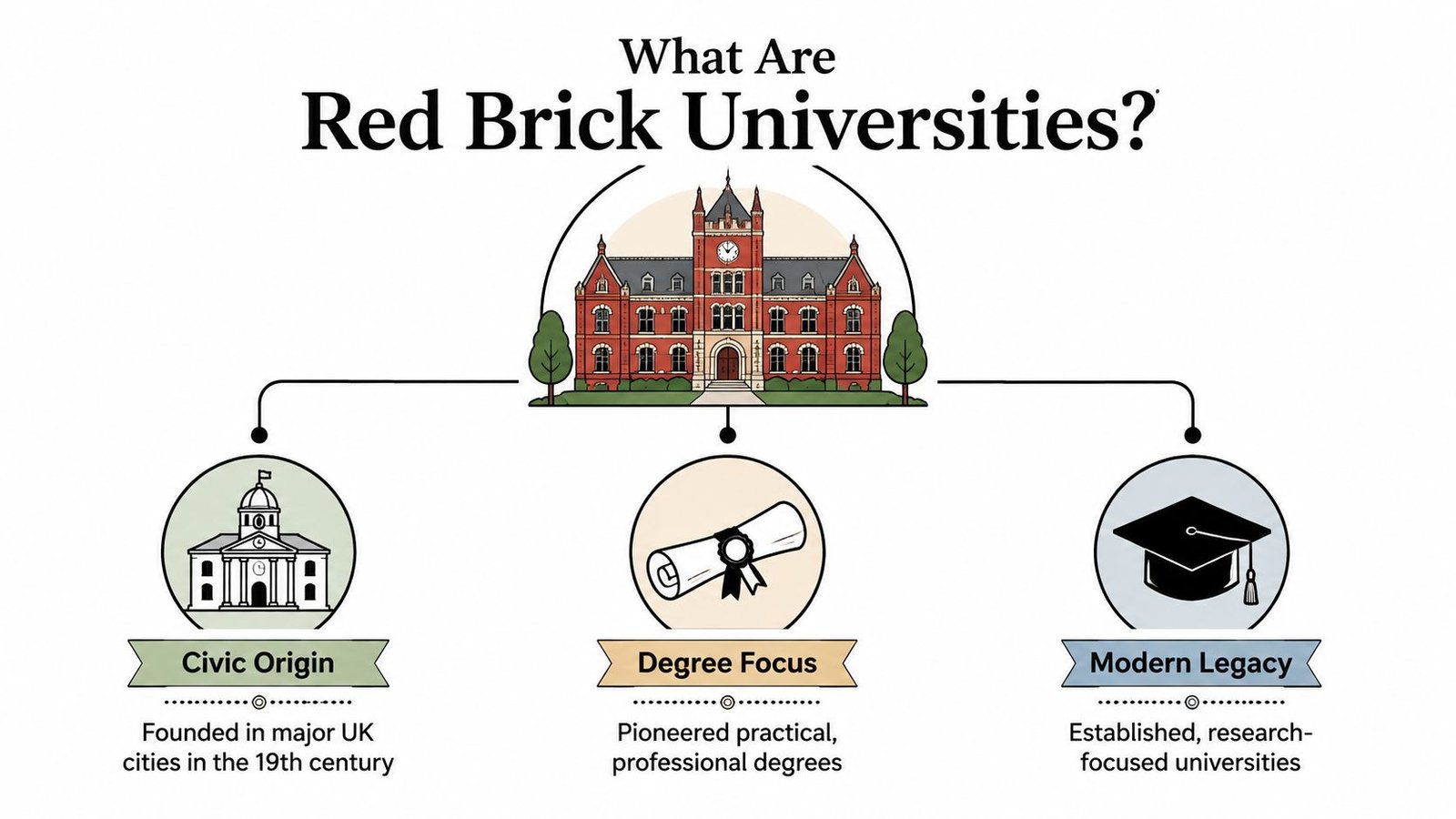
First, they have a civic origin. They were founded in major English cities and developed relationships with local communities, employers and public services. That urban setting often gives students access to a wide range of professional, cultural and community connections.
Second, they have a strong tradition of practical and professional study. Engineering, medicine and applied science were especially important because industrial cities needed trained people who could solve real problems. Many institutions later expanded into law, business, social sciences, arts and other fields.
Third, they developed substantial research identities. The original six were included among the founding members of the Russell Group, formed in 1994 to represent leading research universities in the UK. The original members included Birmingham, Bristol, Leeds, Liverpool, Manchester and Sheffield, alongside Oxford and Cambridge, as recorded in the history of the Russell Group.
A useful comparison
| Feature | Red Brick Universities | Ancient Universities |
|---|---|---|
| Historical setting | Civic institutions created in major industrial English cities | Older universities with long collegiate traditions |
| Main early purpose | Practical education for professional and industrial needs | Established academic and collegiate learning |
| Common early subjects | Engineering, medicine and applied science | Traditional academic and professional subjects |
| Relationship with cities | Closely connected to urban communities and local economies | Developed through older institutional and collegiate structures |
| What the label tells you today | Historical background and civic identity | Historical age and collegiate tradition |
The table gives you a starting point, not a decision formula. A red brick university may be a strong choice for one learner and the wrong fit for another. You should compare the actual course content, teaching arrangements, assessment methods, location and support available.
Entry rules matter too. If you're unsure which qualifications universities accept, use a practical guide to university entry requirements in the UK and then check the specific course page. Requirements can differ between subjects, even within the same institution.
Don't treat the label as a quality stamp
The phrase can hide important differences. Red brick universities have varied admissions profiles, research strengths and local labour-market roles. Times Higher Education's discussion of red brick universities highlights why the label works better as historical shorthand than as a ranking system.
Your success won't depend on a building style or a famous category. It will depend on preparation, the right subject, steady support and a route that matches your circumstances.
The Six Original Red Brick Universities
The six original institutions each grew from the needs of its city. Their shared identity doesn't erase their individual character. Learning a little about each one can make the list feel less like a set of names and more like a group of places with distinct civic stories.
Birmingham
The University of Birmingham gained university status in 1900. It represented the ambition of a major industrial city to build an institution focused on modern subjects and professional knowledge. Its story shows how civic universities could serve a large urban population while developing a serious research role.
Liverpool
The University of Liverpool gained university status in 1903. Liverpool's links with trade, medicine, science and global connections shaped the environment in which the university developed. Its civic purpose was tied to the needs of a busy city and the people who worked, lived and built careers there.
Manchester
The University of Manchester gained university status in 1903. Manchester's industrial history made practical learning especially important. Engineering, science and professional training suited a city known for manufacturing, invention and economic change.
Leeds
The University of Leeds gained university status in 1904. It grew within a city where industry, commerce and public services needed skilled graduates. Its development reflects the wider civic goal of bringing advanced education into the heart of an active regional economy.
Sheffield
The University of Sheffield gained university status in 1905. Sheffield's industrial identity, particularly its connections with engineering and manufacturing, made technical and applied learning central to its mission. The university's origins remind adult learners that education can begin with the needs of real workplaces.
Bristol
The University of Bristol gained university status in 1909. Bristol brought a civic university tradition to another important English city with strong commercial, scientific and professional links. Its place in the original group completes the classic list of six institutions founded before the First World War, as outlined in this guide to the original red brick universities.
These universities later became part of the UK's leading research institutions, but their beginnings were local and practical. That combination can speak powerfully to adults who want education to improve both personal prospects and the communities around them.
How Red Bricks Differ From Other UK Universities
The UK has several broad university traditions, and the categories can overlap. Understanding the differences helps you avoid choosing a university because of a label alone.
Ancient universities are associated with long-established collegiate traditions, especially Oxford and Cambridge. Their history, organisation and student experience can differ from the civic model that shaped the original red bricks.
Red brick universities grew in industrial cities during the late Victorian and Edwardian period. Their early identity centred on practical subjects, professional preparation, research and service to urban communities.
Plate glass universities are usually associated with a later wave of university expansion and modern campus design. Their buildings and institutional models often look different from the urban civic universities, although individual courses and student experiences vary greatly.
Modern universities often developed from polytechnics or other higher education institutions. They may have strong vocational and professional courses, close employer links and varied routes for students with different backgrounds.
What should an adult learner compare?
Look past the category and examine the details that affect your daily life:
- Course structure: Check whether teaching is campus-based, online, blended or organised around particular attendance patterns.
- Entry route: Look for accepted qualifications and alternative pathways if you don't have A Levels or recent academic study.
- Support: Ask about study skills, personal tutoring, wellbeing, careers guidance and help for students balancing responsibilities.
- Subject strength: A university's overall reputation may matter less than its teaching, facilities and professional links in your chosen subject.
- Practical demands: Consider travel, childcare, work patterns, assessment deadlines and the time you can realistically study.
If traditional qualifications aren't part of your background, read about how to get into university without A Levels. A non-traditional route isn't a sign that you don't belong. It means your preparation may need to look different.
A red brick university can offer an established academic environment, but another university may provide a more suitable timetable, support model or vocational focus. The right decision is personal and should support the future you're working towards.
Why Red Brick Universities Matter for Adult Learners Today
The history of red brick universities matters because it changes the question from “Am I academic enough?” to “Which route will help me reach my goals?” These institutions were created to connect higher education with working cities and practical needs. That civic purpose makes them relevant to adults who want a degree that supports a new career, stronger earnings or a chance to make a difference.

You don't need to feel confident before you begin. Confidence often grows after you take a small step, complete a task and see that you can learn. If your children or family are watching, your return to education can also show them that progress is possible at any stage of life.
Start with the destination. Choose the career or subject area that interests you, check the university's entry requirements, then identify the qualification you need. Some adults may apply directly, while others may first complete GCSEs, A Levels, Functional Skills or an Access to Higher Education Diploma.
Build a route that fits real life
A flexible online provider such as Next Level Online College offers recognised courses including Functional Skills, GCSEs, A Levels and Access to Higher Education Diplomas, with academic and pastoral support for adult learners. That kind of preparation can help you organise study around work, family and other responsibilities before applying to a university.
You can also explore guidance on how to get into university and make a simple plan:
- Write down the course or career you want.
- Check the exact entry requirements.
- List the qualifications you already hold.
- Identify the gaps, if there are any.
- Choose a realistic study schedule and ask for support early.
This video can provide another accessible way to think about university progression:
The original red brick universities began by serving communities that needed practical knowledge. Today, adult learners can carry that same spirit forward. Your past doesn't decide what you can achieve next, and earning a qualification can help you become the role model your family already sees in you.
If you're ready to turn your interest in red brick universities into a practical study plan, explore flexible GCSE, A Level, Functional Skills and Access to Higher Education courses at Next Level Online College. Choose the qualification that matches your goal, then take the first supported step towards university and a more fulfilling career.