You're sitting at the kitchen table, helping your child with an English homework task. They ask what a word means, or how to improve a paragraph, and you hope they won't notice that you're unsure too. Perhaps school left you feeling that English wasn't your subject. Perhaps you've carried that feeling for years.
An English GCSE course for adults can change that story. It can help you read official letters with less worry, apply for better work, support your children and take a serious step towards college or university. You don't need to become a different person. You only need a clear route, steady support and the courage to begin.
A Fresh Start You Can Be Proud Of
Mum had always told her daughter that schoolwork mattered. She helped with spellings, listened to reading and checked homework when she could. But when the workbook asked the child to explain how a writer created tension, Mum paused. She remembered struggling with English herself and didn't want her daughter to see that old doubt return.
The next week, she started studying too. Her evening routine stayed busy, but she found a small space after dinner. The kitchen table became a classroom. One night she practised identifying a writer's viewpoint. Another night she wrote a short paragraph and improved it after tutor feedback. The progress was quiet, but it was real.
Her daughter began to notice. She saw Mum reading, making notes and trying again after a difficult task. That example can matter more than a speech about education. A child learns that adults can return to learning, ask for help and keep going when something feels hard.
Confidence grows through ordinary wins
The national picture is challenging for adult returners. In summer 2025, 20.9% of 175,118 post-16 English GCSE students achieved grade 4 or above, according to reported post-16 English GCSE results. That's close to one learner in five, not because adults lack ability, but because many are studying around work, childcare, past disappointment and long gaps away from the classroom.
That figure should make you choose support carefully, not give up before you start. A useful course should offer clear teaching, practice with real exam questions, feedback on your writing and a plan for dealing with weak areas.
A difficult first attempt doesn't decide your future. It shows you where your next bit of support needs to go.
GCSE English remains important beyond school. In 2021/22, adult learners in General Further Education Colleges completed 17,670 GCSE English aims, with 7,450 achieved at grades 9 to 4 and an overall achievement rate of 80.7%, according to Department for Education statistics.
The pages ahead will explain the difference between Language and Literature, the AQA exam structure, study options, entry and resit rules, future pathways and how to compare providers. You'll also find honest answers to the worries many adult learners keep to themselves.

Language or Literature and Which Path Suits You
GCSE English Language and GCSE English Literature are separate qualifications. They overlap in useful skills, but they take different routes through the subject.
Think of English Language as the daily car you drive. You use it to read modern and unseen texts, understand how writers shape meaning, write for real audiences and argue a viewpoint. These are the skills you might use in a job application, a complaint letter, a report or a college assignment.
English Literature is more like a classic car kept in the garage. You study complete texts and return to them closely. Your course may include a play such as Macbeth or An Inspector Calls, along with poetry and prose. The pleasure can be deep, but the exam asks you to remember characters, themes, scenes, language and context from set texts.
Start with the qualification your goal needs
For most adults who need one English qualification, Language is the sensible first choice. It's commonly used as the basic English requirement for employment, further education and progression planning. A university or employer may ask specifically for GCSE English Language at grade 4 or above, so check the exact entry rules for your chosen route.
Literature can be a good addition if you enjoy novels, plays and poetry, or if a future course asks for it. Some adults take both qualifications, but two subjects require more reading, revision and exam preparation. If your time is limited, Language usually gives you the most direct return for your immediate goal.
| Feature | GCSE English Language | GCSE English Literature |
|---|---|---|
| Main focus | Reading, writing, viewpoints and communication | Set novels, plays and poetry |
| Texts | Includes unseen and modern extracts | Closed-book set texts |
| Writing tasks | Creative and transactional writing | Analytical essays about literature |
| Everyday use | Applications, reports, arguments and formal writing | Close reading, interpretation and cultural knowledge |
| Best first choice for | Most adults needing a general English requirement | Learners who need or strongly want a literature qualification |
Language doesn't mean “easy”, and Literature isn't only for people who already love books. The better choice depends on what you need next. Write down your target, such as a nursing course, an office role or an Access to Higher Education Diploma, then check which English qualification that route accepts.
How the Exam Actually Works
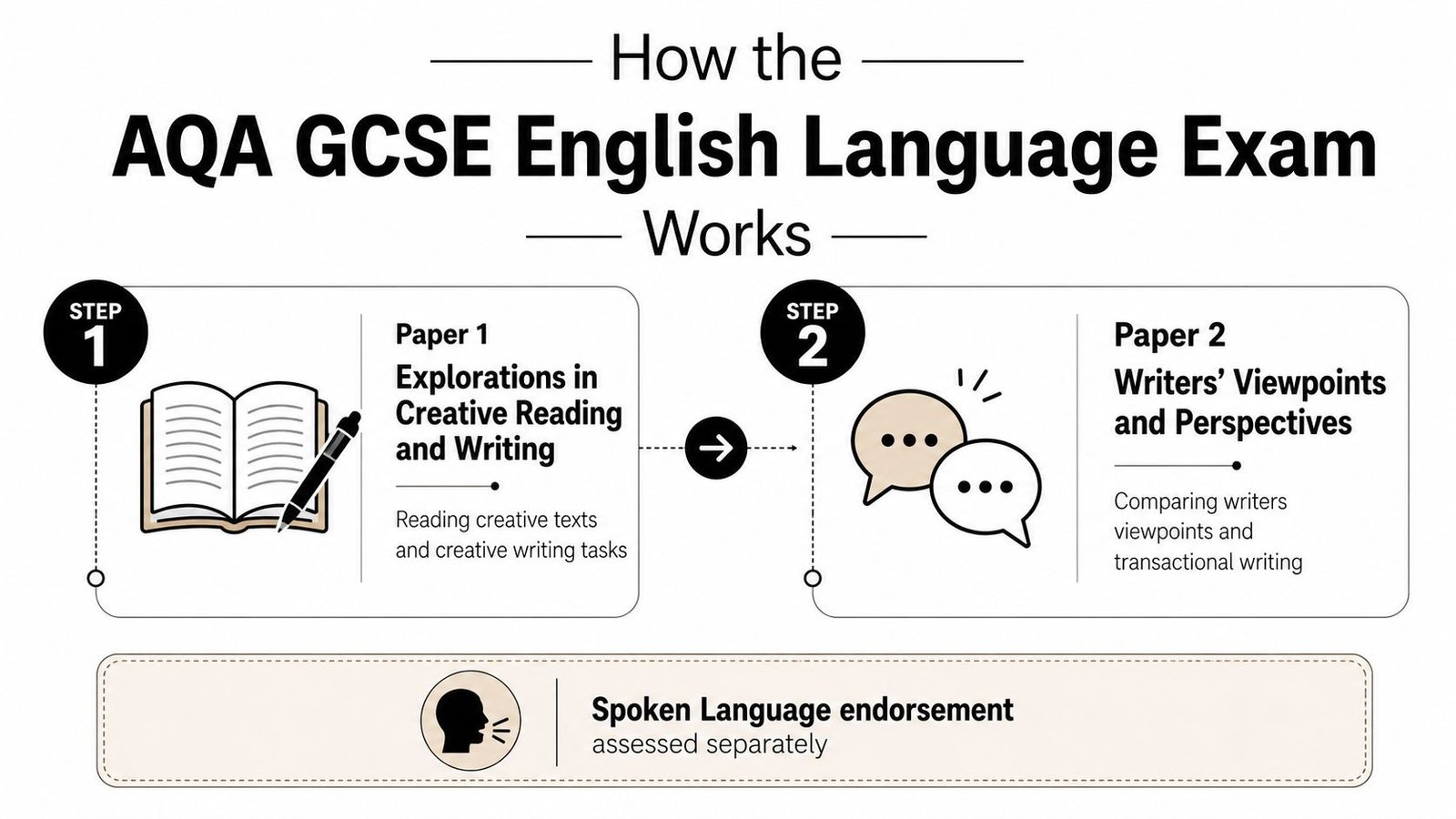
The AQA GCSE English Language course has a clear structure. You complete two written papers worth 80 marks each, giving a total of 160 marks, and the final result is reported on the 9 to 1 grading scale. AQA's specification sets out the qualification mechanics, while government subject guidance confirms that the written assessment is by examination.
Paper 1
Paper 1 is called Explorations in Creative Reading and Writing. You read a fiction extract and answer questions about what happens, how the writer uses language and structure, and how effectively you can create your own piece of writing.
In plain terms, the paper tests whether you can:
- Find meaning: Explain what a character is doing, feeling or facing.
- Analyse choices: Pick a word, phrase or structural choice and explain its effect.
- Write creatively: Produce a clear description or narrative with deliberate vocabulary and organisation.
Paper 2
Paper 2 is Writers' Viewpoints and Perspectives. You work with two non-fiction or literary non-fiction sources, often from different periods, and explore how the writers present their views.
You may need to compare the sources, analyse methods and write for a real purpose. Transactional writing could include an article, letter, speech or essay. The important question is not only “What do I think?” but also “Who am I writing for, and what do I want that reader to believe or do?”
AQA's mark scale doesn't use one permanent pass percentage. In June 2026, its grade boundaries for GCSE English Language were 122 marks for grade 9, 112 for grade 8, 103 for grade 7 and 75 for grade 4, from 160 available marks, as shown in AQA's June 2026 grade boundaries. A grade 4 therefore required 46.9% of available marks in that series, while grade 9 required 76.3%. Boundaries can change because exam papers differ in difficulty.
The spoken language assessment
The spoken language endorsement is assessed separately. You give a presentation or talk, respond to questions and show that you can speak audibly and use Spoken Standard English appropriately in a formal setting. The result is reported as Pass, Merit, Distinction or Not Classified, but it doesn't add marks to the written exam grade, according to government guidance on spoken language.
A short speaking practice can help you prepare. You can also use FluentPass exam preparation to rehearse speaking clearly and answering questions under gentle pressure. For a focused explanation of the assessment, see this GCSE English speaking exam guide.
If you also take Literature, expect closed-book questions on your set texts, such as Macbeth and An Inspector Calls. That preparation feels different from Language because you need to remember the texts and build developed interpretations, rather than respond only to material placed in front of you.
Study Modes That Fit Around Real Life
The right study mode is the one you can keep using when life becomes noisy. A parent working shifts may need recorded lessons and flexible deadlines. Someone who feels isolated may learn better in a room with a teacher and other adults. Another learner may need a practical qualification rather than a GCSE.
Online learning
An online English GCSE course lets you study from a phone, tablet or computer. You can watch lessons when the children are asleep, complete reading tasks during a lunch break and send writing to a tutor for feedback. A steady routine of 4 to 6 hours a week is a common planning guide for adult study, but the exact workload depends on your starting point and course design.
Online learning works well when you can organise your own week. You'll need a quiet place, reliable access to your lessons and the confidence to ask for help rather than disappearing when a task feels difficult. Use a simple weekly plan, and try GCSE revision techniques for adult learners when you begin building exam habits.
In-person evening provision
A college evening class gives you a fixed appointment and face-to-face contact. That structure can be helpful if you keep postponing study at home or want to ask questions immediately. The trade-off is less flexibility, especially when shifts, transport, illness or family responsibilities interrupt the timetable.
Functional Skills Level 2
Functional Skills Level 2 English focuses on practical communication, reading and writing. It may suit someone who needs a work-focused alternative or wants to rebuild confidence before taking GCSE English. It doesn't use a GCSE-style grade letter, so check the requirement carefully if an employer, college or university asks for grade 4 or 5 GCSE English.
| Mode | Typical Weekly Time | Best For | Qualification Gained |
|---|---|---|---|
| Online GCSE | 4 to 6 hours spread across the week | Shift workers, parents and independent learners | GCSE English Language |
| In-person evening class | One evening class plus homework | Learners who need a fixed routine | GCSE English Language |
| Functional Skills Level 2 | Planned around practical tasks | Learners needing a practical alternative | Functional Skills Level 2 English |
Before enrolling, ask the admissions team whether the course includes exam preparation, spoken language assessment and help with finding an exam centre. Those details can make a major difference later.
Entry Rules, Time Needed and Resit Options
Most adult GCSE English courses don't require previous qualifications. Providers may check that you have basic literacy and meet their residency or funding rules, but leaving school without a pass doesn't bar you from returning.
A part-time learner often plans around six to nine months, with study spread across work and family life. One week might include a reading lesson on Tuesday, a writing task on Thursday and a short revision session on Sunday. If you can study full-time, your route may be shorter, but the right pace is the one you can sustain without burning out.
Resitting in England
Adults can resit GCSE English in the autumn or summer exam series, according to the National Careers Service guidance on resits. Government adult funding rules may allow learners aged 19 or over to study English and maths when they haven't already achieved GCSE grade 4 or above, or an equivalent or higher qualification.
Ask about the Level 2 entitlement, bursaries and instalment plans before you commit. Funding depends on your circumstances and the provider's arrangements, so don't assume that every course has the same price or eligibility rules.
The resit figures show why a calm plan matters. In summer 2025, only 20.9% of post-16 English GCSE students achieved grade 4 or above, while the November 2025 resit rate rose to 37.5% from 34.9% a year earlier, according to FE Week's reporting. Treat your first diagnostic assessment as useful information. It tells you whether you need to focus first on sentence control, reading analysis, writing structure or exam timing.
Where an English GCSE Can Take You Next
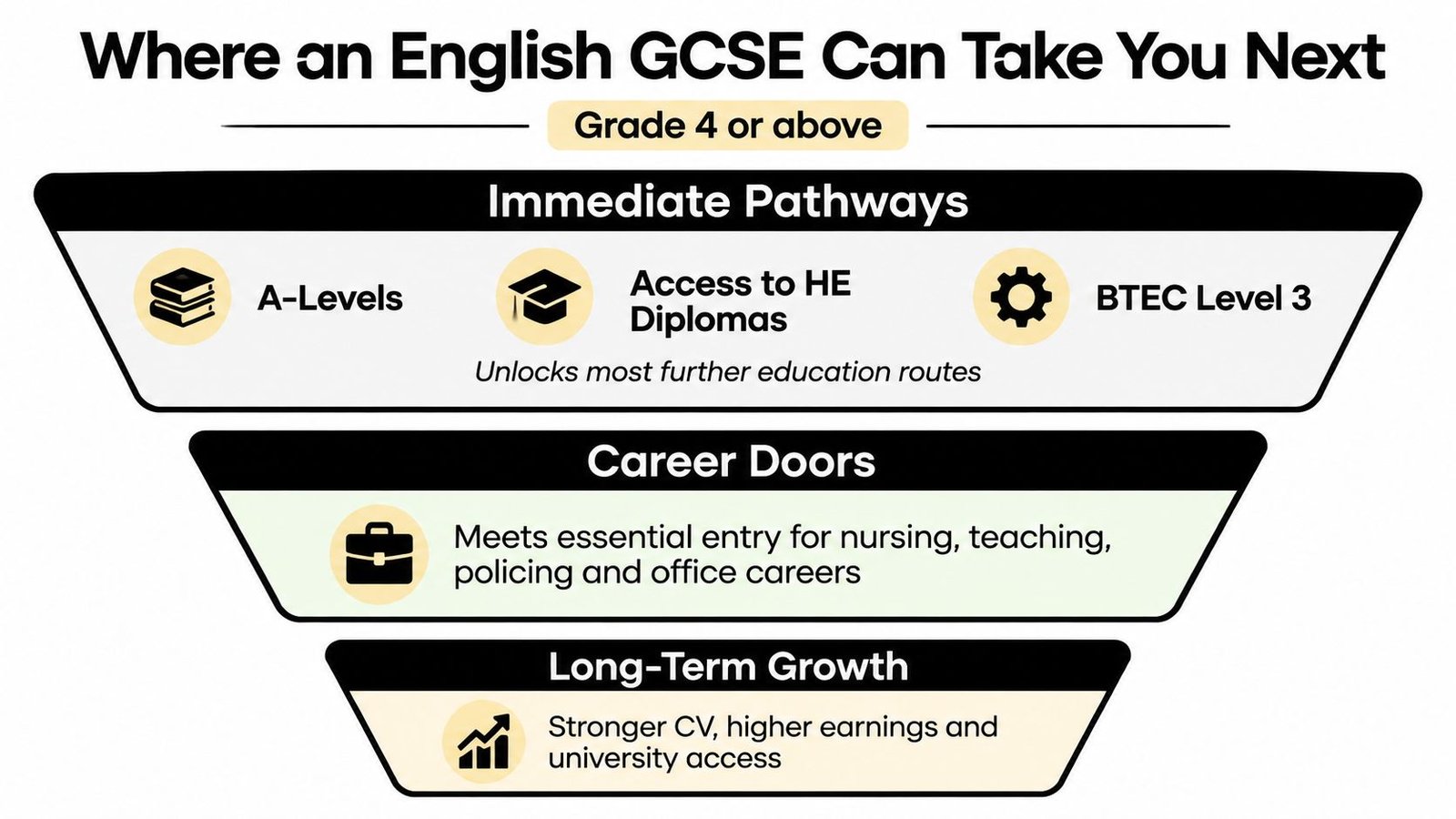
A grade 4 or above can remove a barrier that has been sitting in front of you for years. It may help you apply for A Levels, an Access to Higher Education Diploma, a BTEC Level 3 course or another further education route. The exact requirement still belongs to the course or employer, so check before you enrol.
For some career plans, GCSE English is a basic entry condition. Teaching, nursing, midwifery, social work, policing and civil service roles may ask for English at grade 4 or C, alongside other qualifications and checks. A pass doesn't guarantee a job, but it can stop your application being rejected at the first stage.
The everyday changes count too
The qualification can also improve ordinary moments:
- You can read a tenancy agreement and pause over the meaning, rather than feeling defeated by the page.
- You can fill in an application form that asks for GCSE English without leaving the box blank.
- You can help your child plan a paragraph, check a formal letter or talk about a story with more confidence.
- You can show your family that education isn't something you missed forever.
There's also a practical money reason to continue learning. Level 2 qualifications are generally associated with better lifetime earning prospects than having no qualification, and some promotion processes screen out applicants who don't meet the stated English requirement. Your individual result will depend on your experience, role, employer and later training, so view the GCSE as a foundation rather than a promise of a particular salary.
A national Ofqual overview shows the continuing importance of GCSE results in England. In 2022/23, 65.1% of pupils achieved grade 4 or above in GCSE English and maths, and Ofqual reported that 67.1% achieved grade 4 or above in GCSE outcomes in 2025.
The adult resit route can take more than one attempt. In summer 2025, the reported English resit pass rate for 19-year-olds was 29.6%, compared with 41% for 17-year-olds, which shows why older learners need realistic timetables, useful feedback and proper retake planning rather than promises of a quick pass.
Choosing a Provider and Why Next Level Online College Stands Out
You don't need to understand every education term to compare providers. Ask four direct questions before paying.
Is the qualification recognised?
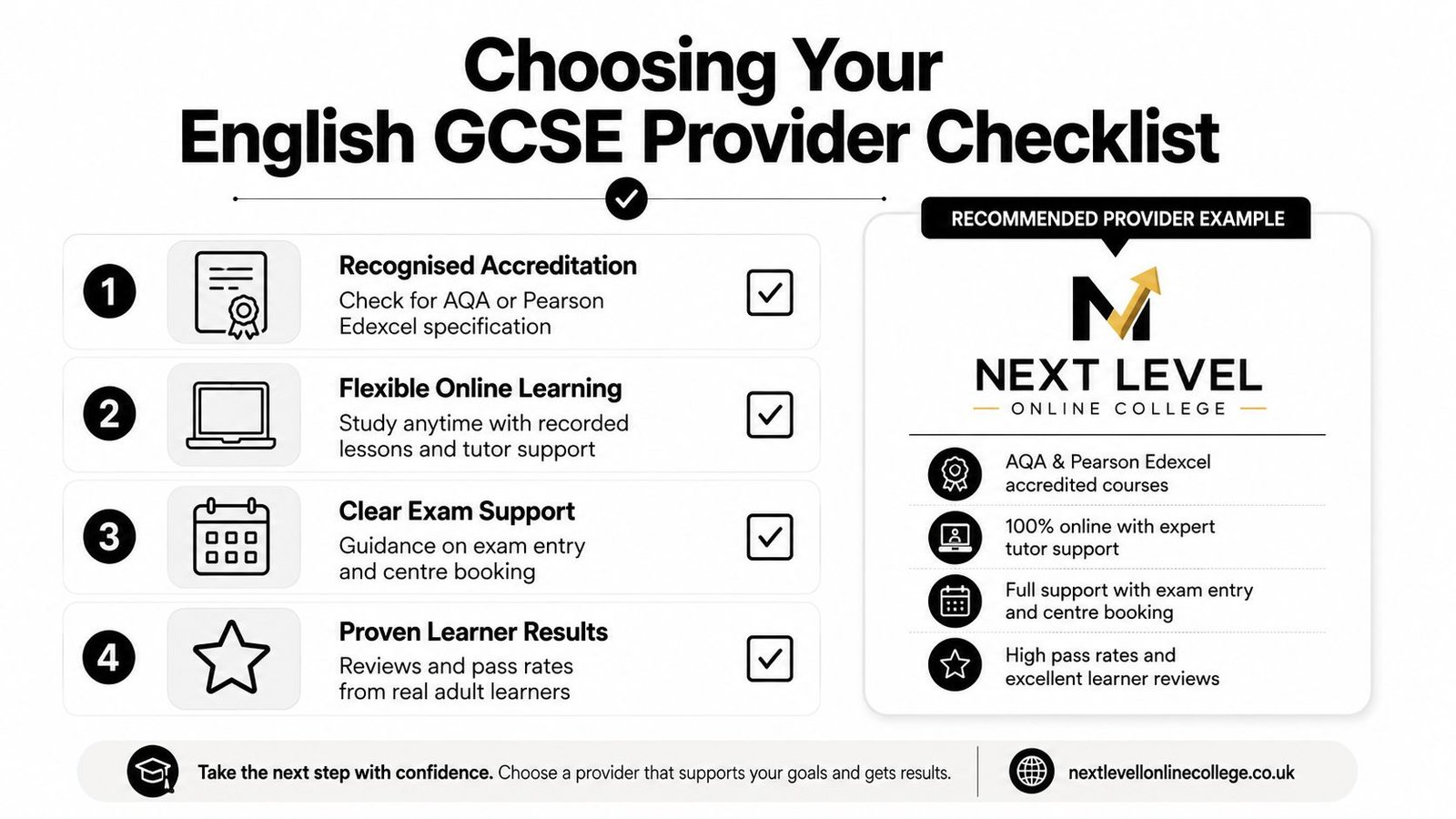
Look for a course based on a recognised exam-board specification, such as AQA or Pearson Edexcel. Be careful with certificates that sound impressive but don't give you the GCSE result a college or employer requested.
Will a real tutor read your work?
Recorded lessons can explain a topic, but feedback helps you improve. Ask how marked work is returned, whether you can ask questions and whether a named tutor or support team helps when you get stuck.
Can it fit your home life?
A flexible online course should let you log in after a shift or once the children are in bed. Check whether lessons are recorded, whether deadlines are manageable and whether exam preparation is built into the programme.
What does the price include?
Ask about course fees, exam entry, centre arrangements and any additional charges. Clear answers help you compare like with like. Next Level Online College describes a fully online GCSE English Language option with tutor support, AQA-focused preparation, past-paper practice and guidance for adult learners. You can review the GCSE English Language course and ask what its current fees and exam arrangements include.
A useful question to ask: “If I struggle with my first writing task, who will help me improve it?”
A provider should make the answer clear. You should be able to picture your first lesson, your first piece of feedback and the weekly routine that will carry you towards the exam. Starting can feel frightening, but it becomes more manageable when the course explains what happens next.
Your Next Step and Honest Answers to Common Worries
Am I too old? No. Adults return to GCSE study at different stages of life, often because a job, a child or a long-held ambition has changed what they want. Your age doesn't erase your ability to learn.
Is it hard? It can be. Reading closely, organising an argument and writing under timed conditions take practice. Hard doesn't mean impossible, especially when a tutor breaks the work into small tasks and shows you how to improve.
What if I failed before? A resit is a fresh attempt. You now know more about the exam room, the pressure and the areas that need attention. That experience can help you study with greater purpose, provided you receive honest feedback and make a realistic plan.
Your English GCSE can become part of your family's story. One day, you may tell your child that you passed after believing for years that you couldn't. That moment won't only belong to a certificate. It will belong to every evening you kept going.
Next Level Online College offers flexible online GCSE English study with structured lessons, tutor guidance and support designed for adults balancing work and family. Visit Next Level Online College to explore the course options and book a conversation about whether this route fits your goal.