
Thinking about taking GCSEs for adults online? It’s a fantastic way to earn official qualifications without putting your life on hold. You can fit your studies around your work and family, learn from home at your own pace, and still earn the exact same certificate as someone in a traditional school.
Why It’s Your Time to Shine with Adult GCSEs
If you feel like your school days didn’t quite do you justice, you’re certainly not alone. The great thing is, it’s never too late to go back and get the grades you truly deserve. Taking GCSEs as an adult isn’t about re-living the past; it’s about taking control of your future and unlocking your potential.
Imagine what could happen with the right qualifications. Many jobs, promotions, and even entire career changes depend on having a grade 4 (what used to be a C) in key subjects like GCSE Maths and English. Getting these grades can be your direct path to a higher salary and more rewarding work.
A Powerful Investment in You and Your Family
This journey is about so much more than a piece of paper. It’s a personal victory that builds incredible self-esteem. The feeling you get when you pass that exam you once thought was out of reach is priceless. It’s proof that you can achieve anything you set your mind to.
And think about the wonderful effect this has on your family:
- Be an Inspiration: You become a powerful role model for your children and loved ones, showing them the amazing value of learning and determination.
- Make Them Proud: The pride your family will feel is a reward in itself. You’re not just improving your own life; you’re inspiring theirs and showing them what’s possible.
- Unlock New Futures: Better qualifications lead to better job security and a higher income, providing more stability and opportunities for your whole family.
The most meaningful part of returning to education is the amazing boost in confidence. It’s not just about passing an exam; it’s about proving to yourself that your potential is limitless, no matter your age or past experiences.
Open Doors to Higher Education and Beyond
GCSEs are often the key that unlocks even bigger goals. They are the essential building blocks for further education, like A-Levels or an Access to HE Diploma. If you’ve ever dreamed of going to university, getting those core GCSEs is the first, most important step on that exciting path. If you want to know more about what comes next, you can learn how to get into universities in our detailed guide.
Deciding to study GCSEs for adults online is a bold, positive move. It’s a choice to invest in yourself, open up your options, and build a future you and your family can be truly proud of. This is your time.
How Online GCSEs Work for Your Busy Life
The idea of going back to get your GCSEs as an adult can feel a bit daunting, especially when you’re already juggling a job, family, and a dozen other things. Where would you even find the time? That’s the exact problem that online GCSEs for adults were created to solve.
These aren’t “easy mode” qualifications. They are the very same, official GCSEs that teenagers sit in school, awarded by the same respected UK exam boards like AQA and Edexcel. The only real difference is that they’re designed to fit into your world, not a school’s timetable.
This means you can work through a lesson after the kids are in bed, catch up on reading during your lunch break, or dedicate a quiet Sunday morning to your studies. There are no bells ringing and no strict schedules. You are in complete control.
Your Course, Your Way
Think of a good online course as a complete toolkit for your success. It gives you all the expert materials, structure, and friendly support you need to get you from your first day to your final exam.
Everything is broken down into manageable chunks, so you never feel overwhelmed. You can expect:
- Structured Lessons: The course is mapped out logically, guiding you through one topic at a time so you can build your knowledge step-by-step.
- Friendly Tutors: You’ll have access to experienced tutors who understand the challenges adult learners face. They’re there to answer questions, mark your work, and give you the encouragement you need.
- A Pace That Suits You: Fly through the topics you find easy and take your time on the ones that are a bit trickier. You’re never rushed or held back.
It’s no wonder this way of learning has become so popular. A recent study found that 21% of British people are now involved in some form of online education. In fact, between 2019 and 2021, searches for ‘online courses’ shot up by over 200%, as more and more people realised the benefits of flexible study. You can read more about these trends over on the Oxford College news blog.
From Your First Lesson to Your Final Exam
So, what does this actually look like in practice? Once you enrol on a course like GCSE Maths or English, you’ll get access to an online portal packed with your learning materials. You simply work through them at your own pace, completing practice assignments along the way to check your understanding and get valuable feedback from your tutor.
The whole setup is designed to build your confidence step-by-step, getting you fully prepared for exam day.
It’s really important to understand this one key point: while all your learning happens flexibly online, the final exam itself takes place in person at an official exam centre. This is what makes sure your qualification is legitimate and recognised by employers and universities.
This mix of learning and exams is the magic ingredient that makes the system work so well for adults. You get all the convenience of studying from home, combined with the credibility of a formal, invigilated exam. When you and your tutor agree you’re ready, you simply book your exam as a private candidate at a centre near you. You can see a full breakdown of how our supported online learning works.
By the time you’re finished, you won’t just have a piece of paper. You’ll hold a nationally recognised certificate that can unlock new job opportunities and the immense pride of knowing you achieved it all on your own terms.
Choosing the Right Study Path for You
So, you understand how GCSEs for adults online work. Now comes the important part: figuring out which study path is the best fit for you. Think of it like planning a big trip. Are you the type to grab a map and go it alone, or would you prefer a guided tour with an expert who knows all the best spots?
Every route leads to the same destination—an official, nationally recognised GCSE qualification. But the journey itself, including the cost, flexibility, and support you get, can look very different. Let’s walk through the three main options to help you decide with confidence.
The Independent Route: Self-Study
This is the classic do-it-yourself (DIY) approach. You’re completely in the driver’s seat. It means buying the official textbook for your subject, downloading the exam board’s specification (their A-to-Z of what’s on the exam), and teaching yourself the entire course.
This path is really only for the most disciplined and self-motivated learners who are happy working entirely on their own. It’s certainly the cheapest option, as your main costs are just the textbook and the exam fees.
But that independence comes with some serious challenges:
- No Tutor Support: When you get stuck on a tricky maths problem or can’t make sense of a poem, there’s no expert to ask for help.
- No Feedback: You won’t have a professional marking your practice papers. This makes it very hard to know how you’re doing and where you need to improve.
- Finding an Exam Centre: You’re on your own to find a local exam centre that accepts private candidates, which can be a surprisingly stressful task.
This route demands a huge amount of organisation. While some people thrive on it, most adult learners find that the lack of guidance can feel quite lonely and make it much harder to reach the finish line.
The Flexible Support Route: Supported Online Learning
This is, by a long way, the most popular choice for adults going back to get their GCSEs. A supported online course offers the perfect middle ground: the freedom to study on your own terms, but with expert backup whenever you need it. It’s like having a co-pilot; you’re still steering, but you’ve got a seasoned expert right there with you.
You get all the flexibility of studying from home at your own pace, but with the huge benefit of a structured course and a dedicated personal tutor.
Think of it this way: a good online college gives you the complete blueprint for success. They provide the learning materials, the expert support, and the encouragement you need to build your knowledge confidently, piece by piece.
This is the ideal route if you want to be in control of your schedule but also need the reassurance of knowing help is just an email away. Your tutor will mark your assignments, give you detailed feedback, and answer any questions to keep you motivated. Providers like Next Level Online College often help with the exam booking process too, which takes a huge weight off your shoulders. It gives you a clear pathway to success without the rigid schedule of a traditional college.
The Traditional Route: Further Education College
Your third option is to enrol in a part-time evening or daytime class at a local further education (FE) college. This is the most structured path, with a fixed timetable in a classroom, learning alongside other students.
This route can work well if you enjoy face-to-face teaching and need a set routine to stay on track. For key subjects like Maths and English, these courses can sometimes be government-funded, making them free for eligible adults. These are different from Functional Skills, which are another option for gaining key qualifications. You can find out more by reading our guide explaining what Functional Skills Level 2 is equivalent to.
The main downside here is the lack of flexibility. You have to be in class at set times, which can be tough to juggle with a full-time job, family life, or other commitments. If you miss a class, you have to play catch-up, and everyone has to move at the same pace.
Comparing Your Adult GCSE Study Options
To make things clearer, here’s a quick comparison of the three main pathways.
| Study Method | Best For | Flexibility | Support Level | Cost |
|---|---|---|---|---|
| Self-Study | Highly disciplined, self-motivated learners on a tight budget. | Total flexibility. You set your own schedule completely. | None. You are entirely on your own. | Lowest (textbook + exam fees) |
| Supported Online Learning | Adults needing a balance of flexibility and expert guidance. | High flexibility. Study anytime, anywhere, at your own pace. | High. Dedicated tutor for marking, feedback & support. | Moderate (course fees + exam fees) |
| Further Education College | Learners who prefer a structured, in-person classroom environment. | Low. Fixed timetable with mandatory class attendance. | Good. In-person teacher and peer support in class. | Varies (can be free for core subjects, otherwise course fees apply) |
Ultimately, there’s no single “best” option—only the one that’s best for you. Take a moment to think honestly about your learning style, your budget, and how much time you can realistically set aside each week. This will help you choose the path that gives you the greatest chance of success.
Your Step-by-Step Enrolment and Exam Guide
Alright, let’s get down to the practical steps. Enrolling on a course and booking your exams can feel like a huge task, but when you break it down, it’s actually quite straightforward. Think of this as your roadmap from deciding to study, right through to sitting your final exam.
First things first: what subjects will you study? For most adults, GCSE Maths and English are the perfect starting point, as a grade 4 (what used to be a grade C) is the standard requirement for so many jobs and university courses. Think about your personal goals—are you aiming for a specific career path or a particular degree? Your answer will point you toward the right subjects.
With your subjects in mind, the next big decision is how you’ll study. As we’ve covered, you have a few routes, from going it completely alone to enrolling in a local college. For most working adults, a supported online provider is the perfect choice, offering a great blend of flexibility and expert guidance.
Taking Action: Enrolling and Booking Your Exams
Once you’ve chosen a provider and your subjects, the actual enrolment is usually refreshingly simple. With an online college, it’s often just a case of filling out a quick online form and sorting out your payment. You generally won’t need to dig out old school reports; a form of ID like a passport or driving licence is typically all that’s needed.
After you’re enrolled, you can get stuck into the course materials straight away. While you’re getting into the swing of learning, it’s a really good idea to start thinking about your final exams sooner rather than later.
This flowchart can help you see which path makes the most sense for you.
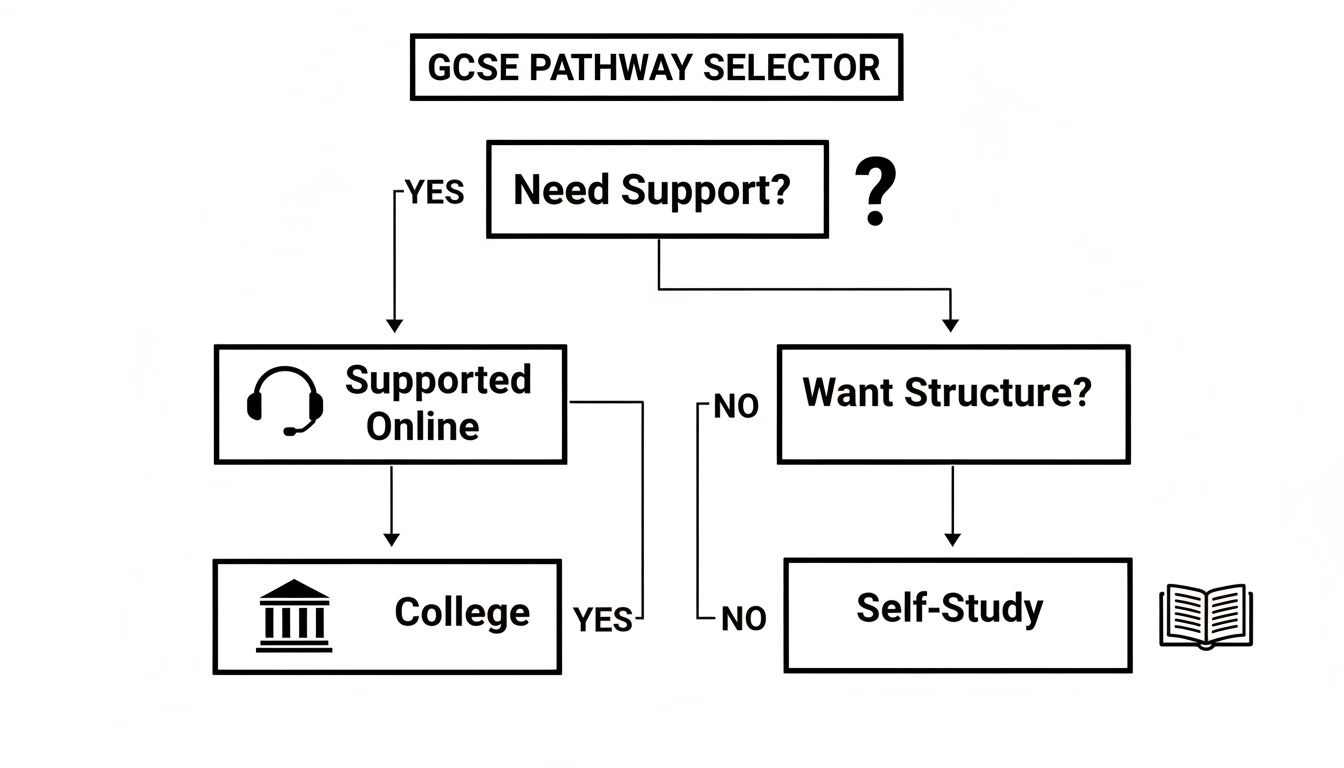
As you can see, the key thing to think about is how much structure and support you feel you need to succeed.
Finding and Booking Your Exam Centre
This is one part of the process you absolutely need to get right. Although you’re learning online, your GCSE exams have to be sat in person at an official exam centre. Your online college can usually give you a list of their partner centres, but you can also find one yourself by searching for centres that accept a “private candidate”.
Here’s what you need to do:
- Start Early: Exam centres only have a limited number of spots for private candidates. To avoid disappointment, you really need to start looking several months before the main exam season (which is typically May/June).
- Contact Centres Directly: Get on the phone or email local schools and colleges. You’ll need to ask them if they accept private candidates for your specific subject and exam board (e.g., AQA, Edexcel).
- Confirm the Details: Once you find a willing centre, they’ll walk you through their booking process. This is when you will pay the exam entry fee directly to them, not to your course provider.
Remember, you are in control here. Booking your exam place well in advance removes a massive weight from your shoulders. It lets you focus entirely on your revision, knowing that your exam spot is secured.
More and more adults are taking GCSEs for adults online and booking exams this way. There are no real barriers to entry, and anyone can book an exam for the summer series. For instance, the provisional dates for 2026 show Paper 1 on Tuesday, 2 June, and Paper 2 on Friday, 12 June, with results day being the same for everyone. You can read more details in this GCSE distance learning information sheet.
By following these steps, you’ll have a clear, manageable plan that takes the guesswork out of getting enrolled and ready for exam day.
Funding Your Studies and Understanding Costs
Let’s talk about the money side of things. Thinking about how you’ll pay for your GCSEs is a perfectly normal, and very sensible, part of the process. The good news is that you have options, and this investment in yourself can pay you back for years to come.
It helps to break down what you’re actually paying for. Typically, you’ll have two main costs: the fees for your online course and the separate fee for booking your exam at a test centre. It’s easy to get bogged down by these figures, but try to see the bigger picture. This isn’t just an expense; it’s a direct investment in your future earning potential and career prospects.
And thankfully, you don’t have to find all the money upfront. Let’s look at the most common ways to make your studies affordable.
Government Funding: Free Courses for Jobs
First things first, you should check if you’re eligible for the UK government’s Free Courses for Jobs scheme. It’s a brilliant programme aimed at adults who don’t already hold a full Level 3 qualification (which is equivalent to two A-Levels). If you meet the criteria, you could get your first Level 3 qualification completely free.
This isn’t some small programme. It’s a major, government-backed route that has already helped thousands of adults gain new skills without the financial worry.
So far, there have been a total of 129,380 enrolments on courses funded through this scheme, with 78,770 people having already successfully achieved their qualifications.
These numbers show that getting qualified without a huge financial outlay is a real possibility for many people across the UK. It’s a clear sign that help is there for those who want to get ahead. You can dig into all the details on the impact of this further education scheme on the official government statistics site.
Flexible Payment Plans: Spreading the Cost
Even if government funding isn’t an option for you, don’t worry. Good online colleges know that adult learners have mortgages, bills, and families to think about. They don’t expect you to have a big pot of cash sitting ready.
Most good providers offer flexible payment plans. This usually means you’ll pay a small initial deposit to get started and then spread the rest of the course fee over several months. This turns a larger one-off cost into a series of smaller, more manageable payments that you can factor into your monthly budget. It’s a great way to get started right away without needing to save up first.
A Smart Investment in Your Earning Potential
When you look at the potential return, the case for getting your GCSEs becomes incredibly strong. Gaining key qualifications in subjects like Maths and English is directly linked to a higher salary. It opens doors to promotions, entirely new careers, and can be your ticket to university—all of which can significantly boost your lifetime earnings.
So, what are the typical costs you should expect when studying for GCSEs for adults online? Here’s a simple breakdown:
- Course Fees: This is the main cost paid to your online college. It covers your learning materials, tutor support and marking, and access to the online student platform.
- Exam Fees: This is a separate fee paid directly to the exam centre you choose. It covers the administration for your final, in-person exam.
- Study Materials: Your course should include everything you need, but you might want to set aside a little extra for things like notebooks, stationery, or maybe an optional revision guide for some extra practice.
Between exploring government schemes and using a payment plan, you can make this happen. It’s more than just an exam; it’s an investment in a more secure and prosperous future for you and your family.
Revision Strategies That Fit Your Busy Schedule
Let’s be realistic—studying as an adult is nothing like it was at school. You’re juggling a job, family life, and a home. The secret isn’t about magically finding more hours; it’s about making the time you do have work much harder for you.
The thought of revision can feel overwhelming, but this isn’t about cramming until 2 a.m. anymore. We’re going to look at smart, realistic strategies built for busy lives, so you can prepare for your GCSEs for adults online feeling confident, not burnt out.
Study Smarter, Not Harder
Your brain isn’t a filing cabinet where you can just shove information and hope it sticks. To truly learn something, you need to engage with it actively. Two of the most powerful ways to do this are active recall and spaced repetition.
-
Active Recall: This means pulling information out of your brain, not just passively putting it in. So, instead of re-reading a chapter, close the book and try to explain the concept out loud. Scribble down a quick summary from memory or test yourself with flashcards. It feels tougher than just reading, but that mental effort is what builds strong, lasting memories.
-
Spaced Repetition: Don’t just study a topic once and tick it off the list. The trick is to review it again just as you’re about to forget it. Revisit a concept after a day, then a few days later, and then a week later. This process tells your brain, “Hey, this is important!” and helps lock the information into your long-term memory.
These methods are proven to be far more effective than just highlighting notes for hours on end. They deliver much better results in less time.
Make a Plan That Actually Works
A revision timetable can be your best friend, but only if it’s realistic. Don’t set yourself up for failure by scheduling a three-hour study block after an exhausting day at work. It simply won’t happen.
Finding 20-30 minutes of focused study time consistently every day is far more powerful than trying to cram everything into one long, exhausting session at the weekend. It’s about building a sustainable habit, not running a sprint.
Look for the hidden pockets of time in your day. Could you flip through flashcards on your commute? What about listening to a recorded lesson while you’re doing the washing up? All those little moments add up, keeping the material fresh in your mind without needing huge chunks of your time.
Your Tutors Are Your Secret Weapon
One of the biggest advantages of a supported online course is having an expert in your corner. Your tutors aren’t just there to mark your work; they are a resource you should absolutely use.
If you’re stuck on a tricky topic or the feedback on an assignment doesn’t quite make sense, get in touch with them. They can explain things in a new way, point you to extra resources, and offer the kind of guidance that can make all the difference to your final grade. They genuinely want you to succeed.
Finally, remember to look after yourself. Effective learning depends on a healthy mind and body. Getting enough sleep, eating well, and taking proper breaks aren’t luxuries—they’re essential parts of your study plan. You want to walk into that exam hall feeling calm and ready to show them what you know. You’ve earned this.
Common Questions About Adult GCSEs
Thinking about going back to education always brings up a few questions. It’s a big decision, especially when you’re balancing it with work and family life, so let’s tackle some of the common worries we hear from adults considering online GCSEs. Getting straight answers is the first step toward feeling confident about your choice.
Am I Too Old to Take GCSEs?
Let’s get this one out of the way first: absolutely not. It’s probably the most common myth we have to bust. There is no upper age limit for taking GCSEs. Every year, thousands of adults, from people in their 20s to those in their 60s and beyond, earn the qualifications they need.
Online colleges, in particular, are built for adult learners. Your life experience isn’t a disadvantage; it’s a genuine asset. It’s never the wrong time to invest in yourself.
Will Employers Accept Online GCSEs?
Yes, without a doubt. A GCSE qualification earned with an online provider holds the exact same weight and value as one from a traditional school. This is a very important point.
You’ll be studying the curriculum set by official UK exam boards like AQA and Edexcel. As long as you sit the final exams at a registered exam centre, the certificate you receive is nationally recognised by employers, colleges, and universities everywhere.
Your final certificate doesn’t mention how or where you studied. It simply lists the subject, your grade, and the official exam board. The qualification is what matters, not the classroom you were in.
How Long Does an Online GCSE Course Take?
This is where the flexibility of online study really shines. Most of our courses are designed to be completed comfortably within one year, which lines up perfectly with the main summer exam season.
But that’s not set in stone. If you have a clear schedule and can commit more time, a fast-track option could see you ready for exams in as little as six months. On the other hand, if life throws a curveball, you can usually extend your study period. A good provider works with you to build a timeline that fits your life.
What Happens If I Fail My Exam?
First off, don’t let the fear of failure stop you from starting. It’s a natural worry, but it’s not the end of the road. Sometimes, a difficult exam paper or a bit of bad luck on the day can get in the way.
If you don’t get the grade you need, you can simply resit the exam at the next available opportunity, which is typically the following year. The real benefit of a supported online course is that you won’t be on your own. Your tutor will be there to help you figure out what went wrong, focus on the right areas, and build a new plan to make sure you feel ready for the next attempt.
Ready to take control of your future and achieve the qualifications you deserve? At Next Level Online College, we provide flexible, fully supported online GCSE courses designed for adult learners. Find out how we can help you succeed.