
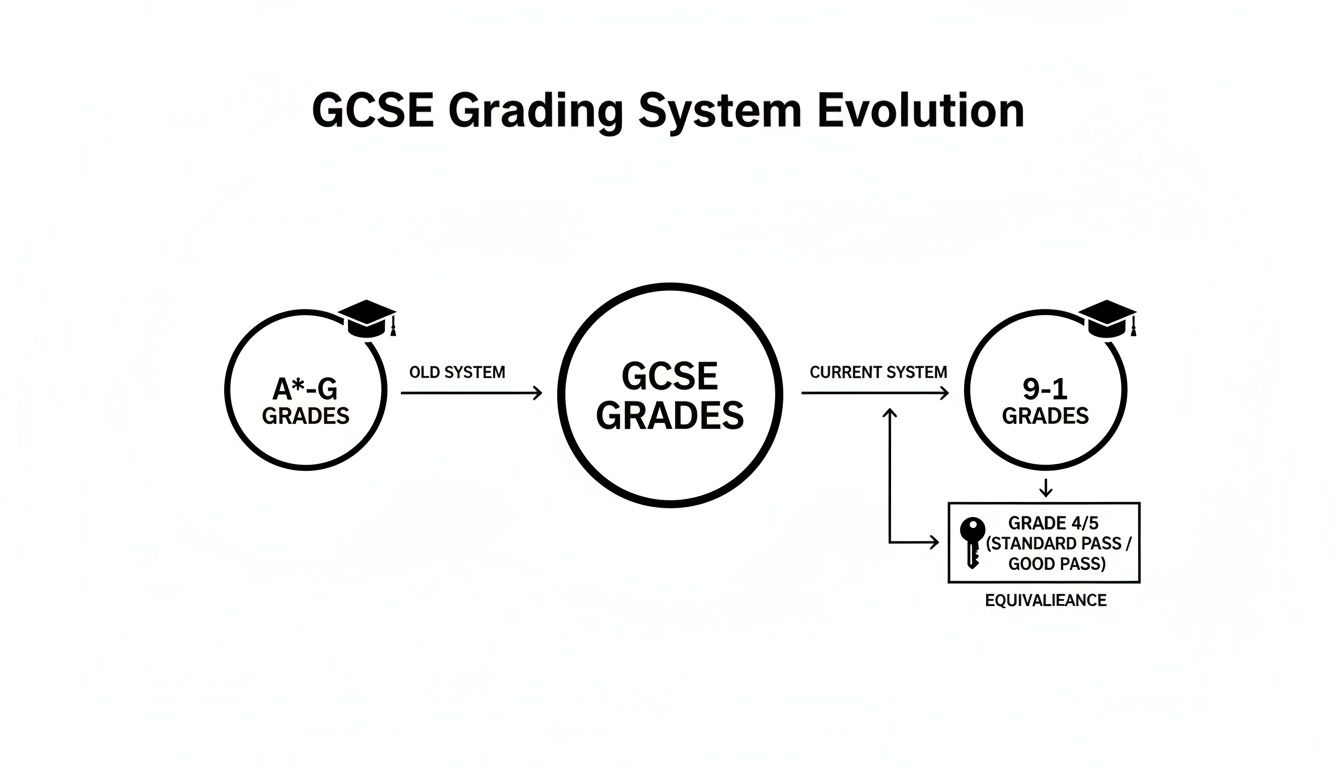
If you’re trying to make sense of the current GCSE grading system, you’ve come to the right place. It can feel like a completely new language, especially if your school days are a while ago and you’re used to the old A* to G scale.
The great news is that it’s much simpler than it looks, and understanding it is the first step towards a brilliant new future for you and your family. Today, GCSEs in the UK are graded on a 9 to 1 scale. Think of it like this: 9 is the top mark you can get, and 1 is the lowest. This guide is here to show you what that means for you as an adult looking to get ahead.
Your Quick Guide to Understanding GCSE Grades
For anyone returning to education, the biggest question is often, “What do these new numbers actually mean for me?” If the last time you saw a GCSE certificate it had letters on it, this new system might seem confusing. But it was actually designed to give a clearer picture of achievement, which is great news for you.
At its heart, the change from letters to numbers allows colleges and employers to see your skills more clearly, especially at the higher end. A grade 9 is now a step above the old A*, rewarding truly exceptional performance. It gives them a much better understanding of your specific abilities and potential.
Decoding the New System
As an adult learner, there are two key numbers you’ll hear about most: 4 and 5. These are the grades that act as the keys to unlocking many future opportunities, from better-paid jobs to higher education.
-
Grade 4 (Standard Pass): This is the modern equivalent of a grade C. Securing a grade 4 in core subjects like English and Maths is the minimum you’ll need for countless jobs, apprenticeships, and entry onto further education courses. It’s the essential foundation that opens the first door.
-
Grade 5 (Strong Pass): This is what’s known as a ‘strong pass’. It sits somewhere between a high C and a low B in the old system. Aiming for a grade 5 is a brilliant move. It makes your CV or application stand out for more competitive roles and university courses, showing you have a really solid grasp of a subject.
To make this even clearer, here’s a straightforward comparison of the new and old grading structures. This table will help you see exactly how your old qualifications stack up or what you should be aiming for now.
GCSE Grades 9-1 vs A*-G At a Glance
| New 9-1 Grade | Old A*-G Grade Equivalent | What This Grade Means for You |
|---|---|---|
| 9 | A** | The highest grade, showing exceptional ability and opening the most doors. |
| 8 | A* | A top grade, equivalent to the previous A*. A fantastic achievement. |
| 7 | A | A solid ‘A’ grade that demonstrates a high level of understanding. |
| 6 | B | A ‘strong pass’, equivalent to a high B grade. A very respectable grade. |
| 5 | C / B | A ‘strong pass’, seen as a key benchmark by universities and employers. |
| 4 | C | A ‘standard pass’, the minimum you need for many career and education paths. |
| 3 | D | Below a standard pass, but a stepping stone to try again and improve. |
| 2 | E / F | A low grade, but don’t be discouraged! This is a starting point. |
| 1 | G | The lowest grade awarded. |
| U | U | Ungraded/Unclassified. |
Seeing the grades side-by-side really helps take the mystery out of the system. The crucial takeaway is that grades 4 and 5 are your modern benchmarks for success and moving forward.
This isn’t just about passing an exam; it’s about proving your capabilities and opening doors that might have seemed closed. The system is well-established, with government statistics showing that around 67.1% of entries achieved a grade 4 or above, confirming it as the national standard.
This new system gives you a clear target to aim for. For many adult learners, achieving these qualifications is a powerful and direct route to their goals. If you’re weighing up your options, you might find it useful to read our guide on what Functional Skills Level 2 is equivalent to.
Why a Grade 4 and Grade 5 Make a Big Difference
Now that we’ve cracked the code of the 9–1 system, let’s focus on the two grades that can really shape your future: the grade 4 and the grade 5. It’s so important to understand what sets them apart, because the difference isn’t just one number—it’s a significant jump in the opportunities that will open up for you.
Think of a grade 4 as the essential key to get you through the front door. This is what the Department for Education officially calls a ‘standard pass’, and it’s the direct equivalent of the old grade C. Nailing this in Maths and English is your ticket to a huge range of jobs, apprenticeships, and further education courses that would otherwise be out of reach.
Unlocking More Doors with a Strong Pass
So, if a grade 4 gets you in the door, a grade 5 lets you access the VIP rooms. Known as a ‘strong pass’, this grade sits comfortably between the old C and B grades. While a grade 4 means you’ve met the benchmark, a grade 5 makes you a much stronger candidate, ready for bigger challenges.
For many employers and university admissions tutors, a grade 5 is a clear signal that you have a deep and confident understanding of a subject. It shows you’re not just capable of scraping by; you’re someone with ambition and a solid foundation.
This isn’t just a number on a certificate—it has real-world power. Pushing for that grade 5 shows a higher level of skill and commitment, which can be the very thing that sets you apart for a competitive job or a popular Access to Higher Education Diploma.
Earning that grade 5 can also do wonders for your confidence. It’s a powerful statement to yourself and future employers that you’re ready for the next challenge. Plus, it sets a brilliant example for your children and family, showing them what’s possible when you put your mind to something.
The Real-World Impact of Your Grades
So, what does this all mean in practical terms? Let’s break down how these two grades can influence your path.
-
Career Progression: Many job adverts list “GCSE English and Maths at grade 4 (or C) or above” as a must-have. But for roles with more responsibility or in competitive fields like healthcare, employers will often look for candidates with grade 5s as a sign of a stronger academic ability.
-
Higher Earnings: It’s a simple fact: stronger qualifications often lead to higher earning potential. Pushing for that grade 5 is a direct investment in your financial future, helping to build more stability for you and your family.
-
University Pathways: While some university courses are happy to accept a grade 4, many of the UK’s top-tier universities and degree programmes (especially for teaching, nursing, and the sciences) will specifically ask for a grade 5 in English and Maths. Achieving it keeps your options wide open for your dream course.
This isn’t about adding pressure—it’s about empowering you to choose your own path. When you know exactly what these GCSE grades mean, you can set clear, ambitious goals. It allows you to aim higher, knowing that a single grade can make a world of difference to your future, making your family proud and proving to yourself what you’re truly capable of.
How Better GCSE Grades Can Boost Your Earnings
It’s easy to think of GCSEs as something you left behind in the schoolyard. But the truth is, those qualifications are far more than just a distant memory—they’re a powerful tool that can directly shape your financial future and give you a real sense of personal achievement.
This is where your effort pays off, literally. Stronger qualifications, especially in core subjects like English and Maths, have a direct and proven impact on how much you can earn over your lifetime. It’s not just about ticking a box; it’s about building a more secure and prosperous future for yourself and your family.

What an Employer Really Sees on Your CV
When a hiring manager scans your CV, good GCSE grades tell a compelling story. They’re not just looking at letters or numbers; they’re looking for proof that you have the essential skills to do a great job.
A grade 4 or 5 in English shows you can write a clear email, understand instructions, and communicate brilliantly with colleagues. That same grade in Maths proves you’re a logical thinker who can manage budgets or understand data.
For an employer, these qualifications show that you:
- Can see things through: You set a goal and had the discipline to achieve it.
- Are ready to learn: You have the foundational knowledge needed for on-the-job training and professional development.
- Are a reliable bet: You are someone who can handle responsibility and deliver results.
As an adult learner, going back to achieve these grades speaks volumes. It shows you’re ambitious, self-motivated, and committed to personal growth—precisely the kind of person every business wants on their team.
The Real-World Financial Impact
The link between education and earnings is undeniable. While your life and work experience are incredibly valuable, passing those key GCSEs can unlock promotions and higher-paying jobs that might currently feel out of reach. Think of it as a key that opens doors to new salary brackets.
For instance, countless skilled trades, healthcare support roles, and entry-level management positions list a grade 4 in English and Maths as a non-negotiable requirement. Pushing for a grade 5 or higher can make you an even more competitive candidate, putting you on a clear path to a better salary.
It’s a simple truth: better qualifications open doors to better jobs with better pay. Taking the time to improve your GCSE grades is one of the most effective ways to increase your lifetime earnings and provide greater financial stability for your family.
This isn’t about pressure; it’s about empowerment. Recent national data shows just how many people are using these qualifications to move forward. Looking at the latest findings on Level 2 results, we can see that students of all backgrounds are successfully achieving these grades. For a motivated adult with access to focused online support, the opportunity to improve your prospects has never been more accessible.
Becoming a Powerful Role Model
The benefits of returning to education go far beyond your payslip. When you commit to improving your skills, you become a source of inspiration for your children, friends, and wider family.
Imagine the pride they’ll feel watching you study, overcome challenges, and succeed. You’re showing them, through your own actions, that it’s never too late to learn and chase your ambitions. You’re not just studying for a certificate; you’re building a legacy of determination and setting a positive example that can inspire your family for generations to come.
Your Pathway to University and Further Education
Have you ever pictured yourself with a degree or a specialised diploma? If that dream feels a little out of reach, we’re here to tell you it’s closer than you think. Your GCSEs are the very first step on that journey, acting as the solid ground you build everything else on.
Whatever your past experience with school was, there is always a path back to education and on to university. It really just comes down to understanding how the system works and what you need to do to get there. Let’s break it down, step by step.
Why Do Universities Care About Your GCSEs?
When you apply to university in the UK, admissions tutors are trying to build a picture of you. While they’ll focus heavily on your A-Levels or an Access to HE Diploma, your GCSEs provide the essential background details.
They’re especially interested in your GCSE English and Maths grades. Why? Because these subjects prove you have the fundamental skills to succeed with degree-level work. They show you can write a well-structured essay, understand complex ideas, and work with information and data—all things you’ll be doing constantly at university, no matter what you study.
- A good English Language grade shows you can communicate well and build a strong argument.
- A solid Maths grade demonstrates logical thinking and problem-solving skills.
Think of it this way: your GCSEs in English and Maths get you through the first checkpoint. Your main qualifications, like A-Levels, get you to the finish line. You need both to succeed.
For most UK universities, a grade 4 or 5 (what used to be a C) in both GCSE English and Maths is a standard requirement. It’s often the first thing an admissions team will check before they even look at the rest of your application.
Choosing Your Next Step: A-Levels or an Access Diploma?
Once you have those key GCSEs under your belt, two main routes open up for getting into university: A-Levels and the Access to Higher Education (HE) Diploma.
A-Levels are the traditional choice. You would typically study three subjects you enjoy in great detail, usually over two years. This is a great path if you have a clear idea of what you want to study at university and want to dive deep into those specific subjects.
The Access to HE Diploma, on the other hand, is designed from the ground up for adults returning to education. It’s a focused, one-year course that’s accepted by over 95% of UK universities. It’s a fantastic route if you’ve been out of the classroom for a while, as it not only covers your chosen subjects but also gets you up to speed on the study skills needed for university life.
Both of these pathways will have their own GCSE entry requirements, which is why getting those grade 4s and 5s is so crucial. They are the key that unlocks the door to these more advanced courses.
You Can Genuinely Do This
It’s completely normal to feel a bit of self-doubt, especially if your school days weren’t the best. But countless adults, in the exact same position as you, have returned to learning and gone on to achieve amazing things.
They’ve shown that with the right support, earning a degree isn’t just a vague possibility—it’s a realistic, achievable goal. It’s not just about getting a certificate, either. It’s about proving to yourself what you’re capable of and becoming an incredible role model for your family. If you’re ready to explore the specifics, our guide on how to get into universities as an adult learner has all the details. Your journey can start today.
What To Do If Your Past Grades Weren’t What You Wanted
So, your school grades weren’t what you’d hoped for. It’s a common story, and it’s easy to feel like those results have closed doors for you. But here’s the good news: those grades are a snapshot from your past, not a life sentence.
As an adult, you’re in a completely different position. You have maturity, real-world experience, and a much clearer idea of what you want to achieve. These are powerful tools you didn’t have as a teenager, and they give you a huge advantage if you decide to return to your studies.
Embrace a Fresh Start with Resits
If old grades are holding you back, the most direct solution is often to resit your GCSEs. This might sound scary, but it’s a world away from the classroom experience you remember. Online courses today are built for busy adults juggling work and family life.
You get to study when it suits you, on your own terms. That flexibility puts you in the driver’s seat, removing much of the pressure. Securing a grade 4 or 5 in key subjects like English and Maths can instantly unlock new career and education opportunities that felt out of reach.
Think of a GCSE resit less as redoing the past and more as upgrading your future. It’s a powerful statement to employers and universities that you’re driven, capable, and ready for what’s next.
Taking this step does more than just earn you a certificate. It builds your confidence, proves to yourself what you’re capable of, and sets a brilliant example of resilience and ambition for your family.
Your Options After Your GCSE Results
It’s completely normal to feel a bit lost when figuring out the next move. The important thing is to understand what your options are so you can choose the right path for you. Here’s a breakdown of some positive, practical steps you can take.
| Your Situation | Recommended Next Step | Why It’s a Great Choice |
|---|---|---|
| You need grade 4s or 5s for a specific job or course. | Resit your GCSEs with an online course. | This is the most direct way to get the exact grades you need, with the flexibility to study around your current commitments. |
| You need to prove your English and Maths skills quickly. | Consider a Functional Skills qualification. | It’s a widely respected alternative focused on practical skills, helping you meet entry requirements for many roles and courses faster. |
| You just missed out on the grades you needed for a course. | Speak directly to the college or sixth form. | It’s always worth a phone call! Admissions tutors can often be flexible, especially for dedicated adult learners. |
| You want to explore career options that don’t need GCSEs. | Look into apprenticeships or vocational training. | These pathways are brilliant for gaining hands-on, practical skills and can lead to excellent careers without the academic route. |
Whatever your situation, there is always a way forward. In recent years, there has been a huge increase in post-16 learners taking and passing GCSEs, proving it’s a popular and successful choice for many adults returning to education.
Taking that first step is the most important part. Whether you’re thinking of resitting a GCSE or exploring a different qualification, you can actively shape your future. If this is a path you’re considering, our guide to GCSEs for adults online offers a much deeper look into how flexible study works.
Frequently Asked Questions for Adult Learners
Thinking about returning to education after some time away? It’s completely normal for that to bring up a lot of questions. We get it. You’re not alone in wondering where to start, so we’ve put together some straight-talking answers to the most common queries we hear from adult learners in the UK.
Do Employers Really Care About My Old GCSE Grades?
This is a question we hear all the time, and the honest answer is: it depends. Of course, your life experience and professional background count for a huge amount, and any good employer will see the value in that.
The best way to think about it is that your experience proves what you can do, while your core qualifications show you have the essential skills to build on. A grade 4 or 5 in English and Maths on your CV is often a non-negotiable baseline for hiring managers. It instantly tells them you can communicate effectively, manage numbers, and think critically – the bread and butter of almost any role in the UK.
But here’s something even more powerful: making the decision to resit your GCSEs as an adult speaks volumes. It shows drive, commitment, and a real desire for self-improvement. That kind of initiative is precisely what makes a candidate stand out and can be the key that unlocks a whole new career path with higher earning potential.
Is It Too Late for Me to Resit My GCSEs?
Let’s get this one out of the way immediately: it is never too late to return to education. That’s a myth that holds too many people back. In fact, adult learners often have a distinct advantage over their younger counterparts.
As an adult, you bring a level of focus and motivation that’s hard to match. You’re not just studying because someone told you to; you’re doing it for yourself, with a clear goal in sight. That sense of purpose can fuel incredible results that might have seemed impossible in your school days.
Forget any old-fashioned ideas about stuffy classrooms. Modern online learning is built for adults, giving you the flexibility to study around your job, family, and life. It’s education that fits you, not the other way around.
You are in the driver’s seat, deciding when and where you learn. So, far from being ‘too late’, this could be the perfect moment to prove to yourself, and everyone else, what you’re truly capable of.
Are My Old A*-G Grades Still Recognised?
Yes, absolutely. If you earned GCSEs with the old A* to G grades, they are still perfectly valid and understood by employers and universities in the UK. Anyone working in recruitment or admissions will know exactly how a grade C, for instance, stacks up against the newer 9–1 system.
Your qualifications haven’t ‘expired’. A grade C is still widely seen as the direct equivalent of a grade 4 (‘standard pass’), which meets the minimum entry requirement for thousands of jobs and further education courses.
The only time you might consider retaking is to give yourself a competitive edge. For certain university degrees or careers like teaching and healthcare, they may ask for a grade 5 (‘strong pass’). In these cases, it’s not that your old grade is invalid – it’s about upgrading it to make your application as strong as it can possibly be.
What Is the Difference Between GCSEs and Functional Skills?
This is a great question, as they are both valuable qualifications that open doors. The key difference is what they focus on.
-
GCSEs are academic qualifications covering a broad curriculum. They are the traditional route to A-Levels and university, making them the ideal choice if you have a degree or a specific academic profession in your sights.
-
Functional Skills are designed to prove your practical, real-world ability in English and Maths. A Level 2 in Functional Skills is equivalent to a GCSE grade 4 (or C) and is a fantastic way to quickly meet the entry criteria for apprenticeships, many college courses, and a wide range of jobs.
You could think of it like this: a GCSE is like learning the entire theory of how a car’s engine works, while Functional Skills is like passing your driving test. One proves deep knowledge, the other proves practical competence. Both are respected, and the right one for you simply depends on where you want to go next.
Are you ready to take that next step and write a new, successful chapter for yourself and your family? At Next Level Online College, we specialise in helping adults like you achieve their goals with flexible online courses.
Explore our recognised qualifications and find your perfect pathway today.