

Thinking about going to university as an adult is a huge and exciting step. With the right preparation and the best qualifications for you, it’s more than just possible. This isn’t about starting from scratch; it’s about building on the life you’ve already lived to unlock better pay and a career you can be genuinely proud of.
Your University Journey Starts Now
Does university feel like something that happens to other people? Maybe school wasn’t for you the first time around, or life just… happened. It’s time to rewrite that story.
Universities aren’t just looking for 18-year-olds. In fact, they actively seek out adult learners because you bring a level of focus and a unique perspective that can’t be taught.
All that experience you’ve gained juggling work, family, and a hundred other things? That’s not a disadvantage—it’s your superpower. It’s given you resilience, fantastic time management skills, and a clear reason why you’re doing this. That kind of motivation is gold dust.
A Brighter Future for You and Your Family
Let’s be honest: a big part of this is about opportunity. A degree can swing open doors to new career paths, promotions, and a big boost to your lifetime earnings. But it’s about more than money; it’s about creating stability and showing your loved ones what’s possible.
Think about the pride you’ll feel on graduation day, and what it will mean to your kids or family. You’ll be living proof that it’s never too late to invest in yourself and chase down a goal. You can’t put a price on that kind of inspiration.
Just thinking about returning to education is the first, and most important, step. It shows you have the courage and ambition to build a better future, and that’s something to be incredibly proud of.
The Path Is Clearer Than You Think
The road to a university place can feel a bit confusing, but there are clear, well-used paths designed specifically for people in your shoes. Here at Next Level Online College, our entire focus is on making that journey feel straightforward and manageable.
We know you need to fit your studies around your life, not the other way around. It’s why our online courses are designed for real people with real commitments. You can see for yourself how our flexible approach to distance learning for A Levels could fit into your schedule.
It’s true that getting a place is competitive. The latest UCAS end-of-cycle data for UK universities shows that acceptances for mature students (aged 21+) saw a slight 2.4% drop, from 52,130 in 2022 to 50,880 in 2023. This just highlights why being well-prepared is so important, and that’s exactly where we come in.
Think of this guide as your personal roadmap. We’re going to break down every single step, from picking your qualifications to writing a brilliant application. Your adventure is just beginning, and we’re here to help you get it right. Let’s get started.
Finding Your Best Pathway to University
So, you’ve decided to go to university. That’s a fantastic, life-changing decision. The next question is, how do you get there? Think of it like planning a big journey—there isn’t just one road, and the best route for you depends entirely on where you are starting from and where you want to go.
There’s no single “correct” way for an adult learner to get into higher education. Your life, work, and family commitments are unique, and your path to a degree should be just as special. The good news is that there are respected, flexible qualifications designed specifically for people in your shoes.
Online A Levels: A Targeted Approach
If you have a very clear idea of the degree you want, online A Levels could be the perfect fit. Many university courses, particularly in the sciences, engineering, or modern languages, have very specific A Level requirements.
Studying A Levels online gives you the freedom to pick and choose the exact subjects you need to meet those entry requirements. This is the ideal route if you need to fill a specific knowledge gap or build a strong foundation in a subject you didn’t take at school. It’s a direct, focused approach that puts you in control.
Access to HE Diplomas: Your Fast-Track to a Degree
But what if you know the career you’re aiming for—like nursing, social work, or web development—but don’t have the typical qualifications? This is exactly where an Access to Higher Education (HE) Diploma is a brilliant choice. It’s a nationally recognised qualification created as a direct launchpad to a university degree.
These diplomas are great for a few key reasons:
- Focused: The modules you study are directly relevant to your chosen degree, so you’re learning what you need from day one.
- Fast: Most people complete their diploma in just one year.
- Respected: UK universities hold Access to HE Diplomas in high regard and regularly make offers to students with them.
Imagine you’re a parent who dreams of becoming a paramedic. An Access to Paramedic Science diploma can be studied flexibly around your family, giving you the precise knowledge that universities are looking for. You can explore the range of career-focused diplomas by taking a look at our Access to Higher Education courses here.
Your past experiences don’t define your future success. Choosing the right qualification now is what truly matters, and it’s a decision that gives you the power to take control of your career and create a better life.
Building Your Foundation First
Sometimes, before diving into an A Level or an Access course, you might need to brush up on the essentials—namely, English and maths. Most universities will ask for a GCSE at grade C/4 or an equivalent qualification in these core subjects.
If you don’t have these, please don’t let it put you off. Qualifications like Functional Skills Level 2 are widely accepted alternatives. They are often much quicker to complete than a full GCSE and focus on the practical, real-world skills you’ll actually use. It’s a superb way to build confidence and tick off those crucial entry requirements.
This flowchart can help you see which path might be the right starting point for you.
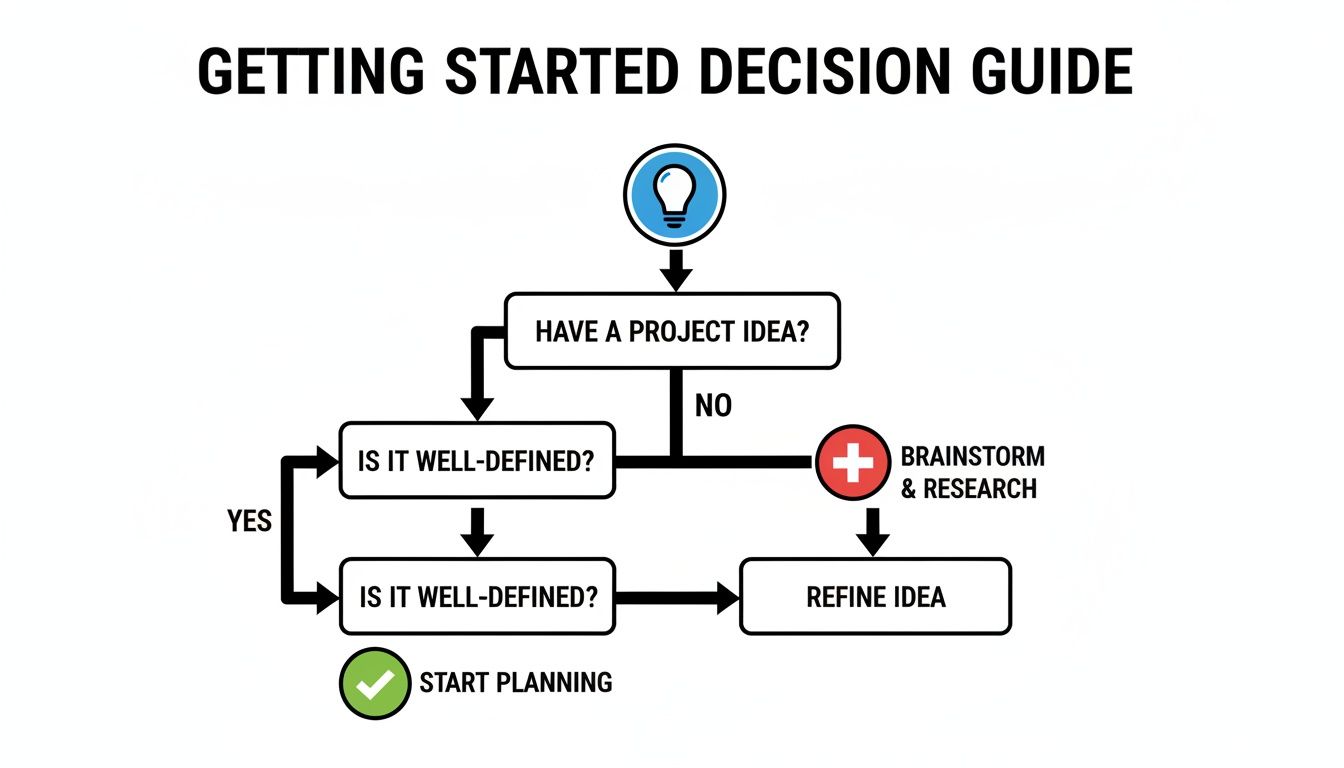
The key thing to remember is that there’s always a clear next step, whether that’s getting your foundational skills sorted or jumping straight into a university-preparatory course.
Which University Pathway Is Right for You?
Choosing between these options can feel a bit confusing, but breaking them down makes it much clearer. This table compares the main qualification routes to help you decide which one works best with your goals.
| Qualification | Best For | Typical Study Time | How It Helps Your Application |
|---|---|---|---|
| Online A Levels | Learners who need specific subjects for a highly competitive degree (e.g., Medicine, Physics). | 1-2 years per A Level | Shows in-depth knowledge in required subject areas. |
| Access to HE Diploma | Learners who know their desired career path and want a fast, direct route to a relevant degree. | 9-12 months | Provides a complete, university-recognised qualification tailored to a specific field. |
| Functional Skills Level 2 | Learners who need to meet the essential English and maths entry requirements before starting a Level 3 course. | A few weeks to a few months | Fulfills the standard GCSE C/4 requirement for most universities and Access courses. |
Ultimately, the best pathway is the one that fits your life and gets you where you want to go efficiently and with confidence.
Choosing a Path That Pays
The qualification you choose doesn’t just open the door to university; it sets the stage for your future earnings. The subject you study has a very real impact on your financial future.
For example, detailed research shows that medical graduates earn an average of £64,700 and economics graduates £49,400 five years after graduating. This is a big jump compared to the £25,900 average for creative arts graduates. You can discover more insights about graduate earnings from the Institute for Fiscal Studies.
For an adult learner, selecting a high-demand subject through a focused course like an Access to HE Diploma in engineering, computing, or health sciences isn’t just an academic choice—it’s a life-changing investment.
This decision is about more than just getting a degree. It’s about building security for your family, providing new opportunities, and becoming a powerful role model for your children. By picking a pathway that leads to a strong career, you’re making a smart move that will reward you for many years to come.
Crafting a Standout UCAS Application
The UCAS application can feel like a huge hurdle, especially when you’re juggling life’s other demands. But let’s look at it differently. It’s not just a form; it’s your first real chance to introduce yourself to universities and show them exactly who you are.
As an adult learner, you have a story that younger applicants simply don’t. Every job, challenge, and responsibility has shaped you into a capable, determined individual. This application is where you prove it.

This isn’t about just ticking boxes. It’s about confidently telling the story of the person you’ve become. Let’s break down how to make every section work for you.
Getting Started on the UCAS Hub
First things first, you’ll need to register on the UCAS Hub. Think of this as your control centre for the entire process. It’s where you’ll fill out your personal details, put in any previous qualifications (it doesn’t matter how long ago you got them), and select up to five university courses.
Choosing your five courses is where the dream starts to feel real. Do your research here. Look into the course modules, check the entry requirements, and get a feel for the university itself. It’s smart to have a mix of choices—some that feel like a stretch and a couple that are more of a sure thing.
Your Personal Statement: Your Secret Weapon
Here it is—the part of the application that truly lets you shine. Your personal statement is your space, all 4,000 characters of it, to tell admissions tutors why you belong on their course. They read thousands of these, but yours will stand out because it’s your genuine story.
Don’t fall into the trap of writing what you think they want to hear. Speak from the heart.
- Why this subject? Get specific. Did your experience in a care home spark a passion for nursing? Did managing the family budget make you realise you have a talent for finance?
- Why now? Tutors are always interested in this. Explaining what’s brought you back to education shows real motivation and a clear sense of purpose.
- What skills do you bring? Connect your life experience to the demands of a degree. Juggling kids and a part-time job isn’t just “life”—it’s proof of exceptional time management and resilience.
This isn’t a school essay. It’s a powerful pitch for yourself, proving you have the passion and strength to succeed. Your journey is your biggest asset, so don’t downplay it.
Your personal statement isn’t just a formality; it’s the heart of your application. It’s where an admissions tutor stops seeing a list of grades and starts seeing a motivated, passionate individual they want at their university.
Securing a Powerful Reference
Every application needs a reference, which can feel tricky if you haven’t been in a classroom for years. Don’t panic; you have excellent options.
If you’re studying an Access to HE Diploma or A Levels with us, this part is simple. Your dedicated tutor knows your academic potential, your work ethic, and your commitment inside and out. They are experienced in writing powerful references that highlight the exact qualities universities look for.
Not currently studying? No problem. Ask a current or recent employer, a manager, or even a supervisor from a volunteering role. The key is choosing someone who has seen you in a professional way and can talk about your skills—things like your reliability, ability to learn new things, and positive attitude. Just be sure to give them plenty of notice and a copy of your personal statement to help them write the strongest reference possible.
Making Your Application Unforgettable
As an adult learner, you bring a perspective that is pure gold to a university. Life experience.
Think about it. A parent returning to study social work already has real-world experience fighting for their family. Someone who has spent a decade in retail has developed communication and problem-solving skills that are perfect for a business degree.
Your application is the place to connect those dots. Frame your past challenges as the very things that have prepared you for university life. This unique perspective makes you a memorable and highly desirable candidate. Our team at Next Level Online College offers personalised guidance on weaving your story into your application. You can learn more about how our expert tutor support can help you craft an application that truly stands out.
Your UCAS application is your first step towards a future with higher earning potential and incredible personal pride. It’s your chance to show your family what’s possible and become the role model you know you can be. You’ve got this.
Making Sense of Student Finance and Support
Alright, let’s tackle the biggest hurdle for most adult learners: money. The question “How can I possibly afford this?” is often the first one people ask. It’s a completely fair question, but here’s the good news: the UK student finance system is specifically set up to help you overcome this barrier.
Try not to think of it as a typical debt. It’s more like a government-backed investment in your future. The whole system is built on a simple, powerful promise: you only start paying it back when you’re earning enough to do so comfortably.
This is your chance to build a more stable, secure life. A degree can open doors to higher-paying careers, and student finance is the key that unlocks that opportunity for everyone, no matter what is in their bank account.
Your Tuition Fees Covered
First up, the Tuition Fee Loan. This loan is paid directly from Student Finance England (or its equivalent in Scotland, Wales, or Northern Ireland) straight to your university. You never even have to handle the money yourself.
It’s designed to cover the entire cost of your course fees, which means you don’t need to find thousands of pounds before you can even start. This loan is available to almost every UK student starting their first degree and isn’t based on your household income.
Help with Living Costs
University fees are just one side of the coin. You’ve still got rent, bills, food, and transport to think about. That’s where the Maintenance Loan comes in.
This loan is for your day-to-day living expenses and gets paid into your bank account at the beginning of each term. The amount you can get depends on a few key factors:
- Where you’ll be living (at home with parents or in other accommodation).
- Your total household income.
- Whether you’re studying in London, where costs are higher.
The goal here is to ease the financial pressure so you can actually focus on your studies instead of constantly worrying about making ends meet.
Worrying about money is a huge barrier for many adult learners. But remember, the student finance system is designed to help you, not hold you back. It’s an investment in your potential and a powerful tool for building a brighter future.
Funding Your Access to HE Diploma
What if you’re not quite ready for a degree and need to take a course like an Access to HE Diploma first? There’s a dedicated funding route for that, too. You can apply for an Advanced Learner Loan to cover the tuition fees for many Level 3 qualifications.
And here’s the brilliant part: if you use an Advanced Learner Loan for your Access to HE Diploma and then successfully complete a university degree, Student Finance England will write off the entire loan. It’s a fantastic incentive designed specifically to help people get the qualifications they need to move forward.
Extra Support When You Need It Most
As an adult learner, you often have more responsibilities than a typical school leaver. Thankfully, there’s extra, non-repayable support available based on your circumstances.
You might be able to get grants (which you don’t pay back) such as:
- Parents’ Learning Allowance: Extra help for students who have dependent children.
- Childcare Grant: Specifically to help with childcare costs.
- Adult Dependants’ Grant: If another adult relies on you financially.
- Disabled Students’ Allowance (DSA): This isn’t for your living costs but covers extra study-related expenses you might have because of a disability.
These grants ensure that personal circumstances don’t prevent you from having a fair shot at succeeding in higher education.
It’s encouraging to see that these pathways are making a real difference. While gaps still exist, university entry rates show genuine progress. In 2023, a record 35,920 18-year-olds from England’s most deprived areas were accepted into university, a 6.4% increase. This proves that structured routes, like the ones we offer, genuinely help level the playing field. You can learn more about how entry to higher education is changing/entry_to_higher_education).
Preparing for University Interviews and Offers
Getting that interview invitation is a huge moment. It’s the university saying, “We’ve read your application, and we’re impressed.” Your personal statement has done its job, and now it’s time for the final, personal touch.
Think of it less as a formal test and more as a two-way conversation. It’s their chance to see the passion and determination behind the paperwork, and it’s your chance to confirm that this course and university are the right fit for you. A bit of focused preparation is all it takes to walk in there feeling calm and confident.

Nailing the University Interview
Whether you’re logging in for a video call or meeting them on campus, the goal is the same: be prepared, but most importantly, be yourself. They’ve already seen your qualifications; now they want to get a sense of your personality and motivation.
The best way to feel ready is to think through some likely questions. You don’t need to memorise scripts—in fact, please don’t!—but having some solid points in mind will make all the difference.
- Why this course? Go deeper than the title. Point out a specific module that caught your eye or explain exactly how this programme connects to your long-term career plans.
- Why this university? What makes it stand out for you? Maybe it’s a leading academic in your field, a unique research facility, or its fantastic reputation for student support. Show them you’ve done your homework.
- What can you bring to the university? This is where you, as an adult learner, have a huge advantage. Talk about the resilience you’ve built, the time management skills you learned juggling work and family, or the real-world problem-solving experience you have.
An interviewer will be far more interested in a story about how you handled a complex project at work than a vague memory from your school days. Your life experience is your superpower here.
Understanding Your Offers
After the interviews, the waiting game begins. Before you know it, offers will start appearing in your UCAS Hub. They usually come in two types, and it’s important to know the difference.
- Conditional Offer: This is the standard offer. It means they’re offering you a place, as long as you achieve certain grades in your current qualifications, like your A Levels or Access to HE Diploma.
- Unconditional Offer: This is fantastic news. It means you’ve already met all the academic entry requirements, and the place is yours if you choose to accept it. It’s a real sign of confidence from the university.
Once you have your offers, you’ll need to make your selections. You’ll pick a ‘firm’ choice (your top pick) and an ‘insurance’ choice (your backup, which should ideally have lower grade requirements).
An interview is your opportunity to show the real you. Your life experience isn’t something to hide; it’s the very thing that makes you a strong, motivated, and valuable student. Be proud of your journey and let that passion shine through.
What If Things Don’t Go to Plan?
Sometimes, despite your best efforts, you might not get the offers you hoped for, or you might have a change of heart. Don’t panic. This is far from the end of your university journey. UCAS has excellent systems in place for this exact scenario.
If you don’t receive any offers or you decide to decline those you have, you may be eligible for UCAS Extra. This service opens up and allows you to apply to more courses, one at a time, until you land an offer you’re happy with.
Alternatively, if results day doesn’t go your way and you miss the grades for your firm and insurance choices, you’ll be automatically entered into Clearing. Clearing is a brilliant system where universities advertise their remaining places. It can feel a bit frantic, but countless students find their perfect course through Clearing every single year.
No matter what happens, there is always a path forward. The final hurdles are all about staying positive, being prepared, and trusting that you have everything it takes to succeed. This is your future you’re building—it’s time to get excited.
Your University Questions Answered
Thinking about university after a break can feel like a huge step, and it’s totally normal for a million questions to pop up. When you’re trying to figure out how to get back into education, the “what ifs” can seem endless. We’ve been there, and we’ve heard these same questions from countless adult learners. Let’s clear up some of the most common ones.
Are My Old School Qualifications Still Valid?
In most cases, yes, they absolutely are. Universities look at the bigger picture of who you are, and your old qualifications are part of that story.
That said, they will want to see proof that you’re ready for academic study now. This is where a qualification like an Access to HE Diploma or new A Levels comes in. They show you’ve got the current skills and commitment to succeed. If you’re worried about old GCSEs in core subjects, don’t be. A Functional Skills Level 2 qualification in maths or English is a widely accepted equivalent and can be completed much more quickly, ticking that box for your application.
Can I Study At University Part-Time?
Absolutely. In fact, most UK universities have a fantastic selection of part-time degrees, designed specifically for people juggling work, family, and other commitments. You get the same degree and quality of teaching as a full-time student, just paced in a way that fits your life.
Better yet, student finance is available for part-time courses too, which makes it a really popular and manageable option for adult learners. It’s all about finding a degree that works for your life, not the other way around.
“Your life experience is not a gap in your CV; it’s a foundation of skills, resilience, and motivation that makes you a stronger student. Universities recognise this and welcome the unique perspective you bring.”
This is a serious investment in your future, and the financial returns are very real. In 2023, the average starting salary for a UK graduate was around £27,000, jumping to over £34,000 in high-demand fields like tech. Over a lifetime, that degree could add more than £100,000 to your earnings, creating a more secure future for you and your family. Discover more insights about graduate earnings from HEPI.
Is It Harder to Get in as a Mature Student?
Honestly, not always. While some courses are competitive, universities actively look for the value that mature students bring. Your real-world experience, professional background, and clear focus on your goals can make your application shine.
Admissions tutors see that drive and commitment as a massive plus. With the right prep course and a personal statement that tells your story with pride, you become an incredibly strong candidate—the kind they are excited to have in their lecture halls.
What Support Is Available for Adult Learners at University?
You’re never on your own. Universities have incredible support systems in place to help you do well. Once you’re in, you’ll find a whole network of services, including:
- Dedicated mature student advisors who really get the challenges you might be facing.
- Financial aid teams to help with budgeting, loans, and bursaries.
- Academic skills centres for workshops on everything from essay writing to referencing.
- Wellbeing and counselling services for private support when you need it.
- Childcare support and even on-campus crèches at many universities.
From day one, you’re part of a community that wants you to succeed. Deciding to go back to education is a powerful move, not just for your career, but for showing your family what’s possible with a bit of hard work and courage.
You’ve got the ambition. At Next Level Online College, we provide the supportive, flexible pathways to turn your university dream into a reality. Our online courses are designed for real life, helping you get the qualifications and confidence you need to take that next step. Explore our courses today and start building your brighter future at https://nextlevelonlinecollege.com.