
Passing your Functional Skills Maths Level 2 exam is all about using practical, real-world maths to solve problems you’d actually come across in daily life. It’s not about difficult algebra or complicated sums you'll never use again. To get that pass certificate, you need a smart study plan that fits around you, a good understanding of the three main topics, and some clever exam tips.
This guide will give you the confidence and the clear steps to get there.
Why Passing Maths Is Your Key to a Brighter Future
It’s completely normal to feel a bit nervous about a maths exam, especially if it’s been a while since you were last in a classroom. But take a moment and just imagine the incredible pride you'll feel when you can turn to your family and say, "I passed!"
This isn’t just about getting another certificate. It’s about unlocking a future full of wonderful possibilities that might have felt out of reach.
Passing Functional Skills Maths Level 2 is your direct path to achieving those big goals. It's a widely respected qualification, equivalent to a GCSE grade 4 (or C), and it can be the key that opens doors to university, a better-paying job you actually enjoy, and a huge sense of personal achievement.
Become a Role Model for Your Children
Think about what this means for your kids. When they see you taking on a challenge and succeeding, you teach them a powerful lesson about determination that no school ever could. You become their real-life inspiration, showing them it’s never too late to learn and grow.
Your success will encourage them to chase their own dreams, both in school and in life. This is your chance to build a legacy of confidence and ambition in your family for generations to come.
"Passing this exam is more than just a grade. It's proof to yourself and your children that you can achieve anything you set your mind to."
Open Doors to Better Careers and Higher Pay
Let's be honest: having more money makes a massive difference to family life. A Level 2 maths qualification is a must-have for thousands of jobs and apprenticeships across the UK. It proves to employers that you have the practical, real-world skills to handle tasks like managing budgets, understanding data, and solving problems.
This one qualification can:
- Boost your earning potential: Many jobs with higher salaries list this level of maths as essential.
- Unlock promotions: It can be the very thing you need to move up in your current company.
- Open up new career paths: It gives you the green light to apply for jobs you previously couldn't, helping you find a fulfilling career where you can make a real difference.
To pass, you need to get comfortable with three main areas. This table shows what they are and how they apply to real life, giving you a clear picture of what to focus on.
Your Quick Guide to Passing the Maths Level 2 Exam
| Core Topic Area | What It Covers | Why It's Important for Real Life |
|---|---|---|
| Using Numbers and the Number System | Fractions, decimals, percentages, ratios, and using them in real-life situations. | Working out a household budget, calculating a 20% discount on a sale item, or splitting a bill with friends. |
| Using Measures, Shape, and Space | Area, perimeter, volume, changing between units (like cm to m), and reading plans. | Figuring out how much paint you need for a room, converting a recipe from grams to kilograms, or planning a journey. |
| Handling Information and Data | Averages (mean, median, mode), range, creating and reading charts and graphs, and basic probability. | Understanding news reports, tracking your monthly spending, or figuring out the chances of a rainy day for a family BBQ. |
As you can see, this isn't about maths for maths' sake. It's about giving you the practical skills that make life easier and open up new opportunities to transform your life.
Your First Step to Success
It’s so important to know you’re not alone if you find this exam challenging. National data shows that not giving up is key. For example, the pass rate for some exam boards can be around 32% on a first attempt, but this jumps to 48% for learners who resit. This proves that determination really does pay off.
You can find more helpful tips in our guide on what Functional Skills Level 2 is equivalent to.
With the right support and a clear, simple plan, success is absolutely within your grasp. Knowing how to pass is all about understanding what to expect and believing you can get there. This guide is here to show you exactly how.
What to Expect from the Maths Level 2 Exam
Taking on a maths exam as an adult can feel like a huge challenge. But let’s take a closer look, because the Functional Skills Maths Level 2 exam isn’t designed to trick you with hard sums. It’s all about practical, real-world maths.
Knowing what the exam actually looks and feels like is a massive step towards passing. It takes away the fear of the unknown and lets you walk into that exam room feeling prepared and in control. This is all about building your confidence, so you can show your family, and yourself, exactly what you’re capable of.
Breaking Down the Exam Structure
The exam is usually split into two parts: one where you can use a calculator, and one where you can’t. This is nothing to worry about. The non-calculator paper tests the kind of quick mental maths you probably do every day without even thinking about it, like working out your change or splitting a bill.
Each exam board, like City & Guilds or Pearson, has a slightly different format, but they all test the very same core skills. The questions are always based on situations you could genuinely face in day-to-day life. It helps to think of it less as a formal test and more as a series of small, practical puzzles to solve.
For example, a typical question might ask you to:
- Figure out the best value deal between two different-sized boxes of cereal at the supermarket.
- Calculate how many tins of paint you need to buy to decorate a room.
- Read a graph showing energy usage and explain what it means.
The Three Pillars of Functional Skills Maths
The whole exam is built on just three key topic areas. You don’t need to be a maths genius, but getting a solid grip on each one is how you’ll earn that pass certificate. These are the skills that employers and universities value so highly because they’re genuinely useful.
1. Using Numbers and the Number System
This is your foundation. It’s everything to do with numbers themselves—from the basics of adding and subtracting to working with fractions, decimals, and percentages. It’s the maths behind managing your weekly budget or figuring out how much you’d save in a 20% off sale.
2. Using Common Measures, Shape, and Space
This part is all about applying maths to the physical world. It involves measuring things like length, weight, and capacity, and understanding 2D and 3D shapes. You’ll use these skills when working out if a new wardrobe will fit, converting a recipe from grams to ounces, or reading a map to plan a family trip.
3. Handling Information and Data
This is about making sense of information when it’s presented in charts, graphs, and tables. It includes skills like working out averages (the mean and median), understanding basic probability, and drawing simple conclusions from data. It’s the skill you use every time you try to understand a news report about statistics or track your progress on a fitness app.
The exam is not about memorising difficult formulas. It’s about applying common-sense maths to solve problems. Every mark you pick up for showing your workings is another step towards that pass certificate.
Understanding How You Get Marks
One of the most reassuring things about the Functional Skills exam is that you can get marks even if you don't get the final answer right. The examiners want to see your thought process. By writing down your steps—what’s called ‘showing your working’—you’re proving you understand the method, which is a fantastic way to collect valuable points.
The pass mark itself isn't a fixed target; it changes slightly for each paper to ensure fairness, no matter how hard a particular exam is. Generally speaking, the pass mark for Functional Skills Maths Level 2 is around 55% to 60%.
That means you don’t need to be perfect. You just have to show a good, solid understanding of the main skills, which makes passing feel much more achievable.
Building a Study Plan That Fits Your Busy Life
You're already juggling work, family, and a hundred other things. The last thing you need is a strict, unrealistic study plan that feels like another chore. A good plan isn’t about finding huge blocks of free time you don’t have; it's about making your study time work for you, no matter how busy life gets.
Getting a plan that fits your life is the first step towards that feeling of pride when you pass. It’s about building a small, achievable habit that will lead to a huge reward—a new career, a place at university, and the chance to be an incredible role model for your children.
Finding Your Strengths and Weaknesses
Before you start revising, you need to know where to focus your energy. Wasting time on topics you already understand is a common mistake. Instead, take a moment for a simple, honest self-check.
Grab a piece of paper and list the main topic areas: Numbers, Measures, and Data. Now, rate your confidence for each one on a scale of 1 to 5. Be honest with yourself—this is just for you.
- 1 – "I have no idea where to start." This is a priority topic.
- 3 – "I remember some of this, but I'm a bit rusty." This needs practice.
- 5 – "I feel pretty confident about this." You can look at this topic later.
This simple exercise gives you a personal roadmap. It shows you exactly where your time will make the biggest difference, helping you study smarter, not harder.
This graphic breaks down the three main pillars of the exam, helping you see how everything fits together.
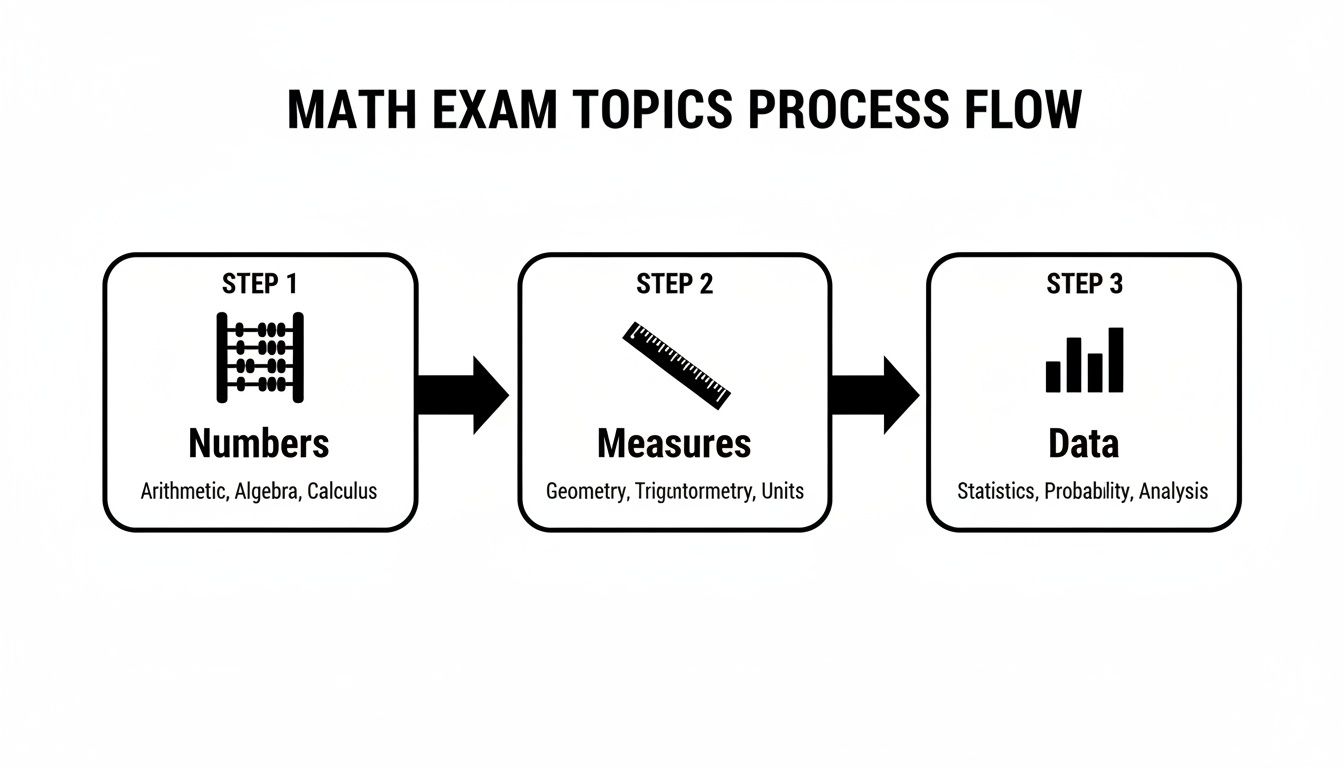
This process shows why a solid plan that touches on every topic is the key to passing your maths exam.
The Power of the 'Little and Often' Approach
Many people think studying means locking yourself away for hours, but for busy adults, that’s just not realistic. The most effective method by far is the 'little and often' approach. Just 20 focused minutes a day can be far more powerful than a stressful, two-hour cramming session once a week.
Think about the small pockets of time in your day. Could you spend 20 minutes on a practice app on the bus? Or work through a couple of problems after the kids are in bed?
A study plan isn't a strict schedule you must follow perfectly. It's a flexible guide that helps you turn small, consistent efforts into real progress and lasting confidence.
This approach stops studying from feeling overwhelming. It becomes a manageable part of your routine, like making a cup of tea. Consistent, short bursts of revision help move information from your short-term to your long-term memory, which is exactly what you need for exam day. An organised online course can provide the perfect structure for these short sessions. Our Functional Skills Maths online course is designed for this exact approach.
Covering All Your Bases
Focusing only on your strong points or favourite topics is a trap many people fall into. It's vital to cover everything because the exam tests your knowledge across all topics. Recent information from City & Guilds showed that around 10% of candidates scored fewer than 10 marks—a clear sign that their revision hadn't covered the full range of topics.
The same data showed much better results for learners in work-based training, where pass rates for first-time attempts were as high as 51%, suggesting that applying maths to real situations helps it stick in your mind.
Your study plan should build in time for everything, even the topics you find tricky. Start with your priority areas from your self-check, but make sure you regularly revisit everything else. This ensures there are no surprises on exam day and gives you the best possible chance to collect marks across the entire paper.
Mastering the Exam with Smart Techniques
Walking into the exam hall feeling prepared is half the battle won. This isn’t just about knowing the maths; it’s about knowing how to pass the exam. With a few smart techniques under your belt, you can turn potential panic into points on the board.
Think of these strategies as your secret weapons. They're designed to help you stay calm, manage your time well, and make sure the examiner can see everything you know. Mastering them is a huge step toward holding that pass certificate and making your family incredibly proud.
Decode the Question and Find the Clues
One of the biggest hurdles in the Functional Skills exam often isn’t the maths itself—it’s those long, wordy questions. They can feel overwhelming, but there’s a simple trick to cut through the noise. It’s called the RUC-SAC method, and it will quickly become your best friend.
Think of it as a mental checklist to run through for every single question, making sure you’ve understood what’s really being asked. Here’s how it works:
- Read the question carefully. Don’t just skim it.
- Understand what it wants you to do. What is the final goal?
- Choose the right maths to use. Is it percentages, area, or an average?
- Solve the problem step-by-step.
- Answer the question clearly.
- Check your work. Does the answer make sense in the context of the question?
Using this method brings a sense of calm and clarity. It breaks a big, scary problem down into small, manageable steps, giving you a clear path to the answer. More importantly, it stops you from rushing and making simple mistakes that can cost you marks.
Make Your Calculator Work for You
Your calculator is a tool, but it's only as good as the person using it. Don't wait until exam day to get to know yours. Make sure you spend time during your revision practising with the exact calculator you’ll be using in the real exam.
Get comfortable with the key functions you'll definitely need, like:
- Calculating with fractions
- Working out percentages
- Using the square and square root buttons
A really common mistake is typing numbers in too quickly and hitting the wrong button. Always take a moment to double-check what you’ve typed on the screen before you press the equals sign. A simple typo can easily cost you precious marks.
Your calculator is there to save you time and reduce stress, but only if you are in control of it. A few hours of practice with it beforehand can make a world of difference on exam day.
Don't Leave Marks on the Table
One of the most encouraging things about this exam is that you get marks for your method, not just the final answer. This is called showing your working, and it’s a golden opportunity to pick up points.
Even if you make a small slip-up and get the final number wrong, showing your step-by-step thinking proves to the examiner that you knew how to approach the problem. This can absolutely be the difference between a pass and a fail.
Always write down every calculation you do. Imagine you're explaining your thinking to someone. This simple habit can secure you a significant number of marks, even on questions you find tough.
Manage Your Time Like a Pro
Time pressure is a huge source of anxiety for many learners, but the key is to go in with a plan. A typical paper gives you around two minutes per mark. So, for a 3-mark question, you should aim to spend about six minutes on it.
If you find yourself stuck on a question and the clock is ticking, don’t panic. Circle it, move on, and come back to it later. It's much better to get marks on questions you can do than to waste all your time on one you can't.
And remember, the pass mark for the Functional Skills Maths Level 2 exam is usually between 50% and 60%. You don't need to get every single question right to pass. Your goal is to collect as many marks as you can across the entire paper. Keeping this in mind takes the pressure off and helps you stay focused.
By using these techniques, you’re not just learning maths. You’re learning how to be a smart, strategic test-taker. This is how you walk out of that exam hall with your head held high, ready for the next chapter.
You Are Not Alone on This Journey

Starting a course like this, especially when you’re trying to fit it around work and family, can feel a bit lonely. It’s completely normal to feel nervous or even overwhelmed at times. But we want you to know one thing for sure: you are not on your own.
Imagine hitting a wall with a tricky maths problem and having someone you can turn to for a clear explanation. Or just needing a bit of encouragement when your motivation dips. That's the kind of support we're talking about, and it's exactly what we're here to provide.
Support That Actually Understands Adult Learners
We get it. As an adult learner, you need more than just a textbook and a deadline. You need real people who understand the pressures of juggling study with life, and who are genuinely invested in seeing you pass.
That’s why our online courses are built around a powerful support network. When you join us, you’re not just enrolling; you’re connecting with a team that truly understands and cares.
"Support isn't just about answering maths questions. It’s about having someone in your corner who believes in you, especially on the days when you might not believe in yourself."
This is what turns a challenging goal into an achievable reality. It's the key to not only passing your Functional Skills Maths Level 2 exam but also building the confidence to chase that university place or new career you’ve been dreaming of.
Your Next Level Support System
Here's a quick look at the dedicated support you'll receive as a learner with us.
| Support Type | What It Means for You |
|---|---|
| Dedicated Tutors | You get a subject-specialist tutor who can explain tough topics in a simple, clear way. They’re there to answer your questions and guide you every step of the way. |
| Flexible Online Lessons | Our courses have clear, bite-sized lessons you can access anytime, anywhere. This means you can study on your terms, fitting learning around your family and work. |
| Wellbeing and Pastoral Care | We know your mindset is just as important as your maths skills. Our pastoral team is here to offer encouragement and support your wellbeing, helping you stay motivated. |
| A Supportive Community | You’ll be part of a community of other adult learners who are on the exact same journey. Sharing experiences with people who know what it’s like is a huge confidence booster. |
This complete system means you're never left to figure things out alone. Instead of feeling isolated, you feel connected, supported, and ready to succeed. To see how this works in practice, you can learn more about our expert tutor support and the real difference it makes.
Making That Goal a Reality
Let's be honest, this isn't just about getting a qualification. It’s about opening doors to a future you and your family deserve. A future with a better-paid, more fulfilling career. A future where you can proudly show your kids you went back to education and smashed your goal.
Our entire approach is built to help you get there. With structured lessons, expert guidance, and a whole team cheering you on, that pass certificate is closer than you think. You’ve got the drive; we’ve got the support to make it happen.
A Few Common Questions Answered
Thinking about taking on a new qualification always brings up questions. It’s a big step, especially when you’re balancing it with work and family, so let’s tackle some of the common worries we hear from people just like you. Getting straight answers is the first step toward feeling confident about your choice.
This isn't just about passing a test; it's about opening doors to a better job, getting into university, and showing your family what’s possible when you decide to go for it.
How Long Does It Take to Pass Functional Skills Maths Level 2?
This is one of the first things everyone asks, and the honest answer is: it really depends on you. The journey can take anything from a few weeks to a few months. It all comes down to the time you can realistically put aside and how much of a maths refresher you feel you need.
Some learners just need to brush up on a few topics and can be ready for their exam in as little as four weeks. Others prefer to take things at a gentler pace, spending a few months building their knowledge and confidence. The brilliant thing about an online course is that you are in control. You decide the schedule that works around your life, not the other way around.
The goal isn’t speed; it’s steady progress. Even just 20-30 minutes of focused study a few times a week makes a huge difference and keeps you moving forward.
What Is the Pass Mark for the Exam?
Lots of people worry about this, but it’s more straightforward than you might think. There isn’t one magic number for the pass mark. It shifts slightly for each exam paper to keep things fair for every single person, no matter which version of the test they sit.
As a general rule, though, the pass mark for Functional Skills Maths Level 2 usually lands somewhere between 50% and 60%. On an exam worth 60 marks in total, that means you’d likely need around 30 to 36 marks to secure your pass. This is exactly why showing your working is so critical—every single mark counts and gets you closer to that certificate.
It just goes to show you don't need to be perfect! The aim is to demonstrate a good, solid understanding of the topics, which makes passing feel much more achievable.
What Happens If I Fail the Exam?
First of all, please try not to let this worry you. It is very common for people not to pass on their first attempt, and it says absolutely nothing about your ability to succeed. In fact, many learners find that their first go at an exam is an incredible learning experience that pinpoints exactly what to focus on for next time.
If you don't pass, you can simply book a resit. We will be right there with you to help you:
- Understand which specific areas need a bit more work.
- Get extra practice materials and guidance where you need it most.
- Build your confidence back up so you feel ready to give it another shot.
Remember, not giving up is everything. Many successful learners get their pass on the second or even third try. Think of it as just a small bump in the road on your way to a much bigger goal, like getting that university place or landing a better-paying job.
Is Functional Skills Maths Level 2 the Same as a GCSE?
Yes, it is. A Functional Skills Maths Level 2 qualification is widely recognised by employers, colleges, and universities as being equivalent to a GCSE grade 4 (or a C in the old system). It’s a respected and valuable qualification that proves you have the practical, real-world maths skills needed to get ahead.
Many adults actually prefer this route because the content feels more relevant to everyday life. It focuses on the kind of problem-solving you’ll genuinely use, from managing a budget to making sense of statistics. That’s exactly why it’s so effective at opening doors to new opportunities.
You have the ambition to build a better future, and with the right kind of support, you can absolutely make it happen. Next Level Online College is here to give you the flexible courses and expert guidance you need to succeed.
Start your journey and enrol on a Functional Skills course today!