
Some evenings, after work is done and the house finally goes quiet, you may find yourself thinking about a different future. One where your job means something human. One where you help women and families through one of the biggest moments of their lives. One where your children see you study, keep going, and build a new career with courage.
If that sounds like you, you are not being unrealistic. You are not too late. And you do not need to have followed a perfect school path to start.
Many adults who look into access to higher education in midwifery feel two things at once. They feel hopeful, and they feel scared. Hopeful because midwifery is a career with purpose. Scared because university can seem far away when you have been out of education for years, do not have A Levels, or are already carrying the weight of work, bills, and family life.
That is exactly why the Access to Higher Education Diploma exists. It gives adult learners a proper route into university study. It turns a big dream into smaller, manageable steps.
Your Dream of Becoming a Midwife is Closer Than You Think
A lot of adult learners begin in the same place. They have a strong sense of care for people. They want stable work. They want to do something that matters. But they also worry that they have missed their chance.
You might be working in care already. You might be in a job that pays the bills but leaves you drained. You might be a parent who put your own goals on hold for years. None of that closes the door.

Midwifery is not just a job title. It is a role built on trust, care, calm thinking, and compassion. Adult learners often already have many of these strengths from life itself. Raising children, supporting relatives, handling pressure at work, and starting again after setbacks all build resilience.
Your life experience counts
Universities do not only look at school history. They also look for people who can cope with challenge, communicate well, and stay committed.
That matters in midwifery. Families need someone who can listen carefully, stay kind under pressure, and act with professionalism. Those qualities often grow stronger with age and experience.
Key takeaway: Needing a different route into university does not mean you are less capable. It means you are taking the route that fits your life now.
This can change more than your job
For many adults, studying is about more than getting a qualification.
It can mean:
- Showing your children what determination looks like when things feel hard
- Building a better future through a career with real meaning
- Growing your confidence again after years of putting yourself last
- Creating fresh options instead of feeling stuck in the same pattern
That is why this path matters so much. It is not only academic. It is personal.
When you start an Access course, you are not pretending life is easy. You are deciding that your goals still matter, even with real responsibilities around you. That decision alone is powerful.
What is an Access to Higher Education Diploma in Midwifery
Think of this diploma as a university preparation toolkit. It is a Level 3 qualification designed for adults who want to go to university but do not have the usual entry route, such as A Levels.
For aspiring midwives, it gives you the subject knowledge and study skills needed before a degree. It is not a random collection of lessons. It is built to prepare you for higher education properly.
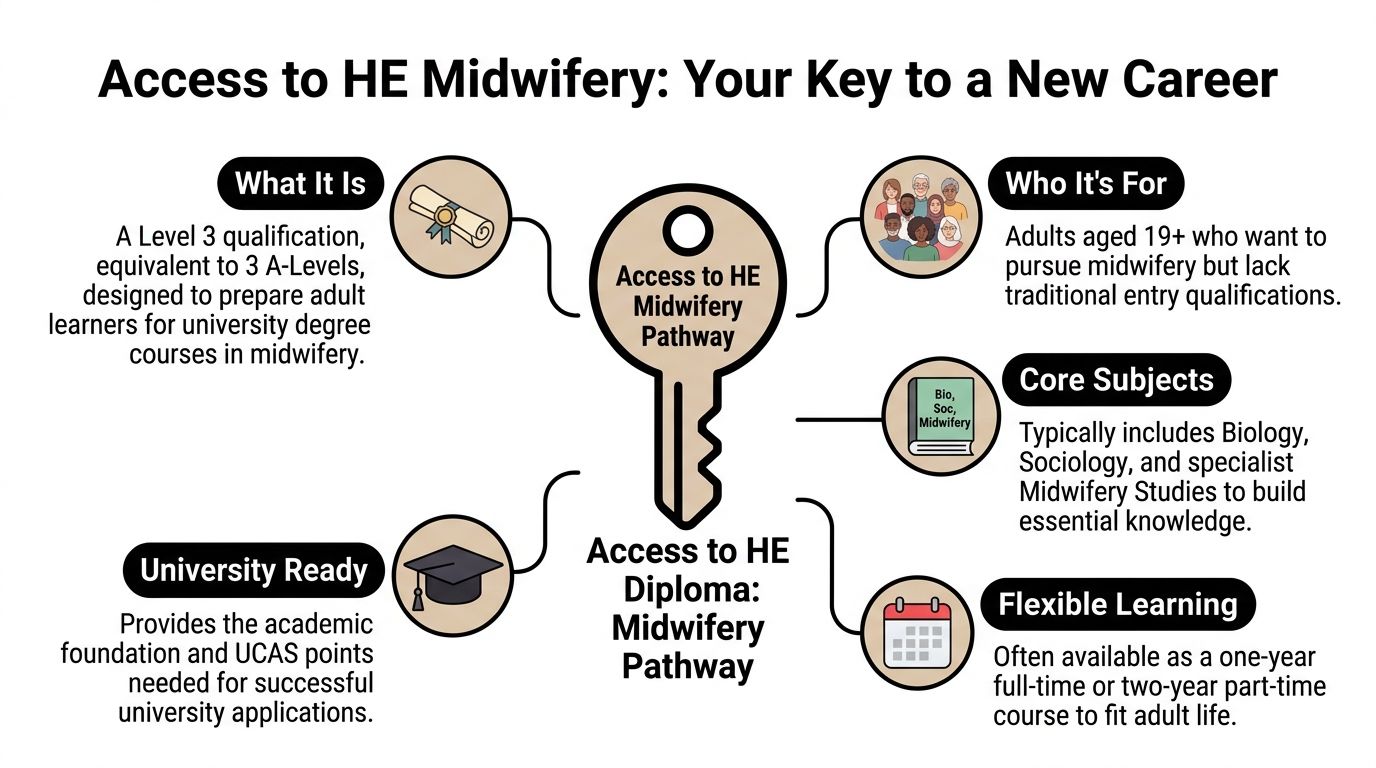
According to the Access to Higher Education Diploma Midwifery course details from learndirect, the qualification requires 60 credits at Level 3, including 45 graded credits from academic subjects, and learners who complete this pathway often experience a high progression rate to midwifery BSc (Hons) programmes at UK universities.
What the credits mean
The word credits can sound confusing at first. Keep it simple.
You complete units across the course, and those units add up to 60 credits. Some are graded, and some are not.
Here is the basic structure:
| Part of the diploma | What it means |
|---|---|
| 45 graded credits | These come from academic subjects and affect your final grade |
| 15 other credits | These support your learning and help prepare you for study at this level |
The graded part matters because it helps show universities how well you performed. Your final grades are usually given as pass, merit, or distinction.
What subjects do you study
The exact unit titles can vary by provider, but the core focus is clear. Midwifery Access courses usually include subjects linked to health and human development.
Common areas include:
- Biological Science so you can understand the body and basic health science
- Health Studies to build knowledge of care, wellbeing, and healthcare settings
- Psychology to help you understand behaviour, emotion, and human development
- Sociology so you can explore families, society, and the wider factors that affect health
There is also often a Research Topic or study skills element. This is important because university learning asks you to read carefully, think independently, and write clearly.
Why this route suits adult learners
This diploma is made for people who are returning to learning. It does not assume you have followed a straight line from school to college to university.
Instead, it helps you build from where you are now.
That includes learning how to:
- Read academic material without feeling overwhelmed
- Write assignments in a structured way
- Research properly and use evidence
- Manage your time across study and home life
If you want a broader look at how these diplomas work, this guide to an Access to HE diploma online gives a helpful overview of the pathway.
Tip: Many adults worry they are “not academic enough”. Access courses are designed to teach you how to study, not just test what you already know.
Is it recognised by universities
A proper Access to HE Diploma is regulated and designed as a real route to higher education. That matters because your next step is a midwifery degree, not just finishing a course for its own sake.
The goal is clear. You complete the diploma, gain the right profile of credits and grades, and use that to apply for university.
That makes access to higher education in midwifery a practical route, not a second-best one. For many adults, it is the route that finally makes university possible.
Are You Ready Checking the Entry Requirements
This is the part that makes many people nervous.
They ask, “What if I am not qualified enough to start?” That fear is common, especially if school did not go well the first time or if life got in the way.
The good news is that entry requirements are usually straightforward. Also, if you are missing something, there is often a clear way to sort it out.

The usual starting point
According to the Skills and Education Group Access diploma specification, learners applying for an Access to HE Diploma typically need GCSE English and Maths at grade 4/C or Functional Skills Level 2 equivalents. The same source notes that integrated study skills units can significantly improve success rates, and that a relatively small percentage of applicants aged 25 and over hold traditional A Levels.
That should tell you something important. This route exists because many adult learners do not come in with the standard school profile.
If you do not have GCSEs
This is not the end of the road.
Many adults need to sort out English, maths, or both before moving on. That is a normal part of returning to education. It does not mean you have failed. It means you are building the foundation properly.
Functional Skills Level 2 is often accepted as an equivalent for this stage. If that term feels unfamiliar, this explanation of what Functional Skills Level 2 is equivalent to can help make it clearer.
A simple way to check where you stand
Use this quick checklist.
| Question | If your answer is yes | If your answer is no |
|—|—|
| Do you have English at GCSE grade 4/C or an accepted equivalent? | You may already meet part of the entry requirement | You may need Functional Skills or GCSE study first |
| Do you have Maths at GCSE grade 4/C or an accepted equivalent? | You may already meet part of the entry requirement | You may need to gain this before applying |
| Are you ready to study regularly each week? | You are thinking like a future university student | You may need to plan your routine before starting |
Why study skills matter so much
Adult learners often think subject knowledge is the main issue. It matters, of course. But study habits matter too.
That includes:
- Reading with focus instead of skimming and hoping it sticks
- Breaking tasks down so assignments feel manageable
- Using feedback well instead of taking it personally
- Keeping going when confidence dips
Study skills units help you build those habits. That can make a big difference when you are returning after a long break.
Tip: If your confidence is low, do not ask “Am I clever enough?” Ask “What do I need to be ready?” That question leads to solutions.
You do not need to feel behind
A lot of adults compare themselves to younger students and feel discouraged. Try not to.
You are not starting from nothing. You are bringing maturity, purpose, and a real reason for being there. Those things can carry you a long way.
The entry requirements are there to help you succeed, not to keep you out. When you meet them, you are giving yourself a stronger start.
Your Step by Step Guide to Applying for University
Applying for a midwifery degree can feel like a maze when you first look at it. There are forms, deadlines, grades, and personal statements. Then there is the interview, which can sound even more daunting than the paperwork.
The best way to handle it is one step at a time.
Step one choose your universities carefully
Do not apply blindly.
Look at midwifery degree pages and check what each university asks for from Access applicants. Some will want certain subjects or a particular grade profile. Some may also expect GCSEs or accepted equivalents alongside your Access course.
Write down the details for each course you are interested in. Keep your notes simple.
A useful shortlist might include:
- The university name
- The course title
- Their Access diploma requirements
- Any GCSE or equivalent requirements
- Whether they mention interviews or extra checks
Step two understand your UCAS points
Your Access diploma grades can translate into UCAS tariff points. This helps you compare your result with other entry routes.
Achieving top grades in 45 Level 3 credits can result in a UCAS points total comparable to strong A-Level results. That gives you a helpful benchmark for understanding how strong this qualification can be.
Here is a simple comparison table.
UCAS Tariff Points Comparison Access to HE vs A Levels
| Access to HE Graded Credits Profile (45 Credits) | UCAS Tariff Points | Equivalent A-Level Grades |
|---|---|---|
| 45 credits at Distinction | 144 | AAB |
Not every learner will achieve that profile, and universities do not all use offers in the same way. But the table helps show that this route carries real weight.
Step three build relevant experience where you can
Not everyone can get formal healthcare experience easily, especially when work and family responsibilities are already full-on. Still, any caring or people-focused experience can help you reflect on why you want to become a midwife.
That might include:
- Paid care work
- Support roles
- Volunteering
- Parenting and family care responsibilities, where relevant to your reflection and skills
The point is not to dress up your life. The point is to identify what it has taught you.
Step four write a strong personal statement
This part often worries adults because they think it has to sound polished or fancy. It does not. It needs to sound thoughtful and clear.
A good personal statement should show:
- Why midwifery matters to you
- What has prepared you for the course
- How your Access studies have helped you grow
- Why you are ready for university-level learning
Keep your focus on real motivation and real learning. If you have overcome setbacks, that can be a strength if you explain it well.
Tip: Do not try to sound like somebody else. A calm, sincere statement is far stronger than one full of phrases you would never say out loud.
Step five prepare for the interview
If you are invited to interview, that is already a positive sign. The university can see potential in your application.
Interview preparation does not mean memorising perfect speeches. It means thinking clearly about your reasons, your values, and your readiness.
You may be asked about:
- Why you want to become a midwife
- What you understand about the role
- How you cope with pressure
- What your course has taught you
- How you manage responsibility
Use examples from your own life. Adult learners usually have more examples than they realise.
Step six use support during the application
A lot of people try to do everything alone because they feel they should “just get on with it”. That often makes the process harder than it needs to be.
Ask for help reviewing your statement, checking your application details, or preparing for interview questions. If you want a clearer picture of the overall process, this guide on how to get into universities may help you organise your next steps.
What to remember when nerves hit
University applications are not only about grades.
They are also about readiness, commitment, and fit for the profession. If you are taking access to higher education in midwifery seriously, doing the work, and learning how to present yourself clearly, you are already moving in the right direction.
Funding Your Studies and Supporting Your Family
Money worries stop many good people from moving forward. Not because they lack ability, but because they are trying to protect their family from risk.
That is understandable. If you are paying rent or a mortgage, buying food, covering travel, and looking after children, study costs are not a small matter. They are central.

According to DistanceLearningPortal UK information on studying in the United Kingdom, the NHS Learning Support Fund offers financial assistance per year for degree midwives, but it does not cover Access courses. The same source states that many Access learners self-fund, often through an Advanced Learner Loan, and that online providers can be less expensive than campus-based courses.
Understand the two funding stages
It helps to think about funding in two parts.
| Stage | Main point |
|---|---|
| Access course stage | You may need to self-fund or use available learner finance options such as an Advanced Learner Loan |
| Midwifery degree stage | Eligible learners can access the NHS Learning Support Fund during degree study |
That matters because the support picture changes once you move into the degree itself.
Why online study can help financially
For adult learners, cost is not only about course fees.
It is also about all the extra spending that comes with study, such as:
- Travel costs
- Time away from paid work
- Childcare around fixed class times
- Daily costs linked to commuting
Studying online can reduce some of those pressures. You are learning from home, which may make your budget easier to manage.
Think of funding as part of your plan
It can help to sit down and ask a few direct questions:
- What can I afford monthly?
- Would a loan or finance option reduce pressure now?
- How will my routine change if I begin studying?
- What support may become available once I reach degree level?
Those questions bring your dream into practical focus. That is a good thing. Clear planning supports confidence.
Key takeaway: Financial planning does not weaken your dream. It protects it.
Your family can be part of the reason you keep going
Adult learners often feel guilty about spending money or time on themselves. But education is not a selfish choice when it builds a stronger future.
Studying toward midwifery can mean more stability, more fulfilment, and a career your family can feel proud of. It also shows your children that growth does not end when school does.
That lesson stays with them.
Why This Path is Perfect for Adult Learners Like You
Adult learners need more than a qualification. They need a route that fits real life.
That is why access to higher education in midwifery can work so well. It does not ask you to pretend you have no responsibilities. It works around the fact that you do.
According to this article on access to higher education midwifery courses, childcare costs for mature students can be substantial, and a notable portion of mature midwifery entrants progress to degree-level study without online support designed to fit around family life.
Flexibility is not a bonus for adults
For many adults, flexibility is the difference between studying and not studying at all.
A flexible route can help when you need to:
- Study after the children are asleep
- Fit learning around shifts
- Pause and restart your day without losing progress
- Work from home instead of travelling to campus
That structure respects adult life. It does not treat it like an inconvenience.
You can learn without stepping backwards
Some adults fear education will make them feel small again. They worry about classrooms, younger students, or being judged for what they do not know.
A more flexible and adult-focused route can feel very different. You study with purpose. You learn skills you can use. You move at a pace that works with your routine.
That can rebuild confidence steadily.
Your motivation is often stronger now
At school, many people studied because they had to.
As an adult, the reason is different. You are choosing this path. You know what is at stake. You have likely thought hard about why midwifery matters to you.
That gives your study a kind of energy younger learners may not have. You are not just collecting grades. You are building a future with intention.
This route supports a bigger personal change
The qualification matters. So does the person you become while earning it.
You may begin feeling unsure, rusty, and frightened of failure. Over time, with support and steady effort, many adults begin to see themselves differently. They become more organised. More confident. More willing to speak up. More able to believe they belong in higher education.
That change carries into family life too.
Children notice when a parent keeps going. Partners notice. You notice.
This is one reason adult returners often make strong students. They know why they are there, and they have something real to fight for.
Frequently Asked Questions About Your Midwifery Journey
A few worries often stay in the background, even after you understand the course and the application process. Let’s answer them clearly.
Your Questions Answered
| Question | Answer |
|---|---|
| What if I have not studied for years? | That is very common. Access courses are designed for adults returning to education. You build your skills step by step rather than being expected to remember everything from school. |
| Will universities take an online Access diploma seriously? | Universities look at whether the qualification is properly recognised and whether you meet the entry requirements for their course. Always check the specific university requirements before applying. |
| Do I need to be brilliant at science already? | No. You do need to be willing to learn and practise. The course is there to teach you the foundations you need for degree-level study. |
| What if I am nervous about writing assignments? | Many adults feel this way at first. Assignment writing is a skill, and skills improve with practice, feedback, and support. You do not need to arrive already confident. |
| Can I manage this with children or work? | Many adult learners study while balancing family and work. The key is choosing a route that fits your life, planning your week carefully, and asking for support when you need it. |
| What if my confidence is very low? | Low confidence does not mean low ability. It often means you have been carrying doubt for a long time. Confidence usually grows after action, not before it. |
| Is midwifery the right goal if I want meaningful work? | If you want a caring profession where you support women and families through life-changing moments, midwifery can be a profoundly meaningful path. It is demanding, but it is also full of purpose. |
One final point matters more than people realise.
You do not need to feel fully ready before you begin. Most adults do not. They begin with questions, nerves, and a hope that life could be bigger than it feels right now.
That is enough to start.
If you are ready to take a serious first step, Next Level Online College offers flexible online study designed for adult learners who need real support around work, family, and everyday life. Whether you need Functional Skills, GCSEs, or a recognised pathway towards university, their team can help you move forward with confidence.