
Some evenings, the thought arrives when the house is finally quiet. You look at a job advert, a college course, or your child’s homework and feel that old sting. “If only I had my maths and English.”
That feeling can sit heavily for years. Not because you aren’t capable, but because life happened. Work got busy. Money was tight. Confidence took a knock. School may not have been a kind place for you the first time round.
If that sounds familiar, you’re not behind. You’re at a starting point. And for many adults, gcse maths and english for adults is not about going backwards. It’s about building a steadier future, one choice at a time.
Your Time to Shine Is Now
A lot of adults come back to learning for the same quiet reasons. They want better work. They want to prove something to themselves. They want to show their children that it’s possible to keep going, even after setbacks.
You might be working hard already and still feel stuck because job applications ask for grade 4 or above. You might want university one day. You might just want to stop feeling nervous whenever numbers, forms, spelling, or writing come up.
You are far from alone
Adults across the UK are making this move. In November 2025, GCSE English language entries rose to 82,900, up 7.7% from 77,005 in November 2024, while maths entries rose to 78,580, up 3.9% from 75,605, according to the UK government’s provisional November 2025 GCSE exam entries statistics.
That matters because it conveys a clear message. Adults are not giving up on themselves. They’re returning to education in large numbers.
A strong first step: Choosing to study as an adult is not a sign that you failed before. It’s a sign that you’re ready now.
This is about more than a certificate
Yes, a GCSE can help with work, training, and further study. But the personal change often starts earlier than the exam.
It starts when you understand a topic you once feared.
It grows when you keep a promise to yourself.
It deepens when your child sees you revising at the kitchen table.
For many adults, that moment is powerful. You stop seeing yourself as “someone who was never good at school” and start seeing yourself as someone who finishes things.
A different kind of success
Adult study doesn’t have to look like school did. You’re not trying to become a teenager again. You’re bringing real life experience, determination, and a reason for learning that is very personal.
That reason might be:
- Family pride so your children see effort, patience, and courage in action
- Career progress so you can apply for roles that ask for qualifications you don’t yet have
- Self-respect because you’re tired of old doubts deciding what your future looks like
If you’ve been waiting for the right time, this may be it. Not because life is suddenly perfect, but because your future still has room to grow.
What GCSE Maths and English Really Mean for You
GCSEs can sound big and intimidating. In plain language, they are recognised qualifications that many employers, colleges, and universities understand straight away.
Think of them as keys. Not magic keys that fix everything overnight, but solid keys that provide access to opportunities that may have felt shut for a long time.
Why these subjects matter so much
English helps you read clearly, write with confidence, and communicate your ideas. That shows up in job applications, emails, interviews, reports, and everyday life.
Maths helps you handle numbers without panic. That can mean budgeting, measuring, checking bills, understanding payslips, or feeling calmer when a child asks for help with homework.
These aren’t just school subjects. They’re life tools.
If your basics feel shaky, that does not mean you can’t do this
Many adults worry they’ve forgotten too much. Some feel embarrassed because even the starting point feels low.
That is more common than people think. The Skills for Life survey summary from the UK government says that around a quarter of adults in some UK regions have numeracy skills at or below 7 to 9 year old level.
So if fractions confuse you, or percentages make your mind go blank, you are not the only one. Not even close.
You do not need to arrive already confident. You need a place to begin.
What good adult learning should feel like
A supportive course shouldn’t throw you straight into difficult exam questions and hope for the best. It should help you rebuild from where you are.
That often means:
- Starting with foundations like place value, basic fractions, sentence structure, punctuation, or reading meaning carefully
- Explaining concepts clearly with clear examples instead of jargon
- Giving you time to practise without shame
- Helping confidence grow alongside skills
A simple example
If a maths lesson asks for 25% of 80, it may look scary at first.
But step by step, it becomes manageable:
- Know what 25% means. It means 25 out of 100, or one quarter.
- Find one quarter of 80.
- 80 divided by 4 = 20.
So 25% of 80 = 20.
English works the same way. A sentence that feels hard to write becomes easier when broken down. First get the idea clear. Then choose the words. Then check punctuation. One step at a time.
GCSEs are not a test of your worth
This matters. Your result is not a measure of whether you are clever enough, good enough, or deserving enough.
A GCSE is a qualification. It matters, but it does not define you.
What it can do is help you build a stronger base. It can make daily life easier. It can help you apply for new opportunities. And it can give you the quiet confidence that comes from facing something you once avoided and saying, “I can do hard things now.”
GCSEs vs Functional Skills Which Path Is Right for You
Not every adult needs the same route. Some people need GCSEs because a university course or career path asks for them directly. Others need a recognised level 2 qualification as soon as possible for work, training, or confidence.
That is where many adults get stuck. They hear about GCSEs and Functional Skills, but no one explains the difference in plain English.
The big difference
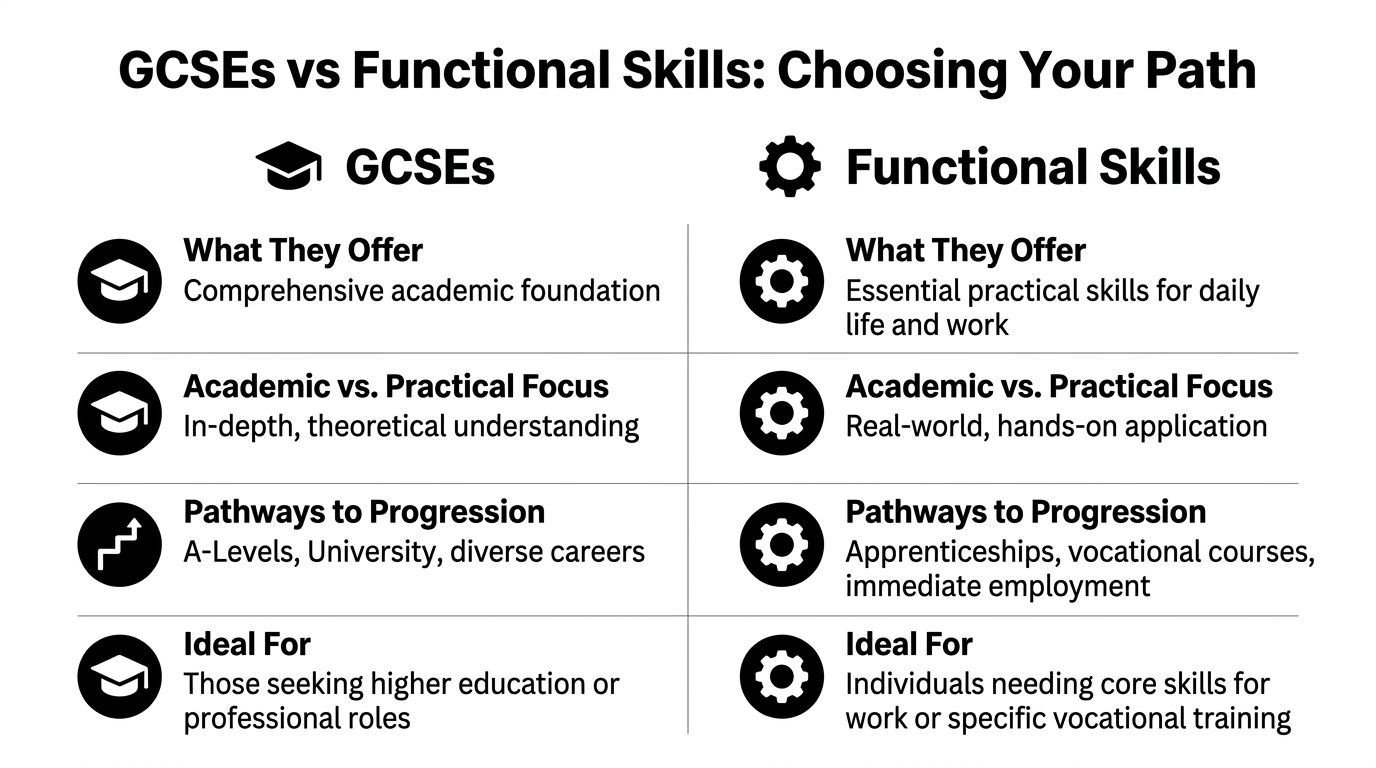
GCSEs are the traditional academic qualification.
Functional Skills focus more on practical English and maths used in everyday life and work.
Neither path is “better” in every situation. The right one depends on your goal.
GCSEs vs Functional Skills Find Your Fit
| Factor | GCSEs | Functional Skills |
|---|---|---|
| Main focus | Academic study of the subject | Practical use of English and maths |
| Best for | University entry, some professional routes, broader academic progression | Work, apprenticeships, vocational routes, confidence with everyday skills |
| Style of learning | Wider course content and more traditional exam preparation | More direct, real-world application |
| If you want a higher grade | Possible, depending on your exam performance and tier | Designed around achieving the level, not a range of grades |
| Good choice when | Your next step specifically asks for GCSEs | Your next step accepts an equivalent level 2 qualification |
When GCSEs usually make sense
Choose GCSEs if you are aiming for things like:
- University routes where GCSE maths or English is a standard entry requirement
- Professional progression where the wording clearly asks for GCSEs
- Longer-term academic plans such as A Levels or other advanced study
GCSEs can also suit adults who want the full subject and who like the idea of a qualification that is widely recognised in the usual school-based format.
When Functional Skills may suit you better
Functional Skills can be a better fit if:
- You need practical confidence for work and everyday life
- Your employer or course accepts an equivalent level 2 qualification
- You found school maths too abstract and want something more applied
There’s a real debate around whether traditional academic maths works for everyone. A teacher survey reported by Maths Horizons on GCSE maths and real-world alternatives found that 57% of teachers believe a more practical, real-world maths qualification would help more people succeed.
That doesn’t mean GCSEs aren’t valuable. It means some learners do better when maths feels connected to real life.
Decision rule: Check the exact entry requirement for your goal. If it says GCSE specifically, take that seriously. If it accepts an equivalent qualification, Functional Skills may be a smart route.
Questions to ask yourself
Try these before you choose:
What do I need this qualification for?
A job, university, an apprenticeship, self-confidence, or all four?Does my next step ask for GCSEs specifically?
If yes, that helps make the choice clearer.Do I need academic depth or practical use?
Some adults want the full GCSE route. Others want practical skills that support work and life first.How do I feel about exams?
Be honest. The right path is not the one that sounds impressive. It’s the one you can stick with.
If you want to explore the practical route in more detail, the Functional Skills English and maths level 2 course page shows what that option looks like.
The kindest choice is the honest one
You do not get extra points for picking the hardest route if it is the wrong route for your life. The best choice is the one that moves you forward.
For some adults, that is GCSE maths and english for adults because they want university and need those exact qualifications. For others, Functional Skills is the bridge that gets them into work, helps them rebuild confidence, and creates momentum.
Both routes can lead to progress. The important thing is choosing with clarity, not fear.
How to Study and Succeed Around Your Busy Life
The biggest worry for many adults isn’t ability. It’s time.
You may be working, parenting, caring for someone, managing a home, or all of those at once. So when people say, “Just study a bit each day,” it can sound unrealistic. Adult study has to fit real life, not an imaginary perfect routine.

Small pockets of time count
You do not need to study for huge blocks every day to make progress. What matters most is keeping contact with the subject.
That might look like:
- Twenty quiet minutes before bed to review a maths method
- A lunch break session to read a short English passage and answer a question
- An hour at the weekend to practise without rushing
- A few short checks during the week so you don’t forget what you learned
That kind of rhythm is often better than one long, exhausting session followed by a week of nothing.
Build a study routine that belongs to you
A parent of young children may need early mornings. A shift worker may need flexible study windows that change each week. Someone with a long commute may use audio lessons or revision notes on a phone.
What matters is choosing a pattern you can repeat.
Try this simple approach:
- Pick three study slots for the week
- Keep them realistic
- Protect them like appointments
- Stop before you feel completely drained
Practical rule: A plan you can follow beats a perfect plan you never start.
Make your study space easy to return to
Your study area does not need to look fancy. A corner of the table is enough.
What helps is reducing friction:
- Keep your notebook, pen, and login details together
- Leave revision materials where you can reach them quickly
- Use headphones if your home is noisy
- Tell family when you need a short stretch of quiet
The easier it is to start, the more likely you are to keep going.
Don’t study alone in your head
One reason adults give up is that they hit confusion and sit with it too long. A good course should give you support, structure, and someone to ask when a topic doesn’t click.
That support matters most on the difficult days, when motivation drops and you start thinking, “Maybe this just isn’t for me.”
If you want to see how online adult learning can fit around daily life, the study GCSE English online page gives a useful picture of that kind of flexible setup.
Protect your confidence while you study
Adult learners often speak harshly to themselves. They say things they would never say to their own child.
Replace these thoughts:
- “I’m too slow.”
- “I should know this already.”
- “I’m useless at maths.”
With these:
- “I’m learning this properly now.”
- “Needing practice is normal.”
- “I can improve with repetition.”
That change sounds small, but it matters. Confidence grows when your study routine feels possible, steady, and safe enough to continue.
Understanding the Exams Without the Stress
Exams feel frightening when they seem mysterious. They become more manageable when you know what they look like.
The good news is that GCSE exams follow a structure. Once you understand that structure, the fear often drops.
GCSE maths in simple terms
GCSE maths is usually split into three papers. Together they total 240 marks over 4.5 hours. There is one non-calculator paper and two calculator papers, each worth 80 marks and lasting 1.5 hours, according to the GCSE maths exam guide from Save My Exams.
The non-calculator paper is not there to catch you out. It checks the core number skills you use without technology, especially things like fractions, decimals, and percentages.
Why the non-calculator paper worries adults
A lot of adults haven’t used these skills for years. That’s why the non-calculator paper can feel like the scariest part.
But think about what it is really asking. It wants to know if you can handle number basics in a calm, steady way.
For example:
- changing 5% into a decimal
- working out a simple fraction of an amount
- comparing decimals in the right order
These are learnable skills. They improve with short, repeated practice.
Foundation and Higher tiers
This is one area where people often get confused.
There are usually two tiers in GCSE maths:
- Foundation tier, which can lead to grades 1 to 5
- Higher tier, which can lead to grades 4 to 9
The highest grade available on Foundation is 5, as explained in the same GCSE maths exam guide.
That doesn’t make Foundation a lesser choice. For many adults, it is the sensible choice because it matches their current level and gives a clear path to a strong pass.
The right tier is the one that gives you the best chance to succeed, not the one that sounds more impressive.
English is more familiar than you may think
GCSE English can sound broad, but much of it comes down to skills you already use in life:
- reading carefully
- spotting meaning
- explaining your ideas
- writing clearly for a purpose
If you can learn to slow down, read the question properly, and organise your answer, you are already building the habits the exam needs.
How to lower exam stress
Try these habits:
Practise the format early
A past paper feels less scary the second or third time.Treat mistakes as information
An error shows what to work on next.Revise in short bursts
This helps memory and keeps panic lower.Learn the routine
Knowing what happens before, during, and after the exam removes some fear.
Exams are still exams. They matter. But they are not unknown monsters. They are structured tasks you can prepare for, one skill at a time.
Funding Your Course and Planning Your Timeline
Money worries stop many adults before they even begin. Time worries stop many more.
Both are understandable. When you have bills to pay and people relying on you, study can feel like a luxury. It isn’t. It can be a practical investment in your future, but you still need a plan that feels doable.
Start by checking what support is available
Funding rules can depend on your age, location, current qualifications, and course type. The smartest first move is to ask directly what help you may qualify for, rather than guessing.
Some adults can access funded or supported routes, especially when they need maths and English to move forward. It’s worth checking properly before you assume you have to carry the full cost yourself.
Build a timeline you can believe in
One reason adults lose confidence is that the goal feels too big and too vague. A loose plan makes it feel smaller and clearer.
A simple study journey might look like this:
| Stage | What it can look like |
|---|---|
| Getting started | Enrolling, settling in, finding your current level |
| Building the basics | Strengthening key maths or English skills |
| Learning the full topics | Working through the course in a steady routine |
| Revision | Going back over weak spots and practising exam questions |
| Exam period | Sitting the papers with better preparation and calmer expectations |
You don’t have to race. Steady progress counts.
Why course support matters so much
This is especially important because national resit outcomes for post-16 learners can be tough. In summer 2025, only 17.1% of 206,732 post-16 learners achieved a grade 4 or above in GCSE maths resits, according to FE Week’s report on 2025 GCSE resit pass rates and entries.
That figure is not here to discourage you. It shows why support matters. Adults need courses built for adult life, adult pressures, and adult confidence levels.
A hard national picture does not predict your personal result. Good support, steady effort, and the right course choice can change your path.
Plan for life, not for perfection
Leave room for busy weeks. Children get ill. Work shifts change. Energy dips.
A good timeline has some flexibility built in. If you miss a study session, you haven’t failed. You restart at the next one.
That is how adults succeed. Not by having an easy life, but by returning to the plan after real life gets in the way.
Your New Future Awaits
The qualification matters. But the life behind it matters more.
Passing maths or English as an adult can change how you see yourself. You may speak up more at work. You may apply for a course you once thought was out of reach. You may help your child with homework and feel proud instead of anxious.
The win is practical and personal
For some adults, success means finally applying for a better paid role. For others, it means opening the door to further study and one day university.
For many, it means something quieter but just as powerful. They stop carrying the label they gave themselves years ago.
Not “the one who struggled at school.”
Not “the one who’s no good at maths.”
Just a person who kept going.
Your children notice more than you think
Children do not need perfect parents. They need real examples of effort, honesty, and resilience.
When they see you studying, asking questions, trying again after a bad day, and sticking with something difficult, they learn a lesson far bigger than any textbook can teach.
They learn that growth does not stop at sixteen.
The future can widen from one brave decision
A GCSE or Functional Skills course will not solve every problem overnight. But it can shift the direction of your life.
It can help you:
- apply with more confidence
- meet entry requirements
- build trust in your own ability
- be the role model you want to be
You do not need to know every step after that yet. You only need the courage to take the next one.
If you’ve read this far, some part of you is already ready. Listen to that part.
Your Questions Answered
Am I too old to do GCSE maths and english for adults
No. Adults return to education at many ages. What matters is not your age. It’s your reason for starting and the support around you.
What if I was terrible at school
School and adult learning are not the same thing. You are not the same person you were then, either. Adult learners often do better because they now have purpose, patience, and life experience.
What if my basic maths is very weak
That’s more common than many people realise. You may need to rebuild from the foundations first, and that is completely fine. Solid basics create stronger progress later.
Should I choose GCSEs or Functional Skills
Choose based on your goal. If your next step asks specifically for GCSEs, that usually answers the question. If it accepts an equivalent level 2 qualification and you want a more practical route, Functional Skills may suit you.
What if I’m busy with work and family
Then your course needs to fit around your life. Flexible study matters for adults. Short, regular sessions are often more realistic than long ones.
What if I fail
A setback is painful, but it is not the end of your story. It shows where more support, time, or a different route may be needed. Many adults succeed because they keep going, not because everything goes perfectly first time.
Do I need confidence before I start
No. Confidence usually comes after action, not before it. You begin with willingness. Confidence grows as you learn, practise, and see proof that you can do more than you thought.
If you're ready to take that next step, Next Level Online College offers flexible online courses in GCSEs, Functional Skills, A Levels, and Access to Higher Education for adults across the UK. With dedicated academic and pastoral support, clear progression routes, and a strong focus on confidence-building, it’s designed for people fitting study around real life. Talk to the team and find the route that matches your goals.