
You might be reading this because maths has been following you around for years.
It shows up when a job asks for a qualification you never got. It appears when your child asks for help with homework. It pops up when you look at a payslip, a household bill, or a college course and feel that old knot in your stomach.
If that sounds familiar, you are not behind. You are not “bad at learning”. You are not the only one starting again as an adult.
Your Chance to Build a Brighter Future
You are at the kitchen table after a long day. There is a bill to check, a form to fill in, or a job requirement staring back at you. Your child may be nearby doing homework. In that moment, getting better at maths is not just about a course. It is about feeling capable, calm, and proud in your own home.
A lot of adults carry shame about maths for years.
They work hard, care for other people, and keep life going. Yet one thought keeps returning. Having that qualification could change what feels possible.

If that is how you feel, you are in good company. Many adults in the UK have found everyday maths difficult at some point. That matters because shame can make people delay action for years, even when they are fully capable of learning with the right support.
A fresh start with a clear purpose
Studying functional skills maths online is a practical step to take control of your future. It can help you become the parent who leads by example, the employee who can apply for more roles, and the person who no longer avoids numbers.
You do not need to be brilliant at maths. You need steady confidence with the kind of maths that shows up in real life.
Progress often starts with ordinary moments. You check a discount properly. You understand the numbers on a payslip. You feel less tension when someone mentions percentages at work.
Those small wins matter. They build confidence the same way bricks build a house, one at a time until something strong starts to take shape.
Then the bigger changes begin. You may feel ready to apply for training, go for a better role, or support your children with a new sense of pride. The qualification matters, but the deeper change is how you see yourself.
What this qualification can mean
For many adults, Level 2 is the point where doors start to open again. It is often the standard employers and colleges look for, and it can help you prove to yourself that past struggles do not decide your future. If you want a clear explanation of where it fits, this guide to what a Level 2 qualification means breaks it down in simple terms.
You do not need to change everything at once.
You only need to begin, one lesson, one skill, and one good decision at a time.
What is Functional Skills Maths Really?
At its heart, functional skills maths means maths you can use in everyday life.
Not pages of confusing theory. Not endless classroom pressure. Just the skills that help you manage money, read information, solve problems, and make decisions with more confidence.
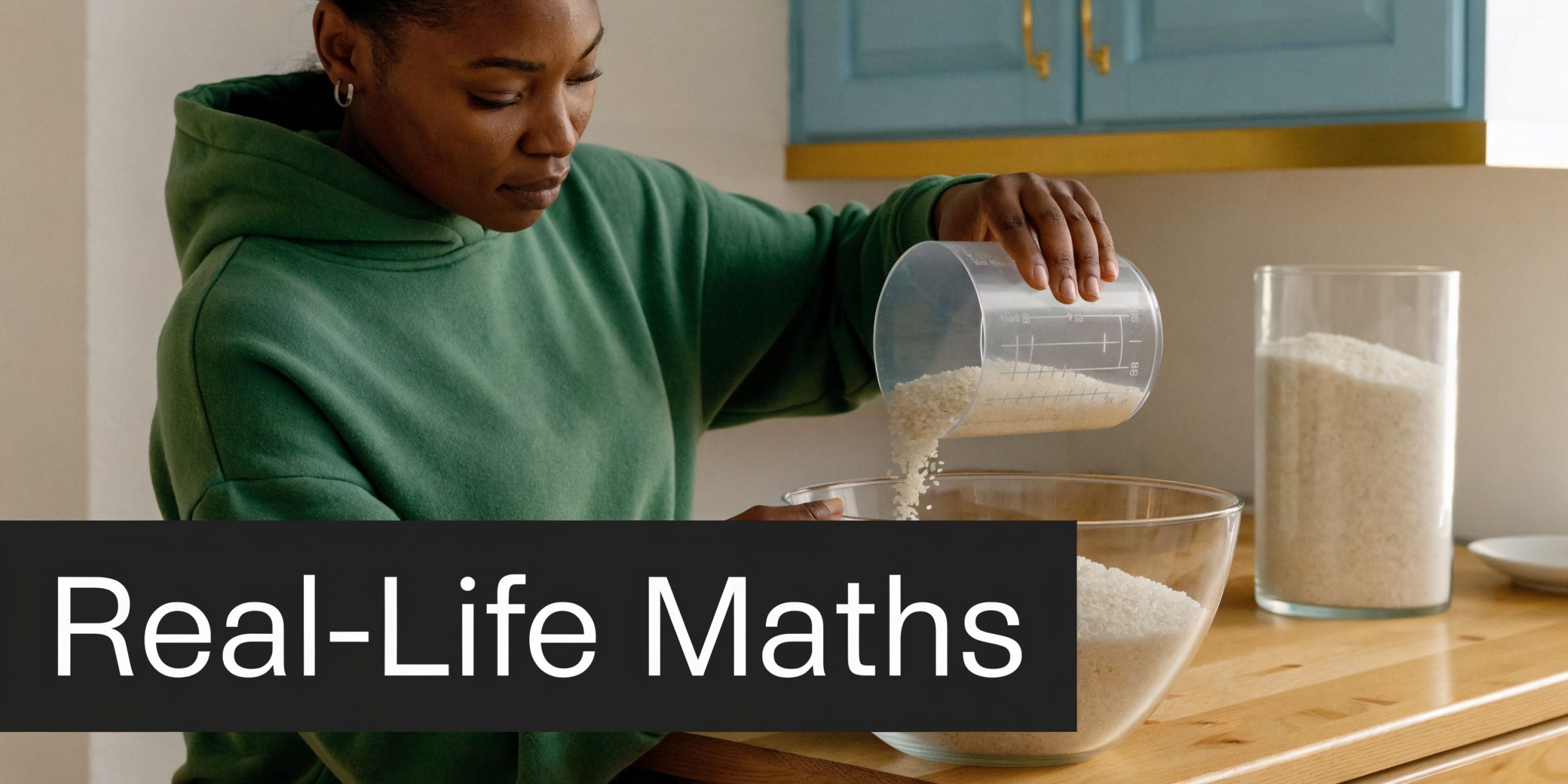
Think of it as a life toolkit
A good way to think about functional skills maths online is as a toolkit.
You don’t carry every tool for every possible job. You carry the ones that help with real tasks. Maths works the same way.
You might use it to:
- Check your wages and make sense of deductions on a payslip
- Work out a budget for food, rent, travel, and childcare
- Measure ingredients when cooking or baking
- Read charts and tables at work, in the news, or at the doctor’s
- Compare prices and discounts before spending money
That’s why many adults find it feels more practical than the maths they remember from school.
The main levels in simple terms
There are two levels many adult learners hear about first.
| Level | What it means in plain English | Why it matters |
|---|---|---|
| Level 1 | A solid base in everyday maths | Helps rebuild confidence and core skills |
| Level 2 | A stronger, recognised level for progression | Often used for jobs, further study, and training routes |
Level 1 is often where people prove to themselves, “I can do this.”
Level 2 is the level that opens more doors. If you want a plain guide to that comparison, this page on what Functional Skills Level 2 is equivalent to explains it in a straightforward way.
What you study
The topics are built around practical use.
You’ll usually meet number skills, percentages, fractions, measures, and data. Data handling matters because life is full of information. Tables, graphs, averages, and comparisons are everywhere.
The curriculum focuses on practical topics like data handling such as mean, median, mode, and range, which 92% of successful candidates in a 2023/24 cohort mastered, helping with real tasks like workplace budgeting or understanding health data (Nottingham College course page with awarding organisation data context).
Practical rule: if a maths skill helps you understand money, time, measurements, or information, there’s a good chance it belongs in Functional Skills Maths.
Where learners often get confused
Adults often worry that maths means hard algebra straight away.
That’s usually not the best way to think about it. Functional Skills focuses more on applying maths than memorising abstract rules with no clear purpose.
You’re learning how to solve problems like:
- How much paint do I need?
- Which mobile plan is cheaper?
- What does this graph show?
- How do I split my monthly spending sensibly?
Once maths connects to real life, it often feels less scary. It starts to make sense because you can see why it matters.
Why Studying Online is Your Secret Weapon
It’s 9:15 at night. The children are finally asleep, the kitchen is mostly tidy, and you remember the goal you keep putting off. Getting your maths sorted.
For many adults, the hard part is not intelligence. It is finding a way to learn that fits around a full life without making you feel stretched, exposed, or defeated before you begin.
That is why online study can work so well.
Online study fits around real responsibilities
Functional Skills Maths online gives you room to learn in a way that matches real life. You can study for twenty minutes before work, revise on your phone during a lunch break, or go back over a topic in the evening when the house is quiet.
That flexibility is a significant advantage for protecting confidence.
A classroom moves at one speed. Online learning works more like a remote control. You can pause, replay, slow things down, and pick back up when your head is clearer. For an adult who has been made to feel “bad at maths” in the past, that change matters.
It often helps because:
- You set the pace. Quick progress on one topic means you can keep going. A harder topic can have more time without anyone rushing you.
- You can repeat lessons without embarrassment. Going over something twice or five times is part of the process.
- You get space to think. Many adults understand more when they are not worrying about answering in front of a room.
- You can build confidence privately. Home can feel calmer, and calm helps learning stick.
Online learning is now a recognised, trusted route
Studying online has become a normal and effective route, equal to traditional methods.
Regulators and awarding bodies now support digital delivery and assessment across many qualifications. Ofqual publishes guidance and updates on the regulation of vocational and technical qualifications, including Functional Skills, through its official vocational qualifications information and regulatory updates. That wider acceptance gives adults a clearer reason to take online study seriously.
Online learning does not remove the effort. It gives that effort a better chance to succeed.
If your week is busy, the best study plan is usually the one you can keep. A perfect timetable that falls apart after three days helps no one. A realistic online routine, even in short sessions, can carry you much further.
A practical choice that can change how you see yourself
If you’re checking whether an online provider offers recognised courses, this guide to accreditation for online courses can help you know what to look for.
There is another reason online study matters. It can begin to repair the story you tell yourself.
Each completed lesson is a small promise kept. Each topic you understand is proof that the old label you were given does not have to define you. Over time, that grows into something bigger than a qualification. You become the parent who shows persistence, the employee who goes for the next role, and the adult who feels proud saying, “I did this.”
Online study gives many adults something they have not had before. Control.
And when you have control, it becomes much easier to keep going.
Your Guided Journey Through the Course
A lot of adults worry that signing up means being thrown into a system they don’t understand.
A good course shouldn’t feel like that. It should feel like being guided, one step at a time, by people who know adult learners need clarity, patience, and support.
Step one starts with where you are now
You do not need to arrive “already good at maths”.
Most adult-friendly courses begin by finding your current level. That matters because confidence drops fast when work feels far too hard, and boredom sets in when it’s far too easy.
A starting assessment helps build the right path.
You may discover that some skills are stronger than you thought. You may also spot a few gaps that need careful practice. Both are useful.
Then the course becomes more manageable
Once your starting point is clear, the course usually feels less like one huge mountain and more like a set of smaller climbs.
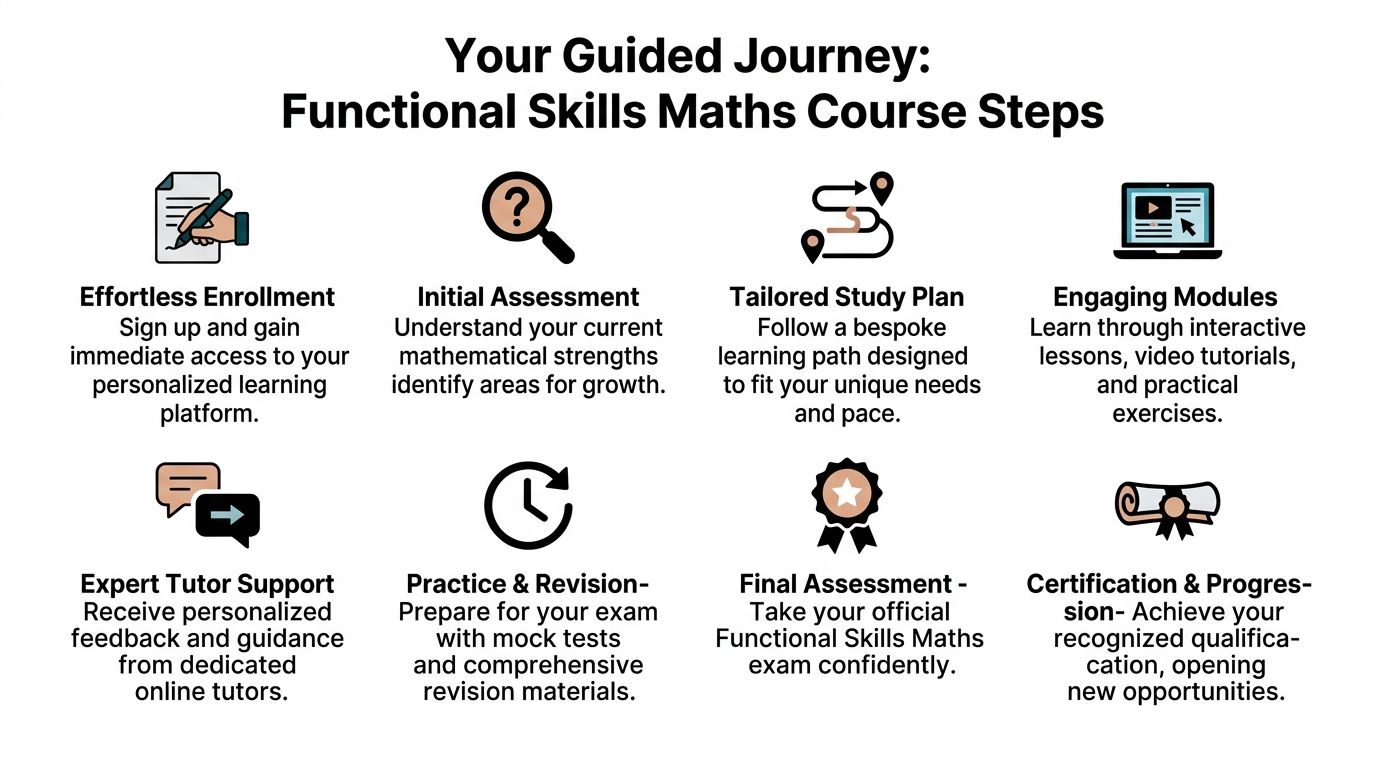
A strong online learning journey often looks like this:
Initial check of your skills
This shows what you already know and what needs more work.A structured study plan
You follow a clear order instead of guessing what to revise.Short online lessons
These often break topics into manageable chunks.Practice questions
You don’t just watch. You try things out.Tutor feedback
When something goes wrong, someone helps you understand why.Mock tests
These help the exam feel familiar rather than frightening.
What support should feel like
Adult learners often need two kinds of support.
The first is academic support. That means help with the maths. You might need a tutor to explain fractions in a simpler way, or show you how to read a graph step by step.
The second is human support. That means someone reminding you that one bad week doesn’t mean you should quit.
Some of the best progress happens when a learner stops hiding confusion and starts asking one clear question at a time.
A good tutor isn’t there to judge you.
They’re there to notice where you’re stuck, explain it differently, and keep you moving.
Practice turns fear into familiarity
Many adults think confidence comes first.
Usually, it doesn’t. Practice comes first. Confidence grows afterwards.
That’s why mock papers and revision tasks matter so much. They help you get used to the style of questions, the timing, and the feeling of solving things independently.
Try to think of revision in layers:
| Stage | What you’re doing | Why it helps |
|---|---|---|
| Learn | Meet the topic for the first time | Builds understanding |
| Try | Answer guided questions | Shows where you need help |
| Repeat | Revisit the same skill later | Helps it stick |
| Test | Complete mock questions | Builds exam readiness |
Progress is rarely a straight line
Some weeks, you’ll feel sharp and focused.
Other weeks, you’ll read a question three times and still feel lost. That’s normal. Adult study has bumps because adult life has bumps.
What matters is not perfect momentum. It’s returning.
If you miss a few days, come back. If one topic annoys you, ask for help. If a mock goes badly, use it as information, not proof that you can’t do it.
Functional skills maths online works best when you treat the course like a guided journey, not a one-shot test of your worth.
Success Tips for Adult Learners
It is 8:30 at night. The dishes are done, your phone is still buzzing, and you are tired. You open your maths course anyway and manage 15 focused minutes on percentages.
That counts.
Adult learners often do best when they stop waiting for the perfect week and start building progress into ordinary life. A pass is usually built in small, steady pieces, much like saving money a little at a time. Each session may look modest on its own, but together they create real change.
Build a routine that fits the week you live
A study plan only works if it matches your life.
If work shifts change, children need you, or your energy drops in the evening, your routine needs to bend without breaking. A simple plan you can repeat is stronger than an ambitious one you abandon after four days.
Try this:
- Use short study blocks. Even 20 minutes can be enough to practise one skill well.
- Choose regular times. The same lunch break, early morning slot, or two set evenings each week helps studying become a habit.
- Keep a backup session. One spare slot during the week stops a missed session from turning into a lost week.
Consistency matters more than long hours.
Let other people support the goal
Many adults carry study in silence, as if it only counts once they have passed. In practice, sharing the goal often makes it easier to keep going.
Tell the people close to you what you are working toward and why it matters. You might need quiet time, help with childcare, or someone to ask, "How did your lesson go today?"
This matters at home too. Children and younger relatives notice effort. When they see you return to learning, stick with a hard topic, and keep going after a tough day, they see what persistence looks like in real life.
You are not only studying for a qualification. You are showing your family that it is never too late to grow.
Ask for help before frustration grows
A lot of adult learners spend too long stuck on one topic because they feel they should have understood it already. That feeling is common. It is also unhelpful.
Fractions, ratios, and graphs can feel like a knot. A tutor, support worker, or study group can help you loosen one strand at a time until the whole thing starts to make sense.
Use a simple rule:
- After one attempt, try the question again by yourself
- After two attempts, check your notes, lesson, or example
- After three attempts, ask for help
That approach saves time and protects your confidence. Needing an explanation does not mean you are bad at maths. It means you are learning.
Keep track of proof that you are improving
Confidence grows faster when you can see evidence.
Many adults brush past their own progress because they are focused on how far they still have to go. Try keeping a notebook or phone note called "Proof I'm getting better." Add small wins as they happen.
That might include:
- Finishing all your study sessions for the week
- Understanding a topic you used to avoid
- Getting more marks on a practice paper
- Feeling calmer when you read a maths question
- Explaining a method out loud in your own words
These wins are not small in the long run. They are the steps that help you become more capable, more confident, and more proud of the example you are setting.
Opening New Opportunities After You Pass
A pass can do more than satisfy a course requirement. It can change the story you tell yourself about what you are capable of.

For some adults, that change shows up the moment they fill in an application they used to skip. For others, it appears in quieter ways first. They speak up more at work. They stop feeling nervous around numbers. They start to believe that progress is still possible.
More doors open in study and work
Functional Skills Maths Level 2 is widely accepted for progression into further education, training, and many job routes.
That matters if maths has been the missing piece holding you back.
A lot of adults do not lack ability. They lack a recognised qualification that proves they can use maths in real life. Once you have that proof, choices that felt closed can start to feel real again. That might mean an Access to HE course, a college programme, an apprenticeship, or a role that asks for a Level 2 maths qualification.
The certificate is small. The effect can be big.
The result reaches beyond your CV
Passing often changes everyday life as well as future plans.
Maths confidence works like learning to drive on roads you used to avoid. At first, you grip the wheel and second-guess every turn. Then one day, the same road feels normal. Numbers can become like that too.
You may feel calmer reading payslips, bills, rotas, measurements, or workplace figures. You may find it easier to compare costs, manage a budget, or help your child check an answer without that old feeling of panic.
Here is what that progress can lead to:
| After you pass | What it can lead to |
|---|---|
| Further study | Access courses, college, and university pathways |
| Career progress | Better job options or meeting entry requirements |
| Apprenticeships | Eligibility for many vocational routes |
| Self-belief | More confidence at home, work, and in learning |
A student story often gives more value than a general explainer, because it shows what changed in real life after the qualification:
Your family notices what this means
Passing sends a message.
It shows that you returned to something that once felt painful and kept going until you got through it. Children notice that. Partners notice that. You notice it too.
That kind of example stays with people. It says that setbacks do not have to be final, and that learning can still lead to a better future.
You are gaining a qualification. You are also becoming the person in your family who proved that it is never too late to grow, qualify, and feel proud again.
Your Questions Answered
Am I too old to go back to learning maths
No.
Adult learners often do well because they bring patience, life experience, and a real reason for studying. You’re not learning because someone told you to. You’re learning because your future matters to you.
That gives your effort real power.
What if I’m embarrassed by how much I’ve forgotten
That feeling is common.
Forgetting old school maths doesn’t mean you can’t learn now. In fact, many adults learn better when teaching is clearer, calmer, and linked to real life. You are not starting from failure. You are starting from today.
What if I struggle with the course
Struggle is part of learning.
You may need to revisit topics. You may need extra practice. That doesn’t mean the course isn’t for you. It means you’re in the normal part of the process where skills are being built.
Try not to treat one difficult topic as a verdict on your ability.
What if I fail an exam
An exam result is important, but it is not your identity.
If things don’t go the way you hoped, the useful question is, “What support or practice do I need next?” Many adults improve once they know what the exam feels like and which areas need more attention.
Can I really fit this around work and family
Yes, if your plan is realistic.
Don’t aim for huge heroic study sessions every day. Aim for a routine that your life can carry. Short, steady effort is often the best way forward for adult learners.
If you’re ready to take that next step, Next Level Online College offers flexible, fully supported online courses designed for adults who are returning to education around work, family, and everyday life. If you want a recognised route that helps you build confidence and move towards better opportunities, it’s a strong place to begin.