
You may be sitting at your kitchen table reading this after work, wondering if university was something you missed your chance to do. Maybe life got busy. Maybe money was tight. Maybe school never felt like your place. Now you’ve got children watching you, bills to pay, and a quiet voice in your head asking whether it’s too late.
It isn’t.
I’ve seen adults come back to learning after years away and do far better than they expected, not because it was easy, but because they finally had a reason that mattered. They wanted a better job. They wanted to prove something to themselves. They wanted their children to see that hard things can be done.
If you’re trying to work out how to get into university without a levels, start with this truth. A levels are one route, not the route. The door is still open.
Your Dream of University Is Closer Than You Think
Sarah is the kind of person I think about when I write articles like this. She works hard, puts everyone else first, and keeps telling herself that university is for other people. People who got the grades first time. People who had support. People who didn’t spend years raising children, working shifts, or rebuilding their confidence.
That thinking stops a lot of good people before they even begin.
The outlook is much more hopeful. In the UK, nearly one in ten new university students enter higher education without a single A level or equivalent qualification, and that proportion has more than doubled in recent years, according to this report in The Times. Universities are already admitting people who took a different route.
Why adult learners often do better than they expect
Adults bring something younger applicants often haven’t had time to build yet. Real responsibility.
You may already know how to:
- Manage pressure by showing up even when you’re tired
- Organise your time around work, school runs, and home life
- Keep going when things feel uncomfortable
- Care about the outcome because this affects your future, not just your next term
That matters. Universities don’t only want exam results. They also want students who are ready to study seriously and finish what they start.
You are not starting from nothing. You are starting with life experience, discipline, and a reason to succeed.
This isn’t just about you
Going back into education changes more than your CV.
Your children see you study. They see you keep promises to yourself. They see you tackle something scary instead of hiding from it. That makes you a role model in the strongest possible way.
For many adults, university isn’t about chasing a dream that sounds nice. It’s about building a different future. Better work. More options. Greater confidence. A chance to do work that matters and get paid properly for it.
If school let you down the first time, don’t let that decide the rest of your life. There are practical ways forward, and some are built especially for adults.
Your Fast-Track to a Degree with an Access to HE Diploma
If you’re an adult without A levels and you want the clearest route into university, my advice is simple. Start by looking at an Access to Higher Education Diploma.
This qualification exists for people exactly like you. Adults who are ready for university now, but don’t have the traditional route behind them.
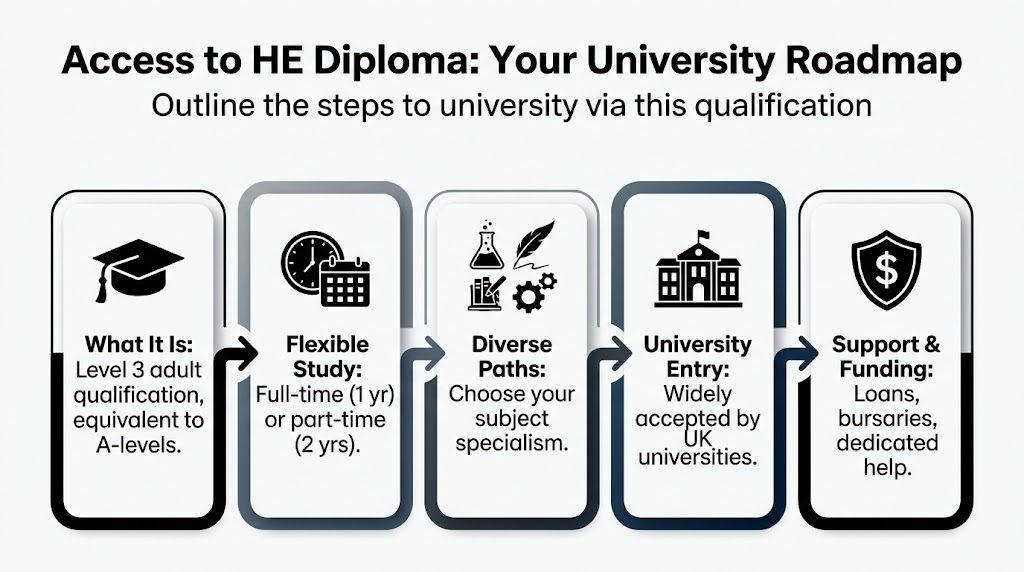
An Access to HE Diploma has helped over 20,000 UK adults each year gain university entry without A levels, with progression rates to higher education reaching 70 to 75% in recent years, as outlined in this Coursera guide. That’s why I recommend it so often. It is direct, respected, and built around adult learners.
What an Access to HE Diploma actually is
It’s a Level 3 qualification that prepares you for degree study.
You choose a subject linked to the degree you want. Common choices include nursing, health professions, business, law, social work, and education. Instead of sitting in a classroom doing school-style study, you complete work designed to build the skills universities expect.
That usually means:
- Written assignments that help you learn academic writing
- Research tasks so you can handle degree-level reading
- Subject-specific study linked to your future course
- Tutor feedback that shows you how to improve
For many adults, that feels more meaningful than going back and doing A levels from scratch.
Why this route suits busy adults
A levels can work, but they often take longer and don’t always fit adult life well.
An Access course is different. It’s focused. You study what matters for progression. Many courses are flexible too, which matters if you’re fitting learning around work and family life. If you want to explore a flexible online route, you can look at the Access to HE Diploma online.
That flexibility matters more than people realise. Adult learners don’t usually fail because they lack ability. They struggle when the course structure doesn’t fit real life.
Practical rule: Pick a route that fits your week as it really is, not as you wish it was.
A simple plan that works
If you want a practical roadmap, use this.
Choose the right subject first
Don’t pick a course because it sounds broad. Pick the one that leads where you want to go.
If you want nursing, choose nursing. If you want business, choose business. The closer the Access course matches your degree goal, the easier your UCAS application becomes.
Check university entry pages early
Before you enrol, look at a few university course pages for the degree you want. Check whether they accept an Access to HE Diploma and whether they mention any extra requirements such as English or maths.
This step saves stress later.
Build a steady study routine
Treat your study like a real commitment from day one.
A good routine might include:
- Set study slots you protect every week
- A quiet place where your books and laptop stay ready
- Small goals for each session
- A family conversation so people know this matters
You don’t need perfect conditions. You need consistency.
Use tutor feedback properly
Too many adults read feedback once and move on. Don’t do that.
Feedback shows you how to improve your grades, your writing, and your confidence. If your tutor says your structure is weak, fix structure on the next task. If they say your analysis needs more depth, work on that one thing.
Steady improvement beats panic every time.
What makes this route powerful
The biggest strength of the Access Diploma is that it turns a vague dream into a plan.
You are no longer saying, “I wish I could go to university one day.”
You are saying:
- I know the subject I want.
- I’m taking the recognised route for adults.
- I’m building the skills universities want.
- I’m moving towards a UCAS application with purpose.
That shift matters. Confidence often comes after action, not before it.
Who should choose this route
An Access to HE Diploma makes the most sense if you are:
- A parent needing flexibility around family life
- A career changer who wants a direct route
- An adult who left school years ago and wants a fresh start
- Someone who wants university options rather than being tied to one provider
If that sounds like you, don’t overcomplicate this. Access is often the smartest move.
Exploring Other Powerful University Pathways
Access to HE is often the strongest route for adults, but it isn’t the only one. The right choice depends on your life, your learning style, and how quickly you want to move.
For the 2025 UCAS cycle, 25% of UK undergraduate entrants used non A Level routes, and T Level holders secured offers from over 50 institutions, including Manchester Met, according to UCEN Manchester’s guide. That should tell you something important. Alternative pathways are not fringe options. They are established routes into higher education.
Comparing your main university pathways
| Pathway | Best For… | Typical Duration | Assessment Style |
|---|---|---|---|
| Access to HE Diploma | Adults returning to study who want a direct route to university | Usually one year full-time or longer part-time | Mainly assignments and course-based work |
| BTEC Level 3 | Learners who prefer vocational, practical study | Varies by course | Coursework and vocational assessment |
| T Level | Learners who want technical study with industry placement | Two years | Classroom learning plus placement-based assessment |
| Foundation Year | Students who want entry through a specific university course | Usually one preparatory year before Year 1 | University assignments, assessments, and subject preparation |
BTEC is strong if you prefer practical learning
Some adults hate the idea of going back to a very exam-heavy setup. That’s where BTEC can make more sense.
BTECs are vocational qualifications. They suit learners who like applied study and want to build knowledge through practical work and coursework. If you’re weighing that option up, this guide to BTEC Level 3 UCAS points helps explain how BTECs fit into university entry.
A BTEC route often suits you if you:
- Learn by doing rather than memorising
- Want a qualification linked to a career area
- Prefer ongoing assessment over one final push
T Levels are growing, but check acceptance carefully
T Levels are newer and more technical. They combine classroom study with industry placement, so they can be a smart option if you want a stronger link between study and work.
They can open doors, but my advice is blunt. Always check the exact university and course requirements before you commit. Growing acceptance is good news, but your chosen degree is what matters.
This route makes most sense for learners who:
- Want a technical subject area
- Like structured programmes
- Value workplace experience alongside study
Foundation Year works if you know exactly where you want to go
A Foundation Year is different from Access or BTEC because it’s usually built into a university course.
That means you often apply to one university and, if accepted, complete a preparatory year before moving into Year 1 of the degree. This can be a smart move if you already know the exact subject and university you want.
Foundation Year is a focused choice. It gives less flexibility than Access, but more certainty if you already know your destination.
Which route fits your life strategy
Use this simple test.
Choose Access to HE if you need flexibility and want a route designed for adults.
Choose BTEC if you want vocational learning and prefer coursework-led study.
Choose T Level if you want technical training with a placement element and your target universities accept it.
Choose Foundation Year if you are set on one university or need a supported bridge straight into a specific degree.
Don’t pick based on what sounds impressive. Pick based on what you can complete and where it will take you.
How to Use Your Life Experience to Impress Universities
A lot of adults make the same mistake in their application. They apologise for their past instead of presenting their strengths.
Don’t write like someone asking for mercy. Write like someone who has earned their place.
Universities don’t expect adult learners to sound like school leavers. They want to see maturity, direction, and proof that you can handle the course. Your job history, parenting, caring duties, and life experience can all help you make that case.

Turn experience into evidence
If you’re applying with an Access to HE Diploma, it’s important to submit a personal statement that links 5+ years of work experience to your chosen degree, as explained in this Access course guidance. The example given is clear and useful: “Managed a 20-person team, developing leadership skills for a BSc in Management.”
That is the standard to aim for.
Not this:
- I’ve been out of education for a long time
- I know I don’t have the normal background
- I just hope you will consider me
Write this way instead:
- What you did
- What skill it built
- Why that skill matters for the degree
What universities like to see
Clear motivation
Say why you want this degree now.
Be honest. Maybe you want a career with more meaning. Maybe you want to progress at work. Maybe you’ve spent years caring for others and now want to build something for yourself too.
Specific reasons sound stronger than vague dreams.
Transferable skills
Your daily life has probably built more degree-ready skills than you think.
These can include:
- Time management from balancing work and home
- Communication from dealing with customers, colleagues, or services
- Leadership from supervising staff or coordinating people
- Budgeting from running a household
- Resilience from handling setbacks and carrying on
Readiness to study
Show that you understand what university will ask of you.
Mention your recent study, your current qualification, or the steps you’ve taken to prepare. Universities want reassurance that you’re not applying on a whim.
Strong applications don’t beg. They connect past experience to future success.
A simple personal statement formula
Use this structure if you feel stuck:
- Why this subject matters to you
- What experience you already have that relates to it
- What studying now says about your commitment
- What you want to do with the degree
Keep your tone steady and real. You don’t need big words. You need clear evidence.
Ask about Recognition of Prior Learning
Some universities may consider prior learning or relevant experience when assessing your application. This is often referred to as Recognition of Prior Learning, or RPL.
The key is not to assume. Ask admissions directly.
You can ask:
- Whether your previous study counts
- Whether work-based learning is relevant
- Whether mature applicant criteria apply
- Whether a portfolio or written explanation would help
This matters especially if you’ve built serious experience over many years. Don’t hide it. Use it.
Your Guide to Funding Options and Next Steps
Money worries stop a lot of adults before they even ask the right questions. That’s understandable. You’ve got real responsibilities, and you can’t afford vague promises.
So be practical.
First, separate the problem into two parts. You may need funding for the course that gets you into university, and then funding for university itself. Don’t bundle everything together in your head and panic. Take one step at a time.
Start with the route that fits your budget and your life
A Foundation Year can be a useful route, but it usually ties you to a specific university and course. It is often part of a four-year degree, and entry can sometimes be achieved with 32 to 48 UCAS points or 5+ years of relevant experience, with a 95% progression rate into Year 1 at integrated programmes, according to this NCCHomeLearning guide.
That can be a good option if you already know exactly where you want to study.
For many adults, though, flexibility matters more. That’s why it’s worth reviewing different adult education courses online before you commit. The right course should fit your responsibilities, not fight them.
Ask these funding questions early
Don’t wait until the last minute. Ask providers and universities directly:
- What funding support is available for this course
- Whether payment plans exist
- What help is available for adult learners
- What happens after progression to university
If you leave these questions too late, stress grows fast. If you ask early, you can make a calm decision.
Your next three moves
If you’re serious about university, do these in order.
Pick the destination
Choose the degree subject you want. Not the one that feels safest. The one you can see yourself finishing.
Match the pathway
Once you know the destination, choose the route that gets you there realistically. For many adults that will be Access to HE. For others it may be BTEC or a Foundation Year.
Speak to admissions before enrolling
Check acceptance, entry requirements, and any English or maths expectations. One short conversation can save months of frustration.
The people who get into university without A levels are not the lucky few. They are the ones who ask questions, choose carefully, and take the next step.
You do not need to have your whole life sorted before you begin. You only need a plan for the next stage.
Your Questions Answered
Can I really get into university without A levels
Yes. You can.
Universities accept several alternative routes, including Access to HE Diplomas, BTECs, T Levels, and Foundation Years. The right route depends on your background and the course you want.
If you’re an adult learner, stop treating A levels as the only answer. They aren’t.
Am I too old to go to university
No.
Adult learners go to university at many different ages. Being older can help because you often have stronger motivation, better discipline, and a clearer reason for studying.
Your age is not the problem. A poor plan is the problem. Fix the plan.
Do I need GCSEs as well
Sometimes you will need English and maths, especially for certain university courses.
The exact requirement depends on the university and subject. Check this before you enrol on any pathway course. Don’t assume all institutions ask for the same thing.
Which route is best if I work full-time
In most cases, an Access to HE Diploma is the strongest option for adults working full-time because it is designed with adult learners in mind and is often available in flexible formats.
That said, your best route depends on your target course and how you prefer to learn. If you want practical coursework-led study, a BTEC might suit you better.
Which route is best if I want to change career quickly
Usually Access to HE.
It is focused, university-facing, and often chosen by adults moving into fields like healthcare, business, education, or social care. If speed and relevance matter, it’s hard to beat.
Is a Foundation Year the same as an Access course
No.
A Foundation Year is usually attached to one university and one degree route. An Access to HE Diploma is a separate qualification that can let you apply to different universities.
If you want flexibility, Access is usually the smarter choice. If you already know your exact university, Foundation Year can make sense.
Will universities take my work experience seriously
Yes, if you present it properly.
Work experience on its own is not enough if you list duties without explaining the skills behind them. Universities want to see what your experience has taught you and how that connects to degree study.
Good examples include leadership, communication, problem-solving, organisation, resilience, and responsibility.
What should I say in my personal statement
Focus on three things:
- Why you want the course
- What you’ve done that proves you’re ready
- What you plan to do with the degree
Do not waste space apologising for being out of education. Use the space to show maturity and direction.
What if I’m scared I’m not academic enough
That fear is common, especially if school was difficult the first time.
Being academic is not about sounding clever. It’s about learning how to read, think, write, and improve. Adult learners often grow fast once they have structure and a reason to keep going.
Fear doesn’t mean you can’t do it. It means it matters to you.
How do I choose the right university
Start with the course, not the campus.
Look at:
- Whether they accept your qualification route
- Whether the course content suits your goals
- Whether the study location and format work for your life
- What support they offer mature students
Pick the university that gives you the best chance to finish and move forward. Prestige is not everything. Fit matters.
Should I apply to several universities
If your route allows it, that is often a sensible move.
It gives you options and lowers pressure. Just make sure every choice is realistic for your qualification and your goals.
What if my confidence is very low
Then start smaller, not later.
Confidence doesn’t usually arrive first. Action does. One phone call. One course enquiry. One evening spent comparing routes. One application draft.
Small steps build belief. Waiting to feel ready usually keeps people stuck.
How do I stay motivated when family life is busy
Tie your study to a bigger reason.
Maybe you want stable work. Maybe you want more money coming in. Maybe you want your children to see you finish something important. Keep that reason visible.
Then make study easier to continue:
- Use a weekly routine
- Tell your family your study times
- Break work into small tasks
- Ask for help instead of disappearing when things get hard
What should I do today if I’m serious about this
Do these three things today:
- Write down the degree subject you want.
- List two or three universities that offer it.
- Check which alternative qualifications they accept.
That turns a dream into a plan.
If you’re ready to stop guessing and start building a real route to university, speak to Next Level Online College. They offer flexible online courses for adult learners, including recognised pathways that can help you move towards university around work and family life.