
You might be reading this because you want more from life. Maybe you want a better job. Maybe you want to apply for university one day. Maybe you want to read a letter from your child’s school without that sinking feeling in your stomach.
A lot of adults carry an old school wound. They tell themselves they were “never good at English” or that education just “wasn’t for them”. Years pass, work gets busy, family life takes over, and that quiet doubt stays in the background.
But that doubt doesn’t tell the truth.
Functional Skills English was created for real people living real lives. It isn’t about going back in time and becoming a different person. It’s about building the reading, writing, speaking and listening skills you need now, in a way that makes sense for adult life.
If you’ve been asking what is functional skills english, the simple answer is this. It’s a practical English qualification that helps you feel more confident at work, at home, and in your next step in education.
Your First Step Towards a Brighter Future
You see a job advert and feel that little spark of hope. The hours are better. The pay is better. It sounds like the kind of role you could grow into. Then you spot the line asking for English qualifications, and your heart drops.
That moment is more common than people admit.
For many adults, the problem isn’t ability. It’s confidence. School may have been a long time ago. You may have children, shifts, bills, and ten other things pulling at you. It’s hard to believe in yourself when life has taught you to put everyone else first.
Functional Skills English can change that feeling because it starts from a kinder place. It focuses on useful English, not showing off. It helps you build the kind of skills that matter when you’re reading workplace instructions, sending emails, talking in meetings, or helping your child with homework.
You don't need to be perfect to start. You just need to be willing.
Many adult learners are not chasing a piece of paper on its own. They’re chasing what that certificate stands for. Pride. Relief. Progress. A chance to say, “I did this, and I did it for myself and my family.”
That’s why this qualification matters so much. It can be the first steady step towards a new career, further study, or a stronger belief in your own voice.
Why this step feels so powerful
- It gives you proof: You’re not “bad at English”. You’re learning skills in a clear, practical way.
- It helps at home: Reading forms, writing messages, and supporting your children becomes less stressful.
- It supports bigger goals: Many adults use it as a stepping stone towards new training, better work, and higher study.
When you start improving your English, you’re not only learning words and rules. You’re rebuilding trust in yourself.
What Functional Skills English Actually Is
Functional Skills English is a nationally recognised qualification designed by the UK government to help adults build practical English for life and work, according to the Department for Education subject content for Functional Skills English.

A simple way to understand it is to think about cooking. Old-fashioned learning can feel like memorising a long list of ingredients and hoping you remember them in the test. Functional Skills is more like learning how to cook a meal you can serve. You learn by using English in situations that matter.
That means the course is built around communication you can use in everyday life. Reading information. Writing clearly. Speaking with confidence. Listening properly and responding well.
It was made for real life
Functional Skills English was introduced in the early 2000s as part of post-16 education reform. It replaced older basic skills standards so the focus could move to functional application in real-world contexts, as set out by the Department for Education in the subject content linked above.
That word functional matters. It means useful. It means practical. It means you’re learning English to do things, not just to remember facts.
Here are the kinds of everyday tasks this qualification connects to:
- At work: Reading instructions, completing forms, writing professional emails.
- At home: Understanding letters, comparing information, replying clearly.
- In education: Building the communication skills needed for further courses.
If you want to explore the qualification itself, this guide to Functional Skills courses gives a helpful overview of the route learners often take.
It focuses on what you can do
Many adults feel nervous because they remember English as something full of tricky rules and hidden traps. Functional Skills English feels different because the point is not to catch you out. The point is to help you use English confidently.
That’s also why many employers and education providers value it. It shows that you can apply English in the sort of situations people face every day.
A short video can help make that clearer:
What makes it feel less intimidating
Practical rule: If a qualification teaches you skills you can use this week, not someday, it’s usually easier to stick with.
Functional Skills English isn’t about pretending adult life is simple. It recognises that people need qualifications that fit around jobs, families, and fresh starts. That’s why so many adult learners find it more approachable than they expected.
When people ask what is functional skills english, the clearest answer is this. It is a respected, practical English qualification that helps adults move forward with confidence.
The Everyday Skills You Will Build and Master
The best way to understand this qualification is to look at what it helps you do in real life. Functional Skills English is built around three main areas. Reading, writing, and speaking and listening.
Each one can change daily life in quiet but powerful ways.
Reading that makes life feel clearer
A parent opens an email from school about a trip, a deadline, and a payment process. Before, they might have read it three times and still felt unsure. After building stronger reading skills, they can pick out the key details, understand what action is needed, and respond calmly.
That’s what reading confidence looks like.
It also matters at work. You may need to understand a rota change, a health and safety notice, a contract, or a training document. When your reading improves, you spend less time guessing and more time knowing.
Reading in Functional Skills English helps you learn how to:
- Find key information: Spot the important points in a letter, notice, advert, or article.
- Understand meaning: Work out what the writer really means, even when the wording is formal.
- Compare ideas: Read two pieces of information and judge what matters most.
Writing that helps people take you seriously
Think about writing a message to a manager, a complaint email, or a personal statement for a course. If writing feels stressful, it’s easy to keep it short, avoid detail, or put it off completely.
Strong writing changes that.
You learn how to organise your thoughts, choose the right tone, and write with clear spelling, punctuation and grammar. That doesn’t mean sounding fancy. It means sounding clear, capable and professional.
A good example is a CV. When your writing improves, you can describe your experience better. You can show your strengths instead of hiding behind one-line answers. The same is true when filling in application forms or sending emails that need to make a good impression.
Clear writing doesn't just help other people understand you. It helps you believe your own voice matters.
Speaking and listening that build confidence
This part often surprises learners. Many adults think English is only about reading and writing. But speaking and listening are part of everyday success too.
Think about a parents’ evening where you want to ask questions and understand the answers properly. Or a workplace meeting where you want to share an idea instead of staying silent. Or a phone call where you need to explain something without getting flustered.
Speaking and listening skills help you:
- Express yourself clearly
- Listen for detail
- Respond with confidence
- Join conversations in a calm, organised way
These are life skills. They help in interviews, meetings, training, customer service, family conversations, and study sessions.
Why these skills matter beyond the classroom
The power of Functional Skills English is that every area links back to daily life. You’re not learning in a vacuum. You’re learning so you can manage tasks, solve problems, and present yourself with more confidence.
Many adults notice changes before they even finish the course. They feel less embarrassed asking questions. They stop avoiding paperwork. They start speaking up more at work. Small changes like these can lead to much bigger changes later.
Here’s what that can feel like in practice:
| Skill area | Everyday example | What changes |
|---|---|---|
| Reading | Understanding a school letter | Less confusion and less stress |
| Writing | Sending a professional email | Better communication and stronger self-belief |
| Speaking and listening | Joining a meeting or phone call | More confidence and a clearer voice |
When these three areas get stronger together, life often starts to feel more manageable. And when life feels more manageable, bigger goals stop feeling impossible.
Climbing the Ladder from Entry Level to Level 2
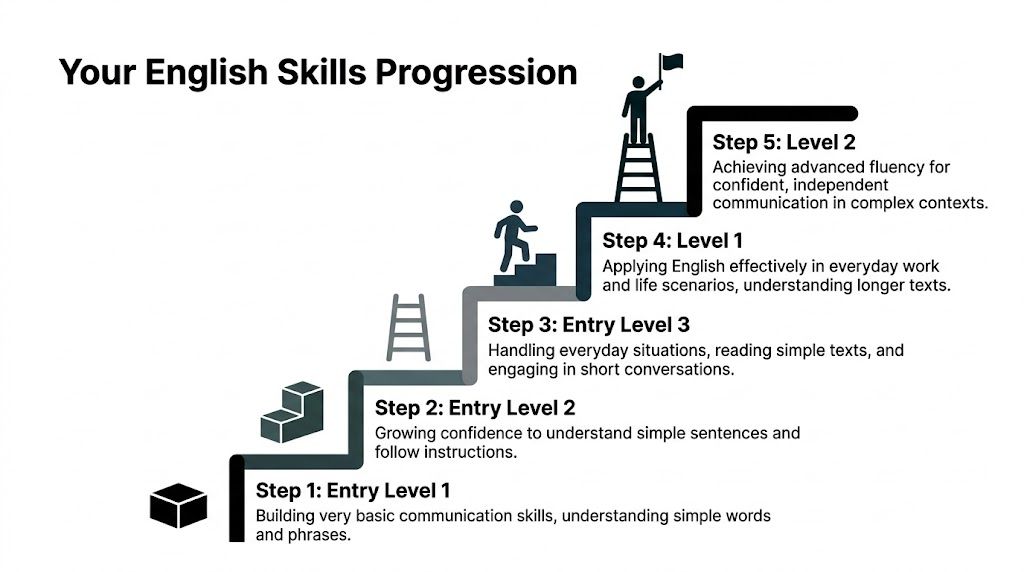
You do not have to start at the top to build a better future. Many adults begin Functional Skills English after years of feeling unsure about reading, writing, or speaking with confidence. Starting at the right level gives you a fair place to begin, and that often makes the whole journey feel possible.
It works like climbing a ladder. Each rung gives you something solid under your feet before you reach for the next one.
The early levels help you settle and grow
The Entry Levels are for learners who need to rebuild the basics in a calm, structured way. That is not a setback. It is a strong place to begin.
- Entry Level 1 focuses on simple words, short phrases, and very basic communication.
- Entry Level 2 helps you understand straightforward instructions and write with more control.
- Entry Level 3 develops more independence in everyday reading, writing, and short discussions.
For many adult learners, these first stages do more than build skills. They rebuild trust in yourself. Each small success helps replace the old voice that says, “I’m not good at English,” with a new one that says, “I’m getting there.”
Level 1 and Level 2 lead to wider choices
After Entry Level, the next stages are Level 1 and Level 2.
At Level 1, you start using English more confidently in real situations such as work tasks, forms, emails, and everyday conversations. Your reading becomes steadier, and your writing becomes clearer and better organised.
At Level 2, many adults reach the standard employers and colleges ask for. If you want a clearer picture of the value of this stage, it helps to read about what a Level 2 qualification means. For a parent, that can mean feeling proud when you help with school communication. For a career-changer, it can mean finally applying for roles you used to rule out.
The assessments are designed to be fair
The word exam can bring back bad memories. That fear is real, especially if school left you feeling judged or left behind.
Functional Skills English is built to assess practical ability at the level expected. Ofqual’s Functional Skills analytics show that pass marks are standardised rather than set unrealistically high. Recent completed-year results have also shown that many first-time learners do pass Level 2 Reading and Writing.
That matters. It means the qualification is not there to catch you out. It is there to show what you can do once your skills are ready.
What each stage gives you
Each level changes more than your English. It changes how you see yourself.
- Entry Levels help you build a base and feel safe learning again.
- Level 1 helps you become more consistent in day-to-day communication.
- Level 2 helps you meet a recognised standard that can support work and further study.
Progress often looks quiet at first. You read a letter without panicking. You send a message without asking someone else to check it. You speak with less hesitation. Those moments may seem small, but they add up to something powerful. You start becoming the person your children notice, your employer can rely on, and you can feel proud of.
Functional Skills English Versus GCSEs Explained
You might be sitting at the kitchen table after work, looking at your options and wondering which path makes sense. You do not want to choose the wrong course, waste time, or end up back in the kind of learning that once knocked your confidence.
That worry is understandable. The good news is that both qualifications have value. The right choice depends on what you need English to do for you now.
Functional Skills English is usually the better match for adults who want practical progress they can use in real life. GCSE English Language is also respected, but it often suits learners who are happy with a broader academic course and a more traditional style of study.
A quick side by side view
This comparison can help you see the difference more clearly.
| Feature | Functional Skills English Level 2 | GCSE English Language |
|---|---|---|
| Main focus | Practical English for work, life and study | Broader academic English study |
| Style of learning | Real-world communication tasks | More traditional course structure |
| Reading content | Everyday texts and useful information | Wider text analysis |
| Writing content | Clear, purposeful writing | Broader writing and language analysis |
| Best for | Adults needing useful English now | Learners who want a more academic route |
A simple way to view it is this. Functional Skills helps you build the kind of English you use at work, at home, and in training. GCSE asks you to study English more widely, including analysis and a more school-style approach.
For an adult learner, that difference matters. If you want to fill in forms with confidence, write clear emails, understand workplace information, and support your children with day-to-day reading and writing, Functional Skills often feels more relevant from the start.
Why many adults choose Functional Skills
Adults usually return to learning for a reason. A better job. A college course. More confidence. The ability to set a stronger example at home.
Functional Skills fits those goals well because the learning stays close to everyday use. You practise reading for meaning, writing with a clear purpose, and communicating in a way people understand. It works like learning to drive on real roads rather than only reading about road signs from a textbook.
That practical focus can lower anxiety too. Many adult learners are not looking to relive school. They want to feel capable in the world they live in now.
GCSE English Language still suits some learners well. If a course, employer, or future plan asks for GCSE specifically, that route may be the right one for you. If you want to compare that option in more detail, this guide to studying GCSE English online can help.
Choosing the right route is a sign of progress
Some adults worry that Functional Skills will be seen as a lesser choice. In reality, it is a focused qualification with a clear purpose. It shows that you can read, write, speak, listen, and respond in practical situations.
That matters in everyday life. It matters when you apply for work, speak to colleagues, read instructions, or write to a school or training provider.
The strongest choice is the one that fits your goal and helps you keep going.
If Functional Skills gives you a realistic, encouraging route back into learning, that is not settling. That is building a future in a way that works for your life, your confidence, and the people who are looking up to you.
Your Path to Success with Next Level Online College
It is 9:30 at night. The children are finally asleep, the washing up is still waiting, and you are looking at your laptop wondering whether now is really the time to start learning again.
For many adults, that moment feels heavy. You may be carrying old memories from school, worries about time, or the quiet fear that you might try and not succeed. You might ask yourself if you have left it too late, or whether study can fit around work, family life, and ordinary tiredness.
Those feelings make sense. They are common. They also do not tell the full story.

Next Level Online College is designed for people with real lives and real responsibilities. Adult learners are often carrying far more than coursework. They are carrying jobs, caring roles, bills, self-doubt, and the hope that gaining this qualification could lead to something better for the people who depend on them.
That is why the learning experience matters so much. A good course is not only about what is taught. It is also about whether the course feels manageable, clear, and encouraging from the first step to the final assessment.
Flexibility helps learning fit real life
Adult study rarely happens in long, quiet afternoons. It usually happens in the gaps. A bit before work. A bit after dinner. A bit on a Sunday morning while the house is calm.
Flexible online learning works like a course that bends around your life instead of asking your life to bend around the course. That can make a huge difference if you are trying to keep going without dropping everything else.
It can help because:
- Parents can study around family routines. Learning can fit between school runs, meals, and bedtime.
- People in work can protect their income. You do not need to put life on hold to keep progressing.
- Learners can build confidence at a steady pace. Small, regular progress often works better than trying to do too much at once.
Support matters just as much as the course content
Many adults do not need someone to talk down to them. They need someone to explain things clearly, answer questions patiently, and give feedback that helps them improve.
Good support can steady you when your confidence dips. It can show you how to revise if you have not studied for years. It can help you prepare for assessments without feeling lost. It can also remind you that struggling with one topic does not mean you are failing.
Learning English as an adult often feels emotional as well as practical. You are not only building reading and writing skills. You are rebuilding trust in yourself.
A supportive course helps that happen.
Why online learning suits many returning learners
Online learning can remove some of the pressure that made education feel hard in the past. You can revisit a lesson. You can pause and try again. You can learn in your own space without worrying about keeping up with a room full of people.
That quieter start helps many adults find their feet again. It gives you time to grow in confidence before you are tested on what you know.
For some learners, the biggest change begins with a simple thought. Maybe I can do this after all.
And once that thought takes hold, studying Functional Skills English can become more than a qualification. It can become proof to yourself, and to your family, that your future is still open.
What Happens After You Pass and Doors Start Opening
Passing Functional Skills English can lead to practical changes very quickly. You may be able to apply for jobs that once felt out of reach. You may feel ready to move onto another qualification. You may finally stop seeing education as a closed door.
For some learners, the next step is further study. That might mean another course, job training, or preparing for university in the future. For others, it means bringing more confidence into the role they already have and going for progression they once avoided.
The visible changes and the deeper ones
The visible change is the certificate. That matters. It gives you proof of your effort and your ability.
The deeper changes often matter even more.
- You trust yourself more
- You speak with more confidence
- You stop shrinking away from forms, emails and applications
- Your children see you learning and growing
That last point is powerful. Children notice what adults do. When they see you study, keep going, and achieve something important, they learn that setbacks don’t define a person. Effort does.
Why families feel the impact too
A qualification can lift the whole mood of a home. Not because life turns perfect overnight, but because hope becomes more real. You may feel prouder. More capable. More open to opportunities you used to dismiss before even trying.
You might be the parent who can now help more with schoolwork. The partner who feels ready to apply for that better role. The person in the family who proves that starting again is brave, not embarrassing.
Success in English isn't only about passing a subject. It's about becoming someone who believes new doors can open.
If you’ve been asking what is functional skills english, the biggest answer may be this. It is a way forward. Not just into study or work, but into a stronger, more confident version of yourself.
Your Questions Answered About Functional Skills English
Is Functional Skills English a real qualification
Yes. It is a nationally recognised qualification designed under the Department for Education’s subject content for practical English skills in life and work, as set out in the earlier government reference. That means it has real value and is not an informal short course.
Do employers accept it
Many employers do accept Functional Skills English because it shows practical communication ability. It is respected as evidence that you can read, write, speak and listen effectively in everyday situations.
Can it help with further study
Yes, it can support progression to employment and further study. For many adult learners, it becomes an important stepping stone towards bigger goals.
What if I’ve been out of education for years
You won’t be the only one. Many adult learners return after a long break and feel nervous at first. That’s normal. Functional Skills English is designed to be practical and more approachable than many people expect.
Is Level 2 the main goal
For many adults, yes. Level 2 is often the level that gives wider progression options. But the right starting point depends on your current skills, and starting lower is still strong progress.
Are the tests impossible if I’m not confident
No. The qualification is designed to be accessible. As covered earlier, the available pass rate data and standardised pass marks show that the assessments are not set at an unrealistic level. With preparation and support, many adults do well.
What do I actually study
You build skills in:
- Reading: Understanding and using written information
- Writing: Communicating clearly with accurate structure, spelling and punctuation
- Speaking and listening: Sharing ideas, listening carefully and responding well
How long does it take
The time can vary from learner to learner. It depends on your starting level, your schedule, and how much study time you can manage each week. A steady routine usually matters more than speed.
What if I fail the first time
Needing another attempt doesn’t mean you can’t do it. It usually means you need more practice, more feedback, or a little more time. Adult learning is not about being perfect first time. It’s about keeping going.
Is Functional Skills English better than GCSE for adults
Not always better for every person, but often more suitable for adults who want practical English for work, family life and further study. It can be a smart choice when you want useful skills and a direct route forward.
If you're ready to rebuild your confidence and gain a recognised qualification that can move your life forward, Next Level Online College offers flexible online study designed for adult learners across the UK. With supportive teaching, practical courses, and a strong focus on helping you progress, it can be a good place to take that first brave step.