
You might be reading this after a long day. The house is noisy, your phone keeps buzzing, and there’s a part of you that still wants more from life, even if you haven’t said it out loud in a while.
Maybe you want a better job. Maybe you want to help your children with homework without that sinking feeling in your stomach. Maybe you’ve looked at college or university before and thought, “That’s for other people, not me.”
It is for you.
Many adults think going back into education means going back to the version of school that made them feel small, confused, or left behind. That isn’t what this is. Functional skills courses online are about building practical English and maths skills for real life, in a way that fits around work, family, and everyday responsibilities.
You don’t need to have everything figured out today. You only need to believe that your future can still change.
It Is Never Too Late to Build a Brighter Future
Leanne is the kind of person many people depend on. She gets the children ready, works hard, pays attention to every penny, and still worries she should be doing more. She’s bright, capable, and caring, but when forms need filling in or numbers get involved, her confidence disappears.
That feeling is more common than is often realised.
For many adult learners, the hardest part isn’t the study itself. It’s the story they’ve been telling themselves for years. “I’m not academic.” “I missed my chance.” “I’m too old now.” Those thoughts can feel heavy, especially when you’re trying to hold family life together and keep everyone else going.
This isn’t about going backwards
Functional Skills can be a fresh start. They don’t ask you to become a different person. They help you strengthen skills you already use in daily life, such as reading clearly, writing with confidence, and handling numbers without panic.
That can change more than your CV.
It can mean feeling calmer when you read a letter from school. It can mean speaking up at work because you trust yourself more. It can mean showing your children that courage doesn’t always look loud. Sometimes it looks like opening a laptop after dinner and trying again.
You don’t need a perfect past to build a strong future.
Small steps can lead to big pride
A course can begin with something simple. One lesson. One tutor message. One piece of work completed on a quiet evening. Then another.
Over time, those small steps build something powerful:
- More confidence at home when helping with homework or reading important information
- More options at work when jobs ask for English and maths qualifications
- More belief in yourself when you prove you can finish what you started
- A stronger example for your children because they see you learning, growing, and not giving up
You may be closer than you think to the life you want. Not all at once. Not overnight. But step by step, with support, it can happen.
What Are Functional Skills Anyway
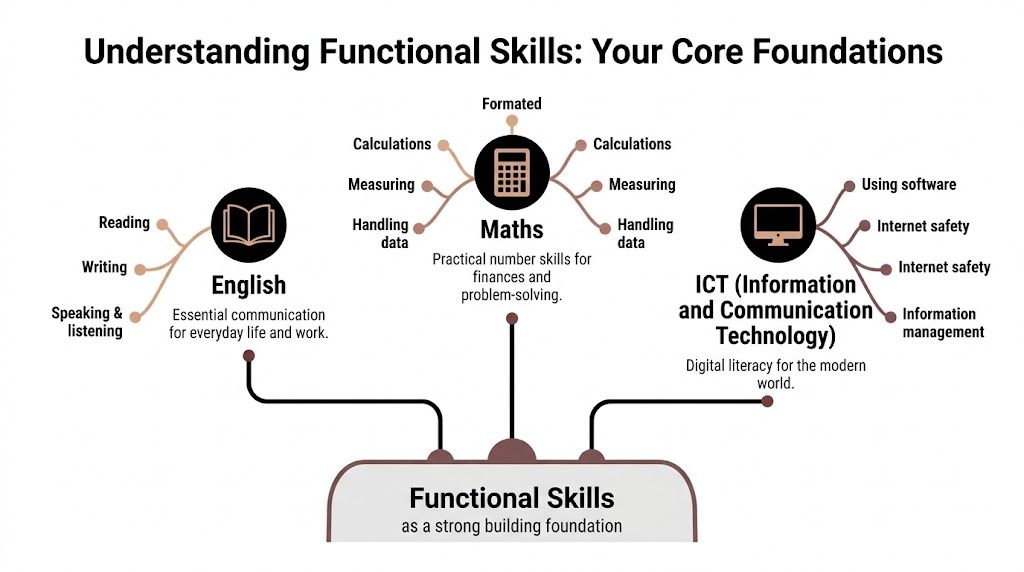
You might hear the words Functional Skills and wonder if they sound more complicated than they really are. In plain terms, they are practical qualifications in English and maths that help with everyday life, work, and further study.
They focus on skills you can use straight away. Reading a letter with confidence. Writing a clear email. Checking a bill. Working out a budget. Understanding a chart at work.
A simple way to view them is this. Functional Skills are the steady ground under your feet. Once that ground feels firm, other goals often feel closer and less frightening.
For many adult learners, that matters. These qualifications can open doors to jobs, college courses, apprenticeships, and training programmes. They can also change how you see yourself at home. A certificate is important, but the bigger change is often the feeling of pride that comes with saying, “I did that.”
What you study in English and maths
Functional Skills English centres on communication in real situations. You build skills in reading, writing, speaking, and listening so you can understand information, respond clearly, and express yourself with more confidence.
Functional Skills maths is about using numbers in ways that make daily life easier. That includes money, measurements, percentages, data, and solving practical problems.
Here is a simple snapshot:
| Subject | Focus in everyday life |
|---|---|
| English | Reading instructions, writing emails, filling in forms, speaking clearly |
| Maths | Budgeting, measuring, comparing prices, understanding tables and charts |
If you want a fuller overview of how these qualifications work, this guide to Functional Skills courses is a useful place to begin.
Understanding the levels
The word “levels” can sound intimidating at first. It helps to picture a staircase rather than a test of your worth. Each level gives you a place to start and a clear next step.
- Entry Level builds the basics and helps you grow confidence.
- Level 1 shows a stronger grasp of everyday English or maths.
- Level 2 is widely accepted for many jobs and further learning routes.
You do not have to guess where you belong. Good courses usually help you find the right starting point, so you can begin at a level that feels stretching but realistic.
Why people often choose Functional Skills
Many adults choose Functional Skills because the learning feels relevant. You are not spending time on content that seems far away from your life. You are building skills that can help you at work, at home, and in those small moments that shape confidence.
People often study for reasons like these:
- Getting ready for work opportunities that ask for English and maths
- Meeting entry requirements for apprenticeships or college courses
- Handling daily tasks with less stress such as forms, school messages, and household budgeting
- Becoming a stronger role model at home by showing that learning can happen at any age
Start where you are. That is enough.
What matters is not how long you have been away from education. What matters is that each lesson helps you build a life that feels more secure, more hopeful, and more in line with the example you want to set for your family.
Real People Real Success Stories
Success doesn’t always begin with confidence. Often, it begins with doubt, mixed with a quiet hope that life could be better.
That’s why adult learner stories matter so much. They remind us that progress often starts with ordinary people who decide they’re tired of standing still.
Sarah wanted to help at home and found a new direction
Sarah had always avoided maths when she could. When her son asked for help with homework, she tried her best, but she often felt embarrassed. She worried that he would notice she wasn’t sure.
She started studying to feel more capable at home. That was her first reason.
As her confidence grew, something changed. She stopped seeing herself only as someone who had missed out. She started seeing herself as someone who could still move forward. The same confidence that helped her at the kitchen table also helped her think about work in a new way. She began to believe she could apply for a school-based support role and speak about her strengths with more pride.
David wanted more responsibility at work
David had been reliable for years. He turned up, worked hard, and people trusted him. But when chances for promotion came up, he held back. Written tasks, reports, and formal communication made him second-guess himself.
Studying English gave him a way to practise without pressure. He learned how to write more clearly and read instructions with greater confidence. That didn’t just help him on paper. It changed how he carried himself.
Soon, he wasn’t the person hanging back in meetings. He was the person sharing ideas.
Sometimes the qualification opens the door. Sometimes the confidence does. Often, it’s both.
Maria thought university had passed her by
Maria left education years ago and had carried that regret ever since. She’d look at course pages online and close them again. University felt too far away. She thought she had left it too late.
Functional Skills gave her a first step that felt possible.
Not easy, but possible. That difference matters. Once she had a plan, the dream stopped feeling like fantasy and started feeling like a route. A route with stages, support, and progress she could see.
Why these stories matter
These stories are examples, but the feelings behind them are very real. Adult learners often begin in one place and finish somewhere much bigger than they expected.
A qualification can lead to:
- Pride because you kept going even when life was busy
- Relief because everyday tasks stop feeling so hard
- Ambition because one success makes the next goal feel reachable
- Hope because your future starts to feel open again
You don’t need to copy someone else’s journey. Your reason might be your children, your job, your confidence, or a dream you buried a long time ago.
That reason is enough.
How Online Study Fits Into Your Busy Life
It is 9:15 at night. The washing up is done, the children are nearly settled, and your phone is still buzzing with things to sort out tomorrow. A traditional class can feel out of reach in that kind of life. Online study gives you another way in.

For many adults, the problem is not ability. It is finding a way to learn without letting everything else fall apart.
That is why functional skills courses online appeal to so many people. They let study fit into the life you already have, instead of asking you to pause work, parenting, or everyday responsibilities just to get started.
Learning can fit around real responsibilities
Online learning works a bit like keeping a slow cooker on during a busy day. You do not need one huge block of free time to make progress. Small, steady pockets of effort can still lead somewhere important.
You might study before the school run. You might read through a lesson on your lunch break. You might spend twenty minutes in the evening practising maths questions after the house goes quiet.
Those short sessions count.
For adult learners, that matters more than perfection. A course only helps if you can return to it again and again without feeling guilty for having a full life.
Structure still matters
Flexibility helps, but freedom without direction can feel overwhelming. Good online courses give you a clear path, so you know what to study, what comes next, and how each step builds on the last.
That clarity can calm a lot of fear. Instead of staring at one big goal that feels too far away, you can focus on one lesson, one topic, one win at a time. If you are exploring a Functional Skills maths online course for adult learners, look for a programme that breaks learning into simple stages and explains each step clearly.
A good course should feel like a guide beside you, not a pile of worksheets left at your door.
What flexible study can look like
Online learning often slips into the gaps that already exist in your week.
- Short evening sessions help you keep going without draining all your energy
- Weekend study time gives you space for topics that need more attention
- Quick revision slots can turn half an hour into real progress
- Recorded lessons or repeat practice help when you need to go over something again
This short video gives a useful feel for how online study can fit into everyday life.
Learning at home can feel safer
Many adult learners worry about keeping up, asking the wrong question, or feeling embarrassed after time away from education. Studying online can ease some of that pressure.
You can pause a lesson. Re-read instructions. Write notes slowly. Try again without anyone watching.
That matters more than it may seem. Confidence grows best when there is room to practise privately first. Then, over time, the subject that once felt intimidating starts to feel familiar.
Study works better when it fits the person you are now, including your responsibilities, your worries, and your hopes for the future.
And those hopes are often bigger than a certificate. When a parent studies at the kitchen table, children notice. When you keep showing up for your course, even in small ways, you are showing your family what persistence looks like. You are not only gaining a qualification. You are building proof that change is still possible, and that can shape the future of your whole household.
Finding a Course That Truly Supports You
You might be sitting at the table after a long day, looking at two course pages that seem similar, and wondering which one will help you finish. That question matters. The right course can steady you when motivation dips, help you make sense of a difficult topic, and remind you that you are capable of more than you may have believed for years.
For many adults, choosing a course is not only about study. It is about trust. You are giving your time, your money, and a very personal hope for a better future. A course should treat that with care.
Start with the qualification
First, check that the qualification is recognised and regulated.
This is the foundation. If the course is unclear about what you will achieve, what level it is, or where it can lead, pause and ask more questions. A clear provider should be able to explain this in plain English.
You deserve to know that your hard work leads somewhere real. That could mean a new job, access to further study, or the confidence to apply for opportunities you may have ruled out before.
Choose support that feels human
Good teaching materials matter, but people matter too.
Adult learners often carry old school memories with them. A confusing lesson can quickly wake up that old voice that says, “Maybe I’m just not good at this.” Support helps quiet that voice before it grows louder.
Look for signs that real help is available, such as tutors who answer questions, staff who explain your starting level clearly, and guidance after enrolment so you are not left guessing what to do next.
Before you sign up, ask:
- Can I contact a tutor if I get stuck
- Will someone help me choose the right level
- How quickly do learners get replies
- What happens after I enrol
- Is there support if I lose confidence or fall behind
Clear answers usually point to a course that has thought carefully about adult learners. Vague answers often mean you may be left to manage on your own.
A supportive course helps you learn the subject and believe in yourself again.
Make sure the lessons make sense for adult life
Adults usually need learning that is clear, respectful, and practical. You are not looking for complicated wording or long explanations that never get to the point. You want lessons that show one step, then the next step, then give you a chance to try.
That works like climbing stairs instead of trying to jump to the top in one go.
A strong course often includes:
| What to look for | Why it helps |
|---|---|
| Clear language | Helps you focus on learning instead of decoding jargon |
| Step-by-step teaching | Builds confidence one stage at a time |
| Everyday examples | Connects maths or English to real life |
| Simple online access | Makes it easier to study around family and work |
This matters even more if you have been out of education for a while. Good materials lower the pressure. They help you feel that progress is possible.
Look for courses that prepare you for real life
A good course should help with more than passing a test. It should help you feel more capable in everyday life and in work. Reading instructions clearly, handling numbers with less stress, writing with confidence, and using online systems more comfortably all make a difference.
The UK Government’s Essential Digital Skills framework sets out the kinds of digital tasks adults may need for daily life and work, such as handling information, communicating, and completing tasks online. That is a useful reminder that learning today should connect to the world you live in now.
If maths is the area you want to build first, this guide to studying Functional Skills maths online can help you compare what a practical course looks like.
Use a simple checklist
You do not need a perfect course. You need one that is clear, supportive, and realistic for your life.
A short checklist can help:
- Recognised qualification
- Helpful tutors or learner support
- Lessons written for adults
- A clear explanation of levels and next steps
- Study and payment options that fit your situation
One more thing matters. Pay attention to how a provider makes you feel before you enrol. If the information is confusing, rushed, or hard to get, the learning experience may feel the same.
The right course should leave you feeling calmer, not smaller. It should give you a sense that this time, with the right support, you can finish what you started. And when you do, the result is bigger than a certificate. It is pride, momentum, and a chance to show your family what steady courage looks like.
Your Simple Path to Getting Started
Starting can feel bigger than it is. Many adults imagine forms, jargon, and pressure straight away. In reality, the first steps are often much simpler.
You don’t need to know everything before you begin. You just need a clear path and someone to help you take the first step.
Step one is finding your starting point
Individuals returning to education aren’t sure which level is right for them. That’s normal.
A good starting conversation should feel friendly, not like a test. The aim is to understand where you are now, what your goal is, and what kind of support will help you most. Some people want a better job. Some want to move towards university. Others just want to stop feeling anxious about English or maths.
Step two is choosing the right level
This part matters. Starting too high can knock your confidence. Starting at the right level builds it.
If you’re not sure how these qualifications compare with school-based ones, this guide on Functional Skills equivalence to GCSEs can make things easier to understand.
A strong start often comes from honesty, not pressure. It’s far better to begin at the level that helps you succeed than to rush into something that doesn’t suit you yet.
Step three is enrolling without stress
Once you know your course, enrolment is usually straightforward. You’ll normally complete an online form with your basic details and choose the course you want.
At this point, it helps to remember something important. Enrolment is not a promise that you’ll be perfect. It’s a decision to give yourself a chance.
Starting a course isn’t about proving yourself. It’s about backing yourself.
Step four is settling in and building momentum
After enrolment, the best experience is one where you feel welcomed. You should know how to log in, where your materials are, and who to contact if you need help.
Your first week doesn’t have to be huge. In fact, small beginnings often work best.
Try this simple approach:
- Log in and explore the course area without pressure.
- Read the first lesson so the content feels familiar.
- Set one study time in your diary for the week.
- Ask one question if anything feels unclear.
That first bit of momentum matters. Once the course becomes part of your routine, it starts to feel less like a scary unknown and more like a normal part of your life.
Top Study Tips for Amazing Adult Learners
Adult learners often think they need more confidence before they can do well. Usually, confidence comes after a few steady wins.
Good study habits help create those wins. They don’t need to be fancy. They need to be realistic.
Build a routine that respects your life
You don’t need hours of free time every day. Many adults do better with short, regular sessions than with long, exhausting ones.
A simple routine might include:
- One fixed study slot each week that rarely changes
- A quiet space at the kitchen table, in the bedroom, or anywhere you can focus
- A notebook and pen so important points don’t stay floating in your head
- A small weekly goal such as finishing one lesson or one topic
The best routine is the one you can keep.
Keep study sessions short and clear
If you sit down thinking you must do everything at once, you’ll feel overwhelmed quickly. Break the work into small pieces.
Try asking yourself one question before each session. “What am I doing today?” The answer should be specific. Not “study maths”. More like “practise percentages” or “read one English task and answer the questions”.
That creates a finish line. Finish lines matter.
Let people support you
Many adults keep their study private because they feel shy about it. But support can make a big difference.
Tell someone you trust. That might be a partner, a friend, a child, or a workmate. Let them know why this matters to you. When other people understand your goal, they’re more likely to encourage you and protect your study time.
Remember your reason
There will be days when you don’t feel motivated. That’s normal. Motivation comes and goes. Purpose lasts longer.
Write down your reason and keep it where you can see it.
- For my children
- For a better job
- For university
- For my confidence
- For the life I want next
When motivation feels weak, return to your reason. That’s what keeps many adult learners moving.
Be kind to yourself while you learn
If a topic takes time, that doesn’t mean you’re failing. It means you’re learning.
Adults often carry old school memories into new learning situations. One confusing lesson can wake up old fears. Try not to let one difficult moment define your whole journey.
A better response is quieter and stronger. “I don’t get this yet, but I can come back to it.” That one word, yet, can change the whole feeling of studying.
Your Next Chapter Begins Today
You may have started reading this with uncertainty. Maybe even with that old voice in your head saying you’re not clever enough, not ready, or too late.
But none of those things has to decide your future.
Functional Skills can be more than a qualification. They can be the moment you stop letting old doubts run your life. They can help you move towards work that pays better, study that opens doors, and a version of yourself that feels stronger, calmer, and proud.
This step matters beyond the certificate
When adults return to learning, families often feel the change too. Children notice effort. Partners notice growing confidence. Even everyday life can feel different when reading, writing, and maths stop feeling like hidden battles.
That’s part of what makes this journey so powerful. You’re not only gaining skills. You’re showing what courage looks like in ordinary life.
You are allowed to want more
You’re allowed to want a better future. You’re allowed to want work you enjoy more. You’re allowed to want to sit in a classroom one day, or at a university desk, and know you earned your place there.
And you’re allowed to begin now, exactly as you are.
You do not need to wait until you feel fearless. Few ever do. You only need enough courage to take the first small step.
The next chapter doesn’t begin when everything is perfect. It begins when you decide your life can still grow.
If you're ready to take that first step, Next Level Online College offers flexible, fully supported online learning designed for adults returning to education. Whether you want to build confidence, improve your job prospects, or move towards university, their friendly team can help you find the right path forward.