
You might be looking at a university course page right now, seeing 104 UCAS points and wondering if you’ve already fallen behind. That feeling is common, especially if school was years ago, life got busy, and your confidence took a few knocks along the way.
But this number doesn’t mean “not for you”. It means there’s a target. A clear one.
For many adults, understanding 104 ucas points in grades is the moment the whole university process starts to make sense. Instead of a fog of jargon, you get something solid to work towards. That matters when you’re trying to build a better future, set an example for your children, or move into work that feels more secure, more meaningful, and better paid.
You don’t need to know everything today. You just need to understand the next step.
Your Future Starts with Understanding 104 UCAS Points
If you’ve been away from education for a while, university websites can feel cold and confusing. They use phrases like “entry tariff”, “Level 3 qualifications”, and “contextual offers”, and it’s easy to think everyone else understands it better than you do.
They don’t. They’ve just learned the language a bit earlier.

Why this number matters
104 UCAS points is a real entry point into higher education. It isn’t a fantasy target for perfect students. It’s a level many adults can work towards with planning, support, and steady effort.
That’s powerful, because once a target feels real, your dream stops feeling silly.
Maybe you want to prove something to yourself. Maybe you want your children to see you studying at the kitchen table and learn that it’s never too late to start again. Maybe you want a career that gives your family more stability. All of those reasons count.
Practical rule: Don’t treat 104 as a judgement of your ability. Treat it as a map reference. It tells you where you need to get to.
What adult learners often get wrong
Many adults assume university is only for people who took the “normal” route at school. That isn’t true. Universities accept different qualification types, and many learners reach their goal through a path that fits around work, caring responsibilities, and everyday life.
A few worries tend to show up again and again:
- “I’m too old.” You’re not. Adult learners return to study every year.
- “I messed up school.” Old results don’t have to decide the rest of your life.
- “I won’t understand the system.” You will, once it’s broken into simple steps.
- “I need perfect grades.” You need the right plan, not perfection.
A better way to look at it
When you understand 104 ucas points in grades, you can start making decisions with confidence. You can compare routes, check what universities want, and choose a path that works for your home life and your future.
That’s when things begin to shift. Not overnight, but properly.
The number on the screen stops looking like a closed door. It starts looking like a handle.
What the UCAS Tariff System Really Is
The UCAS Tariff is a way of turning qualifications into points so universities can compare them more fairly. The easiest way to think about it is this. It works like a currency converter for qualifications.
A-levels, BTECs, and other Level 3 courses aren’t identical. They have different structures and grading systems. The tariff helps universities place them onto one scale, so they can understand what you’ve achieved.
Why UCAS uses points
The current UCAS Tariff system was introduced in 2015 for university entry from 2017, and it was designed to standardise and fairly compare over 40 different types of Level 3 qualifications, including A-levels, BTECs, Scottish Highers, and the Welsh Baccalaureate, making the process more transparent for students, as outlined in the UCAS Tariff overview.
That means the system isn’t there to trip you up. It’s there to help universities read different qualifications in a common way.
For adult learners, that’s good news. Your path might not look neat or traditional. You might be mixing newer study with older qualifications. A tariff system gives structure to that.
What this means in real life
If a course asks for 104 points, the university is saying, “We’re looking for this level of achievement.” They may accept that level through different types of qualifications, not just one narrow route.
That’s why it helps to learn how grades convert into points. Once you understand the conversion, course pages become much easier to read.
If you want to get familiar with the grade side first, this guide to A-Level grades can help make the language less intimidating.
Universities aren’t only looking at whether you followed one perfect route. They’re looking at whether your qualifications meet the level needed for the course.
One point that confuses people
UCAS points and university offers are linked, but they aren’t always the same thing. Some universities use tariff points clearly. Others prefer specific grades or subjects.
So the tariff is a tool. It helps you compare and plan. It doesn’t replace the need to read each course page carefully.
That’s why understanding the system matters. Once you know what the points mean, you can stop guessing and start checking.
Key Ways to Achieve 104 UCAS Points
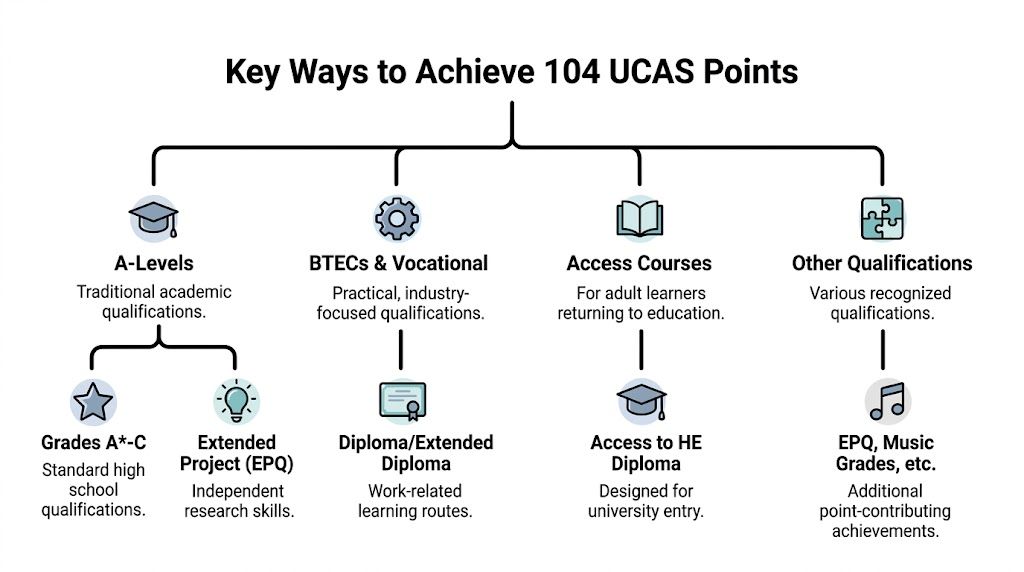
There isn’t just one way to reach 104 UCAS points. That’s one of the most helpful things to know, especially if you’re returning to study as an adult and need options that fit real life.
One well-known A-level route is BCC, because B = 40 points, C = 32 points, and C = 32 points, giving a total of 104 points. According to Save My Exams’ UCAS tariff explanation, achieving 104 points through grades such as BCC can open the door to over 1,200 UK higher education courses with entry requirements at or below that level.
A-level routes
If you’re looking at 104 ucas points in grades, A-level examples are often the easiest place to start because the numbers are clear.
Here are some combinations that reach 104:
| Qualification Type | Grades Needed | Total Points |
|---|---|---|
| A-levels | BCC | 104 |
| A-levels | ACD | 104 |
| Double award A-level | A*A | 104 |
| BTEC Level 3 National Diploma | D*D | 104 |
| Access to HE Diploma | D18 + M21 + P6 | 104 |
These examples show why the tariff is useful. It lets different qualifications lead to the same target.
If you’re exploring vocational options too, this guide to BTEC Level 3 UCAS points can help you compare routes more confidently.
BTEC and vocational routes
Not everyone wants to return through a purely academic path. Some adults prefer practical, career-focused study, and that can still support a university application.
A BTEC Level 3 National Diploma at D*D equals 104 UCAS points. For many learners, that route feels more natural because the style of learning is different from A-levels. It can suit people who prefer applied work and steady coursework.
Here’s a short video that gives extra context on tariff thinking and entry routes:
Mixed routes can work too
Some adults already have part of what they need. You may have an older qualification, a recent course, or a mix of subjects completed at different times.
That matters because universities often look at the total profile, not just a single neat package.
A sensible way to think about it is:
- If you want a traditional route, A-levels may suit you best.
- If you want a practical route, a BTEC may feel more comfortable.
- If you’re returning after a long break, an Access course may be the strongest fit.
The best route isn’t the one that sounds most impressive. It’s the one you can complete well and use confidently in your application.
How Universities Look at Your 104 Points
Reaching 104 UCAS points is a strong milestone. It shows you’ve built a qualification profile that can support a university application. But universities usually look at more than the total alone.
That’s important to know, because it helps you plan wisely instead of getting caught out later.
104 points is a recognised benchmark
A-level grades equivalent to 104 UCAS points, such as BCC, align with the median entry requirements for many mid-tier UK universities, making it a key and achievable threshold for accessing higher education, according to Explore Education Statistics.
That should give you reassurance. This isn’t a random figure. It sits in a real part of the admissions environment.
What universities often check alongside points
Even when a course uses tariff points, admissions teams may still ask extra questions about your application.
They may look at:
- Specific subjects: A course might want a subject linked to the degree, such as science, business, or health-related study.
- Recent study: If your older qualifications are from years ago, they may value newer evidence that you’re ready to study again.
- English and maths: Many courses want these separately, even when tariff points cover the main entry level.
- Your wider story: Adult learners often bring work experience, commitment, and strong reasons for returning to education.
That last point matters more than many people realise. If you’ve balanced jobs, children, or caring duties while studying, that says something important about your determination.
A university application isn’t only a scorecard. It’s also a picture of who you are, how you’ve prepared, and why you’re ready now.
Why course choice matters
Some courses are flexible. Others are more exact. A course in a vocational area may welcome a broader range of accepted qualifications. Another might want a specific subject background.
That doesn’t mean you should feel discouraged. It means you should compare courses carefully and apply where your profile fits well.
A thoughtful shortlist is often stronger than a hopeful one. If you choose courses that match your qualifications and your strengths, your application starts from a much better place.
Your Personal Roadmap to Success as an Adult Learner
Adult learners rarely have the luxury of a simple timetable and a quiet bedroom to study in. You may be fitting education around shifts, school runs, bills, and people who depend on you.
That doesn’t make university less possible. It just means your route needs to be built around real life.

Start with the path that fits your life
Some adults do best by taking A-levels. Others need a more direct university-preparation route. Some need to rebuild confidence first with English or maths before taking the next step.
Your roadmap might begin with one of these:
- A-level study if you want a familiar academic route and need subjects that universities know well.
- BTEC study if you prefer practical learning and want a qualification linked to work-related skills.
- Access to HE Diploma if you’ve been out of education for a while and want a route designed for university entry.
None of these choices is “less than”. They’re just different.
Why Access to HE works so well for adults
The Access to HE Diploma is a hugely popular route for mature students, with over 38,000 adults enrolling each year, and a combination such as 18 credits at Distinction, 21 at Merit, and 6 at Pass can meet the 104 UCAS point requirement, according to Oxford Brookes guidance on achieving 104 points.
That matters because many adults don’t want to spend years trying to recreate a school-based route that never suited them in the first place.
An Access course is often a better emotional fit too. It’s designed for people returning to learning, people changing direction, and people who want a proper chance to move forward.
If school didn’t bring out your best, that doesn’t mean education isn’t for you. It may just mean you needed a route built for the adult you are now.
Build your plan in small pieces
A good study plan doesn’t start with pressure. It starts with honesty.
Ask yourself:
- What qualifications do I already have? Old A-levels, BTECs, or other Level 3 study may still help.
- Do I need English or maths first? Some adults need to strengthen the basics before aiming for university entry.
- How much time can I really give each week? A smaller, steady plan is better than an unrealistic one.
- Which route feels doable, not just impressive? The right course is one you can stick with.
If you’re trying to make sense of progression routes, this guide on how to get into universities can help you think through the practical steps.
What success can look like
For one adult learner, success means earning BCC at A-level. For another, it means completing an Access diploma after years away from study. For someone else, it means first passing English and maths, then moving on to a Level 3 course.
Each of those journeys counts.
Try thinking in stages instead of one giant leap:
- Stage one: rebuild confidence
- Stage two: gain the qualification
- Stage three: apply to the right universities
- Stage four: step into a new career direction
That kind of progress changes more than your CV. It changes the way you see yourself.
And your children see that too. They see someone trying again, learning, growing, and refusing to stay stuck. That example stays with them.
Take Your First Step Towards a Brighter Future Today
By now, 104 UCAS points should feel much less mysterious. It’s a target you can understand, break down, and work towards.
That matters because confidence often grows after clarity, not before it.

You may be closer than you think
Many adults assume they must start from nothing. Sometimes that’s true. Often, it isn’t.
You may already have useful qualifications. You may only need one strong course to bridge the gap. And if you’re aiming at a vocational field, combining qualifications can be a smart move. For Business or Health Studies, an adult learner with a BTEC Level 3 National Diploma at D*D, worth 104 points, who adds a single A-level B, worth 40 points, can present 144 points, which strengthens an application for more competitive programmes, as explained in Whatuni’s tariff calculator guide.
That example shows something hopeful. Your future doesn’t have to rest on one exam result or one bad year from the past.
Three simple next steps
You don’t need to solve your whole future tonight. Start with these:
- Choose a direction: Look at courses that interest you. Motivation is easier to maintain when the goal means something.
- Check the entry requirements carefully: Look at points, subjects, and any English or maths requirements.
- Pick a realistic study route: A-levels, BTEC, or Access to HE. Choose the route that fits your life and gives you the best chance of finishing well.
Small, steady action beats waiting until you feel fearless. Most people begin while still doubting themselves.
Let this be your turning point
There’s something special about an adult learner deciding to return to education. It takes courage. It takes humility. It takes grit.
It also creates change that can last for years.
A qualification can lead to university. University can lead to a new job, a new level of income, and a new sense of purpose. But before all of that, there’s a quieter change. You begin to trust yourself again.
That might be the biggest win of all.
You don’t need to be the most confident person in the room. You just need to be willing to begin.
If you’re ready to turn your goal into a plan, Next Level Online College offers flexible online courses for adult learners working towards university, including Functional Skills, GCSEs, A Levels, and Access to HE Diplomas. If you’ve been waiting for the right time to start, this could be it.