

You might be reading this after work, with a cup of tea gone cold beside you, wondering whether your chance has passed.
Maybe you left school years ago. Maybe life got busy. Children, bills, jobs, caring for other people. You kept going, but part of you still thinks, “If only I had the right qualifications, things could be different.”
They can.
A Levels aren't only for teenagers in classrooms. They can be a fresh start for adults who want more from life. More confidence. More choices. A better career. A real shot at university. A chance to show your children that it’s never too late to grow.
Your Guide to A Levels for Mature Students
If you’ve ever felt embarrassed about going back into education, you’re not alone. Many adults worry they’ve been out of learning for too long. They tell themselves they’re too old, too busy, or not academic enough. I’ve seen those worries many times, and I’ve also seen people move past them.
It's simple. A Levels can still be for you. They can help you build a new future, even if school didn’t go the way you wanted the first time.

Why this path is more achievable than you may think
Success in A Levels is not rare. In 2025, the overall A Level pass rate in England reached 97.4%, showing how achievable success is, according to Tutorful’s summary of A Level pass rates by subject. That matters because adults often come back to study with a stronger reason to succeed.
You’re not doing this because someone told you to pick three subjects at school. You’re doing it because your life has taught you what matters. You want security. Pride. Progress. A better example for your family.
Big truth: Motivation looks different when you’re an adult. It often runs deeper.
What this could mean for your life
A Levels can help you move towards goals that once felt far away:
- University entry: Many degree courses ask for A Levels or equivalent qualifications.
- Career change: Some jobs and training routes open up once you have recognised Level 3 study behind you.
- Personal pride: Finishing a serious qualification can change how you see yourself.
- Family impact: Your children don’t just hear you talk about perseverance. They watch you live it.
For many adults, this isn’t just about grades. It’s about becoming someone who no longer says, “I wish I had tried.” It’s about proving to yourself that your story is still being written.
If your confidence is low right now, that doesn’t mean your ability is low. It just means you need a clear path, support that fits your life, and a starting point that feels manageable.
That’s what a levels for mature students can offer. Not a test of whether you’re clever enough, but a route towards the future you want.
What Are A Levels and Why They Matter for You
A Levels are recognised Level 3 qualifications. In plain English, that means they’re an important step after GCSE level and are widely accepted by universities, colleges, and employers.
A simple way to think about them is this. An A Level is like a master key. It can open doors that may have felt shut for years.
The doors A Levels can open
Some adults take A Levels because they want to go to university. Others want to train for a new role. Some want to apply for jobs where stronger qualifications give them a fair chance of being taken seriously.
Whatever your reason, the qualification has real weight.
Here’s what that key can help open up:
- Degree courses: Many university routes ask for A Levels as part of entry requirements.
- Professional training: Some career pathways expect this level of study before you can move forward.
- Better options at work: Employers often see A Levels as proof that you can learn, think clearly, and stay committed.
- Belief in yourself: This part isn’t listed on application forms, but it matters just as much.
Why adults often care more about the result
Teenagers are often choosing A Levels while still figuring out who they are. As an adult, you usually have a much clearer reason.
You may want a career that feels stable. You may want work that pays better and gives you room to grow. You may want to qualify for a degree so you can enter a profession that helps others. You may want to finish something you once thought was beyond you.
That purpose gives your study meaning. It turns revision from a chore into a step towards something bigger.
A Level study isn’t about going backwards to school. It’s about moving forwards with a recognised qualification.
What studying them actually involves
Typically, students take three A Levels, though the right number depends on your goal and your circumstances. Each subject goes into more depth than GCSE, so you’re not expected to know everything on day one. You build your understanding over time.
You’ll read, make notes, complete assignments or practice tasks, and prepare for exams. Some subjects are essay based. Others are more mathematical or scientific. The important point is that you don’t have to be brilliant at everything. You need the right subjects, a realistic plan, and steady effort.
If grade requirements feel confusing, a simple guide to understanding A Level grades can make the system much easier to follow.
Why this qualification still matters so much
A Levels are respected because they show more than subject knowledge. They show that you can:
- Stay organised
- Handle pressure
- Work independently
- Communicate clearly
- Keep going when something feels difficult
Those are not just study skills. They’re life skills. They help in university, in work, and in everyday responsibilities.
For adult learners, that’s why A Levels matter. They don’t just give you a certificate. They give you a recognised step-up that can move you closer to the life you want for yourself and the people you love.
Why You Are Ready for A Levels Even if You Don't Feel It
Many adults don’t struggle most with the course content. They struggle with the voice in their head.
It says things like, “I was never good at school.” Or, “I’m too old now.” Or, “What if I try and fail?” Those thoughts can feel heavy, especially if your confidence has taken knocks over the years.
But feeling unsure doesn't mean you aren't ready.
Your age is not the problem
There is no upper age limit for A Levels in the UK, and mature students are often defined as anyone over 19. Colleges value them for their focus, time management, and life experience, as explained in this guide to taking A Levels as a mature student.
That matters more than many people realise. You’re not trying to squeeze into a system that doesn’t want you. Adult learners are welcome.

The skills you already use every day
You may not call them study skills, but you already use them.
If you run a home, care for children, show up to work, manage a budget, or juggle appointments, you have built habits that matter in education too. You already know how to prioritise, adapt, and keep going when you’re tired.
Here’s how real life overlaps with successful study:
- Running a household: You already plan ahead, organise tasks, and solve problems quickly.
- Working a job: You know how to meet expectations, follow routines, and stay responsible.
- Raising children: You’ve built patience, persistence, and the ability to keep going on difficult days.
- Managing money: You understand trade-offs and long-term thinking, which helps when planning study time and goals.
You don't need to feel confident first
This catches many people out. They think confidence comes before action.
Most of the time, it doesn’t. Confidence usually comes after you start. It grows when you complete a piece of work, understand a topic you once found scary, or keep your promise to yourself for one more week.
“I’m nervous” and “I’m capable” can both be true at the same time.
What mature students often do better
Adult learners often bring something younger students are still developing. They know why they’re there.
That gives you an edge in ways that matter. You may waste less time. You may take feedback more seriously. You may be more willing to ask for help because you understand what’s at stake.
A mature student might study after the children are asleep, use a lunch break to review notes, then return to it again on Sunday afternoon. That routine may look ordinary, but it builds strong results over time.
If school hurt your confidence before
Some adults still carry old labels from school. Lazy. Average. Not academic. Distracted. Those labels can cling on for years.
They were never your whole story.
People change. Circumstances change. Support changes. Motivation changes too. The version of you who returns to learning now is not the same person who sat in a classroom years ago.
If you care deeply about creating a better future, you already have one of the most powerful reasons to succeed. Your life experience is not baggage. In education, it can become your strength.
How to Study A Levels Around Your Life
Adult life rarely leaves big empty spaces for study. Work needs you. Family needs you. Your home needs you. That’s why the way you study matters just as much as what you study.
For most mature learners, the main question isn’t, “Can I do A Levels?” It’s, “How do I fit them into everything else?”
Your main study routes
There are three common ways to study a levels for mature students in the UK. Each one suits a different kind of life.
Some adults like a structured classroom. Others need flexibility because their week changes all the time. Many want support, but can’t commit to fixed daytime lessons.
Here’s a clear comparison.
Comparing Your A Level Study Options
| Feature | Online College (e.g., Next Level) | Local Part-Time College | Full-Time College |
|---|---|---|---|
| Schedule | Flexible, usually around your own routine | Fixed sessions, often evenings | Fixed daytime timetable |
| Travel | Study from home or anywhere quiet | Travel required | Regular travel required |
| Best for | Adults with work, children, or changing commitments | Adults who want face-to-face sessions at set times | Learners who can commit large blocks of time |
| Pace | Often self-paced within course access period | Set by class schedule | Set by term timetable |
| Study environment | Your own space | Shared classroom | Shared classroom |
| Practical challenge | Requires self-discipline and planning | Requires attendance at specific times | Harder to combine with full-time adult responsibilities |
Why online study often fits adult life better
Online learning works well for many adults because it can fit around real life instead of asking real life to step aside.
You might study early in the morning before work. You might read through a topic at lunch. You might spend an hour on a Sunday while the washing machine is running and the house is quieter. That flexibility can make the difference between “I wish I could” and “I’m doing it”.
If you want to see how this route works in practice, distance learning for A Levels gives a useful overview of what flexible study can look like.
Practical rule: Choose the study method you can keep doing on ordinary weeks, not just on your best weeks.
A simple way to choose the right route
Ask yourself these questions:
When do I realistically have time to study?
Not ideal time. Real time.Do I learn better alone or with regular live classes?
Be honest. There’s no right answer.Can I travel easily every week?
If travel already drains your time and energy, that matters.Do I need flexibility because my job or family routine changes?
If yes, fixed classes may become stressful.
Making study work in a busy week
The best study plan is usually boring. It’s small, repeatable, and built around your real life.
Try a pattern like this:
- One main weekly session: A longer block when you can focus properly.
- Two short catch-up sessions: Quick revision, reading, or note review.
- One backup slot: A spare space in the week in case life gets in the way.
That kind of rhythm is often better than waiting for huge bursts of free time that never arrive.
Give yourself permission to study differently
As an adult, you don’t need to copy how school worked. You can build systems that suit your brain and your home.
Some people print notes and highlight them at the kitchen table. Some use digital flashcards on the bus. Some listen to recorded material while walking. Some keep a notebook nearby and grab ten minutes whenever they can.
What matters is consistency, not perfection.
You are allowed to learn in a way that fits your life now. In fact, that’s often what helps adult learners keep going long enough to finish.
Choosing A Level Subjects for Your Dream Career
Choosing subjects can feel like a lot of pressure. People worry that one wrong choice will ruin everything.
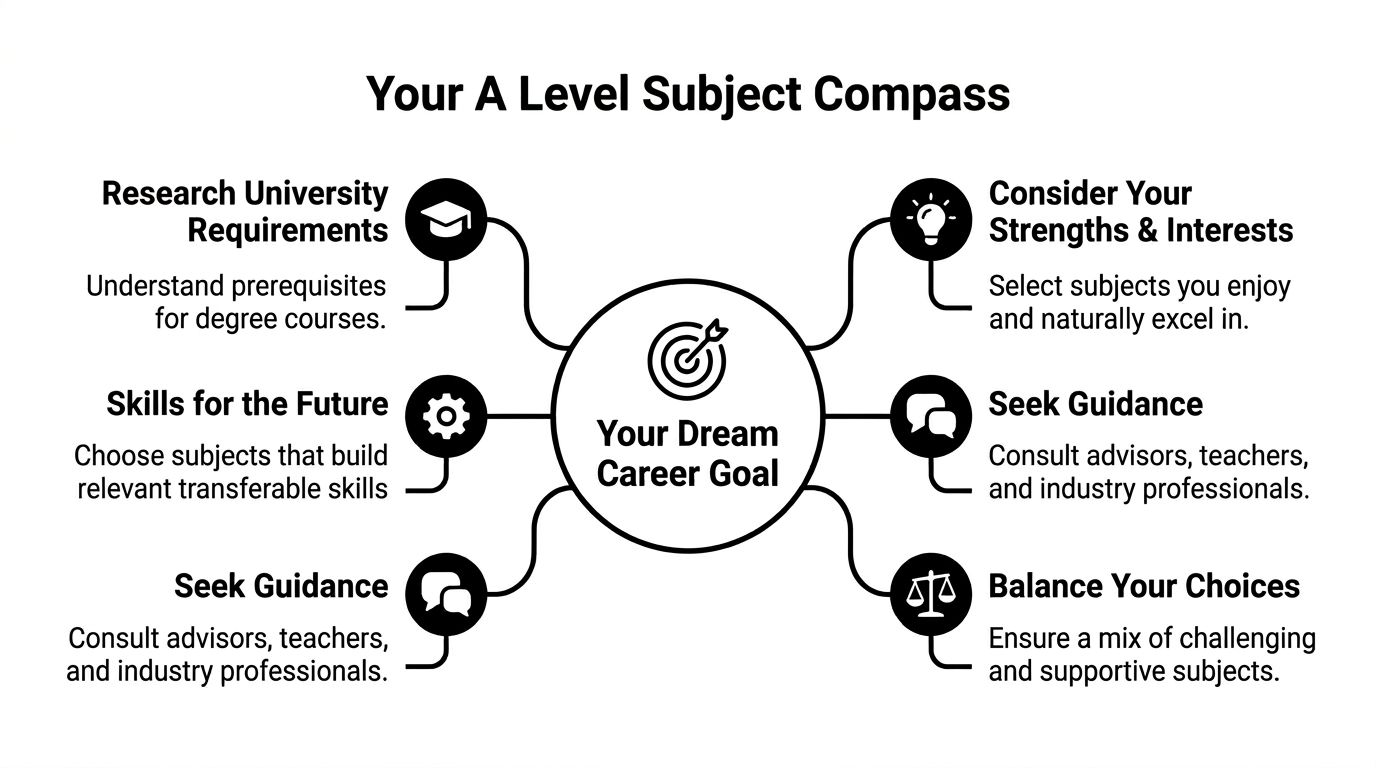
It usually isn’t that dramatic. You don’t need to guess perfectly. You need to make thoughtful choices based on your goals, your strengths, and the doors you want to keep open.
Start with the career, not the subject list
A good first question is not, “Which subject sounds easiest?” It’s, “Where do I want this to lead?”
If you already have a degree course or career in mind, look at the entry requirements first. Some routes ask for specific subjects. Others are more flexible.
Think in pathways.
Subject ideas by career direction
Healthcare and science
If you’re interested in nursing, health-related degrees, laboratory work, or science-based university courses, subjects such as Biology, Chemistry, and sometimes Mathematics can be useful choices.
These subjects often suit learners who enjoy understanding how things work, solving problems, and building careful knowledge over time.
Business and management
If your goal is business, accounting, management, or a broad university route, you might look at Mathematics, Business, Economics, or essay-based subjects that build strong communication and analysis.
This path can work well if you like structure, decision-making, and practical thinking.
Social sciences and people-focused careers
If you’re drawn to teaching, social work, criminology, psychology, or community-based roles, subjects such as Psychology, Sociology, History, or English may be worth exploring.
These help you build writing, argument, and understanding of people and society.
Creative and communication-based roles
For careers linked to writing, media, design, or humanities, subjects like English Literature, History, or other creative and analytical options may support your progress.
This route often suits people who enjoy ideas, storytelling, interpretation, and expression.
Why subject combinations matter
Choosing subjects that work well together can help. According to Ofqual’s A-level subject combinations analytics, strategic subject selection can significantly boost grades. The data shows that combining subjects like Mathematics and Physics can increase the chances of achieving A*/A grades by over 25% because of overlapping skills.
That doesn’t mean everyone should take Maths and Physics. It means your subjects shouldn’t fight each other if they don’t need to. When skills overlap, learning in one subject can support another.
Some combinations strengthen each other. That can make your workload feel more connected and your progress more steady.
A simple subject choice checklist
Use this when you’re narrowing your options:
- Check entry requirements: Look at the university course or training route you want.
- Notice your strengths: Choose at least some subjects that match what you already do reasonably well.
- Think about enjoyment: You’ll stay with subjects longer if they genuinely interest you.
- Balance challenge and confidence: Stretch yourself, but don’t pick three subjects that all drain you in the same way.
- Consider future flexibility: If you’re unsure about your direction, include subjects that keep more routes open.
Facilitating subjects in simple terms
You may hear the phrase facilitating subjects. This means subjects that are widely respected and often useful for university entry across a range of courses. Maths, sciences, English, and similar traditional academic subjects are often seen this way.
If university is your goal, these subjects can be especially helpful because they’re accepted across many routes. They won’t suit everyone, but they’re worth considering if you want strong progression options.
The best subject choice is the one that matches both your future and your reality. You are not picking subjects to impress strangers. You are choosing tools that can help build the life you want.
How to Fund Your A Level Studies as an Adult
Money worries stop many adults before they even begin. That’s understandable. If you’re working hard to keep your household going, spending money on yourself can feel uncomfortable, even when you know it could change your future.
This part needs honesty. Many guides talk about motivation but avoid the practical pressure. Yet this discussion of how adults study A Levels points out that real financial and time pressures are a major reason adults hesitate, and that being open about costs, payment plans, and return on investment builds trust.

Treat it as an investment, not a guilty expense
That doesn’t mean you should ignore the cost. It means you should view it clearly.
You’re not spending money on something random. You’re investing in qualifications that can help you apply for university, move into a different career, or become eligible for roles that were harder to access before. You’re also investing in confidence, which often affects how you speak, apply, plan, and push for better opportunities.
For many adults, that shift in thinking matters. The question becomes less about “Can I justify this?” and more about “What could staying stuck cost me over the next few years?”
Ways adults often make study more manageable
Funding A Levels as an adult usually means being practical and creative. Common approaches include:
- Monthly payment plans: Spreading the cost can make study feel more manageable than paying all at once.
- Employer support: If your subject links to your current role or future role in the organisation, it may be worth asking whether any help is available.
- Careful comparison: Different providers structure fees differently, so it’s worth checking what is and isn’t included.
- Planning for exam costs: If you study as a private candidate, exam fees may be separate, so it helps to budget early.
A small monthly amount can feel far more possible than one large total. That’s why transparent pricing matters.
Time is part of the cost too
Adults don’t only pay with money. They pay with time, energy, and attention.
That’s why your course choice and study plan matter so much. A cheaper course that doesn’t fit your life can end up costing more in stress, delays, or lost confidence. A more suitable route may help you stay consistent, which is often what gets people over the finish line.
Here’s a helpful explainer on studying and adult learning routes:
Questions worth asking before you enrol
Before committing, make sure you understand the full picture.
Ask things like:
- What does the course fee include?
- Are exams included, or booked separately?
- Is there a payment plan?
- What support do I get if I lose confidence or fall behind?
- Can I study around work and family commitments?
Paying for study feels easier when the path is clear and the provider is straightforward about what you’re getting.
You are allowed to invest in your future
Many adults will happily spend money on their children, their home, or everyone else’s needs before their own. That generosity is admirable, but it can also keep you at the bottom of your own list.
Your growth matters too.
If gaining A Levels helps you become more secure, more fulfilled, and more hopeful, that doesn’t only help you. It can help your whole family. Your children may grow up remembering not just what you provided, but the courage you showed when you decided to build something better.
Your First Step Towards a New Future Today
Starting often feels bigger than it really is. People think they need a full life plan before they can do anything.
You don’t.
You only need a first step that feels small enough to take this week.
Step one is remembering your reason
Write down why this matters to you. Keep it simple and honest.
It might be:
- I want to qualify for university
- I want a better job
- I want to feel proud of myself
- I want my children to see me finish something important
- I want more choices than I have now
When study feels hard, your reason helps you keep going.
Then look at the paths in front of you
Don’t try to solve everything in one sitting. Start by browsing subjects that connect to the future you want.
If university is part of your goal, read through how to get into universities so the route feels clearer and less intimidating. Once you understand the destination, subject choices start making more sense.
Keep your next action very small
A good next move might be one of these:
- List three careers or degree routes that interest you
- Write down the subjects you enjoyed most in the past
- Check entry requirements for one course
- Ask a provider what support adult learners receive
- Talk to someone who will encourage you, not talk you out of it
That’s enough for now.
You don't need to become a different person first
You don’t need to wait until you feel fearless. You don’t need perfect study habits before you begin. You don’t need to have all the answers.
You need willingness. You need a bit of courage. You need the honesty to admit that you want more, and the kindness to believe you’re still allowed to go after it.
The adults who succeed in education are not always the ones who start with the most confidence. They’re often the ones who decide their future matters enough to begin anyway.
Let this be the moment you stop counting yourself out
A levels for mature students are about much more than exams. They can become a turning point.
They can help you walk into rooms with more confidence. They can help you apply for opportunities you once dismissed. They can show your family what determination looks like in real life. They can help you build a future that feels bigger, steadier, and more hopeful.
You are not behind. You are not too old. You are not finished learning.
You may be closer than you think to a new chapter.
If you're ready to explore your options in a calm, supportive way, Next Level Online College offers flexible online courses for adult learners who want to study around work, family, and everyday life.