
You might be reading this after a long day. The kids are sorted, the house is quieter, and your mind keeps coming back to the same thought. You want more. Maybe you want a better job, a fresh start, or the chance to finally go to university. But part of you still hears that old voice saying you’re too late, too busy, or not academic enough.
That feeling is common. It doesn’t mean you can’t do this.
Many adults look at accredited online courses uk options because they need learning to fit around real life. Work still needs doing. Bills still need paying. Family still needs you. The right course doesn’t ask you to pause your life. It helps you build a better one, step by step.
Your Time to Shine A Fresh Start with Education
Take Sarah as an example. She left school years ago, got on with work, raised a family, and put herself at the bottom of the list. She wasn’t lazy. She was busy surviving. But when her children started talking about their own futures, she felt something shift. She wanted to show them that starting again is brave, not embarrassing.
That’s where many adult learners begin. Not with perfect confidence. With hope mixed with nerves.
An accredited online course can feel like a safe first step because it isn’t just “some course on the internet”. It’s a route that leads somewhere real. It can help you build skills, move towards university, or open the door to a more secure job. If you’re exploring flexible adult education courses online, that sense of direction matters.
Why this moment matters
Returning to education as an adult is about more than a qualification. It’s about changing the story you tell yourself.
Maybe school didn’t suit you the first time. Maybe nobody explained things in a way that made sense. Maybe life got in the way. None of that means you’ve missed your chance. Adult learners often bring something powerful to study. Patience, life experience, grit, and a clear reason for doing it.
You don’t need to feel ready to begin. You need a starting point that feels steady.
That’s why accredited online courses uk searches are so important. You’re not only looking for convenience. You’re looking for trust. You want to know your hard work will count, that your certificate will be recognised, and that the path you choose can lead to something better.
A better future can start small
You don’t need to decide your whole future tonight. You don’t need a five-year plan pinned to the fridge.
You might need to choose one next step:
- Build confidence first: Start with English or maths if those subjects have held you back.
- Open job options: Study for qualifications employers understand and respect.
- Aim for university: Work towards GCSEs, A Levels, or an Access to HE Diploma.
- Show your children what’s possible: Let them see you trying, learning, and growing.
That last point matters more than many people realise. When your children see you study, they don’t just see books and notes. They see courage. They see discipline. They see what it looks like to keep going.
What ‘Accredited’ Really Means for You and Your Family
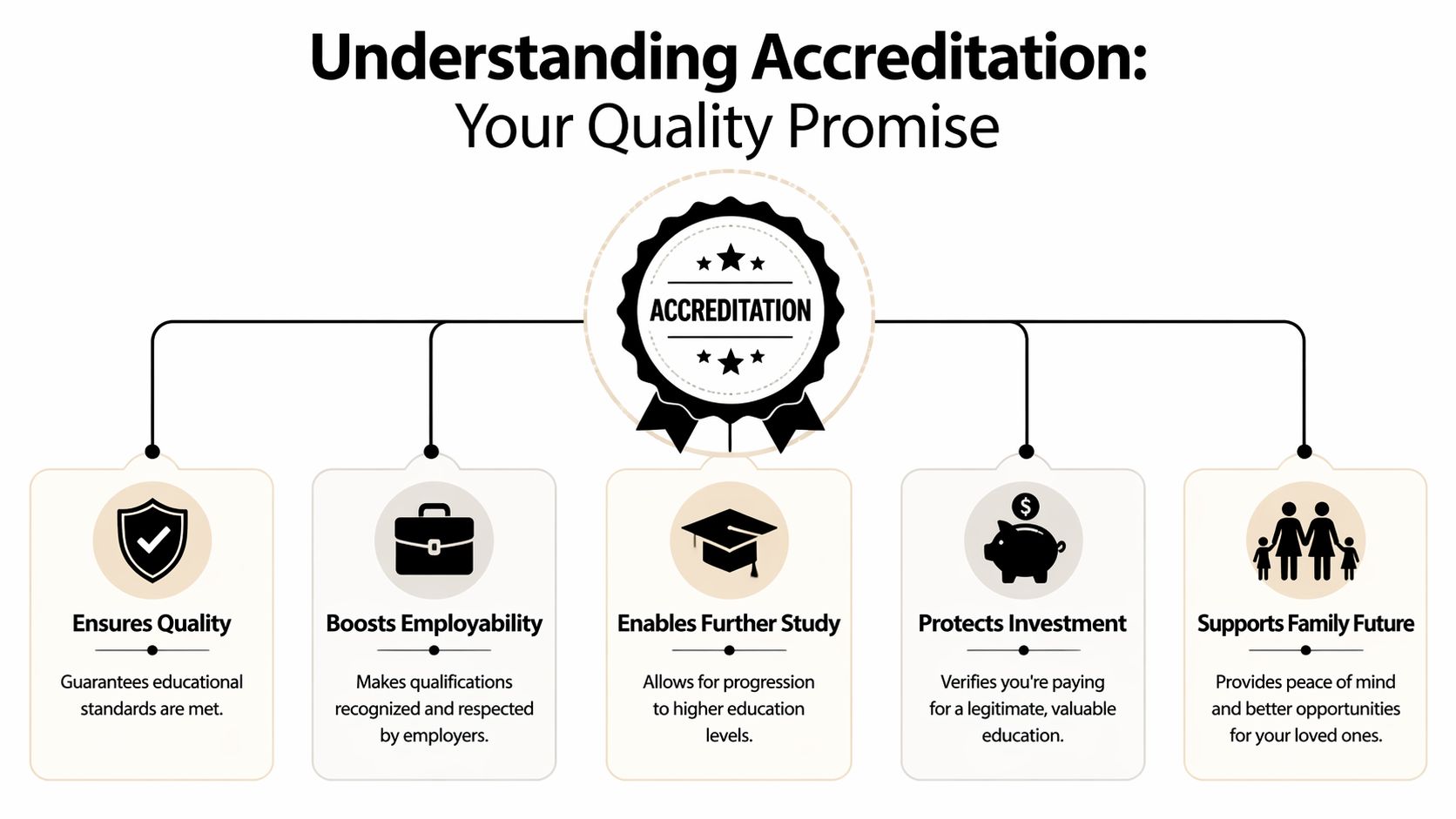
The word accredited can sound formal, but the idea is simple. It means your course has a quality promise behind it.
When considering a child’s car seat, you wouldn’t choose one with no safety checks, no standards, and no proof that it works. Education is similar. You’re investing time, effort, and money. You need to know the course is real, respected, and built properly.
The simple version of how it works
In the UK, there’s a system designed to protect learners.
- The rules are set nationally: Qualifications have to meet recognised standards.
- Ofqual checks the system: Ofqual regulates qualifications so online courses meet strict quality standards, just like in-person ones.
- Awarding organisations create qualifications: These are the bodies behind the certificate you earn.
That last part often confuses people. A course provider teaches and supports you. An awarding organisation is the recognised body that awards, or oversees, the qualification. When both parts are in place, you know you’re on solid ground.
Why this matters in real life
Accreditation isn’t just paperwork. It affects what happens after you finish.
Data shows 78% of UK HR managers reject non-Ofqual qualifications, and accredited course holders have a 40% higher employability rate, with pass rates for flexible online diplomas averaging 92%, according to UK guidance on accredited online courses and Ofqual-regulated quality. That tells you something important. Employers often check whether a qualification is properly recognised.
If your goal is a job, a promotion, or a route into further study, accreditation helps protect your effort.
Practical rule: If a provider can’t clearly explain who regulates the qualification and who awards it, pause before enrolling.
What accreditation gives your family
For adult learners, the benefit goes beyond you. It gives your family reassurance too.
A recognised qualification can mean:
- Real progression: You can move on to further study or use the course for career development.
- Less risk: You’re less likely to waste money on something employers or universities won’t accept.
- Peace of mind: Your partner, children, or parents can see that your study has a proper purpose.
- A stronger example at home: You’re showing that effort should lead to something meaningful.
Accreditation and online learning can work together
Some people still worry that online means lower quality. It doesn’t. A regulated online course can carry the same value as a classroom-based one when it sits inside the proper UK system.
That matters if you’re studying from your kitchen table while helping with homework, or revising on your lunch break in the car. The location is different. The standards don’t have to be.
For nervous learners, that can be a huge relief. You’re not choosing a second-best route. You’re choosing a flexible route that still has structure, checks, and recognised outcomes.
Finding the Right Key to Unlock Your Future
Not every qualification is for the same job or goal. That’s why it helps to think of each one as a different key for a different door.
If you pick the right key, everything feels clearer. If you pick the wrong one, you can still change direction, but it’s easier when you know what each route is for.
The main doors people want to open
Some adults want a foundation. They need English or maths to move forward. Others want university entry. Others want proof that they can achieve something they once thought was out of reach.
Here’s a simple guide.
| Qualification | What It's For | Who It's Best For |
|---|---|---|
| Functional Skills | Building core English and maths for work, daily life, and further study | Adults who need a practical starting point or want to improve confidence |
| GCSEs | Gaining recognised school-level qualifications often needed for jobs and courses | Learners who need formal grades in subjects like English, maths, or science |
| A Levels | Preparing for higher-level study and many university applications | Adults aiming for competitive courses or wanting traditional academic qualifications |
| Access to HE Diploma | Fast-tracking adults towards university study | Career changers and returners who want a direct route into higher education |
How to choose without overthinking
A simple way to decide is to start with your end goal.
If you want better basics in reading, writing, or maths, Functional Skills can be the right first move. These are often a confidence-building step for adults who’ve been out of education for years.
If an employer, college, or training course asks for specific grades, GCSEs are often the answer. They’re familiar, widely understood, and useful for many progression routes.
If university is the dream and you need more advanced entry qualifications, A Levels may be the right path. They ask for commitment, but they can open powerful doors.
If you’re an adult who wants to move into higher education without taking the longer school-style route, an Access to HE Diploma may feel more direct and purposeful.
A quick self-check
Ask yourself these questions:
- What do I want this course to lead to? A job, a better job, university, or confidence?
- What qualifications do I already have? Be honest, not harsh.
- Which subject has held me back most? That may be the best place to begin.
- How much study time can I realistically manage each week? A plan that fits your life is stronger than an ambitious plan you can’t sustain.
The best course isn’t the most impressive-sounding one. It’s the one that gets you to your next real goal.
Don’t let pride choose for you
Some adults skip foundation qualifications because they feel they “should” start higher. That can make the journey harder than it needs to be.
There is no shame in starting where you are. Functional Skills can lead to GCSEs. GCSEs can lead to A Levels or Access. Access can lead to university. Education is not a straight line for most adults. It’s a staircase, and every step counts.
If you’ve been searching accredited online courses uk because you want a path that fits family life, choosing the right level is one of the kindest things you can do for yourself. You’re making success more likely from day one.
How to Be Sure Your Course Is The Real Deal
Online learning gives you more choice. That’s good. But it also means you need to check what you’re signing up for.
A polished website doesn’t prove a qualification is recognised. A low price doesn’t always mean value. You need a simple way to tell whether a course is the real deal.
Your quick check list
Use this list before you enrol.
Look for the awarding organisation
The course page should clearly name the body behind the qualification. If that information is missing, ask why.
Ask a direct question
Send a message or call and ask, “Who is the awarding body for this qualification?” A trustworthy provider should answer plainly and confidently.
Check the wording carefully
“Endorsed”, “recognised by industry”, or “designed by experts” are not the same as a regulated qualification. Read slowly.
Use the Ofqual register
A quick search can help you confirm whether a qualification is regulated. If you want help understanding what proper recognition looks like, this guide to accreditation for online courses can make the language easier to follow.
Small signs that tell you a lot
Sometimes the warning signs are subtle.
- Vague course pages: If you can’t tell what qualification you’ll receive, be cautious.
- No mention of exams or assessment: Real qualifications usually explain how you’re assessed.
- Pressure to buy quickly: Good providers inform you. They don’t rush you.
- Confusing promises: If the claims sound bigger than the details, slow down.
A good provider won’t make you feel silly for asking questions. They’ll welcome them.
Trust your instincts and your notes
Write down what matters to you before comparing providers. That might be recognised qualifications, tutor support, flexible study, or a clear route to the next stage.
Then check each course against your list.
That one habit can stop you from enrolling based only on emotion. Nerves can make anyone grab the first option they see. A calm checklist gives you control. It turns you from a worried applicant into an informed learner.
More Than a Certificate A New You for Your Family
The moment you pass a subject you once feared can change something deep inside you.
It’s not just relief. It’s proof.
Proof that the voice saying “I can’t” was wrong. Proof that your past doesn’t decide your future. Proof that your children are watching someone who keeps going even when life is hard.

Confidence grows through action
Many adults wait to feel confident before they begin. In study, confidence usually comes after you begin.
It grows when you finish your first assignment. It grows when you understand something that used to confuse you. It grows when you sit an exam and realise you handled it better than you expected.
That inner change matters. It affects how you speak, how you apply for jobs, and how you carry yourself at home.
Your children notice more than you think
Children don’t only learn from what we tell them. They learn from what we do.
When they see you revising, asking for help, trying again after a hard week, and sticking with your goal, they see a living example of resilience. You become the proof that learning doesn’t stop at school and that setbacks aren’t the end of the story.
That example can shape the atmosphere in a home. Study starts to feel normal. Ambition starts to feel possible.
Some of the most powerful teaching your children will ever receive is watching you refuse to give up on yourself.
Support changes outcomes
There’s another important piece here. Adults do better when online learning includes real support.
The Open University reports that 75% of students complete their supported online programmes, and 85% of these graduates progress to higher study or secure better jobs, according to distance learning statistics on UK online Master’s in Statistics and adult learner outcomes. That matters because it shows supported online learning can work well for adults managing busy lives.
The key word is supported.
A good course isn’t only a pile of worksheets. It includes people who answer questions, explain difficult topics, and help you keep going when confidence dips. That human support can make the difference between stopping and succeeding.
A fuller kind of success
A qualification can help you move towards better-paid and more fulfilling work. It can strengthen job applications and open progression routes.
But the emotional rewards are just as powerful:
- Pride: You finish something important.
- Self-respect: You start seeing yourself differently.
- Purpose: Your week has direction.
- Hope: Your future feels open again.
For many adults, that’s where the real transformation begins. Not in the certificate folder, but in the mirror.
How You Can Afford to Invest in Your Dream
Money worries stop many adults before they even ask about a course. That’s understandable. When you’ve got rent, food, travel, and family costs to think about, education can feel like a luxury.
But for many people, it isn’t a luxury. It’s a route to a more secure future.

Start with the full cost, not just the headline price
A low advertised fee can be misleading if key costs are left out. That’s why your first question should be simple. “What will I pay in total?”
A 2025 government report showed 52% of working-class adults avoid study due to cost fears. The same source notes that many providers have hidden fees for things like exam resits at £50-£200, while trustworthy colleges offer transparent payment plans. It also explains that for Level 3+ courses like Access Diplomas, Advanced Learner Loans can cover fees, as outlined in guidance on accredited online courses in the UK and funding concerns for adult learners.
That tells us two things. Cost fears are real, and asking careful questions matters.
Questions worth asking before you enrol
Keep these written down when you speak to a provider:
- Are exams included?
- Do I pay extra for resits or certificates?
- Are learning materials included in the fee?
- Can I spread the cost monthly?
- Is there funding for this level of course?
If a provider answers clearly, that’s a good sign. If the answers stay fuzzy, be careful.
Money tip: A transparent payment plan is often safer than a cheap-looking course with missing costs.
Funding can make the journey possible
For some learners, paying monthly can make study manageable. It turns the cost into something that fits alongside ordinary household budgeting.
For others, formal funding is the key. If you’re looking at a Level 3+ route such as an Access to HE Diploma, it’s worth asking about an Advanced Learner Loan. That kind of support can make a big goal feel less out of reach.
You can also explore finance plans for online courses to understand how spreading payments might work in practice.
Reframing the cost
It helps to think carefully about what you’re buying.
You’re not only paying for lessons. You’re paying for a route forward. You’re paying for a qualification that can support career change, progression, and confidence. You’re paying for the chance to stop feeling stuck.
That doesn’t mean you should ignore your budget. It means you should weigh the decision fairly. Cheap and unclear can cost more in the end. Clear and manageable can be the wiser choice.
For many adults, the right course becomes one of the best investments they ever make. Not because it feels easy at the start, but because of where it can lead.
Your Next Step Taking Control of Your Future Today
By now, one thing should feel clearer. A good online course is not just a set of notes on a screen. The best accredited online courses uk options give you structure, recognised outcomes, and people who want you to succeed.
That last part matters more than many adults expect.
Support isn’t a bonus
When life is busy, study can feel lonely. You might miss a deadline because your child is unwell. You might lose confidence after one poor result. You might feel guilty for taking time for yourself.
That’s why human support matters.
A 2023 UK study found that 40% of distance learners cited mental health as a barrier. The same source reports that Ofqual data from 2025 shows providers with mandatory pastoral support, like mentor check-ins and wellbeing advisors, retain 25% more mature students, according to UK guidance on online learning platforms and adult learner wellbeing support. Those figures show something very practical. Support helps people stay the course.
What good support can look like
Not all support looks the same. Sometimes it’s academic. Sometimes it’s emotional. Often, adult learners need both.
Look for signs like these:
- Tutor access: Someone explains the subject when you get stuck.
- Regular check-ins: A mentor notices if you go quiet.
- Wellbeing support: You have somewhere to turn when stress builds up.
- Clear study planning: You get help breaking a big goal into smaller steps.
This isn’t about being dependent. It’s about studying in a realistic way. Adults have responsibilities. Support respects that.
If a course offers flexibility without support, the flexibility can turn into drift. The strongest online learning gives you both freedom and guidance.
Your next move can be small
You don’t need to make a huge leap tonight. You don’t need to promise yourself perfect discipline, straight distinctions, or a dramatic life overhaul by next month.
A better next step is simpler.
Make a list of your goals. Ask what qualification matches them. Check that the course is regulated and clearly awarded. Ask what support is there when life gets hard. Ask the full cost. Then have a conversation.
That conversation matters because it turns a vague dream into a practical plan. It gives you clarity. It helps you choose with confidence instead of fear.
You are not too old. You are not behind. You are not asking for too much by wanting a better future for yourself and your family.
You’re allowed to begin again. And this time, you don’t have to do it alone.
If you're ready to talk through your options with someone who understands adult learners, Next Level Online College offers flexible recognised courses with academic and pastoral support designed around real life. A simple conversation could help you find the right starting point.