
You might be reading this after a long day. The house is noisy, your phone keeps buzzing, and part of you is wondering whether studying again is really for someone like you.
It is.
Many adults in the UK come back to learning after years away from school or college. Some want a better job. Some want to get into university. Some want to prove to themselves, and maybe to their children, that it’s not too late to start again. If that sounds like you, you’re not behind. You’re brave.
Distance learning can be the doorway that makes this possible. It lets you learn around real life instead of asking real life to stop. That matters when you’re working, parenting, caring for others, or rebuilding your confidence one step at a time.
This isn’t a tiny niche either. The UK’s online education sector was valued at £4.7 billion in 2024, with over 760 businesses providing courses, which shows how many people are choosing flexible learning to move forward with their lives, according to UK online learning market data.
The important part isn’t just the market size. It’s what that growth means for you. It means flexible study is normal. It means you’re not odd for wanting a second chance. It means there are real, recognised routes you can take from your kitchen table, your sofa, your lunch break at work, or the quiet hour after everyone else has gone to bed.
Your Time to Shine A New Chapter Starts Today
Let’s talk about the feeling many adults carry in silence. You want more, but you’re not sure where to begin. You may have left school early, had a bad experience in education, or spent years putting everyone else first.
That doesn’t mean your chance has gone.
A lot of adult learners start with a simple thought. “I want my children to see me try.” That thought can grow quickly. It becomes, “I want a proper qualification.” Then, “I want a better job.” Then, “Maybe I could go to university after all.”
The dream is often very ordinary
It might look like this:
- You want stability: a job with better pay, clearer hours, or room to progress.
- You want pride: not the loud kind, but the quiet kind that comes from finishing something important.
- You want to be a role model: showing your family that learning doesn’t stop when school ends.
- You want choice: the freedom to say yes to new opportunities instead of feeling stuck.
Distance learning works because it meets you where you are. You don’t have to put your life on hold to begin. You start with the life you already have, then build study into it bit by bit.
You don't need to feel fully confident before you begin. For many adults, confidence grows after the first small win, not before it.
Why this path feels different
Traditional study can feel hard to imagine if your days are already full. Fixed timetables, travel, childcare, and lost work hours can make learning seem out of reach.
Distance learning is different. It gives you a way to move forward without pretending life is simple. That’s why so many adults are drawn to distance learning courses UK options when they’re ready for a fresh start.
If you’re nervous, that’s normal. If you’re hopeful, hold on to that. Hope is often the first sign that a new chapter has already started.
What Exactly Are UK Distance Learning Courses
Think of distance learning like a flexible gym membership. A fixed in-person class says, “Be here at this time, on this day, every week.” A flexible membership says, “Use what you need when it suits your schedule.”
That’s the basic idea.
With distance learning courses UK learners study online, usually from home, using course materials, tutor support, and planned assessments. You’re still working towards a real qualification. The difference is that the learning fits around your life more easily.

What learning usually looks like
Most distance learning courses include a mix of these:
- Online lessons and materials: videos, written guides, quizzes, worksheets, and revision tools.
- Tutor support: a real person who answers questions, marks work, and helps you improve.
- Independent study time: moments where you read, practise, and build understanding at your own pace.
- Assessments: these might include assignments, coursework, mock papers, or exams depending on the qualification.
The simple version is this. You study in your own space, but you’re not left alone to guess your way through.
What people often get wrong
Some adults worry that studying online means watching videos without any help. That can happen with some short informal courses, but recognised distance learning is usually much more structured than that.
You’re normally given a course plan, clear materials, and deadlines or milestones to help you keep moving. Good providers also make it easy to ask for help when something doesn’t click the first time.
Practical rule: If a course feels vague before you enrol, it may feel even vaguer once you start. Look for a clear plan, named qualifications, and real support.
Are the qualifications the same
This is the part that reassures many adult learners. If you choose a recognised course, the qualification itself is what matters, not the fact that you studied online. Employers and universities care whether your qualification is genuine and awarded properly.
That’s why the words recognised, regulated, and awarding body matter so much. We’ll come to those in a moment.
For now, the main thing to remember is that distance learning isn’t a second-best route. It’s a flexible route. If you’ve got work, children, health needs, or a busy home life, that flexibility can be exactly what makes study possible.
Finding Your Starting Point Which Course Is Right for You
Choosing a course can feel confusing at first because the names don’t always explain themselves. Functional Skills, GCSEs, A Levels, Access to HE Diplomas. They can sound like a list of labels rather than a clear path.
The easiest way to think about it is as a ladder. You don’t need to leap to the top rung. You just need to begin at the rung that matches where you are now.
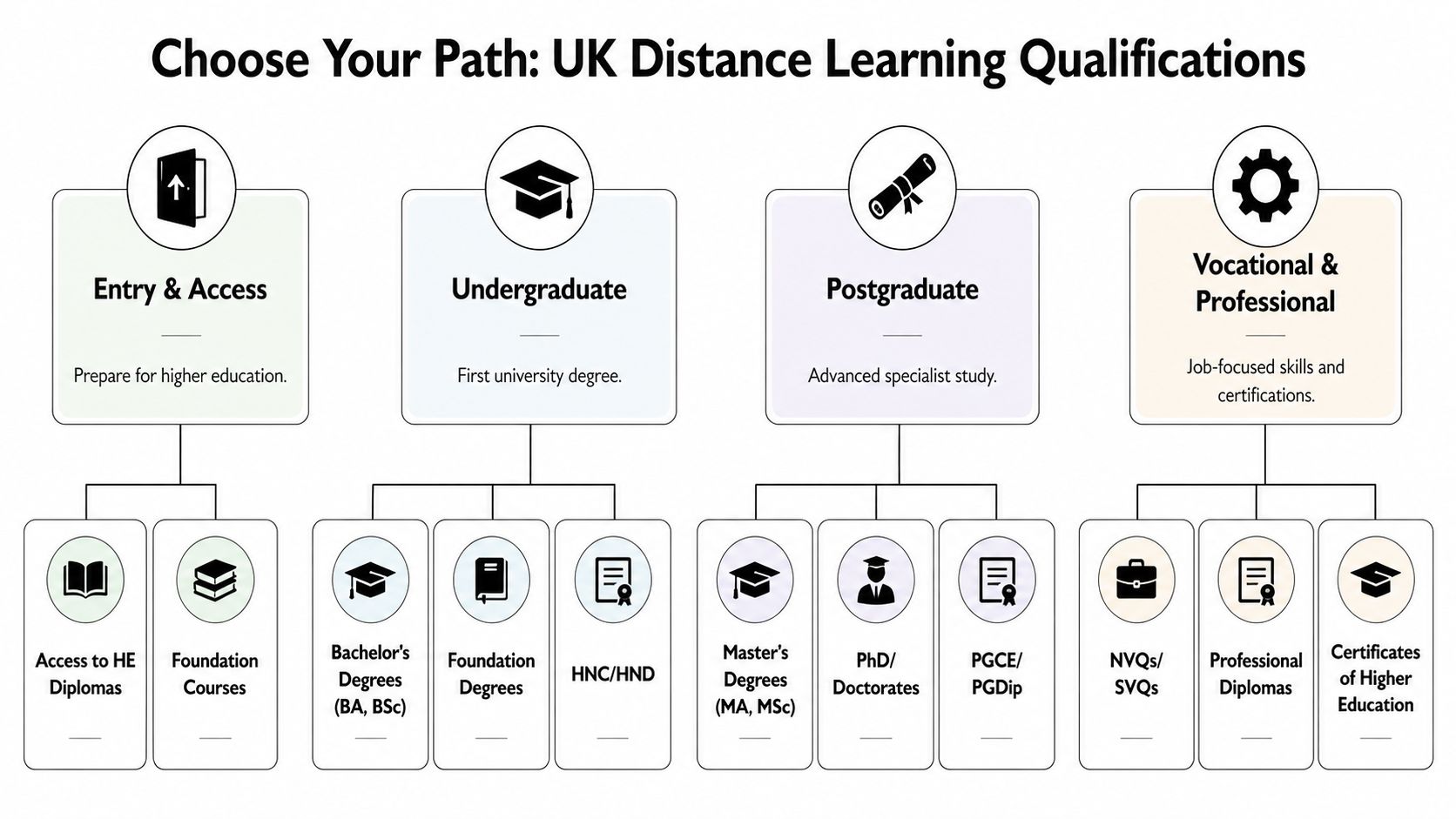
The main routes in plain English
Functional Skills are often the best place to start if you need to rebuild confidence in English or maths. They focus on practical, everyday skills. For many adults, they feel more manageable than jumping straight into a bigger qualification. Online Functional Skills courses in English and maths, with good tutor support, can have pass rates as high as 62%, according to online foundational qualification data.
GCSEs are the familiar school qualifications that still open many doors. If a job advert asks for GCSE English or maths, or if a college or university course has entry requirements, these often matter.
A Levels are a stronger step up. They’re often used for university entry and are useful if you already know what subject area you want to move into.
Access to HE Diplomas are designed especially for adults who want to go to university but don’t have A Levels. They can be a very encouraging route because they were built with adult returners in mind.
Which qualification path is yours
| Course Type | What It Is | Who It's For | Leads To |
|---|---|---|---|
| Functional Skills | Practical English or maths qualifications | Adults who want strong foundations or need key skills for work and further study | GCSE study, job applications, confidence in core skills |
| GCSEs | Well-known school-level qualifications | Adults who need recognised entry qualifications | A Levels, Access courses, jobs, apprenticeships |
| A Levels | Higher-level subject qualifications | Adults aiming for university or more advanced study | University, further specialist training |
| Access to HE Diploma | A university preparation route for adults | Adults returning to education without traditional qualifications | Higher education and degree study |
| Foundation Courses | Introductory routes into further or higher study | Learners who need a bridge before the next stage | Degree-level or career-focused learning |
| Vocational and Professional Courses | Job-focused qualifications and certificates | Adults wanting practical career development | Employment, promotion, specialist training |
If you’d like to browse different adult education courses online, it helps to start with your goal rather than the course title. Ask yourself, “What do I want this qualification to help me do?”
A quick way to choose
Use these simple questions.
If your confidence is low
Start smaller. That isn’t weakness. It’s wisdom. Functional Skills or a single GCSE can help you get moving without feeling buried under pressure.
If you need qualifications for work
Check the job adverts for the roles you want. See what they ask for most often. English and maths are common starting points, followed by subject-specific GCSEs or vocational qualifications.
If university is your goal
Think about the route that matches your current position. If you already have strong prior qualifications, A Levels may suit you. If you’re returning after a long break and want a more adult-friendly bridge, Access to HE can be a better fit.
The right course is not the most impressive one on paper. It’s the one you can realistically start, stick with, and use to move to the next stage.
You do not have to map your whole life today
Many adults freeze because they think they must choose their final career before choosing a first course. You don’t.
Sometimes the first qualification has one job only. It helps you remember that you are capable. Once that confidence comes back, the next decision is much easier.
How to Know Your Qualification Is Real and Respected
This matters more than glossy websites or clever wording. If you’re giving your time, energy, and money to a course, you need to know the qualification will count.
A real and respected qualification should be clearly linked to official regulation and a recognised awarding body. If a provider makes this hard to find, slow down and look carefully.

What regulation means in simple terms
In the UK, regulated qualifications are checked against official standards. A course provider may teach the content, but the qualification itself is usually awarded by an approved organisation.
Think of the provider as the place helping you prepare and learn. Think of the awarding body as the official organisation that sets and confirms the qualification standard.
Names like AQA and Pearson Edexcel are familiar because they’re used widely in UK education. When you see recognised awarding bodies named clearly, that’s a strong sign you’re looking at something meaningful.
What to check before enrolling
Use this checklist when comparing providers:
- Look for regulation details: The website should say whether the qualification is regulated and who awards it.
- Check the exact course name: Vague titles can hide weak or unclear outcomes.
- Find the assessment method: You should know whether there’s coursework, an exam, or both.
- Read the support offer: Good learning isn’t only about content. It’s also about staying on track.
- Confirm progression routes: A good course should show what it can lead to next.
If you want to compare examples of accredited online courses in the UK, pay attention to how clearly the qualification and awarding information is presented.
Respect also comes from support
A qualification can be technically valid and still be delivered badly. That’s why support matters so much.
A 2025 report from Advance HE found that structured pastoral care can boost completion rates for adult learners by up to 35%, yet many providers overlook it, as noted in guidance discussing online study support and wellbeing.
That matters because adult learners often carry more than coursework. They carry family pressure, financial stress, self-doubt, and tiredness. A provider that understands this is often a provider that helps learners finish.
A respected course should do two things. Give you a qualification people recognise, and give you support that helps you reach the finish line.
Red flags worth noticing
Sometimes the warning signs are small:
- promises that sound too easy
- no named awarding body
- no explanation of how assessments work
- no visible student support
- lots of marketing language but little practical detail
Trust grows when the facts are clear. If you can understand exactly what you’re studying, who awards it, and what support you’ll receive, you’re much more likely to make a safe decision.
Making Your Studies Affordable With Smart Funding
Money worries stop many adults before they even begin. That’s understandable. When you’re managing a household, paying bills, and trying to be sensible, study can feel like a luxury.
But the cost picture is often more manageable than people first think.
Distance learning can cut some of the extra costs linked to campus study. You may avoid daily travel, parking, relocation, and some timetable clashes with work. That doesn’t mean every course is cheap. It means the full cost of studying may be easier to handle when learning fits around your life.
Start by breaking the cost into parts
When you look at a course, ask:
- What is the full course fee?
- Can I spread the payments?
- Are exam or assessment fees included?
- Is there funding support for my type of course?
- Could my employer help?
That last question matters more than many learners realise. A 2025 SFA report noted a 28% rise in employers sponsoring flexible upskilling for their staff, and the UK Government’s Advanced Learner Loan can cover 100% of course fees for eligible adults over 19, according to guidance on online study costs and funding routes.
The Advanced Learner Loan in plain language
For many adults, the phrase “loan” brings instant worry. That’s normal. It helps to separate this from high-pressure borrowing.
The Advanced Learner Loan is a government-backed option for eligible adult learners on certain courses. The big reason people consider it is simple. It can cover the full course fee, so you don’t need to find all that money upfront.
Before you apply, check the current official eligibility rules carefully. Course level and age usually matter. A good provider should explain whether the course may fit this route and point you towards the right information.
Other ways adults make study possible
Different learners build affordability in different ways:
- Monthly payment plans: These spread the cost into smaller chunks.
- Employer support: Some employers will fund study if it helps you do your job better or prepare for a new responsibility.
- Household budgeting for a season: Some families agree to cut back in one area to invest in education.
- Starting with one subject: Taking one course first can make the next step easier financially and emotionally.
Education doesn’t have to be paid for in one dramatic leap. Many adults reach their goal through a calm, planned approach.
Hidden costs are worth asking about
A course fee isn’t always the full picture. Ask whether you’ll need printed materials, a laptop, exam centre fees, or travel for assessments. Clear answers help you plan properly and avoid stress later.
Paying for study should feel informed, not rushed. If a provider can explain the actual costs plainly and discuss your options with respect, that’s a very good sign.
Creating a Study Plan That Works With Your Life
One of the most common worries sounds like this. “I want to do it, but I don’t know where the time will come from.”
That fear is real. Adult life is busy. But study does not need huge empty afternoons to work. It needs a plan that fits the shape of your week.

Small pockets of time still count
Many adults imagine studying means sitting at a desk for hours every evening. That idea puts people off before they’ve begun.
A better approach is to use smaller blocks of focused time. Read a section before work. Watch a lesson during lunch. Do practice questions while dinner is in the oven. Review notes after the children are asleep.
What matters most is consistency. Short, repeated sessions are often easier to protect than one perfect study block that never arrives.
Build a weekly rhythm, not a perfect timetable
Try this simple pattern:
- Choose your anchor days: Pick two or three days that usually feel more predictable.
- Set one main session: This might be your deeper study slot for reading or assignments.
- Add short top-up sessions: Use brief moments for revision, flashcards, or planning.
- Leave catching-up space: One spare slot can rescue the week if life goes off track.
You don’t need a beautiful planner. A calendar on your phone, a notebook, or sticky notes on the fridge can work well.
A useful mindset: Don’t ask, “Do I have loads of time?” Ask, “Where are the small windows I can use well?”
Make your study space easy to return to
Your study area doesn’t need to look like a library. It just needs to be practical.
A good setup usually includes:
- One reliable spot: a corner of the kitchen table, a desk, or a quiet chair
- Your essentials ready: laptop, charger, notebook, pens, login details
- Low distractions: phone on silent if possible, television off, tabs closed
- A signal to others: headphones, a closed door, or a simple “study time” agreement
The easier it is to sit down and begin, the less energy you waste talking yourself into it.
Tell your family what this means to you
Adults often try to study discreetly so they don’t inconvenience anyone. But family support is easier to build when people understand why this matters.
You can say something simple. “I’m doing this so I can create more choices for us.” Children often respond well when they can see your effort. In many homes, your studying becomes a powerful example. You’re showing that learning has value, even when life is full.
Later in your routine, it can help to watch or listen to something encouraging that keeps you focused on the long game.
Support keeps momentum alive
Self-discipline matters, but support matters too. Data shows that distance learning programmes with dedicated mentors and regular check-ins can boost learner retention by 28% because they help tackle isolation and motivation dips, according to government guidance on digital and data learning.
That matters on ordinary weeks. Not just crisis weeks.
When someone checks in, helps you reset your plan, or notices you’ve gone quiet, it becomes easier to keep going. Adult learners don’t usually stop because they lack ability. They stop because life gets heavy and they lose connection.
A simple plan for tough weeks
When work is hectic or family life becomes demanding, use a “minimum win” plan:
- Log in.
- Read one page or watch one lesson.
- Write one key note.
- Message your tutor if you’re stuck.
- Return properly when the week settles.
That keeps the thread alive. You haven’t failed. You’ve adjusted.
Your Next Chapter From Courses to Careers and University
Finishing a course changes more than your CV. It changes how you see yourself.
At the start, you may think you’re just trying to get through an English qualification, pass maths, or earn the grades you need. Later, you realise something deeper has happened. You kept a promise to yourself.
That kind of achievement has weight. It shows your children what persistence looks like. It gives you stronger ground when you apply for jobs. It can also reopen the university dream many adults thought had passed them by.
Where this path can lead
For some learners, a qualification leads straight to work opportunities. GCSE English and maths can help with job applications, training routes, and promotion possibilities.
For others, it’s part of a longer journey towards higher education. Distance learning is already a major route into advanced study. In 2021/2022, over 280,000 UK students were studying through distance learning, and recent HESA-based analysis shows postgraduate online enrolments are continuing to grow, according to analysis of UK higher education online student trends.
If university is your goal, it helps to understand how to get into universities through routes such as A Levels or Access to HE.
Success often starts quietly
It rarely begins with applause. It begins with ordinary moments.
You submit an assignment. You understand a topic that once scared you. You sit an exam and stay calm. You pass. Then one day you hear yourself say, “I think I could do the next level.”
That’s how many life changes happen. Not with one huge leap, but with one finished step followed by another.
“Adult learners don’t just earn qualifications. They often rebuild confidence, widen career options, and show their families what determination looks like.”
The emotional reward matters too
A better income matters. Career progress matters. University entry matters. But so does the feeling of becoming someone you’re proud of.
You may become the first in your family to return to study. You may become the parent who normalises homework at the kitchen table because you’re doing your own as well. You may become the person who proves that a difficult past in education doesn’t get the final word.
That’s a powerful thing.
Your Questions Answered
Am I too old to start distance learning
No. Adult learning is built for people who are returning after a break. Your age is not the problem. The main question is choosing the right level and the right support.
What if I was never good at school
Many adults felt overlooked, rushed, or discouraged at school. Learning as an adult can feel very different because you now have a reason, a goal, and more choice about how you study.
Will I be studying completely alone
Not if you choose a supportive provider. Good distance learning includes tutor help, feedback, and often pastoral support so you’re not left to struggle in silence.
How many hours a week do I need
It depends on the course and your pace. What matters most is regular study, not heroic study. Small, steady sessions usually work better than waiting for the perfect free day.
Can distance learning really lead to university
Yes. Many adults use qualifications such as GCSEs, A Levels, or Access to HE courses as stepping stones towards higher education.
What if I lose motivation halfway through
That happens to many learners. Motivation rises and falls. The answer is structure. Keep a simple plan, stay in touch with tutors, and aim for progress rather than perfection.
How do I know if I’m ready
If you care about changing your future and you’re willing to take one step at a time, you’re more ready than you think.
If you’re ready to take that first step, Next Level Online College offers flexible online courses for adult learners across the UK, including Functional Skills, GCSEs, A Levels, and Access to Higher Education diplomas. If you want support that fits around work, family, and real life, it’s a good place to explore your options and begin building the future you want.