
You might be sitting at your kitchen table right now with a notebook open, a cup of tea going cold, and one worry running through your mind.
“What if I get something wrong?”
That fear is common when you come back to education as an adult. You may not have written an assignment in years. You may be balancing work, children, bills, and a hundred other responsibilities. You may even feel that everyone else knows the rules and you’re the only one trying to catch up.
You’re not behind. You’re learning.
Academic integrity sounds like a big, formal phrase, but the idea is simple. It means being honest and responsible in your studies so that the work you hand in is your own, properly supported, and something you can feel proud of. It isn’t there to catch you out. It’s there to help you build real skills, real confidence, and a future that stands on solid ground.
Your Journey to Success Starts with Trust
A lot of adult learners come back to study with courage, but not always with confidence. They want better qualifications, better job options, and a better future for their family. At the same time, they worry about rules they don’t fully understand.
A common fear sounds like this. “What if I accidentally copy something wrong?” Or, “What if I ask a friend for help and that counts as cheating?” Those questions don’t mean you’re doing badly. They mean you care about doing well.
Academic integrity starts with that care.
Proud work feels different
Think about two results. In the first, someone rushes, copies bits from a website, and hands in work they don’t fully understand. In the second, someone takes longer, asks for help when needed, writes in their own words, and learns properly along the way.
Only one of those results builds confidence you can carry into an exam, an interview, or university.
That’s why academic integrity matters so much. It protects the value of your effort. It helps you know that when you pass, you’ve really earned it. For adults returning to education, that feeling can be life changing. It’s not just about a grade. It’s about being able to say, 'I did this with integrity. I can do hard things. I can move forward.'
Practical rule: Academic integrity isn’t a trap. It’s the way you turn study into proof of your ability.
Trust opens doors
Study is built on trust. Your tutor trusts that the work you submit is your own. You trust that your tutor will assess it fairly. Colleges and universities trust that qualifications mean something real.
That trust matters beyond the classroom too. If you want to move into university or a professional career, people need to believe in the value of your work. Honest study shows that you’re dependable, serious, and ready for responsibility.
That’s a powerful message to send, especially if you’re building a new future for yourself and your family.
What Is Academic Integrity A Code of Honour for Your Future
So, what is academic integrity?
In plain language, it means doing your work with integrity, giving credit when you use someone else’s ideas, following the rules of assessment, and taking responsibility for your learning. It’s not only about avoiding dishonest behaviour. It’s also about doing your work with care and purpose.
One helpful way to think about it is as a Code of Honour.
Doctors, engineers, teachers, and other respected professionals are trusted because they follow standards. They don’t just know things. They act with responsibility. Academic integrity works in the same way. It shows that you’re ready to be trusted with bigger opportunities.
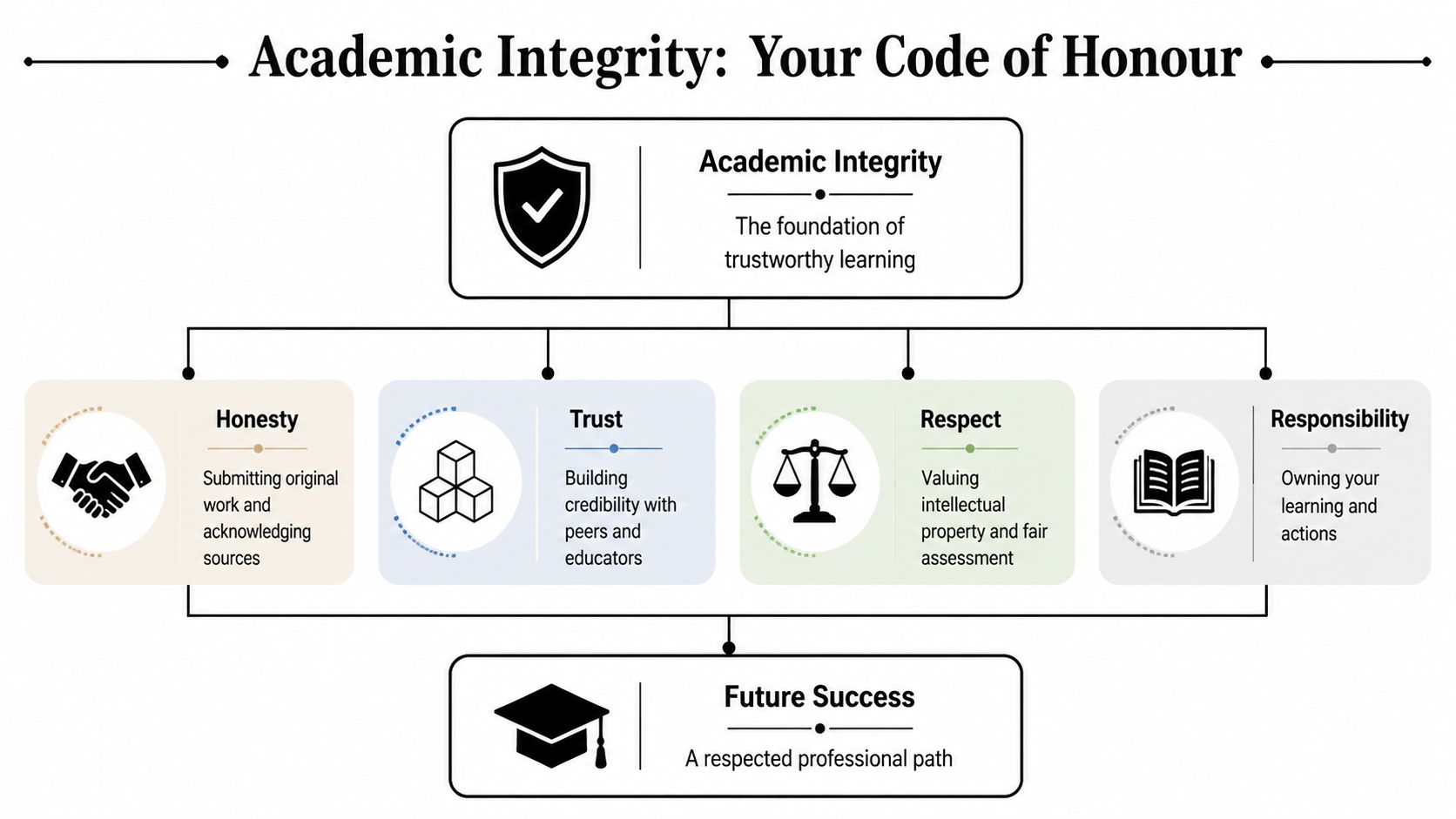
The values behind the code
The International Center for Academic Integrity identified honesty, trust, fairness, respect, and responsibility in 1999, then added courage in 2014, as noted in this overview of academic integrity and its core values.
These aren’t just school words. They’re life words.
- Honesty means your work reflects what you know and can do.
- Trust grows when tutors and colleges can rely on your work being genuine.
- Fairness means everyone is assessed by the same standard.
- Respect means valuing other people’s ideas enough to credit them properly.
- Responsibility means owning your choices, your deadlines, and your progress.
- Courage means asking for help instead of hiding, guessing, or taking shortcuts.
You already use these strengths
You may already live by these values every day, even if you’ve never called them that.
If you keep your word at work, that’s responsibility. If you help your child understand why telling the truth matters, that’s honesty. If you treat other people’s effort with care, that’s respect. Study gives you a new place to use qualities you already have.
Here’s a simple way to see it:
| Value | What it looks like in study |
|---|---|
| Honesty | Writing your own answer |
| Trust | Building a good relationship with your tutor |
| Fairness | Not getting an unfair advantage |
| Respect | Citing a book, website, or article you used |
| Responsibility | Planning your time and checking the rules |
| Courage | Saying “I’m not sure, can you help?” |
Academic integrity is your chance to prove, to yourself as much as anyone else, that your success is real.
That’s why the question “what is academic integrity” matters so much. It’s not just a definition to memorise. It’s a way of studying that helps you become the person universities, employers, and your own family can trust.
Why Honesty in Your Studies Is Your Superpower
Honesty in study gives you something no shortcut can ever give. It gives you real confidence.
When you write your own assignment, solve your own problem, or revise until you finally understand a topic, you’re building knowledge that stays with you. You’re not borrowing success for a moment. You’re creating it for yourself.

Real confidence can’t be taken away
Lots of adults returning to education struggle with self-doubt. They worry they’re not clever enough, too old, too rusty, or too busy. Honest study pushes back against that fear because every piece of genuine work becomes evidence.
Evidence that you can learn.
Evidence that you can improve.
Evidence that you can achieve something meaningful.
Research described in the earlier background explains academic integrity as more than avoiding dishonest practices. It is an engagement with learning and work that is done properly and for a good purpose. That positive view matters because it turns study into growth, not just rule-following.
Your children notice more than your grades
If you have children, they watch how you handle hard things. They notice when you keep going after a long day. They notice when you choose honesty over the easy option. They notice when you open a laptop instead of giving up.
That example can stay with them for years.
You don’t have to be perfect to be a role model. You just have to be real. When you study with integrity, you show your family that success doesn’t come from pretending. It comes from effort, courage, and self-respect.
A short reminder can help when motivation dips.
Trustworthiness matters in the wider world
Universities and employers want more than subject knowledge. They want people they can rely on. Someone who works with integrity is often seen as someone who can handle responsibility, follow standards, and contribute well to a team.
That matters if your goal is a university place, a career change, or a more secure income. The qualification itself matters, but so does the person you become while earning it.
Consider the difference:
- Shortcuts may get a task finished.
- Honest effort helps you answer questions in interviews.
- Real understanding helps you cope when work gets harder later on.
When you study with integrity, you aren’t just passing a course. You’re becoming ready for what comes next.
Common Stumbles and How to Stay on Your Feet
Most learners don’t set out to do the wrong thing. More often, they get confused, rushed, or unsure. That’s why it helps to look at common mistakes as stumbles you can avoid with a little care.
Plagiarism often starts with panic
Plagiarism means presenting someone else’s words or ideas as if they were your own. Sometimes people think this only happens when someone deliberately copies a whole essay. It can also happen in smaller, accidental ways.
For example:
- Copying a sentence from a website and forgetting to put it in quotation marks
- Changing only a few words from a textbook and thinking that counts as your own writing
- Using an idea from a video or article without saying where it came from
The fix is simple. If the words are exact, use quotation marks and include the reference. If the idea came from someone else, mention the source even when you write it in your own words.
If you’ve used someone else’s thinking, show where it came from. That’s respect, not weakness.
Working together can cross a line
Studying with a friend can be brilliant. You can explain topics to each other, compare notes, and keep each other motivated. The problem comes when shared revision turns into shared assignment writing.
That’s sometimes called collusion. A simple example is when two learners submit very similar answers because they planned or wrote too much of the task together.
Use this quick guide:
| Situation | Usually fine | Usually not fine |
|---|---|---|
| Revising together | Discussing ideas | Writing one answer together for individual work |
| Checking understanding | Asking “What does this question mean?” | Copying a friend’s paragraph and changing a few words |
| Getting support | Asking someone to read for spelling mistakes | Asking someone to rewrite your assignment |

Small habits prevent big problems
You don’t need to be frightened of mistakes. You need habits that keep you steady.
Try these:
- Keep notes clearly. Write down where each idea came from while you research.
- Start early enough. Rushing makes people careless.
- Save drafts. Your draft work shows how your thinking developed.
- Ask when unsure. A quick question early can prevent a bigger problem later.
AI and online tools need care too
Many learners now use digital tools to help with spelling, planning, or ideas. The safe rule is this. Support tools should help you learn, not replace your thinking.
If a tool writes your answer for you, that creates a problem. If a tool helps you spot grammar mistakes and you still produce your own work, that’s different. Always check your course rules and ask your tutor if anything feels unclear.
The aim isn’t to make you anxious. It’s to help you stay in control of your own learning.
Your Toolkit for Confident and Honest Study
Good academic integrity doesn’t happen by luck. It grows from simple habits that make study calmer, clearer, and more manageable.
Give credit where it’s due
Referencing can sound complicated, but the main idea is kind. It means saying, “This idea came from someone else, and I want to acknowledge that.”
It's similar to thanking someone for helping you build something. You still did the work. You’re just being honest about the materials you used.
A useful habit is to keep a running list while you study:
- Book title or webpage title
- Author or organisation
- Date, if shown
- The page or section you used
- The web address for online material
That way, you won’t be hunting for details at the last minute.
Learn the difference between quoting and paraphrasing
This is one area where many returning learners get stuck. Here’s the simple version.
- Quoting means using the exact words from a source. You need quotation marks and a reference.
- Paraphrasing means reading the idea, understanding it, and writing it fully in your own words. You still need a reference because the idea is not originally yours.
A quick comparison helps:
| Method | What you do | What you must include |
|---|---|---|
| Quote | Copy the exact wording | Quotation marks and reference |
| Paraphrase | Rewrite the idea completely in your own words | Reference |
| Your own point | Explain your own view or experience | No source needed unless you drew on one |
Give yourself the gift of time
A lot of integrity problems begin with pressure, not bad intentions. Someone leaves work too late, feels trapped, and makes a poor choice.
That’s why time planning is a study skill and an integrity skill.
Try this routine:
- Break the task down into reading, note-taking, planning, writing, and checking.
- Set mini-deadlines a few days before the final deadline.
- Stop researching at some point so you have time to write properly.
- Leave one final check for references, spelling, and instructions.
If you’re not sure how you learn best, it can help to explore different learning styles and study habits so you can build a routine that suits your strengths.
Study habit to keep: A planned week is kinder than a panicked night.
Asking for help is part of honest study
Some adults think they should stay quiet and work everything out alone. That can come from pride, nerves, or fear of looking foolish. But asking for support is a strong choice.
Ask when you don’t understand the question. Ask when you’re confused about references. Ask when family life or work has thrown your plan off course. Honest students don’t always know everything. They know when to seek guidance.
That’s not weakness. That’s responsibility in action.
What Happens If You Make a Mistake Understanding Support and Consequences
Fear gets louder when people don’t know what happens next. Many learners imagine one mistake means instant failure or harsh judgement. Real academic processes are usually more careful than that.
Across higher education, academic integrity is treated seriously because qualifications need to keep their value. Guidance on understanding academic integrity explains that breaching it can have professional consequences, including cases where professional bodies may refuse to accredit an individual. It also makes clear that institutions must support honest practice and apply fair discipline.
Why colleges take it seriously
This isn’t about being strict for the sake of it. If a qualification is going to help someone move into university or a profession, people need to trust what that qualification represents.
That trust depends on three groups doing their part:
- Students submit original work and sit their own assessments.
- Educators set and mark work fairly.
- Institutions provide support, guidance, and fair procedures.
When those parts work together, honest learners are protected.
What support usually looks like
If a learner makes a genuine mistake, the first helpful step is often clarity. What happened? Did they misunderstand referencing? Did they get poor advice? Did pressure lead to a bad decision?
Many colleges use procedures that help staff look at the situation properly rather than jumping to conclusions. Support may include a conversation, guidance on study skills, clearer instructions, or a chance to learn from the problem.
If you’re ever worried about rules, deadlines, or how support works, it helps to check a college’s frequently asked questions for practical guidance.
Fairness matters too
Academic integrity also includes fairness. Rules should be clear, applied properly, and supported with education. A good system doesn’t just tell learners what not to do. It helps them understand how to do things right.
That matters especially for adults returning after a break. You shouldn’t be expected to magically know every academic convention. You should be taught, supported, and treated with respect while you learn.
Your Questions Answered by Our Supportive Tutors
Some worries keep coming back, so it helps to answer them plainly.
What if I plagiarise by accident
If you’re learning how to write assignments again, that fear is normal. Accidental plagiarism often comes from weak note-taking, confusion about paraphrasing, or not knowing how to reference properly.
The answer is to ask early, keep clear notes, and let a tutor check that you’re on the right track. One mistake doesn’t define you. Learning the right habit does.
Can I study with a friend or will that get me in trouble
You can absolutely study with a friend. Revising together, testing each other, and discussing ideas can be helpful. The line is crossed when individual assessed work stops being individual.
If you’re unsure, ask a tutor what kind of collaboration is allowed for that task. That protects both of you.

What should I do if I feel overwhelmed and tempted to give up
Pause and reach out before things pile up. Struggling in silence is what makes problems grow. Support with planning, feedback, and encouragement can make a huge difference when confidence dips.
If you want to see what that kind of guidance can look like, explore expert tutor support for adult learners. The strongest learners aren’t the ones who never need help. They’re the ones who use help well.
You don’t have to know everything on day one. You just need to keep choosing honesty, effort, and support.
If you’re ready to rebuild your confidence and earn qualifications you can be proud of, Next Level Online College can help you take that next step with flexible online study and supportive guidance designed for adult learners.