
Some evenings have a way of making you stop and think. The dishes are done, work is finished, the house is quieter, and a question appears that you might have pushed aside for years. Could I go back to study? Could I manage this now?
If that sounds like you, you’re not behind. You’re not “too late”. You’re not the only adult who has looked at english a levels and felt a mix of hope, nerves, and excitement.
Plenty of adults return to education because they want more for themselves and for the people they love. Sometimes it’s about university. Sometimes it’s about a better job. Sometimes it’s about proving, to yourself most of all, that your story didn’t stop when life got busy.
Your Time for a Brighter Future Starts Now
You might be reading this after years away from school. Maybe you left education early. Maybe family life came first. Maybe work took over and your own plans were put on hold. That happens to good, hardworking people every day.
The important part is this. The wish to learn has come back.

An English A Level can be a powerful next step because it changes more than your qualifications. It can change how you see yourself. It can turn “I’m not academic” into “I can do hard things”. It can show your children that learning doesn’t end when adulthood begins.
The quiet doubts many adults carry
Adults often worry about the same things:
- Time: “How will I fit study around work and family?”
- Confidence: “What if I’ve forgotten how to write essays?”
- Fear of failure: “What if I start and can’t finish?”
- Belonging: “Will this even be for someone like me?”
Those worries are normal. They don’t mean you’re not ready. They usually mean you care a lot about getting it right.
You don’t need to feel fearless before you begin. You just need to believe that your future is worth the effort.
English A Level study isn’t about being perfect from day one. It’s about starting where you are and building steadily. One lesson. One paragraph. One good week at a time.
Why an English A Level is a Life-Changing Step
An English A Level can open doors in a very practical way, but the deeper change often happens inside you first. You begin to trust your own mind again. You speak up more. You stop shrinking yourself.
That matters at home as much as it matters at work.
It gives you skills people respect
English builds skills that travel well. You learn to read carefully, write clearly, argue your point, and understand meaning beneath the surface. Those are useful in offices, schools, healthcare settings, business roles, public services, and creative work.
There’s another reason this qualification stands out. English A-level entries in England fell from 89,442 in 2013 to 54,000 in 2023, a decline of about 40%, according to research on the decline in A-level English. For an adult learner, that means the qualification is becoming less common while the skills remain highly valued.
It can help you move towards university
For many adults, english a levels are part of a bigger dream. You may want to apply for a degree later. You may want to qualify for a profession that once felt out of reach. You may want proper options.
English is especially useful if you’re interested in subjects linked to writing, communication, media, teaching, humanities, law, social sciences, or any course that asks you to read, think, and express ideas well.
It changes the example you set at home
Children notice more than we think. They notice when you keep going. They notice when you study at the kitchen table instead of giving up on yourself. They notice when you say, “I’m doing this for a better future,” and then mean it.
That kind of example lasts.
The victory is personal as well as practical
An English A Level can help with:
- Career progress: Better qualifications can support new applications and stronger progression routes.
- Self-belief: Finishing serious study proves to you that your goals are still alive.
- Family pride: Your success often becomes shared success.
- Future choices: More courses, more job routes, more confidence to keep moving.
A truth many adults discover: the qualification matters, but the person you become while earning it matters just as much.
When adults return to study, they often bring strengths younger students are still developing. Patience. Real-world experience. Motivation. A stronger reason to succeed. You’re not starting with nothing. You’re starting with life behind you, and that can be a real advantage.
Choosing Your English A Level Path
Many people hear “English A Level” and think it’s one single course. It isn’t. There are three main paths, and choosing the right one can make study feel far more enjoyable.
A simple way to think about them is this. English Literature looks closely at stories, poems, and plays. English Language studies how language works in real life. English Language and Literature brings both together.
English Literature
If you enjoy novels, drama, poetry, character ideas, and big themes, Literature may suit you best. You’ll explore how writers create meaning and how texts affect readers.
It can feel a bit like being a thoughtful critic. You don’t just say whether a text is good. You explain how it works.
You might enjoy this course if you like:
- Characters and themes: Why people behave the way they do in stories
- Close reading: Looking carefully at words, tone, and structure
- Essay writing: Building clear interpretations with evidence
- Big ideas: Love, power, conflict, identity, memory
English Language
Language is different. It asks how English works in the world around us. That includes conversation, identity, social groups, media, spoken language, digital communication, and how meaning changes in different situations.
It can feel like detective work. You collect clues from language and explain what they show.
The subject criteria for A Level English Language require internal assessment within a regulated range of 15 to 40 per cent, which also means a large share of the qualification is still assessed through external exams, as set out in the official subject criteria for English Language. For online learners, that means you can study from home but will still need to sit supervised written exams at an approved centre.
English Language and Literature
This combined route gives you both ways of thinking. You study literary texts, but you also analyse language in a more technical way. Many adults like this balance because it mixes creative reading with structured analysis.
The subject is a good fit if you don’t want to choose between loving books and being curious about communication itself.
Which English A Level is right for you
| Course Type | Main Focus | What You Will Study | Best For You If… |
|---|---|---|---|
| English Literature | Meaning in poems, plays, and prose | Novels, drama, poetry, themes, context, essay analysis | You enjoy reading set texts and discussing characters, themes, and writer choices |
| English Language | How language works in real life | Spoken and written language, language change, identity, media, analysis of unseen material | You’re curious about everyday communication and like spotting patterns in how people speak and write |
| English Language and Literature | Both text study and language analysis | Literary works plus analysis of style, voice, and meaning | You want variety and like both creative texts and technical thinking |
A useful way to decide
Ask yourself three questions.
What do I naturally enjoy reading or noticing?
If you love novels and poems, Literature may feel most rewarding. If you notice accents, texting habits, headlines, or how people speak in meetings, Language may click faster.What kind of writing do I prefer?
Literature leans into interpretation of set texts. Language often asks you to analyse unseen material and apply ideas about how language works.What keeps me interested enough to stay consistent?
This matters more than people think. Adults do best when they care about the subject, because interest helps you return to your studies after a long day.
Pick the course that makes you curious. Curiosity carries you further than pressure does.
There isn’t one “best” English A Level for everyone. There is only the one that fits your mind, your goals, and the way you like to learn.
How Your A Level is Assessed and What Grades Mean
Assessment worries many adults more than the subject itself. That’s understandable. If you’ve been away from education for a while, words like coursework, exams, and grading can sound heavy before you know what they really mean.
The good news is that the system is structured. Once you understand the moving parts, it feels much less mysterious.
Exams and coursework
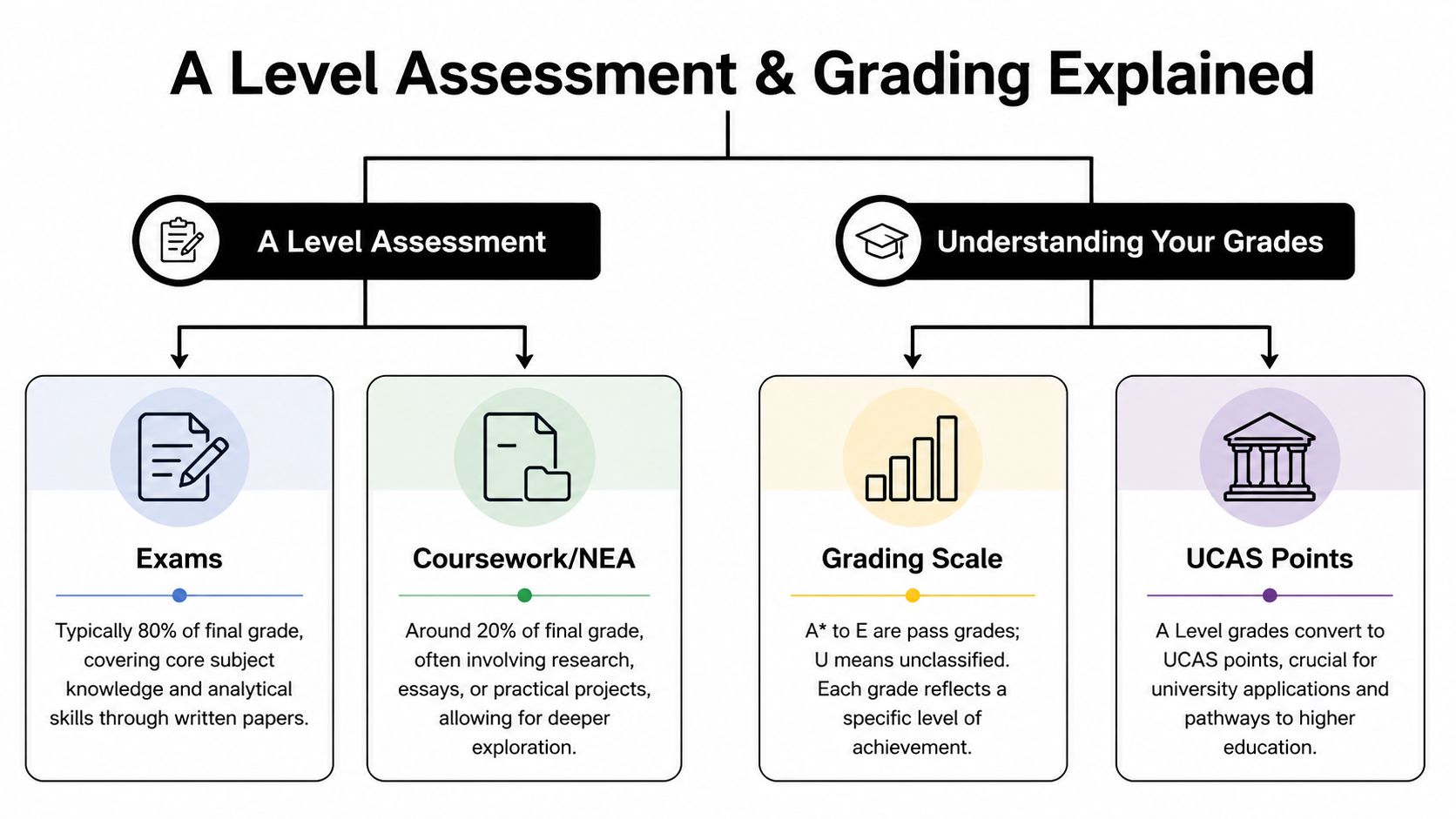
Most A Levels include a mix of written exams and some form of coursework or non-exam assessment. In English subjects, that usually means you’ll prepare through regular study, practise questions, feedback, and independent reading or writing, then complete final exams under formal conditions.
For English Language, the rules are especially clear. Internal assessment must sit within a set range, so even if you study online, a substantial part of the qualification is assessed through external written exams.
What the grades mean
A Level grades run from A* down to E for pass grades. U means unclassified.
Each grade shows the level you reached by the end of the course. Universities and employers use those grades to understand your achievement. If you’re aiming for higher education, your grades are also converted into UCAS points for many applications.
If you want a simple breakdown of how the grading system works in practice, this guide to A Level grades and points is a helpful place to start.
Why the results should encourage you
A lot of adults secretly assume that students often fail A Levels. That isn’t true. In 2024, 76.0% of A-level students in England achieved grade C or above across all subjects, according to the A-level results 2024 infographic from the government.
That figure matters because it shows success is realistic. With preparation, support, and steady effort, passing isn’t some distant miracle.
A sensible way to think about assessment
Try to think about assessment in layers rather than as one huge final test.
- First layer: Learn the ideas clearly.
- Second layer: Practise applying them to questions.
- Third layer: Get used to timing and exam technique.
- Fourth layer: Build confidence through repetition.
Practical rule: don’t revise only by rereading. Practise writing short answers, plans, and timed paragraphs so your brain gets used to doing the real task.
What often confuses returning learners
Two things cause the most stress.
The first is thinking coursework will carry the whole subject. It won’t. Coursework can help, but exams still matter a great deal. The second is believing grades are only for “naturally academic” people. They aren’t. Grades reflect what you can show by the end of the course, not who you were years ago.
If you keep showing up, ask for help when you need it, and practise in a structured way, the assessment side becomes manageable. It stops feeling like a wall and starts feeling like a route.
Your Study Journey With Next Level Online College
For adults, studying has to fit real life. You may be working full-time, raising children, caring for family, or managing all three at once. A good online course has to respect that reality.
That’s why flexibility matters so much.

Learning step by step
A Level study isn’t meant to throw everything at you at once. The course structure builds from earlier learning and introduces concepts in a clear order. The Pearson specification shows that A Level English Language is designed as a progression from GCSE, with systematic teaching of linguistic knowledge and analytical methods in the AS English Language specification.
That matters for adults because it means you don’t need to arrive already knowing the whole subject. You build up your understanding over time.
Study habits that work in a busy home
Long study marathons often sound noble, but they can be hard to sustain. Busy adults usually do better with smaller, repeatable routines.
Try this kind of pattern:
- Short weekday sessions: Read, annotate, or revise for a manageable block of time.
- One stronger weekly session: Use this for essay planning or a timed response.
- Visible planning: Keep a simple study plan where you can see it.
- Small wins: Finish one task fully instead of starting five at once.
A flexible online setup can make that easier. If you’re exploring remote options, distance learning for A Levels shows how studying from home can work around jobs, school runs, and changing routines.
Confidence grows through routine
Many adults wait to feel confident before they start. Usually, confidence comes after you start.
A good weekly rhythm helps more than motivation alone. Read a little. Make notes. Attempt one question. Review the feedback. Repeat. Progress often looks ordinary while it’s happening, but over months it becomes something powerful.
Here’s a short video that can help you picture flexible online study more clearly.
Practical points adults often ask about
You may also be wondering about everyday details:
Will I need to be online at fixed times?
Many adult learners need flexibility because family life doesn’t always run to a perfect timetable.Will I need to travel?
Study can happen at home, but final exams are usually sat in formal exam conditions.Will the technology be too hard?
Most learners don’t need advanced technical skills. They need clear instructions, a calm place to study, and regular support.
Steady study beats perfect study. If you can keep going through ordinary weeks, you can get much further than you think.
How We Champion Adult Learners Like You
Adults returning to education need more than course content. They need understanding. They need flexibility without being left alone. They need support that respects the pressure of work, family, money worries, and self-doubt.
That kind of support can make the difference between stopping and succeeding.

Adult learners are not an afterthought
Some education providers are built mainly with school leavers in mind. Adult learners can then feel as if they have to fit into a system that wasn’t really designed for them.
That’s why it matters that there has been a 15% rise in A Level entries from adult learners aged 25+ via online colleges, as stated in this guide discussing A Level English pathways. Adults are returning in growing numbers, and they deserve learning built around adult life.
If you want to explore study designed with that stage of life in mind, A Levels for mature students gives a useful overview.
Support means more than marking work
Adult learners often need a mix of academic and personal support. That can include help understanding assignment tasks, planning revision, staying motivated after a difficult week, and getting past the old fear of “I’m not clever enough”.
Useful support usually looks like this:
- Subject guidance: Clear explanations when a topic feels confusing
- Study planning: Help turning a big course into manageable steps
- Encouragement: Someone noticing when your confidence dips
- Pastoral care: Human support when life gets heavy
You shouldn’t have to do it all alone
Many adults have spent years putting everyone else first. Studying can feel strange at first because it asks you to claim some time and energy for your own future.
That isn’t selfish. It’s responsible.
When an adult learner keeps going, the whole family often sees what persistence looks like in real life.
Good support doesn’t remove the work. It helps you keep doing the work when your week becomes messy. That kind of partnership can turn a private dream into a finished qualification.
Your English A Level Questions Answered
Can I study english a levels online if I’m an adult
Yes. Many adults study online because it gives them more control over when and where they learn. You can usually complete lessons, reading, and written work from home, then sit the final exams in formal exam conditions.
Do I need to be brilliant at English already
No. You need willingness, consistency, and support. Adult learners often worry that they’ve forgotten too much, but strong courses build knowledge in stages and help you improve as you go.
Is English Language harder than English Literature
Neither is “harder” for everyone. They are different. Literature suits people who enjoy set texts and interpretation. Language suits people who like analysing how English works in real situations. The best choice is the one that keeps you engaged.
Can I do this if I work full-time
Yes, but you’ll need a realistic routine. Small, regular study sessions are often better than waiting for huge blocks of spare time that never arrive. Adults who succeed usually protect study time the same way they protect other important commitments.
Will universities accept an online A Level
Universities care about the qualification itself and the grades achieved, not whether you sat at a school desk every day while preparing for it. What matters is that the course is recognised and the assessment is completed properly.
What if I’m nervous about exams
That’s common. Nerves don’t mean you can’t succeed. They usually ease when you understand the format, practise regularly, and stop treating the exam as one giant unknown.
Do I need GCSEs first
Entry expectations can vary. Some learners start with GCSEs before moving on to A Levels, while others already meet the entry requirements. If you’re unsure, the safest step is to ask for advice based on your own qualifications and goals.
Take Your First Step Towards a New Future
You don’t need to change your whole life in one day. You just need to take one honest step towards the future you want. An English A Level can be that step. It can lead to university, fresh career options, deeper confidence, and the quiet pride of showing your family what’s possible.
Start small. Ask questions. Explore your options. Let yourself believe that this chapter could belong to you.
Next Level Online College offers flexible, fully supported study for adults who want recognised qualifications without putting the rest of life on hold. If you’re ready to explore a new path with caring guidance and practical support, visit Next Level Online College.