
Some evenings end with you staring at a screen or a notebook after everyone else has gone to bed. The house is quiet. The washing up is done. The children are asleep. And there you are, wondering whether a better future is still possible for you.
If maths has ever made you feel small, you're not alone. Many adult learners carry old memories from school that still hurt. Some were rushed, some were embarrassed, and some were made to feel that maths was only for other people. That kind of experience can stay with you for years.
But it doesn't have to decide what happens next.
Functional maths level 2 can be the step that changes things. Not because it turns you into a different person overnight, but because it helps you prove something important. You are capable. You can learn. You can gain a respected qualification. And you can build a future that makes you and your family proud.
Your First Step to a Brighter Future
A lot of adults come back to learning for the same reason. Life has moved on, but a missing qualification still stands in the way.
You might want a new job. You might want to start a university course. You might want to stop saying, “I’m no good at maths,” especially when your children are watching. That feeling can be heavy. It can make you put things off for months, even years.
The hard part isn't always the sums. Often, it's the fear.
Many adult learners struggle with maths anxiety and self-doubt, often because past educational experiences were not supportive. Guidance that builds confidence and connects maths to real life, such as budgeting and work, is important for overcoming those barriers, yet it is often missing from standard materials, as noted in this discussion of adult learner confidence and real-life maths support.
Why this feels personal
When you're returning to education as an adult, it isn't just about passing a course. It can feel tied to everything.
- Your family: You want your children to see that learning matters.
- Your confidence: You want to stop doubting yourself every time numbers appear.
- Your future: You want more choice, more stability, and more pride in what you do.
That is why functional maths level 2 matters so much. It isn't just a qualification on paper. It can become proof that your past doesn't control your future.
You don't need to be fearless to start. You only need to be willing to take the first small step.
What changes when you start
At first, progress can look simple. You understand a percentage question that used to confuse you. You work out a bill without panicking. You help your child with homework and feel calmer.
Then something bigger happens. You begin to trust yourself again.
That confidence can spread into other parts of life. People often find that once they face the thing they feared most, other goals start to feel possible too. University doesn't sound so distant. A better job doesn't feel like it belongs to someone else. You start thinking, “Why not me?”
And that question can change everything.
What Is Functional Maths Level 2 Really
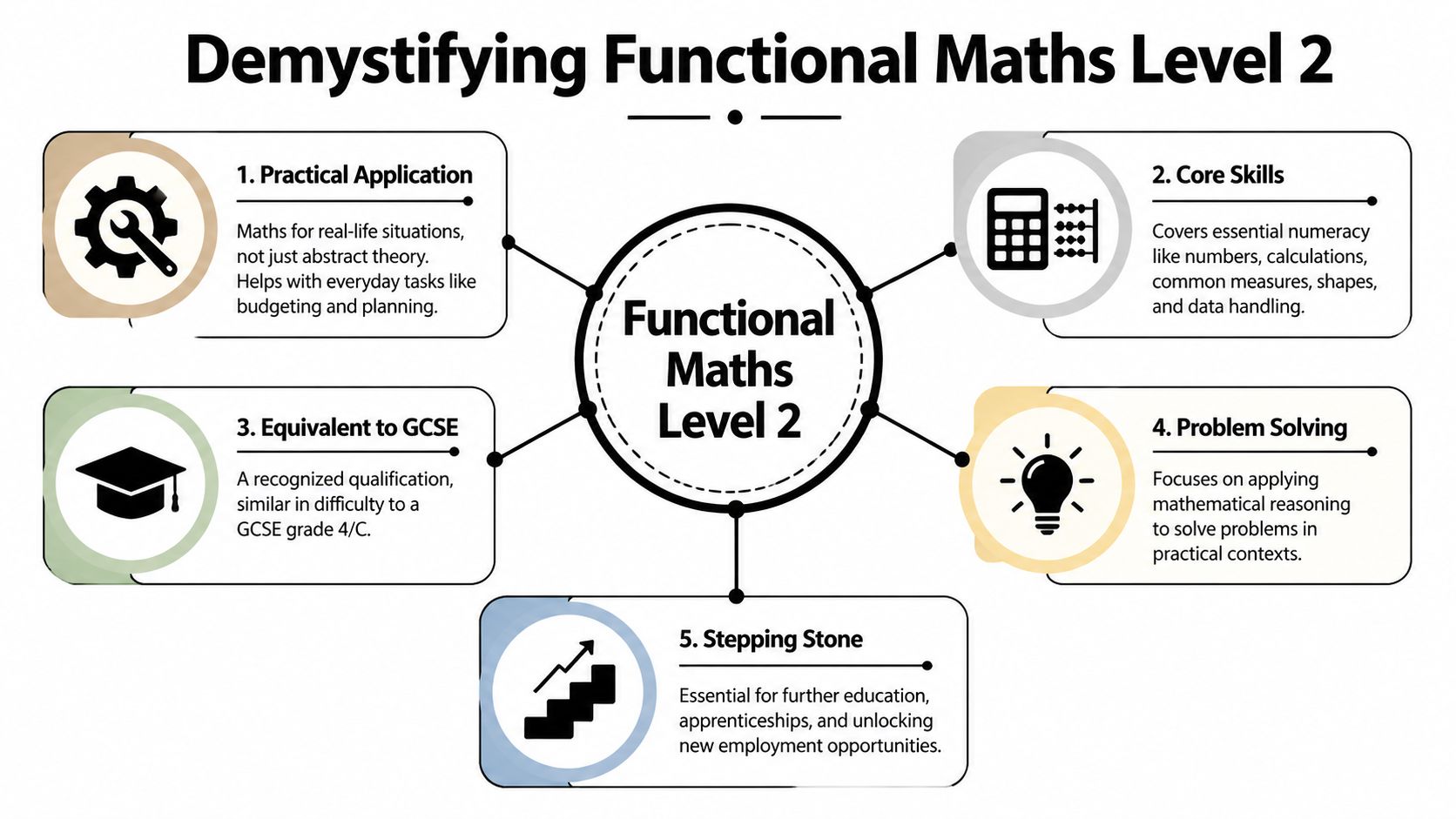
Functional maths level 2 is practical maths for real life. It focuses on using maths in situations that make sense, such as money, measurements, data, and problem solving. It isn't about trying to catch you out with maths that feels miles away from everyday life.
Think of it as a toolkit for life. A hammer is useful because you can use it. Functional maths works the same way. It gives you skills you can use at home, at work, and in further study.
A qualification that opens doors
Functional Skills Maths Level 2 was introduced as part of UK government skills reform and is now a key gateway qualification. It is equivalent to a GCSE grade 4 to 9, and official data shows that 68% of people who achieve it progress to higher education or apprenticeships within two years, while pass rates reached 57.3% in 2022/23, according to officially summarised Functional Skills Maths Level 2 data.
That matters because employers, training providers, and universities want to see that you can handle everyday numeracy with confidence.
How it differs from school maths memories
A lot of adults hear the word “maths” and think of school straight away. Timed tests. Red pen. Feeling behind.
Functional maths level 2 is different in feel and purpose.
| Aspect | What functional maths level 2 focuses on |
|---|---|
| Everyday use | Working with numbers you might meet in real life |
| Problem solving | Figuring out what method to use, not just memorising rules |
| Practical contexts | Money, charts, time, measures, proportions, and planning |
| Clear goal | Showing you can use maths competently in realistic situations |
Who it's for
This course often suits adults who:
- Need a recognised qualification: For work, university, or an apprenticeship
- Want practical maths: Not abstract topics that feel disconnected from life
- Have been out of education for years: And need a route back that feels manageable
- Learn better with purpose: Because relevance makes study easier
Practical rule: If you can see why a maths skill matters, it's much easier to learn it.
Functional maths level 2 isn't a lesser option. It's a focused one. It asks a simple question. Can you use maths in the world around you? If the answer becomes yes, many new doors can open.
The Everyday Skills You Will Master
One reason adults begin to enjoy functional maths level 2 is this. The topics stop feeling random when you see where they fit in real life.
You aren't learning maths for the sake of it. You're learning how to make decisions, check information, solve problems, and feel more in control.

Numbers you can use with confidence
You will work with whole numbers, decimals, fractions, percentages, and negative numbers. That sounds like a lot when written down, but these ideas show up everywhere.
A decimal question can help when checking prices, wages, or fuel use. Fractions and percentages matter when comparing deals in shops, splitting amounts, or understanding interest and discounts. Negative numbers appear in temperatures, debt, and changes in value.
A good example is seeing that 0.75, 3/4, and 75% all represent the same amount. Once that clicks, many questions become less scary.
Multi-step thinking that helps in work and life
Some questions involve more than one stage. That doesn't mean they're impossible. It means you learn to slow down and work in order.
The qualification requires learners to handle multi-step problem solving, including using BIDMAS for order of operations, calculating with decimals up to three places, and working with ratios, as set out in the Functional Skills maths subject content on GOV.UK.
For example:
- BIDMAS: In a question like (2+3)×4, you do the bracket first, so the answer is 20
- Decimals: You might need to compare costs such as £3.25, £3.05, and £3.50
- Ratios: You could scale up a recipe, mix paint, or compare ingredients
Real-life examples that make the syllabus feel useful
Here is where learners often say, “I need this.”
- Budgeting at home: You compare bills, total spending, and work out what you can save.
- Helping with homework: You explain simple percentages or averages to your child without feeling lost.
- DIY and decorating: You measure lengths, calculate area, and avoid buying too much or too little.
- At work: You read tables, understand targets, and make sense of number-based instructions.
When maths is tied to a real task, your brain has something solid to hold on to.
Data handling without the panic
You will also learn how to read and use data. That includes charts, tables, averages, and common statistical ideas such as mean, median, mode, and range.
This matters more than many people realise. Data is all around you. It's in work reports, school information, news stories, rotas, and timetables. Once you know what the numbers are saying, you feel less at the mercy of them.
You might look at a small set of numbers and work out the average. Or you might read a chart and decide which day was busiest, which product sold most, or which option makes better sense.
Measures, shapes, and space
This part helps with practical tasks. You could be measuring a room, reading a scale, checking capacity, or comparing distances.
These skills are useful in many settings:
| Everyday task | Maths skill involved |
|---|---|
| Buying flooring | Area |
| Filling a container | Volume or capacity |
| Planning travel | Time and distance |
| Reading packaging | Units and conversions |
The more you learn, the more you notice that maths isn't separate from daily life. It's already there. Functional maths level 2 helps you understand it and use it with more confidence.
Functional Maths Level 2 vs GCSE Maths Which Is For You
A lot of adults ask the same question. Should I take functional maths level 2 or GCSE maths?
The honest answer is that both are respected. The better choice depends on what you need right now. If you want a practical qualification that supports work, apprenticeships, and many university routes, functional maths level 2 is often the more direct option. If you need a GCSE specifically for a certain provider or pathway, a GCSE resit may be the better fit.
Functional Skills Level 2 vs GCSE Maths at a Glance
| Aspect | Functional Skills Maths Level 2 | GCSE Maths |
|---|---|---|
| Main focus | Practical maths used in everyday life and work | Broader academic maths |
| Style of learning | Real-world problem solving | Wider theory and topic coverage |
| Assessment feel | Clear, applied tasks | More traditional exam approach |
| Result style | Pass or fail | Number grade |
| Often suits | Adult learners, career changers, practical learners | Learners who need a GCSE specifically |
If you want a closer look at accepted equivalence, this guide on whether Functional Skills is equivalent to GCSE can help.
When functional maths level 2 is often the right choice
Functional maths level 2 can be a strong option if you:
- Need maths for progression: Such as a course, apprenticeship, or job requirement
- Prefer practical learning: Because real-life examples make more sense to you
- Want a straightforward goal: Pass the qualification and move forward
- Feel put off by school-style maths: And want something more applied
This doesn't mean GCSE maths is wrong. It means your route should fit your life, your confidence, and your goal.
Questions to ask yourself
Some adults find the choice easier when they ask these simple questions:
What does my next step require?
Check whether your employer, college, university, or training provider accepts functional maths level 2.How do I learn best?
If you do better when maths connects to everyday tasks, functional skills may feel more natural.What would help me act now?
The right course is the one you will start and stick with.
Choosing a practical route isn't settling for less. It's choosing the path that matches your goal.
For many adult learners, the biggest win is momentum. Once you choose the right course, the fog starts to lift. You stop circling the decision and start moving forward.
Understanding the Assessment and How You Pass
Exams can bring up old nerves fast. Even confident adults can feel shaky when assessment day gets closer. That reaction is normal.
What helps is knowing what you're walking into.
What the assessment is checking
Functional maths level 2 is designed to check whether you can use maths in practical situations. The questions are meant to reflect realistic problems rather than obscure tricks.
You may come across tasks linked to money, time, data, measurement, or planning. The point is to show that you can apply what you've learned clearly and sensibly.
A simple way to think about the papers
Many learners prepare by treating the assessment in two parts:
- Core number confidence: The arithmetic and essential skills you need to do accurately
- Applied problem solving: Questions where you read a situation, choose a method, and work through it step by step
That approach helps because it turns one big fear into smaller, manageable pieces.
What pass really means
One good thing about functional maths level 2 is that the result is straightforward. You are aiming to meet the standard. You do not need to chase a top grade. You need to show secure, practical competence.
That can take a lot of pressure off. Instead of thinking, “I must be brilliant at maths,” you can think, “I need to be prepared, steady, and accurate enough to pass.”
Most mistakes happen when learners rush. Slow work is often strong work.
How to prepare in a calm, smart way
If you're worried about passing, keep your preparation simple and consistent.
- Practise little and often: Short sessions are easier to manage than long stressful ones
- Revise methods, not just answers: Learn why a method works
- Use realistic questions: The more familiar the format feels, the less intimidating the exam becomes
- Check your working: Small checking habits can save marks
Support can make a big difference too. If you'd like practical revision advice, this guide on how to pass Functional Skills Maths Level 2 gives a useful starting point.
Walking into an exam with a plan feels very different from walking in with panic. That's why preparation matters so much. It builds calm as much as skill.
Unlocking Doors to University and Your Dream Career
For many adults, this is the moment everything becomes real. You stop seeing functional maths level 2 as just a course and start seeing it as a key.
A key to study. A key to better work. A key to choices that may have felt out of reach for years.

The route back into education
A missing maths qualification often blocks adult learners from taking the next step. Once that barrier is removed, pathways begin to open.
That could mean an Access to Higher Education course. It could mean applying for a professional training route. It could mean finally taking your ambition seriously instead of treating it like a dream for someone else.
For adults who want to move towards higher education, this guide on how to get into universities shows how returners can build a realistic path forward.
Careers where maths matters
Functional maths level 2 can support progress in areas where accurate numeracy matters every day. Think about jobs connected to healthcare, construction, engineering, administration, and apprenticeships. In these settings, people use maths to follow instructions, work safely, manage information, and make sound decisions.
Existing resources often don't show progression routes clearly enough. Mapping functional maths level 2 to growth sectors and employer expectations helps learners see a more tangible return on their effort, as explained in this discussion of progression pathways and industry relevance.
That matters emotionally as well as practically. Adults are more likely to keep going when they can see where the road leads.
What your family sees when you keep going
Your children may not remember every worksheet or revision session. But they will remember your example.
They will remember that you kept studying when it was hard. They will remember that you chose growth instead of giving up. They will see that learning doesn't end at school and that courage often looks quiet.
The certificate matters. The example you set may matter even more.
That can become one of the most powerful parts of this journey. You are not only improving your own future. You are changing what success looks like at home.
A short video can help make that next-step thinking feel more real.
A better future can start with one qualification
People sometimes dismiss one course because it seems small. But small things can open doors to bigger ones.
A single qualification can help you meet an entry requirement. That requirement can lead to a new course. That course can lead to a profession. That profession can change your income, your confidence, your routine, and the way you see yourself.
Functional maths level 2 isn't magic. You still have to do the work. But it can be a turning point. And turning points are where new lives begin.
Your Success Story Starts Here with Next Level Online College
Starting again is brave. Doing it alone is much harder than it needs to be.
Adult learners do best when they have clear lessons, patient support, and a study routine that fits around real life. That's why the learning environment matters so much. The right support doesn't just help you understand maths. It helps you keep going on the days when confidence drops.

Why support changes the whole experience
Targeted support makes a real difference. Data shows that centres offering dedicated online support achieve pass rates of around 65%, compared with the national average of 57%, showing the value of a structured and supportive environment for adult learners, according to this report on online support and Functional Skills pass rates.
That doesn't mean success is handed to anyone. It means support helps learners stay organised, ask questions, fix weak areas, and build confidence steadily.
What adult learners need most
Adults returning to study usually need more than content. They need learning that respects the reality of adult life.
That often includes:
- Flexibility: Study around shifts, school runs, and family responsibilities
- Clear structure: Lessons that build from simple ideas to harder ones
- Human encouragement: Someone who explains things calmly when you're stuck
- Confidence-building: Teaching that doesn't make you feel judged for what you don't yet know
A good online college understands that many learners are carrying doubt as well as ambition. The course has to support both.
Why Next Level Online College suits this journey
Next Level Online College is built for adult learners who want recognised qualifications in a flexible format. That matters if you're trying to balance study with work, parenting, or a busy home life.
Its wider approach also fits what adult returners often need most:
| What learners worry about | What helps |
|---|---|
| “I’ve been out of education too long” | Structured learning and patient guidance |
| “I don’t know how to fit this in” | Flexible online study |
| “I’m scared I’ll lose confidence” | Ongoing academic and pastoral support |
| “I need this to lead somewhere” | Clear progression into further study and career routes |
There is something powerful about being supported by people who understand adult education properly. Not just the syllabus, but the emotions that come with starting over.
Your next step matters
You do not need to have everything figured out today. You do not need to feel fully ready. That's a common sentiment.
You only need to decide that your future is worth investing in.
If you keep going, this qualification can become more than a pass. It can become the moment you stopped shrinking your goals and started building the life you want. A life with more choice, more stability, and more pride. A life your children can look at and think, “If they can do it, maybe I can too.”
If you're ready to take that first step, Next Level Online College offers flexible online study, recognised qualifications, and support designed for adult learners returning to education. If you want a calmer, clearer path to functional maths level 2, it's a strong place to begin.