

You might be reading this after a long day at work, with dinner still to sort and a hundred other things on your mind. You know you want more from life. Not just a job that pays the bills, but work that means something. Work that makes your family proud and shows your children that it's never too late to build a better future.
That's one reason the question what does criminologist do matters so much. It isn't just about picking a subject. It's about finding a path for your curiosity, your sense of fairness, and your wish to help people.
A lot of adults first become interested in criminology through TV dramas, documentaries, or news stories. You see a crime, an investigation, and a result. But part of you keeps asking the bigger questions. Why did it happen? Could it have been prevented? Why do some places struggle more than others? Why do some people offend again, while others turn their lives around?
Those are criminology questions. And if you've been carrying those questions for years, that doesn't make you behind. It makes you ready.
Your Journey Into the World of Criminology Starts Here
You may already have more of a criminologist's mindset than you realise. If you notice patterns, care about fairness, and want to understand people rather than just judge them, you're starting in a strong place.

For many adult learners, the word criminologist sounds academic and distant. It can feel like a role for someone else. Someone younger, more confident, more qualified. That isn't true. Plenty of people return to education later in life because they want work with purpose, and criminology speaks directly to that goal.
The bigger reason this career matters
Criminology is about understanding crime so society can respond better. It asks hard questions about behaviour, communities, justice, and prevention. That makes it a good fit for people who want to do more than watch problems happen.
You're not just learning facts. You're learning how to think clearly about serious issues and how to turn evidence into action.
A good starting point: If university feels like a distant goal, seeing how adults get into universities through flexible routes can make the path feel far more real.
Why adult learners often suit this field
Life experience helps in criminology. If you've worked with people, managed stress, supported family, handled setbacks, or seen how unfair systems can be, you already understand something important. Crime doesn't happen in a vacuum. It connects to real lives and real pressures.
That's why this field can feel so powerful. It gives structure to the questions you already care about.
- You want meaning. Criminology connects study to real social problems.
- You want progress. Education can open doors to more respected and fulfilling work.
- You want to set an example. Choosing to learn sends a strong message to your children about courage and persistence.
Criminologist vs Crime Scene Investigator A Crucial Difference
Many people face a common misconception. They hear the word criminologist and think of someone in gloves at a crime scene, collecting fingerprints or chasing suspects. That's not what a criminologist usually does.
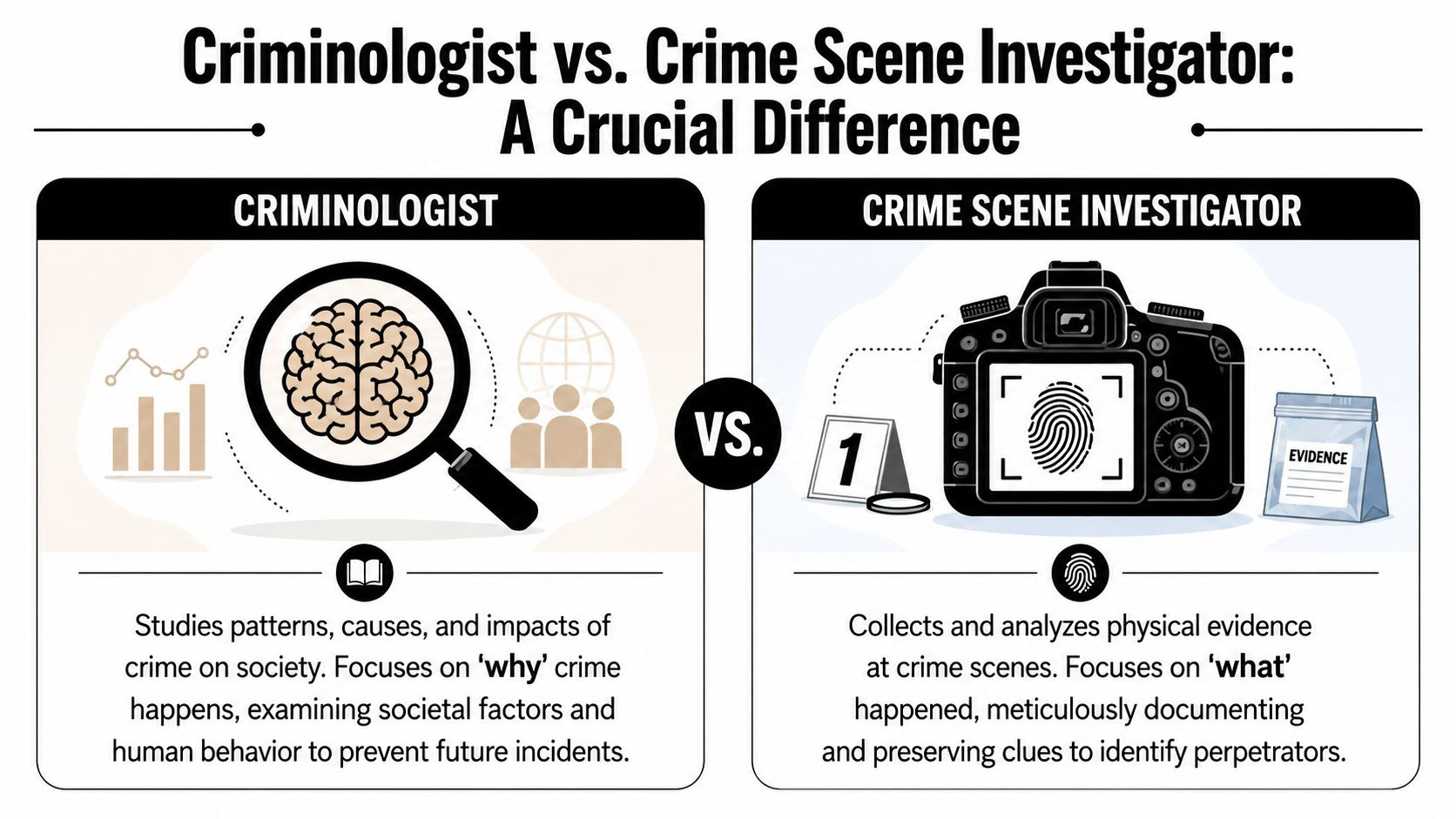
The National Careers Service description of a criminologist makes the difference clear. Criminologists look “at reasons why people commit crimes” and use research to understand patterns, rather than solving individual cases.
The simplest way to remember it
A detective asks who did this crime.
A crime scene investigator asks what happened here and what evidence is left.
A criminologist asks why does this kind of crime happen, and what can reduce it in future.
That's a huge difference.
What this means in real life
If a burglary happens, a detective may focus on the suspect. A crime scene investigator may examine the scene. A criminologist steps back and asks wider questions.
They might look at things like:
- Area patterns. Are similar crimes happening in the same places?
- Social factors. Are there local pressures linked to offending?
- Policy questions. Are current prevention methods working?
- Behaviour over time. What pushes some people into repeated offending?
Many people choose criminology because they care deeply about justice, then discover they're actually more interested in causes, systems, and prevention than in frontline investigation.
Why this distinction matters for your future
This isn't a small detail. It can shape your whole study path.
If you dream of analysing society, writing reports, shaping policy, improving services, or helping organisations make better decisions, criminology could suit you very well. If your main goal is gathering physical evidence at scenes, that points towards a different route.
Knowing the difference early protects your time, money, and confidence. It helps you choose a path that matches your strengths, not a TV version of the job.
What a Criminologist Actually Does Day to Day
A criminologist is a bit like a crime doctor. Doctors study symptoms, causes, and treatments. Criminologists do something similar with crime in society. They look for patterns, try to understand causes, and help suggest responses that can reduce harm.

Their work is usually research-based. That means reading reports, analysing data, spotting trends, writing findings, and helping decision-makers understand what those findings mean in practice.
The daily work in plain language
Some days involve looking at crime figures and asking what they show. Some involve studying how offenders move through the justice system. Others involve reviewing whether a policy or community programme is helping.
Here are some common parts of the role:
- Analysing data. Criminologists work with information from surveys, police records, and justice system data.
- Looking for patterns. They ask where crime is rising, falling, or changing.
- Researching causes. They study links between crime and social conditions, behaviour, or policy.
- Writing reports. Their job often includes explaining findings clearly to organisations that need to act on them.
- Advising on solutions. They help shape prevention strategies, interventions, and policy decisions.
Why the numbers matter
One key example comes from the Crime Survey for England and Wales. According to the University of Derby criminology resource, the survey showed a 91% decline in overall crime since 1995, falling from an estimated 19 million incidents at that peak to around 1.7 million by the year ending March 2023. Criminologists study evidence like this to understand what changed and which responses may have helped.
That same source explains that criminologists use national data, police-recorded information, and statistical methods to identify trends and support evidence-based interventions. In other words, they help turn raw numbers into practical decisions.
Why this matters: When a criminologist explains a trend properly, police forces, government teams, and community organisations can make better choices.
A criminologist may also study reoffending, evaluate a local safety scheme, or look at the effects of prevention work in a neighbourhood. The job isn't about guessing. It's about using evidence carefully.
This short video gives a helpful feel for the field in action.
Tools they may use
The tools depend on the role, but the thinking stays similar. A criminologist might use spreadsheets, research methods, mapping software, and written analysis to answer real-world questions.
That makes the job a strong choice for someone who likes both people and problem-solving. You're not only studying crime. You're helping others respond to it more wisely.
Where Criminologists Work and Who They Help
Criminologists don't all work in one type of place. That's good news if you want a career with options. The same core skills can be used in different settings, depending on whether you care most about policy, public services, rehabilitation, or community support.
In government and public policy
Some criminologists work in departments that shape national or local responses to crime. Their reports can help leaders decide which programmes to fund, which risks need attention, and how laws or services affect people.
This kind of work suits people who want to improve systems. You may not meet every person affected, but your work can influence decisions that reach whole communities.
In police and community safety teams
Some roles sit close to policing, but not in the way TV suggests. These jobs often involve analysing trends, helping teams understand local problems, and supporting prevention plans.
You might help answer questions like:
- Which areas need attention most
- What pattern is showing up over time
- Which response seems to reduce harm
- How resources should be directed
In charities and support organisations
The human side of criminology is particularly evident. Charities that support victims, young people, families, or people leaving the justice system often need staff who understand crime from a wider social angle.
A criminologist in that setting might help build programmes, evaluate support services, or explain why certain groups need different kinds of help. If you've always wanted work that feels useful and compassionate, this path can be very rewarding.
Some of the most meaningful criminology-related work happens away from the spotlight. It happens in reports, meetings, outreach projects, and support plans that help people rebuild their lives.
In universities and research settings
Some criminologists teach, research, and publish work that helps others understand crime better. This route is often a good fit for people who love learning and want to keep asking bigger questions throughout their career.
The workplace may vary, but the purpose stays steady. Criminologists help organisations make smarter, fairer choices. They help communities become safer. They help move the conversation beyond blame and towards understanding.
Your Path to Becoming a Criminologist
If this career speaks to you, the next question is usually practical. How do you get there from where you are now?
For many individuals, the journey begins with formal schooling. That can seem intimidating, particularly if you have been away from the classroom for a long time. However, adult students do not need to make massive transitions. They require defined progressions.
Start with the qualifications you need
A university criminology degree is a common route into this field. If you don't yet have the entry qualifications for university, there are stepping-stone options that can help you build up to that goal.
For many adults, that means checking whether they need GCSEs in English and maths, then considering an Access to Higher Education Diploma in a related subject such as Social Science or Law before applying to university.
Here's a simple way to think about it.
| Qualification | What it's for | Best for you if… |
|---|---|---|
| GCSE English and maths | Builds the foundation many colleges and universities expect | You need to strengthen core qualifications before moving on |
| Access to Higher Education Diploma in Social Science or Law | Prepares adult learners for degree-level study | You've been out of education and want a clear route back in |
| Criminology degree at university | Gives specialist subject knowledge and academic training | You're ready to study crime, justice, behaviour, and policy in depth |
Don't let the word university scare you
University can feel like a world for other people. But thousands of adults reach it through non-traditional routes. The important thing is not whether your path looks perfect. It's whether it moves you forward.
If you're comparing degree options, looking at the best universities for criminology in the UK can help you understand what different courses offer and what might suit your goals.
What makes adult learners succeed
Adult students often bring strengths that younger students are still developing. They tend to have stronger motivation, better time awareness, and a clearer reason for studying.
That matters because criminology isn't only about passing assignments. It's about growing into a thoughtful, capable professional.
A steady path often looks like this:
- Check your current qualifications and identify any gaps.
- Choose the next realistic step, not the final one all at once.
- Build study habits around real life, including work and family.
- Apply to university when you're ready, with more confidence and a clearer purpose.
Encouragement for adult learners: Needing a stepping stone doesn't mean you're behind. It means you're building properly.
The Essential Skills That Make a Great Criminologist
A lot of adults worry they're missing the “right kind of brain” for this work. In truth, many of the best criminology skills start in everyday life.

Skills you may already have
If you've ever solved problems at work, managed a difficult family situation, or tried to understand why someone behaved the way they did, you've already used parts of a criminologist's skill set.
These qualities matter a lot:
- Analytical thinking. Seeing patterns and asking sensible questions.
- Empathy. Trying to understand people without excusing harm.
- Communication. Explaining ideas clearly in speech and writing.
- Patience. Being willing to look closely instead of jumping to conclusions.
Skills you can learn
You don't need to arrive as an expert in statistics or software. Those are teachable tools. What matters is being willing to learn them.
The Stonebridge overview of criminology careers notes that modern criminologists should aim to learn data analysis and GIS software for mapping crime hotspots. It also explains that this expertise is valued in analytical roles within UK police forces and supports strategies that reduce violence and save money.
If you enjoy understanding behaviour, studying something like A Level Psychology can also be a useful way to strengthen your thinking about people, evidence, and human actions.
Your life experience counts
This is worth holding onto. You are not starting from zero.
You may already know how to stay calm, listen well, notice warning signs, and think about cause and effect. Education helps you sharpen those abilities and apply them in a professional way. That's one reason adult learners can grow into strong criminology students.
You Can Make a Difference Your Next Step
By now, the answer to what does criminologist do is probably much clearer. A criminologist doesn't usually solve one crime at a time. They study the bigger picture of crime, behaviour, systems, and prevention so communities can become safer and fairer.
That matters if you're looking for a future with purpose. This field can suit people who want more than routine work. It can suit people who care about justice, ask thoughtful questions, and want their effort to count for something.
It can also be a powerful fresh start. If you've doubted yourself because you left education early, changed direction, or spent years putting other people first, you're not disqualified from this path. You may be more prepared for it than you think.
A simple way to move forward
You don't need to plan your whole life tonight. You only need one next step.
That next step might be:
- Checking your current qualifications
- Looking into GCSE or Access courses
- Reading about criminology degrees
- Asking for advice about the best route for your situation
Your children don't need to see a perfect parent. They need to see someone brave enough to grow. Your family doesn't need you to have all the answers today. They'll be proud of the fact that you chose to begin.
The future changes when you decide your goals still matter.
If you're ready to turn your interest in criminology into a real study plan, Next Level Online College offers flexible online courses designed for adult learners across the UK. Whether you need GCSEs, an Access to Higher Education Diploma, or a clear route back into learning, the college can help you build confidence, study around family life, and take a practical step towards university and a career that makes a difference.