
You might be reading this after the kids have gone to bed, or during a lunch break, or in that quiet moment when you finally admit to yourself, “I want more from life than this.” You may have looked at job adverts, university courses, or training options and seen the same thing come up again and again. GCSE English.
If school was hard the first time, that can bring up old doubts very quickly. You might worry that you've left it too late, that you won't fit in, or that you're “not academic”. Those feelings are common. They're also not the truth about what you can do now.
Studying GCSE English as an adult isn't about going backwards. It's about moving forward with purpose. It's about opening doors that have felt closed for too long, building confidence, and showing your children and family what courage looks like in real life.
Your Time to Shine A New Beginning with GCSE English
A lot of adults start in the same place. They're working hard, caring for other people, and doing their best. But something keeps getting in the way. A course application asks for English at grade 4. A job needs a Level 2 qualification. A dream of university suddenly depends on one subject they never quite got the first time.
That moment can feel heavy. It can also be the start of something powerful.

In England, GCSE English remains a core gateway qualification for adult learners because many jobs, training routes, and university pathways require at least a grade 4, as shown in national GCSE attainment data for England. The same data shows that in the 2022 to 2023 school year, 65.1% of pupils in England achieved grade 4 or above in GCSE English and maths combined, with major gaps between groups, including 88.6% for pupils from the Chinese ethnic group and 16.2% for white Gypsy and Roma pupils in that combined measure. Adult education matters because many people are still trying to overcome barriers that shaped their earlier school years.
This time is different
As an adult, you bring things you may not have had at school. You know why you're doing this. You've handled real responsibilities. You've learned patience, resilience, and how to keep going when life is busy.
That changes the whole experience.
You don't need to be the person you were at school. You only need to be the person who is ready now.
For many learners, GCSE English for adults becomes more than a qualification. It becomes proof. Proof that they can finish something important. Proof that they can aim higher. Proof that their children can look at them and say, “If Mum can do it, maybe I can too.”
What this step can mean
A pass in English can help you move towards:
- Better opportunities through courses, training, and job applications
- More confidence in writing, speaking, and understanding information
- A stronger example at home when your family sees you learning and growing
- A new direction if you want to retrain, apply for university, or change career
If you're nervous, that's normal. If you're hopeful, hold onto that. Hope is often where change begins.
What You Will Learn in Adult GCSE English
Many adults worry that GCSE English will feel confusing or overly academic. In reality, the course builds skills you use in everyday life, then strengthens them to a recognised Level 2 qualification. According to the AQA GCSE English Language specification, the course is designed to help learners read, understand and analyse a wide range of texts, write for different purposes, and complete spoken language work.
Reading with more confidence
Reading in GCSE English isn't just about books from school. It's about learning how language works.
You might read a newspaper article, a letter, a speech, or a piece of fiction. The aim is to understand what the writer is saying, how they say it, and why it affects the reader in a certain way.
That helps in real life. If you can spot tone, purpose, and meaning, you become better at understanding workplace messages, official letters, course materials, and information online.
Writing that gets your point across
Writing is a big part of the course, but it isn't about using fancy words to impress people. It's about being clear, organised, and effective.
You'll practise writing for different reasons, such as:
- To explain an idea clearly
- To argue a point in a convincing way
- To describe a scene or situation
- To tell a story in an engaging way
These are useful skills far beyond the exam room. They can help with applications, emails, personal statements, reports, and everyday communication.
Practical rule: Good writing isn't about sounding clever. It's about helping the reader understand exactly what you mean.
Spoken language matters too
Many adult learners are surprised to hear that spoken communication is part of the course offered by many providers. This usually means preparing and delivering a short presentation, then responding to questions.
For adults, this can be one of the most valuable parts of all. Speaking clearly, sharing ideas, and answering questions can help in interviews, meetings, and training.
Why some adults take a staged route
GCSE English is more demanding than a basic literacy course. It asks you to analyse language, shape arguments, and manage exam questions with care. That's why some providers suggest starting with Functional Skills Level 1, then moving on to GCSE, especially if you've been out of education for a long time.
A staged path isn't a setback. It's often a smart way to build confidence before tackling the full GCSE standard.
GCSE or Functional Skills Which Path Is Right for You
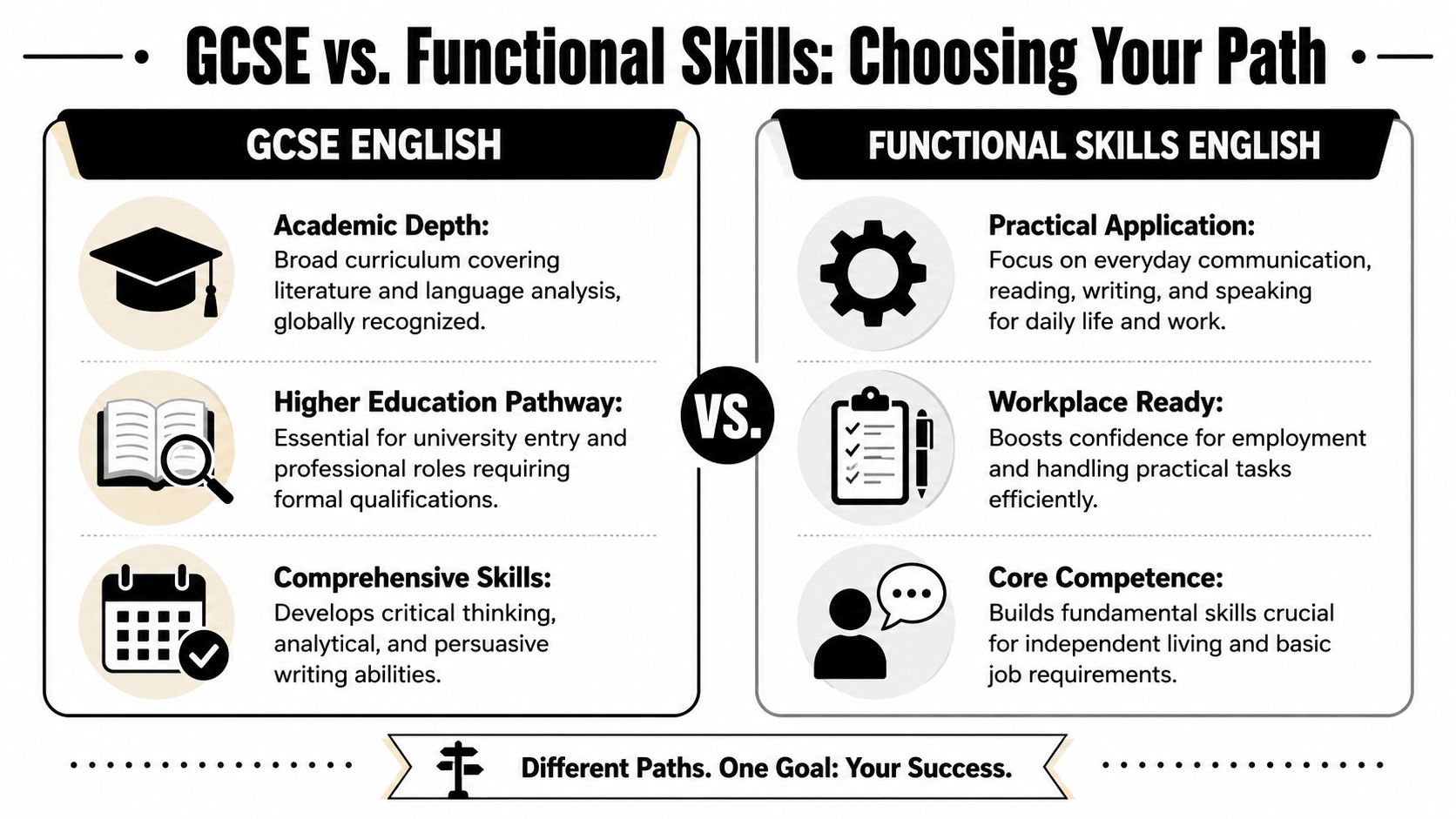
This is one of the biggest questions adults ask, and it's a good one. GCSE English and Functional Skills English are not the same thing, but that doesn't mean one is always better than the other.
The right choice depends on your goal.
Many UK providers now present Functional Skills Level 2 English as a valid alternative for adults who need a recognised qualification for work or apprenticeships, while GCSE remains the traditional route for academic progression, as explained in this guide on GCSE English and adult study options.
Start with your end goal
If you want to apply to university, train for a profession, or meet formal entry requirements, GCSE English is often the safer route. It's widely recognised as the traditional academic qualification.
If you mainly need a qualification for work, an apprenticeship, or day-to-day confidence with reading and writing, Functional Skills may suit you better. It focuses more on practical communication.
A helpful way to think about it is this:
- GCSE English is often best for longer-term academic progression
- Functional Skills English is often best for practical progress and faster workplace readiness
A simple comparison
| Factor | GCSE English | Functional Skills English |
|---|---|---|
| Main focus | Broader reading, writing, analysis, and communication | Practical reading, writing, speaking, and listening |
| Best for | University plans, regulated entry routes, academic progression | Work, apprenticeships, everyday communication needs |
| Style of learning | More exam-focused and analytical | More practical and applied |
| Good choice if you | Need the traditional qualification many colleges and professions ask for | Need a recognised qualification with a real-world focus |
You can also read more about Functional Skills compared with GCSE if you're weighing up both routes.
Questions to ask yourself
When learners feel stuck, these questions usually help:
What do I need this qualification for?
A job, a course, an apprenticeship, university, or confidence?How comfortable am I with exams?
GCSE can be the right route, but some adults prefer a more practical style first.How long have I been away from study?
If it's been many years, Functional Skills can be a useful stepping stone.Will I need GCSE English specifically?
Some universities, professions, and training routes ask for GCSE rather than an alternative.
If your goal is clear, your choice becomes much easier.
There isn't a wrong choice, only the wrong fit
This matters. Adults often feel pressure to choose the “highest” option straight away. But the best qualification is the one that fits your life and moves you forward.
For some people, that's GCSE English now. For others, it's Functional Skills first, then GCSE later. Progress is still progress.
Where You Can Study Your GCSE English
Once you've decided that GCSE English is the right route, the next question is practical. Where can you study it?
In England, adults can usually find English courses through colleges, adult education centres, libraries, and community venues, and government guidance also notes that adults can often study English to GCSE level free of charge through these settings. That makes the qualification far more reachable for busy adults who need local or flexible options.
Local colleges and community learning
A further education college is often the first place people look. Many colleges run adult GCSE English classes in the daytime, evenings, or part time. Adult education centres and community venues can also offer a more relaxed setting, which some learners prefer.
These options can work well if you like face-to-face teaching and a regular weekly routine.
Online study for busy adults
Online learning works well for adults with jobs, children, caring duties, or changing schedules. You can study at home, organise your week more easily, and revisit materials when you need to.
That flexibility can make the difference between wanting to study and being able to do it.
Some learners choose a local provider. Others choose an online option such as studying GCSE English online if they need a course built around work and family life.
What to look for in a provider
Try to look beyond the course title. Ask practical questions.
Tutor support
Will you get help when you're stuck?Clear structure
Are lessons, tasks, and deadlines explained clearly?Exam guidance
Will someone prepare you for the exam format and expectations?Adult-friendly teaching
Does the provider understand that adult learners may be returning after a long break?
A good course should feel challenging, but not lonely. Support matters. So does flexibility.
How to Get Your Course Funded
Cost stops many adults before they even begin. That's understandable. When money is tight, paying for a course can feel risky.
The encouraging news is that in England, adults aged 19 and over who have not previously achieved a grade 4 (C) in GCSE English Language are typically eligible for full funding, according to government guidance on improving English, maths and IT skills. In simple terms, many adults can study this qualification without paying tuition fees.
Why this matters so much
That funding changes the decision for a lot of people. It means GCSE English for adults isn't only valuable. It can also be accessible.
Instead of thinking, “I can't afford to go back into education,” many learners find they can start without that financial barrier hanging over them.
What to check
Funding depends on your situation, so it's worth asking a provider about your eligibility before you enrol. The key points to ask about are:
Your age
Adult funding commonly applies from age 19 and overYour previous English qualification
The usual question is whether you already hold GCSE English Language at grade 4 or aboveWhere you live and study
Funding rules can depend on location and course setup
Asking about funding isn't awkward. It's part of planning wisely.
If you don't qualify for funded tuition, there may still be payment options through some providers. But for many adults, the main message is simple. The course may be far more affordable than you think.
Unlocking Your Future with a GCSE English Pass
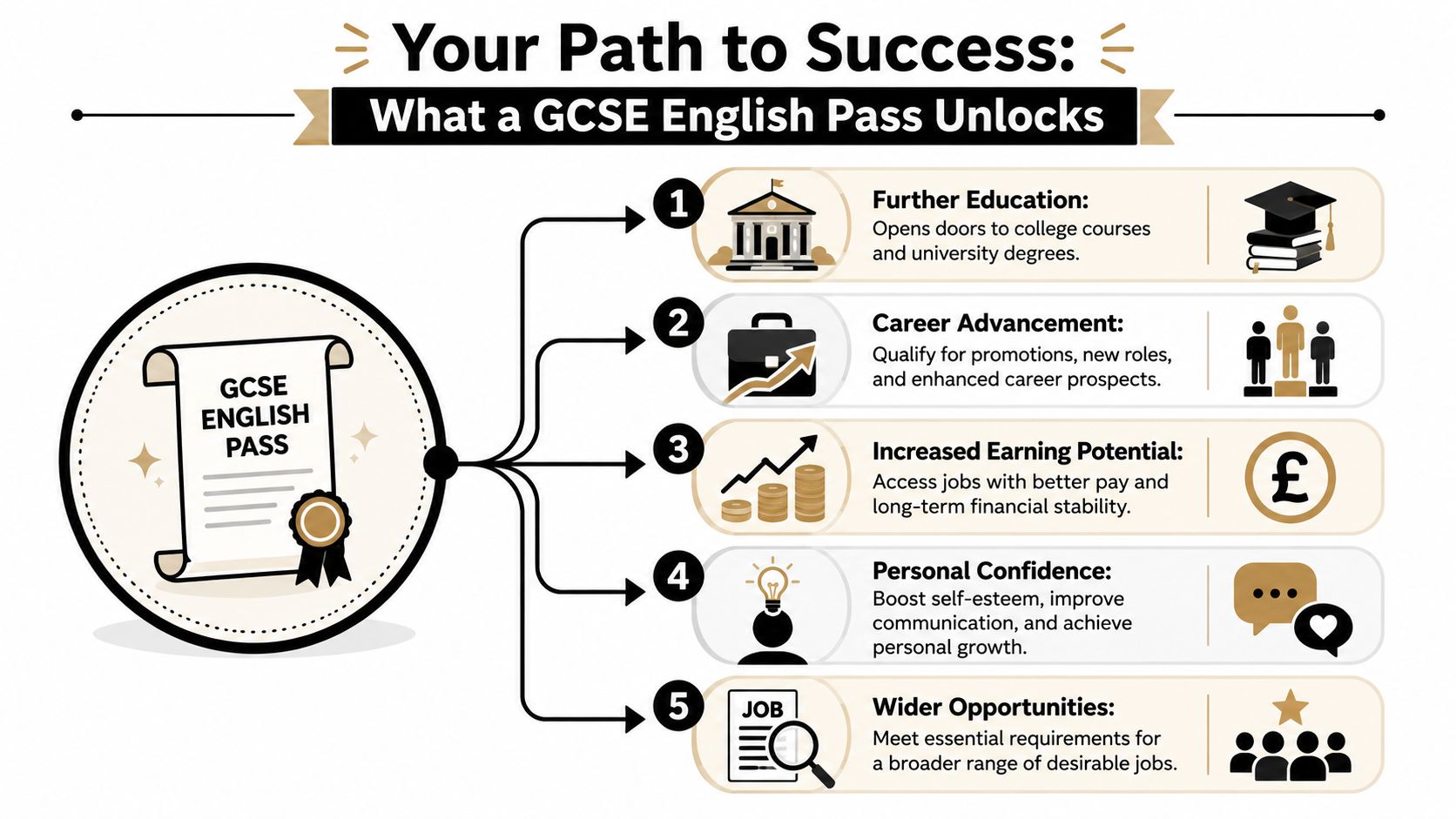
When you pass GCSE English, you don't just get a certificate. You remove a barrier that may have followed you for years.
For many adult learners, that pass means they can finally apply for the course they wanted, go for the job they kept putting off, or stop feeling embarrassed when a form asks about qualifications.
Doors that often open
Adult colleges often highlight GCSE English as part of the minimum entry requirements for careers such as nursing, teaching, and policing, and one college states that its adult course can be completed in up to 17 weeks in some cases, as shown on Knowsley Community College's GCSE English course page.
That matters because a qualification can stop being a distant dream and start becoming a near goal.
A different future at home as well as work
There's also the personal side, and it matters just as much.
Your children notice what you do. They notice when you keep going, even when something is hard. They notice when you sit down to study instead of giving up on yourself.
A parent who returns to education sends a powerful message. Learning doesn't end at school. Setbacks don't have to decide your future. You can rebuild confidence one step at a time.
What a pass can help you move towards
Further study
This could mean college courses, access courses, or university pathways, depending on your wider plans.Career change
If a role asks for English at Level 2, you may finally meet that requirement.Stronger self-belief
Many adults carry old school labels for years. Passing GCSE English can help break them.Better communication
Clear reading, writing, and speaking help in work, study, and daily life.
Sometimes the biggest change isn't the certificate itself. It's the moment you start seeing yourself as someone who can succeed.
Your Practical Plan for Study Success
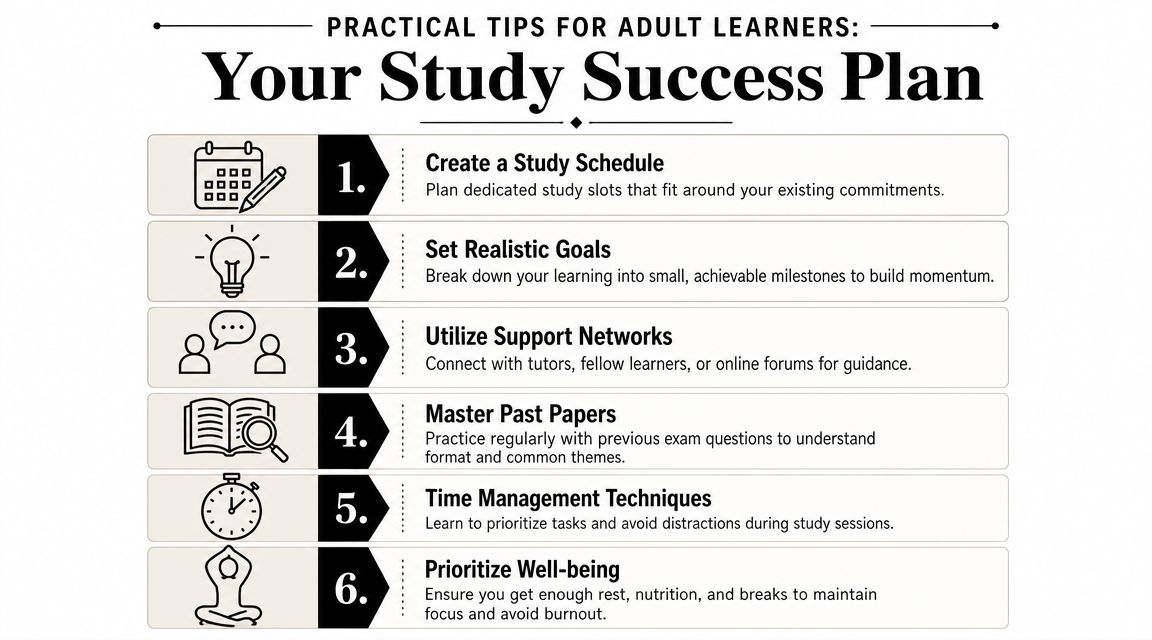
Success in GCSE English for adults doesn't come from being perfect. It comes from being steady. Small efforts, repeated often, can carry you a long way.
If your life is busy, your plan needs to fit real life. Not an ideal week. Your actual week.
Keep your routine simple
You don't need long, perfect study days. Short, regular sessions are easier to stick to.
Try this:
Choose set times
Pick a few study slots each week that you can protectUse short blocks
Twenty or thirty focused minutes can be enough to make progressLeave your work ready
Put your notebook, login details, and pen in one place so it's easy to start
Build confidence through small wins
A lot of adult learners lose momentum because they only notice what they haven't done. It helps to track what you have done instead.
You could set small targets like finishing one reading task, planning one answer, or learning how one question type works. These little wins build momentum.
Ask for help early
Struggling in silence is one of the biggest mistakes learners make. If something doesn't make sense, ask. If you're behind, say so. Good support can turn a bad week around quickly.
Past papers can also help because they show you how questions are asked and what the exam expects. If you want a simple place to start, these GCSE revision techniques for adult learners can help you build a routine.
Protect your energy
Studying while working or caring for others takes effort. Rest matters too.
Take breaks
Your brain works better when you pauseBe kind to yourself
One difficult lesson doesn't mean you're failingNotice your progress
Confidence often grows subtly before you fully feel it
Keep going, even if the steps feel small. Small steps still move you forward.
You don't need to know everything today. You only need a plan, some support, and the willingness to begin.
If you're ready to take that first step, Next Level Online College offers flexible online study options for adults returning to education, including recognised pathways that can fit around work, family, and everyday responsibilities.