
You might be reading this after a long day. The house is noisy, or finally quiet. You've done the jobs that had to be done, looked after everyone else, and now you're wondering if there's still room for your own future.
There is.
A lot of adults come back to learning with a mix of hope and fear. They want better work, more confidence, and a chance to show their children that it's never too late to grow. But they also worry they've been out of education too long. They worry they're “not academic”. They worry they'll start and then struggle.
Those feelings are real. They don't mean you can't do this.
A Level Geography can be a powerful fresh start. It isn't just about school memories, old atlases, or memorising facts. It's a subject about the world you live in now. It helps you understand weather, cities, climate, people, places, resources, and how decisions shape everyday life. It also builds the kind of thinking that helps in university, at work, and at home.
For an adult learner, that matters. This qualification can become more than a certificate. It can become proof to yourself that you can still learn, still aim high, and still build a different future.
Your Journey to a Brighter Future Starts Here
You may feel like life has been on hold for a long time. Maybe work pays the bills but doesn't inspire you. Maybe you've spent years putting your family first. Maybe you've watched other people move ahead and wondered when your turn will come.
Your turn can start now.
I've seen adults return to study carrying a lot of doubt. They often say things like, “I was never good at school,” or “I'm too old to start again.” Then something changes. They begin learning one topic at a time. They answer one question correctly. They write one essay they're proud of. Bit by bit, their confidence grows.
When learning becomes personal
A parent studying Geography A Level isn't only learning about rivers, cities, or climate. They're showing their children what courage looks like. They're showing that goals matter, even after setbacks. They're proving that education isn't only for the young. It's for anyone ready to build a better life.
That can be highly emotional.
You might be the first person in your family to go back into education. You might want qualifications for university entry. You might want a more secure career. You might want to feel proud when someone asks, “What are you doing for yourself this year?”
You don't need to feel ready to begin. You need to be willing to begin.
Why Geography feels different
Some subjects feel narrow. Geography often feels bigger than that. It connects the world outside your window to the future ahead of you. It helps you understand floods, housing, transport, food, migration, energy, and climate. These aren't distant ideas. They shape the lives of families across the UK every day.
That's why many adult learners find it surprisingly motivating. You're not studying for the sake of it. You're learning how the world works.
And when you understand the world better, you start believing you can find a stronger place within it.
What A Level Geography is Really Like Today
If your memory of geography is colouring maps or naming capital cities, modern Geography A Level will feel very different.
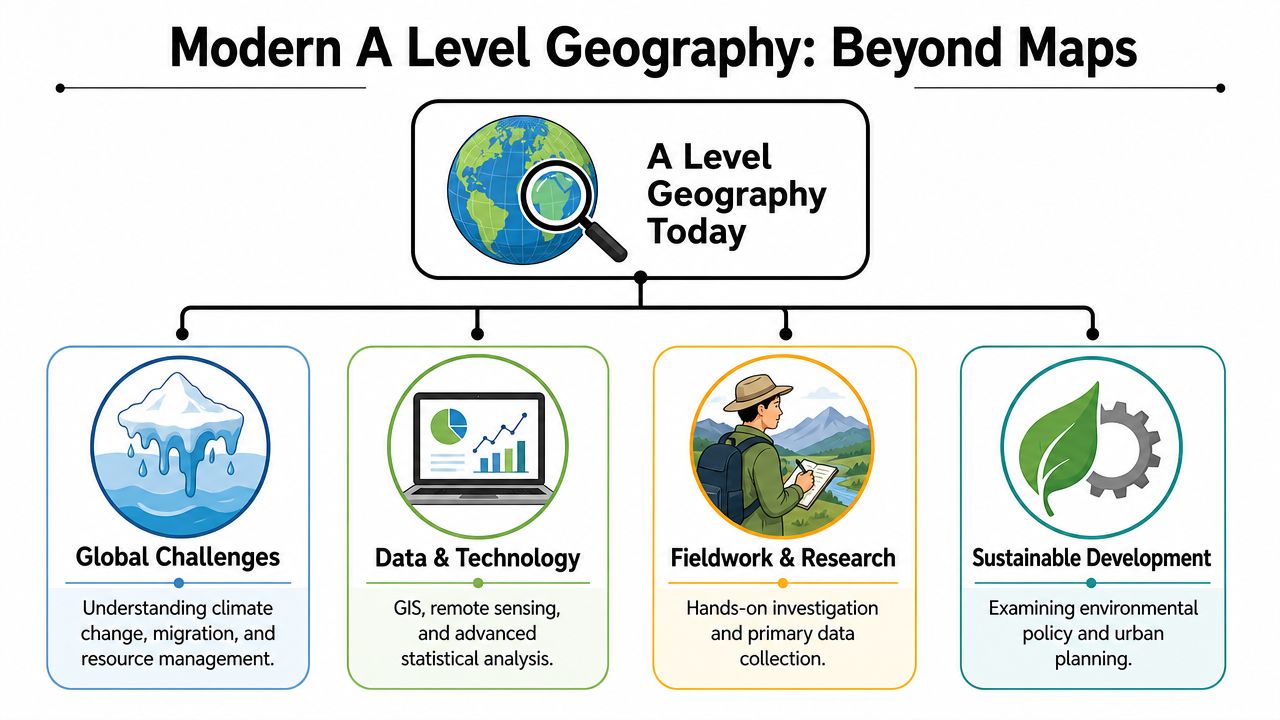
Today, it's a subject about systems, people, places, evidence, and change. Modern syllabuses are designed around real issues, not dusty trivia. For example, the Cambridge International Geography specification says its updated syllabus includes six key areas at AS and A Level, including hydrology, river processes and hazards, atmospheric processes, global climate change, earth processes, and human geography. That tells you something important. This is a modern course shaped around current global issues.
Two big sides of the subject
A simple way to understand Geography A Level is to see it as two linked stories.
Physical geography is the story of the planet itself.
It looks at things like rivers, coasts, weather, hazards, and climate systems.
Human geography is the story of people living on the planet.
It explores cities, migration, population, development, resources, and how communities change.
These two sides often overlap. A flood is a physical event, but where people build homes, roads, and businesses affects the impact. Climate change is about atmospheric processes, but it also changes farming, transport, housing, and public planning.
What learners often get wrong
Many adults think geography is mostly remembering case studies. Memory does matter, but that's not the heart of the course. The heart of it is understanding patterns and explaining them clearly.
You might be asked questions such as:
- Why does a river behave differently in one place than another?
- How does city growth create both opportunities and pressure?
- What happens when climate systems and human decisions interact?
- How can a place become more sustainable over time?
Those questions are interesting because they connect directly to life.
A helpful way to think about it: Geography is where science, society, and decision-making meet.
Why this matters to adult learners
Adults often do well in geography because they bring life experience. If you've worked, raised a family, paid bills, moved house, worried about weather disruption, or followed news about climate and housing, you already have useful background knowledge.
That doesn't mean the course is easy. It means it's meaningful.
A good Geography A Level course helps you turn everyday understanding into academic confidence. It gives structure to what you already notice about the world. It teaches you how to explain it, analyse it, and write about it in a way that exam boards reward.
That's one reason this subject can feel so rewarding. You're not memorising a disconnected list. You're learning to make sense of the world your children are growing up in.
The Powerful Skills You Will Build for Your Future
One of the best things about Geography A Level is that it changes more than your subject knowledge. It changes how you think.

The national subject content for geography makes this clear. Students are expected to study geography across different times and places, complete fieldwork in physical and human geography, and use evidence to explain links between processes such as climate, urbanisation, and coastal change. In plain English, that means the course builds evidence handling, analysis, evaluation, and clear written argument, not just memory.
You learn to work with evidence
This matters more than many learners realise.
At first, you may think, “I just need to know the content.” Soon you realise strong students do something deeper. They look at data, maps, patterns, and findings, then decide what those things mean. That's a valuable real-world skill.
In work, people trust the person who can look at information and make sense of it. In family life, that same skill helps you weigh choices carefully. In study, it helps you write stronger essays and give better answers.
Here are some of the most useful skills Geography A Level develops:
- Data analysis helps you read graphs, maps, tables, and patterns with more confidence.
- Problem-solving teaches you to ask why something is happening and what could improve it.
- Evaluation helps you compare options instead of accepting the first answer.
- Extended writing trains you to explain ideas clearly and support your point of view.
- Research skills help you gather information, organise it, and reach sensible conclusions.
Why employers and universities value this
Universities don't only want students who can repeat facts. They want learners who can handle ideas, weigh evidence, and build arguments. Employers want much the same.
That's why Geography A Level can be such a strong stepping stone. It prepares you to become the kind of person who can read a problem properly before jumping to an answer. That quality earns respect.
Practical rule: Every time you practise analysing evidence instead of guessing, you're building a skill that reaches far beyond the exam.
A subject like this can also rebuild confidence in a very deep way. Adult learners often arrive feeling rusty. Then they start interpreting a graph, comparing places, or writing an argument with structure and clarity. That moment matters. It's when they stop seeing themselves as someone “trying to get by” and start seeing themselves as someone capable.
A short video can help make the modern course feel more real:
The growth you feel along the way
Not every reward comes at the end.
Some of the biggest rewards happen during the course itself:
- You become more articulate. You find better words for complex ideas.
- You become calmer with information. Charts and written sources stop feeling scary.
- You trust your own mind more. That confidence can carry into work interviews and university applications.
- Your children see persistence in action. They watch you keep going, even when life is busy.
That last point is powerful. When children see an adult study with purpose, they learn that effort matters. They learn that setbacks don't end the story.
And you learn it too.
Understanding How Your A Level is Marked
Exams often feel frightening when they seem mysterious. The good news is that A Level assessment follows a clear structure. Once you know what you're aiming for, it becomes much easier to prepare.
A useful example is OCR A Level Geography. In that specification, 22% of marks come from Physical Systems, 22% from Human Interactions, 36% from Geographical Debates, and 20% from an independent investigation. That split tells you something very important. Success doesn't come only from short revision bursts before written exams. A large part of the course depends on sustained thinking, evaluation, and practical investigation.
What this means in plain language
Let's turn that exam structure into something less intimidating.
Physical Systems covers natural processes such as water, physical features, and environmental systems.
Human Interactions focuses on how people shape, use, and change places.
Geographical Debates asks you to think more critically and weigh up arguments.
Independent investigation is your chance to carry out and write up your own enquiry.
Many adult learners find the investigation less scary once they realise it's not about being a genius. It's about asking a sensible question, gathering evidence, and drawing conclusions clearly.
The main question types you'll face
Most Geography A Level assessments include a mixture of tasks. These can include shorter data questions, longer explanations, and essays where you must weigh different arguments.
A simple way to prepare is to treat them as three separate skills:
- Reading evidence carefully such as maps, graphs, photos, and tables
- Explaining processes clearly such as how or why something happens
- Evaluating viewpoints so you can judge which argument is stronger and why
Exams reward clear thinking. They don't reward panic.
Choosing Your Geography A Level Exam Board
| Exam Board | Key Features | Best For Learners Who… |
|---|---|---|
| OCR | Clear split between physical, human, debates, and investigation | want a strongly structured course with a significant independent enquiry |
| AQA | Well-known route with a broad geography offer | like established resources and a familiar exam board name |
| Edexcel | Popular option with its own approach to topics and assessment | want to compare specifications carefully before committing |
The most important point isn't which board sounds nicest. It's whether your course helps you understand that board's style of questions and mark schemes.
How to make marks feel less scary
Adult learners often lose marks for reasons that can be fixed. Common ones include drifting away from the question, describing instead of analysing, and not using evidence strongly enough.
Try this approach:
Read the command word first
If the question asks you to assess or evaluate, don't only describe.Use evidence with purpose
Don't throw in facts randomly. Link them to your main point.Reach a clear judgement
Examiners want to see what you think, based on the evidence.Practise under timed conditions
Confidence grows when the format becomes familiar.
If grades feel confusing, a simple guide to how A Level grades work can help make the bigger picture clearer too.
Creating a Study Plan That Fits Your Busy Life
Adult learners rarely have perfect study conditions. You may have work, children, caring duties, or shifts that change each week. That doesn't mean study is impossible. It means your plan has to fit real life.
The best study plans are usually simple.
Build with small blocks
Many people fail because they imagine study has to happen in huge, perfect chunks. It doesn't. Steady progress often comes from smaller blocks used well.
A flexible week might include:
- One focused session for new learning, such as watching a lesson or reading a topic guide
- Two short recap sessions for flashcards, notes, or key terms
- One writing session to practise an exam answer
- One review moment to check what felt hard and what improved
That kind of rhythm is manageable for many adults because it bends around life instead of fighting it.
A realistic week in adult life
Here's an example of how this can work.
On Monday evening, after the children are settled, you spend a short session reading about coasts or urban change. On Wednesday lunch break, you review class notes and key terms. On Thursday night, you answer one past-paper question. On Saturday morning, you spend a little longer improving that answer and checking feedback.
That isn't dramatic. It's effective.
Small sessions count. A tired parent who studies consistently is often doing better than someone waiting for a perfect free day.
Make online learning work for you
For many adults, flexibility is the difference between “I'd love to” and “I can”. Studying online lets you fit learning around your own timetable, not the other way round.
That matters if you work irregular hours, share childcare, or need to study when the house is quiet. A useful guide to distance learning for A Levels can help you picture how this style of study fits around adult responsibilities.
A simple plan when confidence is low
If you've been away from study for years, start smaller than you think you need to.
Try this weekly pattern:
- Pick one topic only so you don't overload yourself
- Write three key points after each study session
- Test yourself briefly instead of rereading everything
- Keep one notebook for tricky words, case studies, and feedback
- Finish each week with one win even if it's only understanding a graph better than before
That final point matters. Adult learners often focus on what they haven't done. It's much healthier to notice progress.
What to do when life knocks you off track
It will happen. A child gets ill. Work becomes stressful. Your energy drops. You miss a few study sessions.
Don't call that failure. Call it normal life.
The best response is to restart quickly and gently. Go back to one short task. Read one page. Review one set of notes. Write one paragraph. Momentum returns faster when you stop punishing yourself.
A good study plan doesn't demand perfection. It protects persistence. That's what carries adults through to the finish line.
Your Path to University and a Fulfilling Career
For many adult learners, the biggest question is simple. Is Geography A Level worth it?
For a lot of people, yes.
Geography had 40,657 A Level entries in England in 2024 and is recognised by the Russell Group as a facilitating subject. That matters because a facilitating subject can support entry to a wide range of degree courses. It isn't boxed into one narrow future.
Why universities respect it
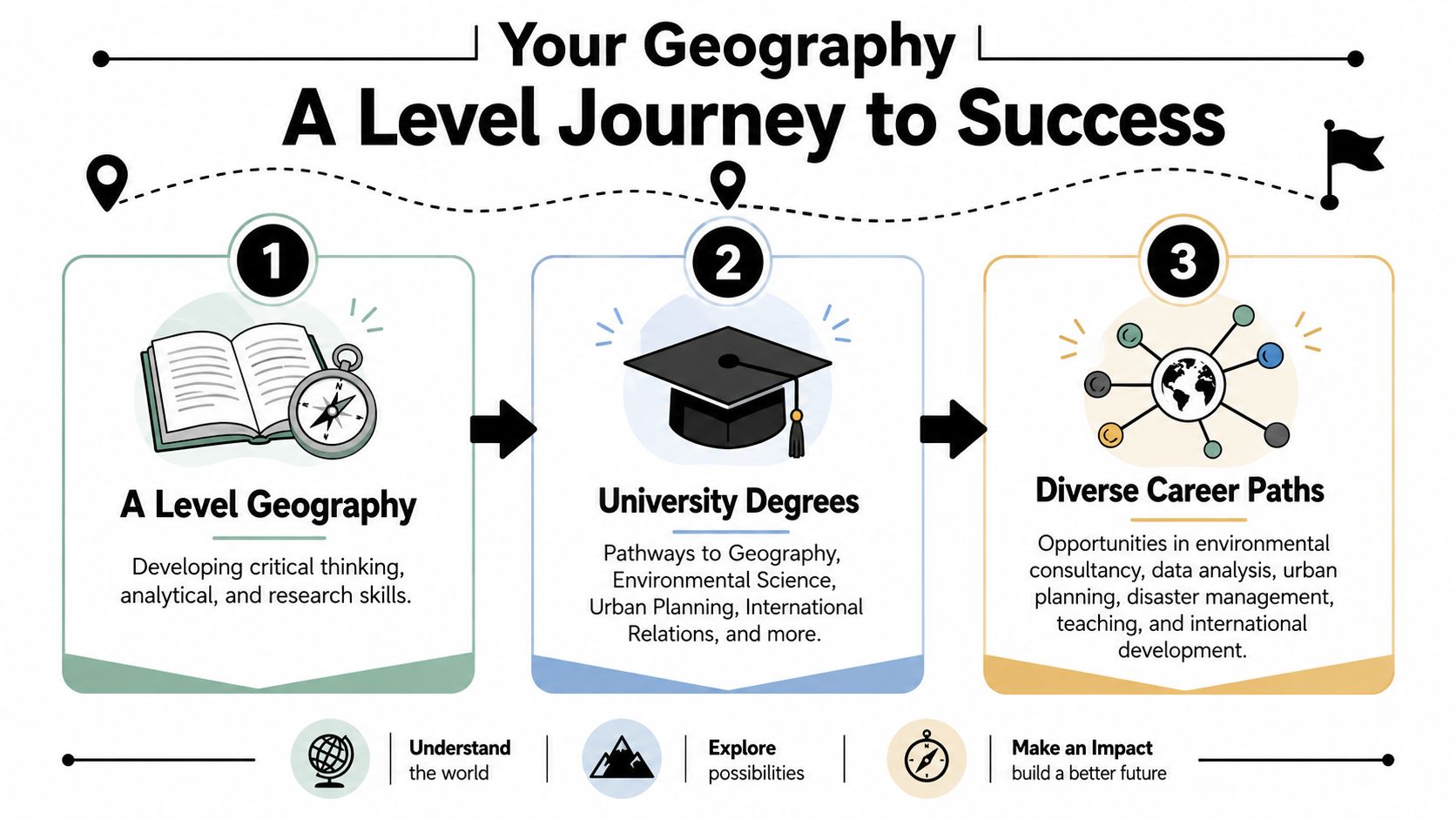
Geography sits in a strong middle ground. It includes essay writing, research, evidence, and analytical thinking. That combination can support many university paths, not only geography degrees.
Learners often move from Geography A Level into areas such as:
- Geography and Environmental Science
- Urban Planning
- International Relations
- Teaching
- Sustainability-related study
- Courses that value strong analytical and written skills
That flexibility is reassuring if you don't have every detail of your future mapped out yet.
Careers that feel meaningful
Many adults want more than a wage. They want work that feels useful.
Geography can connect well with careers where people solve real problems, understand places, and use evidence well. Depending on your next steps, it can support routes into planning, environmental work, teaching, GIS-related roles, and data-focused jobs. It can also help you move towards work linked to sustainability, climate awareness, and community change.
Here's why that can feel so motivating. You're not just studying to pass an exam. You're studying to become someone who can contribute. Someone who understands the pressures shaping towns, environments, transport, resources, and future decisions.
A qualification can open a door. Confidence gives you the courage to walk through it.
A story many adults recognise
A learner starts with one goal. “I need qualifications.” That feels practical and urgent.
Then something shifts. They begin to enjoy the subject. They realise they're good at weighing evidence. They feel proud handing in an assignment. Their children ask what they're studying. Their answer sounds stronger each time.
Soon the goal grows.
Now it's not only about meeting an entry requirement. It's about applying to university, changing career direction, or moving into work that feels more respected and more rewarding. That journey can reshape how a person sees themselves.
And families notice. Children notice when a parent becomes more hopeful. Partners notice when someone speaks about the future with more belief.
That's one reason education can be life-changing. It changes opportunities, but it also changes identity.
How We Help You Succeed Every Step of the Way
Starting again takes courage. Keeping going takes support.
Adult learners do best when they don't feel alone. They need clear teaching, patient guidance, and people who understand that study is happening alongside work, family, and everyday pressures. They need structure, but they also need kindness.
That's why the right course matters as much as the subject itself.
Support that fits adult life
A strong online college should do more than send materials and wish you luck. It should give you a learning experience designed for adults returning to education.
That means support such as:
- Clear course structure so you always know what to study next
- Tutor guidance that helps you improve, not just spot mistakes
- Flexible online access so you can study around your own responsibilities
- Encouragement and accountability for the weeks when motivation dips
When learners have that kind of support, the course stops feeling like a lonely mountain climb. It starts to feel possible.
Confidence grows through guidance
Many adults don't need someone to “push” them. They need someone to show them they're capable.
A good tutor can help you break down a hard topic, improve your essay style, and understand where marks come from. Equally, they can help you see that one poor answer doesn't define you. Progress in adult education is rarely neat. It's built through practice, feedback, and persistence.
If you're ready to look at a flexible route, the A Level Geography course at Next Level Online College is designed for adults who want recognised study that works around real life.
You don't have to become a different person first
This matters. You don't need to become ultra-confident before you enrol. You don't need a perfect routine, a quiet house, or a flawless academic past.
You need a reason to move forward.
Maybe that reason is university. Maybe it's a better career. Maybe it's showing your children what resilience looks like. Maybe it's finally proving to yourself that your story didn't stop when life got busy.
All of those reasons are enough.
If you're ready to take a real step towards a better future, Next Level Online College can help you begin with support, flexibility, and a course built for adult learners. Your goals still matter. Your future is still open. And this could be the moment you start building it.