
You might be reading this after a long shift, with the washing up still waiting and a quiet worry sitting in the back of your mind. You know you're capable of more. You want a career that feels respectable, useful, and steady. You want to prove to yourself, and maybe to your children, that it's not too late to start again.
That's where a mortgage advisor qualification can feel different from many other career routes. It doesn't ask you to disappear into university for years before you can move forward. It gives you a clear path into a regulated profession where your advice can help real families make one of the biggest decisions of their lives.
If your confidence has taken a few knocks, hold on to this. You do not need to be a maths genius. You do not need to come from a financial background. You do need commitment, support, and a willingness to learn step by step. That is enough to begin.
Your Fresh Start in a Career That Matters
A lot of adults don't lack ability. They lack a route that feels realistic.
Maybe you've spent years in retail, admin, care, customer service, or a job where you work hard but never feel you're getting ahead. You come home tired, but not proud. You know you've built useful skills, yet your CV doesn't seem to show the full picture.
A career as a mortgage advisor can change that in a very practical way. You're not just moving into finance. You're moving into a role where people rely on your calm thinking, your honesty, and your ability to explain things clearly when they feel stressed.
Why this kind of career feels different
When a person buys a home, they're not just choosing a product. They're trying to build safety for their family, stability for their future, and hope for the years ahead. A mortgage advisor helps them make that move with more confidence.
That human side matters.
You could be the person who helps a first-time buyer understand what they can afford. You could reassure a worried couple who feel lost in the paperwork. You could help someone avoid a poor choice because you took the time to explain the options in plain English.
A fresh start doesn't begin when you feel fearless. It begins when you decide your future matters enough to take the first step anyway.
For many adults, education becomes easier when it has a purpose. Studying for a mortgage advisor qualification isn't just about passing an exam. It's about building a professional identity. It's about showing your children that learning doesn't stop when school ends. It's about becoming the kind of role model who keeps going.
If you've been looking at ways to rebuild confidence through learning, flexible adult education courses online can help you get back into study habits and believe in your own progress again.
What this can mean for your family
The authentic transformation often starts at home.
Your children see you revising instead of giving up. Your partner sees you working towards something solid. You begin to speak differently about yourself. Less apology. More direction.
That shift is powerful because it reaches beyond work:
- You model resilience: Your family sees that setbacks don't have to define your future.
- You build financial stability: A professional role can open the door to better long-term earning potential.
- You gain self-respect: That confidence often spreads into every part of life.
A mortgage advisor qualification isn't magic. But it can be the start of a life that feels more secure, more skilled, and more hopeful.
What a Mortgage Advisor Really Does
At heart, a mortgage advisor is a guide.
People come to you when they want to buy a home, remortgage, or understand what they can realistically afford. They may feel excited, confused, or frightened. Your job is to listen carefully, explain their options clearly, and help them move forward in a way that makes sense for their situation.

A simple way to think about the role
Think of a family trying to get through a maze.
The maze is full of lenders, rules, forms, affordability checks, and unfamiliar language. They can see the goal, which is the front door of their new home, but they don't know which turns are safe and which ones could waste time or cause problems.
You help them read the map.
You ask questions. You find out what matters to them. You explain what different mortgage choices mean. You help them understand the likely next steps, and you make sure the advice fits their needs rather than pushing them towards something unsuitable.
What the work often includes
A mortgage advisor's day can include a mix of people skills and practical tasks.
Some parts are about conversation. Some are about detail. Both matter.
You may spend time:
- Listening to clients: You ask about income, spending, goals, and concerns.
- Explaining mortgage choices: You turn technical wording into simple language people can act on.
- Checking suitability: You consider whether a mortgage is appropriate for the client's circumstances.
- Handling paperwork: You help keep applications organised and moving.
- Working with others: You may speak with lenders, administrators, or other professionals involved in the process.
A good advisor doesn't just know products. A good advisor helps clients feel informed and steady.
Some of the best mortgage advisors aren't the loudest people in the room. They're the ones who can listen well, spot what matters, and explain the next step without making anyone feel small.
The skills people often already have
In this scenario, many adult learners underestimate themselves.
If you've worked with customers, solved problems, managed difficult conversations, or kept records accurate under pressure, you already have useful foundations. The role does require technical learning, but it also rewards patience, empathy, and care.
Here's a quick view of how everyday experience can transfer:
| Everyday experience | How it helps in mortgage advice |
|---|---|
| Customer service | Builds trust and clear communication |
| Admin work | Supports accuracy and organisation |
| Sales roles | Helps with client conversations and follow-up |
| Care work | Strengthens empathy and listening |
| Teaching or support roles | Improves explanation and guidance |
That's why this career can suit adults coming from many backgrounds. You're not starting from nothing. You're building on skills you've already earned.
The Qualification That Opens Your New Career
A lot of adults reach this point with a private worry. You want a career that feels respected and stable, but you also wonder whether you have left education too long, or whether other people already know something you do not.
This is often the moment where the path becomes clearer.
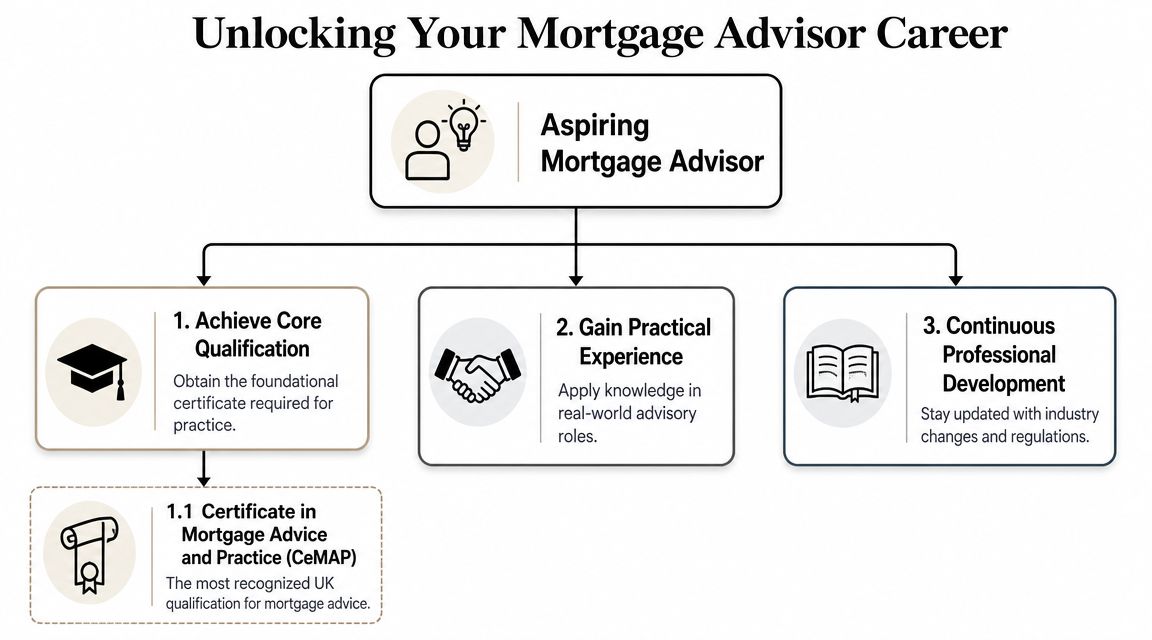
In the UK, the best-known mortgage adviser qualification is CeMAP, which stands for Certificate in Mortgage Advice and Practice. For many career-changers, it is the recognised starting point employers look for. If you want your children to see you building something solid step by step, this qualification can feel like the first brick in that new future.
According to the LIBF CeMAP qualification page, CeMAP is a Level 3 qualification. The career guidance on becoming a mortgage adviser says there are no formal entry requirements, although good Maths and English are helpful.
Why Level 3 matters
“Level 3” can sound more intimidating than it really is, especially if your last classroom was years ago.
A simpler way to read it is this. The study sits around the same level as A Levels, so it is professional and respected, but still realistic for adults returning to learning. You do not need a university degree to begin. You need a plan, steady effort, and the willingness to keep going when a topic feels unfamiliar.
If the levels system has always felt foggy, this guide to what a Level 2 qualification means can help you place Level 3 in context.
What CeMAP includes
CeMAP is split into three modules, which makes the learning process less overwhelming. You build your knowledge in stages, a bit like learning to drive in parts. First you learn the rules of the road, then you practise reading situations, and then you show you can make sound decisions.
According to Oxbridge Home Learning's mortgage advisor guide, the course commonly takes six months to one year and covers:
Financial services and regulation
You learn how the industry works and why advisers have to follow clear standards.Mortgage law, policy, applications, payments, and completion
The job starts to take shape, revealing how a mortgage case moves from first conversation to finished application.An assessed mortgage advice case study
This part checks whether you can apply what you know to a client situation, rather than just remember facts.
Why adults often do better than they expect
Many learners start with a label they have carried for years: “I'm just not academic.”
That label is often unfair. CeMAP rewards consistency, careful reading, and calm thinking under rules. Adults who have worked, raised families, handled pressure, or kept going through hard seasons often bring exactly those strengths.
What usually helps most?
- GCSE-level English: You need to understand questions properly and explain ideas clearly.
- GCSE-level maths: You need confidence with figures and affordability thinking.
- A study routine: Short, regular sessions usually work better than cramming.
Practical rule: Do not judge the whole qualification by how nervous you feel at the start. Judge it by what happens when you learn one topic, then the next, then the next.
One more point matters. Passing the qualification gives you the knowledge base employers expect, but formal study is only one part of becoming confident in the role. As noted in industry commentary on the limits of formal qualifications, practical work brings live cases, lender criteria, and day-to-day complexity that experience teaches best.
That should reassure you, not discourage you. You do not have to become perfect before you begin. You qualify, you practise, and you grow. That is how many respected advisers started, and it is a path you can follow too.
Following the Rules That Keep Families Safe
Some people hear the word “regulation” and feel nervous straight away. But in mortgage advice, rules are there for a good reason. They protect families making high-stakes decisions.
If someone is taking on a mortgage, the advice they receive must be responsible. It must be based on proper knowledge, not guesswork. That's why the Financial Conduct Authority, usually called the FCA, sets standards for advisers.
The qualification is about safety, not box-ticking
In the UK, the FCA benchmark is a Level 3 mortgage advice certificate such as CeMAP or the CII Certificate in Mortgage Advice. FCA-regulated firms use this to meet the “appropriate examination” requirement for mortgage advice, and the CII qualification page explains that the exam must test mortgage law, regulation, and advice competence.
That matters because an adviser who hasn't passed an FCA-recognised exam can't legally advise on regulated mortgages. So the mortgage advisor qualification is not just a badge. It is part of how firms reduce compliance risk and protect clients.
Why this should reassure you
Rules can make the job feel clearer.
You are not expected to “wing it”. You are trained to work inside a framework. You learn what good advice looks like, what information matters, and how to think carefully about a client's needs.
That's a strength, especially if you're the kind of person who wants to do things properly.
- You gain trust: Clients know the profession is regulated for a reason.
- You build good habits: Strong training supports accuracy and consistency.
- You protect people: The right advice can prevent costly mistakes.
A lot of adults find this part makes them feel more capable once they understand it. The standards are high because the work matters.
If you're returning to study and want a broader sense of how recognised learning works, accredited online courses in the UK can help you understand the difference between informal learning and qualifications that support real progression.
When you follow the rules well, you don't become less human. You become more reliable.
The real meaning of professionalism
Professionalism in this field is not about sounding clever.
It's about being the person who explains clearly, checks carefully, and puts the client first. The rules support that kind of behaviour. They help you become someone families can trust at a stressful time.
For many learners, that is one of the most attractive parts of the role. You're not trying to chase status. You're building credibility through competence.
Choosing Your Best Path to Success
A good study plan should still work after the school run, a full shift, and a tiring evening when your brain feels half full.
That is why choosing a route matters so much. You are not picking the most impressive-looking option. You are picking the one you can keep showing up for, week after week, until qualified becomes real.
For many career-changers, this is a turning point. You stop asking, “Could I do this?” and start asking, “What setup gives me the best chance to finish?” That is a stronger question, because it treats success as something we can build, not just hope for.
The main study options
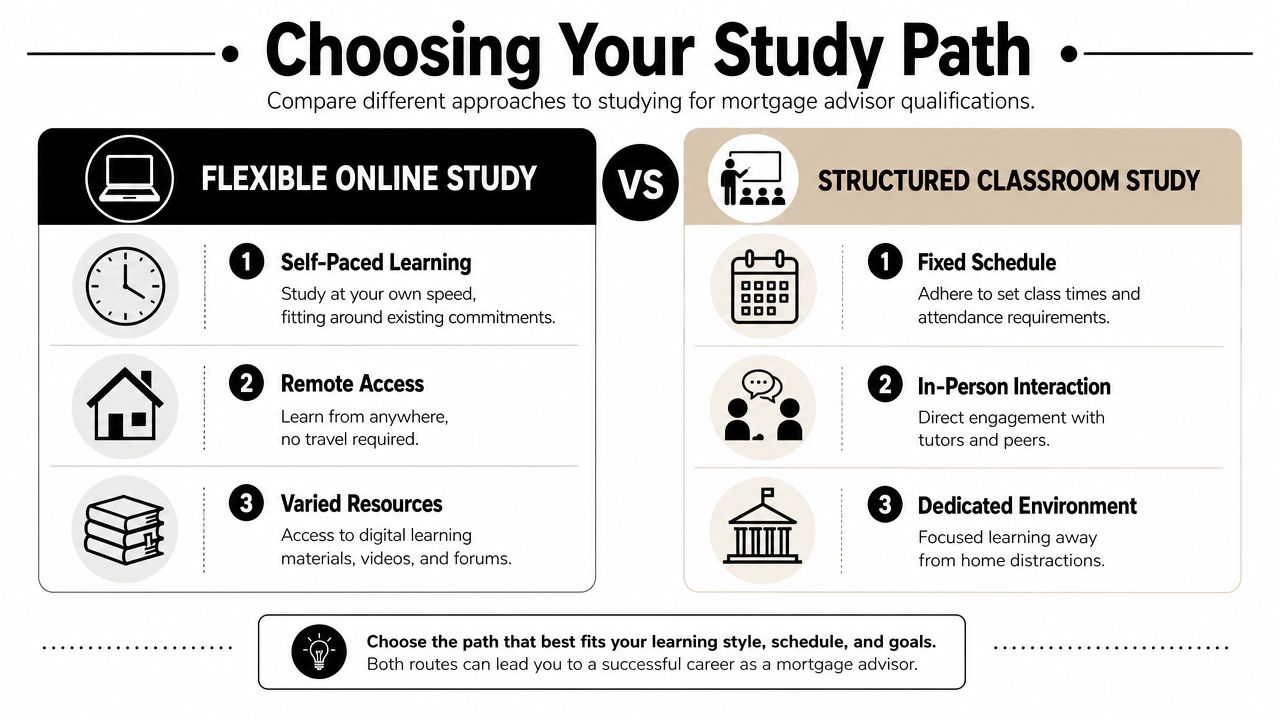
Three routes come up again and again. None is automatically better than the others.
| Study route | What it suits | What to watch for |
|---|---|---|
| Self-study | Independent learners who like working alone | Can feel isolating if you get stuck |
| Classroom study | People who prefer fixed timetables and in-person teaching | Less flexible around work and family |
| Supported online study | Busy adults who want structure with flexibility | Requires self-discipline and routine |
Your best option depends on how you learn under real pressure. Plenty of capable adults pick a course that sounds sensible on paper, then struggle because it does not fit their actual week.
Self-study, classroom, or online
Self-study works well for people who already know how to organise their time and keep going without much outside support. If that sounds like you, it can feel efficient and focused. If you tend to lose momentum after a difficult topic, it can start to feel like carrying heavy shopping bags home alone. Possible, yes. Pleasant, not always.
Classroom study gives you a fixed rhythm. The timetable makes some decisions for you, which can be a relief when life already feels busy. But fixed sessions can become hard to protect if your job changes, childcare falls through, or family responsibilities shift.
Supported online study often fits adults who need flexibility without being left to guess their way through. You can study at home, replay lessons, and build learning around your responsibilities. You still need routine, but the structure can help you keep moving even during messy weeks.
Questions that make the choice clearer
A better question than “Which course is best?” is “Which course can I complete?”
Try answering these truthfully:
- When can I study consistently? Early mornings, lunch breaks, evenings, or weekends?
- What usually knocks me off track? Tiredness, confusion, interruptions, or lack of accountability?
- How much support helps me stay calm? Some learners need tutor contact to keep confidence steady.
- What does my busiest week look like? Your plan has to fit that week too.
- Why am I doing this? A better career, more stability, and being someone your children can point to with pride are strong reasons. Keep them visible.
As noted earlier, many learners aim to complete CeMAP within a manageable period rather than trying to rush it. That steady pace often suits adults who are building a new future around existing responsibilities.
Choose the route that still makes sense on a difficult Tuesday night, not just on a quiet Sunday afternoon.
Choose for the person you are now, not the student you used to be
This part catches people out.
You might remember how you studied at 19 and assume you should work the same way now. But adult learning is different. You have more responsibilities, less spare time, and often a bigger emotional stake in the result. You are not only passing an exam. You are proving to yourself, and maybe to your family, that a new chapter is possible.
That is why the right path often feels less dramatic than expected. It may be the course that gives you enough structure to keep going and enough flexibility to stay in the game.
Don't ignore the digital side of the job
Study method is only one part of the decision. The work itself now includes digital systems, online documents, and tools that help advisers manage information more efficiently.
A recent broker survey reported that 55% of brokers use AI regularly and average training satisfaction was 6.49/10, according to HousingWire's report on AI use among brokers. That points to a gap between using newer tools and feeling well trained with them.
So as you choose a course, look beyond the exam. A good route should help you build confidence with learning systems, digital workflows, and the habit of continuing to learn after you qualify.
Your Bright Future After Qualification
Once you've earned your mortgage advisor qualification, life won't transform overnight in a film-style flash. But something important does change. You become qualified for a profession that has a clear purpose and real progression.
That matters because your next chapter starts to feel solid. You're no longer only hoping for change. You've got evidence that you can study, pass, and move into a regulated career.
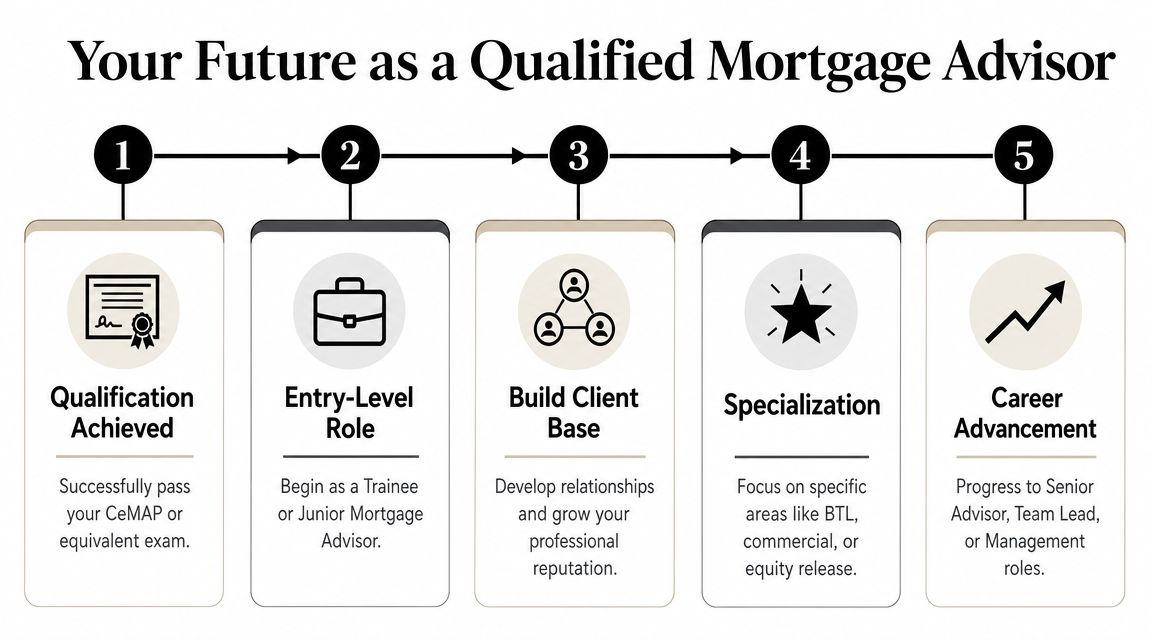
A quick visual can help you picture that path more clearly.
What the first stage often looks like
Many newly qualified advisers start in a trainee, junior, or closely supervised role. That is a good thing. You get the chance to apply your knowledge with support around you.
This is often where confidence deepens fast. The theory you studied begins to connect with real client situations, real documents, and real conversations.
You start to learn things that only work can teach:
- Case handling: How files move from enquiry to completion
- Client care: How to calm nerves and explain options clearly
- Lender knowledge: How criteria differ and why details matter
- Professional judgement: How to slow down and check what is right for the client
Why the outlook is encouraging
There is also a practical reason many people are drawn to this field. The UK has had a long-running shortage of mortgage advisers.
Industry reporting says adviser numbers have stayed below 29,000 since the post-2008 decline, and one report says the 2023 figure was around 47% lower than the pre-crisis level, according to Mortgage Introducer coverage of falling adviser numbers. For new entrants, that points to a market where employers still need trained people.
That doesn't mean success arrives automatically. It does mean your qualification leads into a sector where your skills can be needed.
The future you may be building
Over time, your career could move in different directions. You might work in a bank, join a brokerage, build a specialist area, or progress into senior and leadership roles.
But the personal side matters just as much.
You may become the person in your family who changed the story. The one who returned to learning. The one who kept going when it would have been easier to stay still. The one your children point to when they think about what determination looks like.
The qualification can change your job. The journey to it can change how you see yourself.
That is why this path means more than a certificate. It can lead to stronger income, greater stability, and the quiet pride of knowing you built something worthwhile through effort and courage.
If you're ready to take that first step, Next Level Online College offers flexible online learning for adults who want recognised qualifications, real support, and a study path that fits around work and family life. If your confidence is low but your ambition is still there, this could be the place where your next chapter begins.