

Yes, you absolutely can do A Levels online. In the UK, they are typically studied over about 2 years, and you complete your learning online before sitting your final exams at an approved exam centre as a private candidate.
If you're reading this with a knot in your stomach, wondering whether you've left it too late, whether you're clever enough, or whether life is too busy, take a breath. This path is real. It exists for people exactly like you. People with jobs, children, bills, responsibilities, and a quiet hope that life could still change.
Maybe you want to go to university. Maybe you want a better career. Maybe you want your children to see you trying, growing, and refusing to give up on yourself. That matters more than you know.
A Levels online are not just about study. For many adults, they are about getting unstuck. They are about proving to yourself that one chapter of your life does not decide the next one.
Your Dream of a Better Future Starts Here
It is 9:30 at night. The kitchen is finally quiet, the children are asleep, and you are staring at your phone or laptop asking one question that feels much bigger than words on a screen. Can you do A Levels online, and can you really do them at this stage of life?
If that question carries hope and fear in equal measure, you are in very good company.
Many adults come back to education with more than a career goal in mind. They want a fresh start. They want to prove to themselves that one difficult school experience did not define their ability forever. They want their children to grow up seeing what courage looks like in ordinary life. For some, looking into A Levels for mature students is the first time in years that a better future has felt realistic.
You are allowed to begin before you feel ready
Adult learners rarely start from a place of perfect confidence. They start from real life. Work shifts. School runs. Bills. Tired evenings. A long gap since they last wrote an essay or opened a textbook.
That does not make you less capable. It means you need a route that fits the life you already have.
A lot of the fear comes from mixing up your past with your potential. If school once made you feel slow, embarrassed, or left behind, it is easy to assume study will feel the same now. But adult learning is different. You are not studying because someone told you to. You are studying with purpose, and purpose changes how people learn.
Some worries tend to show up again and again:
- Am I too old? No. Adults return to study at many different stages of life.
- What if I was never good at school? A poor experience at school does not predict how you will do now.
- What if I only have small pockets of time? Small, steady study sessions can carry you much further than you think.
You are not starting late. You are starting with reasons that matter, and that gives this journey real strength.
This step reaches beyond qualifications
An A Level course can lead to university, training, or a career change. But the first change often happens much closer to home.
You begin to trust yourself again. Your family sees you keep going on hard days. Your children watch you choose growth over regret. That lesson stays with them.
A Levels remain one of the main routes used for university entry in the UK. Online study follows that same overall academic path, even though the day-to-day learning happens at home rather than in a classroom. So if part of you is worried that this route is somehow less real, you can let that fear soften a little. The setting is different. The goal is still meaningful, respected, and within reach.
What Online A Levels Really Mean for You
Some adults worry that online A Levels might be a watered-down version of traditional A Levels. They aren't. The important difference is how you study, not what qualification you earn.

If you learn at home through videos, notes, marked work, and tutor support, you're still working towards the same subject content set by the exam board. That's why many adults look specifically at A Levels for mature students when they need a route that fits around real life.
Same qualification, different delivery
A simple way to think about it is this. If two people cook the same recipe, one in a college kitchen and one in their own kitchen, the location changes, but the recipe doesn't.
Online A Levels work in a similar way:
- Same subject specification: Distance-learning providers usually align their teaching to the same exam board specifications.
- Same qualification level: UK A Levels are a Level 3 qualification.
- Same value for progression: When awarded by recognised exam boards, they carry the same UCAS tariff value whether studied remotely or in a classroom, as explained by LearnNow's guide to A Level home study.
That last point is often the one that brings the biggest sigh of relief.
What changes for you day to day
The main change is practical. Instead of travelling to a college building at set times, you study when it suits your life. That could mean early mornings before work, lunch breaks, weekends, or evenings after the children are asleep.
For many adults, that flexibility is the reason study becomes possible at all.
Practical rule: An online A Level is not a different qualification. It is the same qualification studied through a different mode of delivery.
That doesn't mean it's effortless. It means it's adaptable. And for adults who need learning to fit around family life, that can make all the difference.
How Your Online A Level Journey Works
On a Tuesday night, the house is finally quiet. You clear a space at the kitchen table, open your laptop, and wonder whether you can really do this after so many years away from study.
You can. The journey usually feels manageable once you can see the path in front of you.
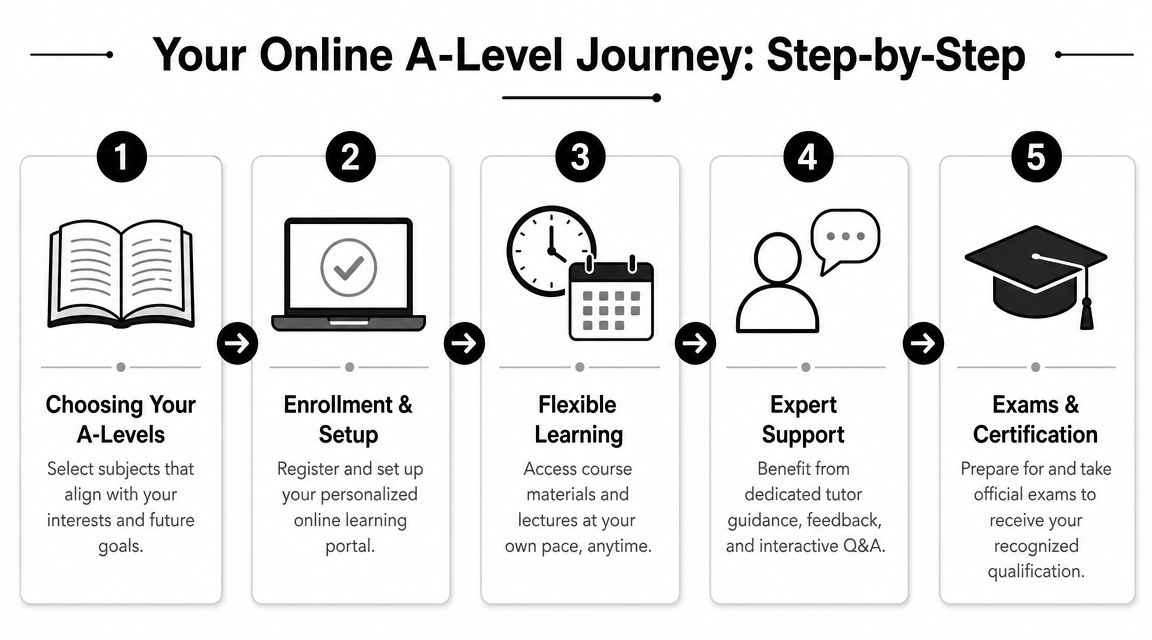
An online A Level works a bit like training for a long walk. You do not need to sprint. You need the right route, a steady pace, and a plan for the days when life gets in the way.
Step one to step three
Choose subjects with your future in mind
Start with where you want this qualification to take you. That might be university, a new profession, or finishing something life interrupted years ago. If you feel torn between subjects, check the entry requirements for your goal first. That gives you a clear starting point and takes away a lot of second-guessing.Enrol and set up your study space
After enrolment, you usually get access to an online learning area, course materials, and tutor support. If you want to see what that process looks like in practice, see how the online study process works.Your study space does not need to be perfect. A corner of the table, a notebook, and regular quiet time can be enough.
Create a weekly rhythm you can keep
Adults often worry they need huge blocks of free time. They usually do better with shorter, regular sessions. One calm hour used well can carry you further than a panicked six-hour catch-up on Sunday.
A realistic week might look like this:
| Time of week | What you might do |
|---|---|
| One evening | Read a lesson and write short notes |
| Lunch break | Review flashcards or watch part of a lesson |
| Weekend hour | Answer an assignment question |
| Another evening | Read tutor feedback and plan the next task |
What study usually looks like week by week
Your course will normally be broken into lessons or topics, with activities that help you check understanding as you go. You study from home, submit work online, and build up your knowledge step by step. Tutors are there to mark work, answer questions, and help you correct mistakes before they grow into bigger gaps.
That matters more than many adults expect.
A lot of learners return to study carrying an old fear that they are "not academic." In practice, the issue is often rustiness, not ability. Learning after a break can feel stiff at first, like using muscles you have not stretched in years. With repetition, it gets easier.
A short video can help make the process feel more real:
The exam part people worry about most
This is often the point that makes adults pause. You study online, but final exams are usually sat in person at an approved exam centre as a private candidate.
Once you break that into tasks, it becomes far less intimidating:
- Study from home first. Lessons, notes, assignments, and revision happen online.
- Find an exam centre early. Centres vary by subject and location.
- Register before the deadline. Late planning creates avoidable stress.
- Check the exam details carefully. Make sure the centre accepts private candidates for your subjects.
- Prepare for the day itself. Knowing where to go and what to bring helps settle your nerves.
The exam is the final checkpoint, not the whole journey. By the time you walk into that room, you are not starting from scratch. You are showing what you have built over months of steady work.
Some weeks will go well. Some will be messy. A child gets ill, work runs late, or your confidence dips after a hard topic. That does not mean you are failing. It means you are a real adult learner building a better future in real life.
What carries people through is not perfection. It is returning to the plan, one small step at a time.
Are Online A Levels Respected by Universities
For many adults, this is the question underneath every other question. If you're going to put in the work, you want to know it counts.
The reassuring answer is yes. Universities care about recognised qualifications and grades. They do not reject an A Level because you studied from home.
What universities look at
Universities use A Levels in admissions. That is one reason A Levels remain such an important route into higher education in the UK.
What matters most is usually this:
- The qualification is awarded by a recognised exam board
- The subject meets the entry needs of the course
- Your final grade is strong enough for the course you want
UK A Levels are a Level 3 qualification and, when awarded by recognised exam boards, they carry the same UCAS tariff value whether studied remotely or in a classroom, according to this explanation of accredited online courses and qualification status.
The part adults often need to think about
Formal recognition is one thing. Personal planning is another.
If you're aiming for a competitive course, changing field, or returning after a long break, it's wise to check entry requirements carefully. Some adults also need to think about subject choice, whether they need resits, and how to show they're ready for higher study after time away.
A useful way to think about it is this:
| Concern | Plain answer |
|---|---|
| Will universities accept online A Levels | Yes, if the qualification is from a recognised exam board |
| Do they have the same tariff value | Yes, when awarded properly |
| Does the study location matter most | No, the qualification and grades matter more |
| Should I still check course entry rules | Yes, always |
Universities are interested in whether you can meet their entry requirements. Studying online doesn't stop you doing that.
So if your goal is university, online A Levels can be a serious and valid route. The key is choosing the right subjects and treating your studies with the same care you would give any major life step.
Is This Right for You and Your Family
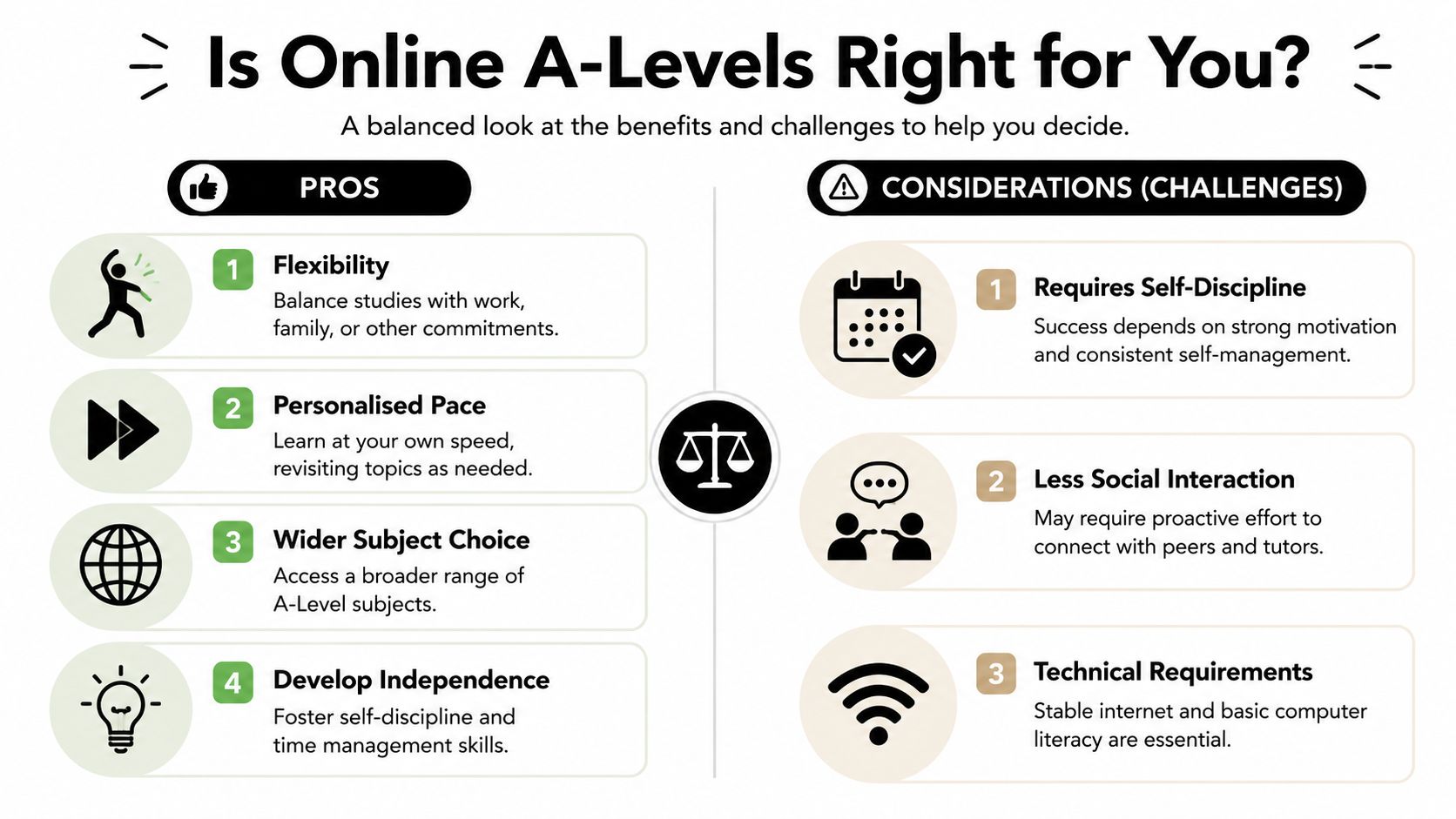
Online A Levels can be brilliant for the right person. They can also feel hard if your life is already stretched and you don't have a plan. Both things can be true at once.
Who often does well with this route
Think about the parent who studies after bedtime, with a cup of tea and a notebook on the kitchen table. Think about the worker who uses a quiet hour on Sunday to move one lesson forward. Think about the adult who didn't get the grades they needed years ago and is now coming back with a clear reason.
These learners often do well because they have purpose.
Online A levels are flexible and formally equivalent, but their suitability for mature learners depends on individual circumstances. Success often hinges on self-discipline and planning, balancing freedom with the need for structure and support, as discussed by Learndirect's information on A Level courses.
The honest pros and challenges
It helps to be kind and truthful with yourself.
Good reasons this route may suit you
- You need flexibility: work, children, caring duties, or travel make fixed college timetables hard.
- You like learning in a calm setting: home study can feel calmer and less pressured.
- You want control over pace: some topics need extra time, and online study allows that.
- You have a clear goal: university, a better job, or a new direction can keep you going.
Things you need to prepare for
- You must organise your time: no one is standing over you every day.
- You may feel alone sometimes: online learning needs active effort to stay connected to support.
- Exams still matter: even flexible study leads to formal assessment.
- Life can interrupt your routine: you'll need ways to restart after difficult weeks.
What this can mean for your children
Children notice more than we think. They notice when you keep going. They notice when you study instead of giving up. They notice when you believe your future can improve.
You don't need to say the perfect words. Your actions say enough.
Your family doesn't need you to be fearless. They need to see what courage looks like when life is busy and hope still matters.
If you're asking whether this is selfish, it usually isn't. Building your education can strengthen your home, widen your options, and show your children that learning doesn't end when school does.
Your Journey with Next Level Online College
You may already be picturing the hard part as the studying itself. For many adults, the harder part is quieter than that. It is opening the laptop after a long shift, returning to a subject you have not seen in years, and trying to believe you still belong in education.
That is why support matters so much.
Adult learners often need more than course notes and recorded lessons. They need a college setup that makes room for real life, including work rotas, school runs, caring duties, and the occasional week that goes off track. They also need calm, clear guidance so a difficult moment does not start to feel like proof that they are not capable.
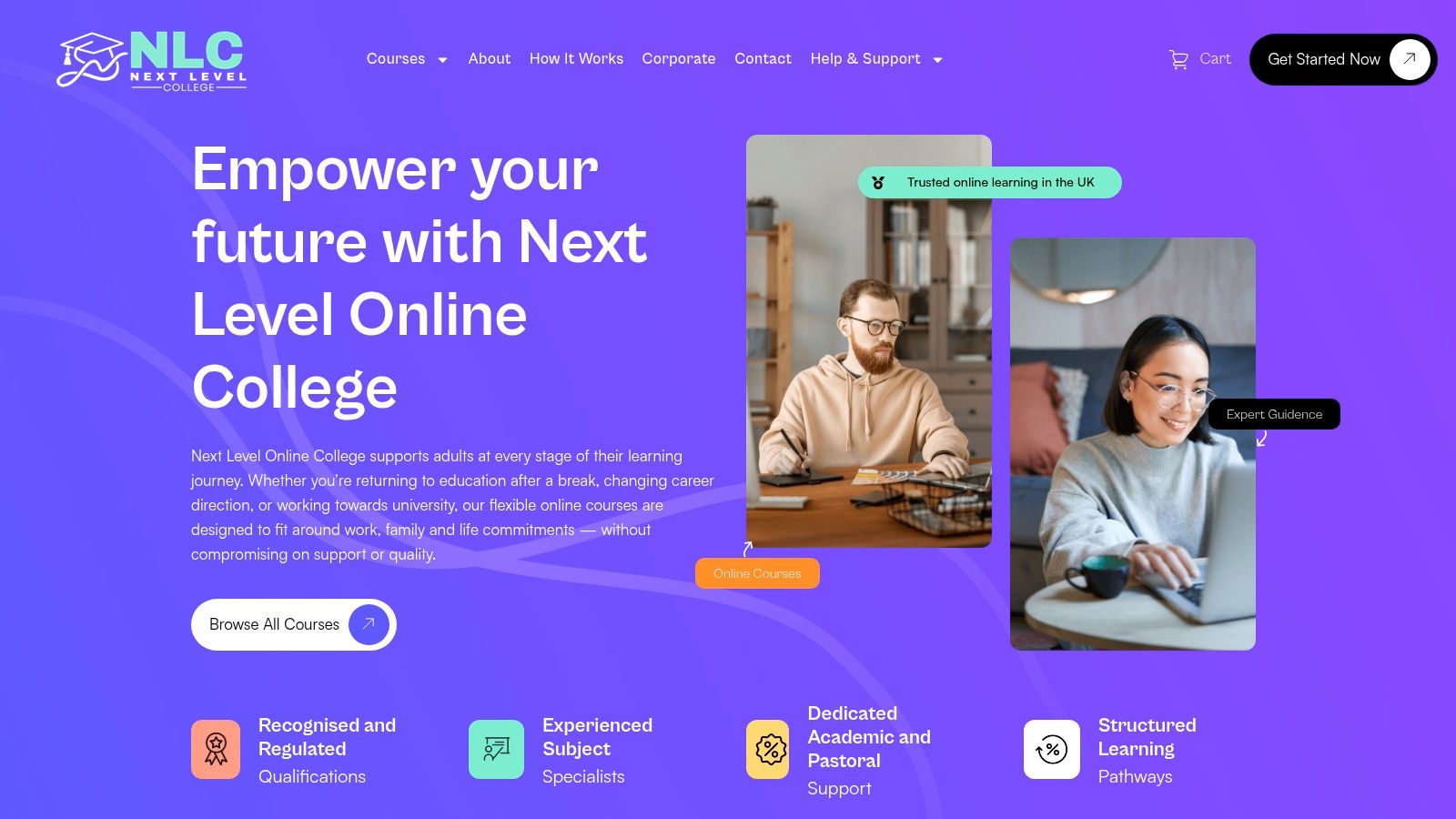
One option in the UK is Next Level Online College. It offers online courses for adult learners, including A Levels, GCSEs, Functional Skills, and Access to Higher Education diplomas. Its courses are presented as flexible and designed around work and family commitments, which is often what returning learners are looking for.
The support adults value most is rarely fancy. It is usually practical and human. A tutor who explains a topic in plain English. A study plan that breaks one large course into manageable pieces. A reassuring reply when you have lost confidence after one poor week.
Good adult support often includes:
- Academic guidance: teaching, feedback, and help when a topic does not click the first time
- Personal encouragement: someone who understands that confidence can dip, especially after time away from study
- A workable routine: help turning good intentions into a weekly plan you can keep
- Advice about next steps: support with understanding where the qualification could lead
- Exam guidance: help with the practical side, so the process feels clearer and less intimidating
Structure matters just as much as flexibility. Flexibility gives you room to study around your life. Structure gives you something steady to return to when life gets messy.
A good college for adults treats that balance with respect. It should not talk to you like a teenager who needs chasing. It should give you clear expectations, sensible support, and enough guidance that you can keep going without feeling alone.
That kind of support can change the whole feel of the journey. Instead of carrying every doubt by yourself, you have a framework to lean on and real people to ask when you get stuck. For an adult learner building a better future, that can make the difference between stopping at the first wobble and staying the course long enough to change what comes next.
Your Questions Answered and Your First Step
A lot of adults reach this point with one hand on the door and one hand pulling back.
You may want the qualification, the better job, the university place, or the quiet pride of proving to yourself that you can still do hard things. At the same time, you may be wondering whether real life will get in the way, whether exam season will feel overwhelming, or whether you have left it too late to be good at studying again. Those worries are normal. They do not mean you are not capable. They mean this matters to you.
What if I have not studied for years
The first few weeks can feel rusty. That is often the hardest part.
Coming back to study after a long gap is like using a muscle you have not trained in a while. It may feel stiff at first, but it strengthens with regular use. Adult learners are often better at asking practical questions, spotting what matters, and staying focused on a goal. You do not need to feel academic on day one. You need a routine you can keep long enough for confidence to return.
How much time will I really need
This depends on your subjects, your deadline, and how much space your week has.
A better question is whether you can protect a few steady pockets of time. For many adults, progress comes from consistency rather than long study marathons. Three or four planned sessions each week often work better than waiting for a perfect free day that never comes. If your life is busy, a realistic plan matters more than an ambitious one.
What makes the exam side feel manageable
The exam side feels less frightening once you split it into jobs.
You will need to know which exam board your course follows, whether your subjects include coursework or practical requirements, and where you can sit the exams in person. Those details can sound intimidating when they are all lumped together. Spread them out, and they become a checklist. One decision at a time is much easier to handle than one large cloud of worry.
How do I know I am ready to start
You are ready when you can answer one simple question. What is this for?
Maybe it is for university. Maybe it is for a career change. Maybe it is for your children to see that starting again is possible. A clear reason will carry you on the tired evenings better than motivation alone.
What should you do first?
- Name the goal clearly: say exactly what you want your A Levels to lead to
- Check the entry requirements: make sure you choose the right subjects and grades for your next step
- Ask practical questions early: exam arrangements, deadlines, and support matter
- Choose one small action this week: enquire, compare courses, or map out your study hours
Small steps count. Kettle on, notebook open, one decision made.
If you want a calm place to begin, Next Level Online College is one option to look at as you compare courses and support. You do not need to rebuild your whole future tonight. You only need to begin it.