
You might be reading this after the school run, on your lunch break, or late at night when the house is finally quiet. Part of you feels excited. Another part feels scared to even hope. Maybe you left education years ago and still carry that heavy thought that you “missed your chance”.
You haven't.
Plenty of adults look at their lives and feel ready for more. More confidence. More choices. A better job. A proper path to university. A future that feels earned, not settled for. If that sounds like you, A Level courses for adults can be a very real way forward.
This isn't about pretending the journey is easy. It's about understanding it clearly, so it feels possible. When you know how A Levels work, how study can fit around family life, and how they can help you move towards university or a new career, the whole idea becomes less frightening and far more exciting.
Your Time to Shine Is Right Now
A lot of adults come back to study with mixed feelings. They want change, but they also worry they're too old, too busy, or too far behind. Those feelings are normal. They don't mean you're not capable. They usually mean this matters to you.
Think about a parent helping with homework and wondering whether they could do more with their own life. Or someone sitting in a job that pays the bills but offers no real future. Or a person who once dreamed of university and still feels that dream hasn't fully gone away. Those are not silly thoughts. They are signs that you still care about your future.
Going back isn't going backwards
Returning to education as an adult can feel strange at first because people often imagine learning belongs to the young. It doesn't. Adults often bring something even more powerful to study: purpose.
When you choose A Level courses as an adult, you're not rewinding your life. You're building on it. You know why you're doing it. You understand responsibility. You've handled pressure, work, family, and setbacks. Those life skills matter.
Studying as an adult often feels different from school because you're choosing it for a reason that matters to you.
That reason might be very personal:
- Your children are watching: When they see you studying, trying, and growing, they learn that it's never too late to improve your life.
- You want better work: Many people want a role that feels more secure, more meaningful, or more in line with who they are.
- You want self-belief back: Qualifications can open doors, but they can also rebuild confidence that has been missing for years.
Small steps can change everything
You don't need to have your whole future mapped out today. You only need to be willing to take the next sensible step.
For some adults, that step is checking entry requirements. For others, it's choosing subjects. For many, it's admitting, “I do want more from life.” That honesty is powerful. It's often the beginning of a bigger change than people expect.
A Levels can be part of that change. Not because they magically fix everything, but because they give structure to your ambition and turn a vague hope into a recognised path.
What Exactly Are A Levels and Why They Matter
You might be sitting at your kitchen table after work, reading course pages and wondering whether A Levels are only really for 18-year-olds. That worry is common. The good news is that A Levels are not tied to a certain age. They are a recognised qualification route, and they still carry real weight for adults who want university entry, career change, or proof of academic ability in 2026.
A Levels are subject-based qualifications, usually studied in three areas, although some adults take one or two depending on their goal. They are widely accepted by universities across the UK, and employers recognise them too. If GCSEs show you have a foundation, A Levels show that you can study a subject in depth and handle more demanding academic work.
Why adults choose them
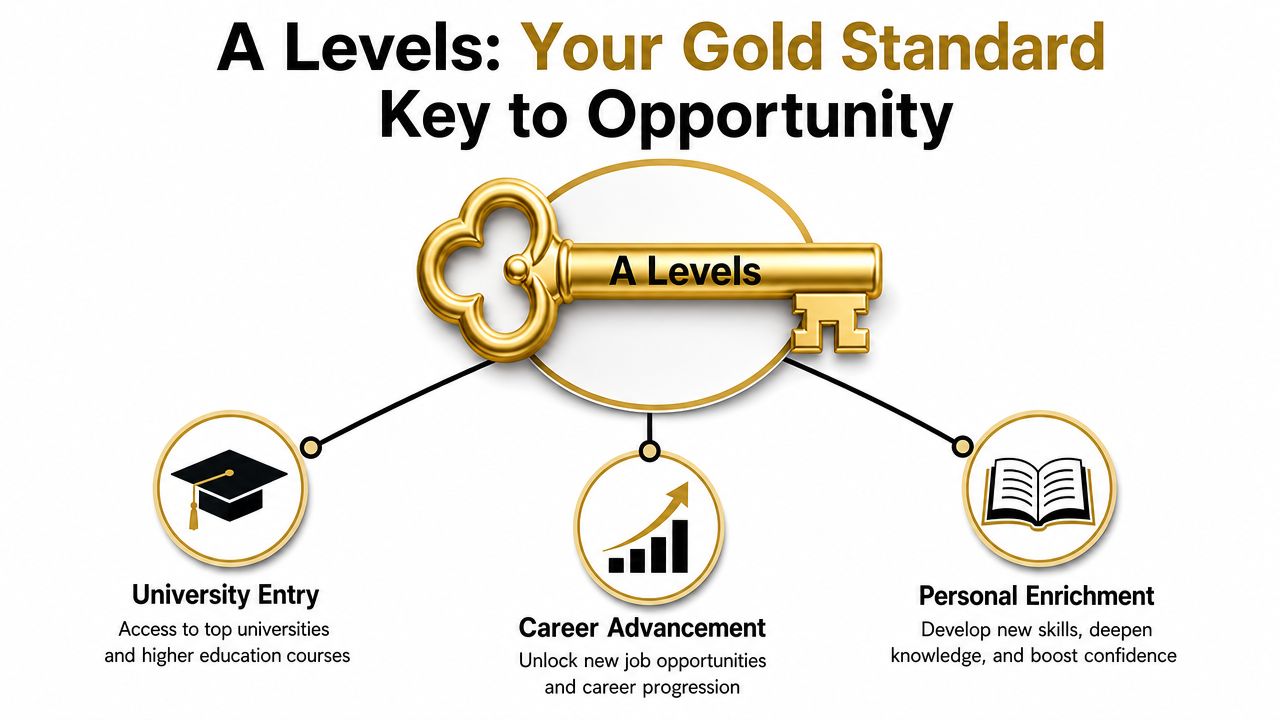
For adult learners, one of the biggest strengths of A Levels is clarity.
They are not a qualification you have to explain from scratch in every interview or university application. Admissions teams already know what A Levels involve. That matters more than many people realise, especially if you want a route that feels solid and familiar rather than uncertain.
The structure also helps calm nerves. Each subject has a set specification, clear content to cover, and formal assessment. In plain English, you know what you are working towards. For someone returning to education after years away, that can feel like having a map instead of being dropped into the dark.
Why they still matter in real life
A Levels matter because they answer practical questions adults usually ask early on.
| Question | Why A Levels help |
|---|---|
| Can I apply to university? | Many degree courses use A Levels as a standard entry route |
| Will employers recognise them? | Yes, A Levels are well known across the UK |
| Do they show serious academic ability? | Yes, they are designed to prepare learners for higher-level study |
This is also where many guides stop too early. Adults often need more than a description. You need to know whether the time, effort, and cost are likely to lead somewhere worthwhile.
For many people, the answer is yes. A Levels can lead to university, which can then lead to professions with clearer progression and better long-term earnings potential. They can also help with direct career development in roles where recognised qualifications strengthen an application. Just as important, they can change how you see yourself. Studying at this level often rebuilds confidence in a very concrete way because you are no longer guessing whether you can do it. You have evidence.
A Levels compared with other routes
A Levels are not the only path back into education. Some adults choose an Access to HE Diploma instead, especially if they want a route aimed closely at university preparation in a shorter format.
A Levels often suit adults who want:
- Clear subject depth: You spend real time building knowledge, not skimming broad topics
- Recognised progression: Universities can easily see how your subjects connect to a degree
- Flexibility in future choices: Strong A Level subjects can keep more than one door open
- A qualification with lasting credibility: It still means something years later
A simple way to see it is this. Access courses can feel like a direct train to one destination. A Levels are more like a well-connected line with several stops available, which can be useful if you are still deciding between careers or degree options.
If you have been worrying that studying as an adult will not count in the same way, set that fear down. A Levels are a realistic, respected route. For many adults, they are the qualification that turns “I wish I could” into “I'm on my way.”
Finding Your Way to Study A Levels
Many adults hear “A Levels” and immediately picture themselves back in a classroom at fixed times every week. That image puts people off before they've even started. In reality, there are different ways to study, and some fit adult life much better than others.
The best option depends on your routine, energy, and responsibilities. A parent with young children may need flexibility. Someone working shifts may need freedom to study at odd times. Another learner may want a more formal timetable to stay focused.
The main study formats
Here's a simple comparison of common ways adults approach A Level study.
| Study format | What it suits | What a typical week may feel like |
|---|---|---|
| Online distance learning | Busy adults with work or family commitments | Study in shorter blocks at home, often mornings, evenings, or weekends |
| Part-time college study | Learners who like routine and in-person teaching | Fixed class times, travel to a centre, homework around other commitments |
| Fast-track or intensive study | Adults who need to move quickly and can handle pressure | A heavier workload, less breathing space, strong self-discipline needed |
Online learning for real life
For many adults, online learning is the most practical choice because it fits around real life rather than asking real life to move out of the way.
You might study after the children are asleep. You might do an hour before work. You might use a quiet Sunday afternoon to catch up. That flexibility matters when your day already includes jobs, bills, family, appointments, and everything else adult life throws at you.
Online study can also help emotionally. Some adults feel nervous about stepping into a classroom again. Learning from home can remove that first layer of fear and give you space to rebuild confidence privately.
A flexible routine beats a perfect routine. The study plan you can actually keep is the one that works.
Part-time study if you like structure
Some adults do better with regular class times and face-to-face teaching. If you know you focus better when someone expects you to turn up at a set time, part-time college study may suit you.
This route can feel more familiar, but it also needs planning. Travel time, childcare, and work shifts can all affect whether it stays manageable. It's not a bad option. It just needs to fit your life.
Fast-track courses for urgent goals
A fast-track course can sound attractive if you feel behind and want to move quickly. Sometimes that works well. Sometimes it adds too much pressure.
Before choosing an intensive route, ask yourself:
- Can I protect regular study time? Fast-track learning demands consistency.
- Am I rebuilding confidence? If confidence is low, a steadier pace may help more.
- Do I have support around me? Family help can make a big difference when the pace is high.
Choose the format that helps you finish
The smartest choice isn't the one that sounds impressive. It's the one that gives you the best chance of completing the course well.
If you're exploring A Level courses for adults, try not to compare yourself with school leavers or other people online. Your route can look different and still be the right one. A course that fits your responsibilities is not a compromise. It's a serious strategy.
How A Level Courses for Adults Really Work
You finish work, make dinner, answer a few messages, and then open your course portal at 8:30pm. For a moment, it can all feel bigger than it really is. Then you start the next lesson, complete one task, and the path becomes clearer. That is how A Levels often work for adults in real life. Not as one huge leap, but as a series of manageable steps that build into a recognised qualification.
The practical side usually feels confusing at first because adult learners are asking several questions at once. How long will this take? Will I be studying alone? What happens if I have not been in education for years? How do exams fit into an online course?
The reassuring answer is that the process is far more structured than it first appears.
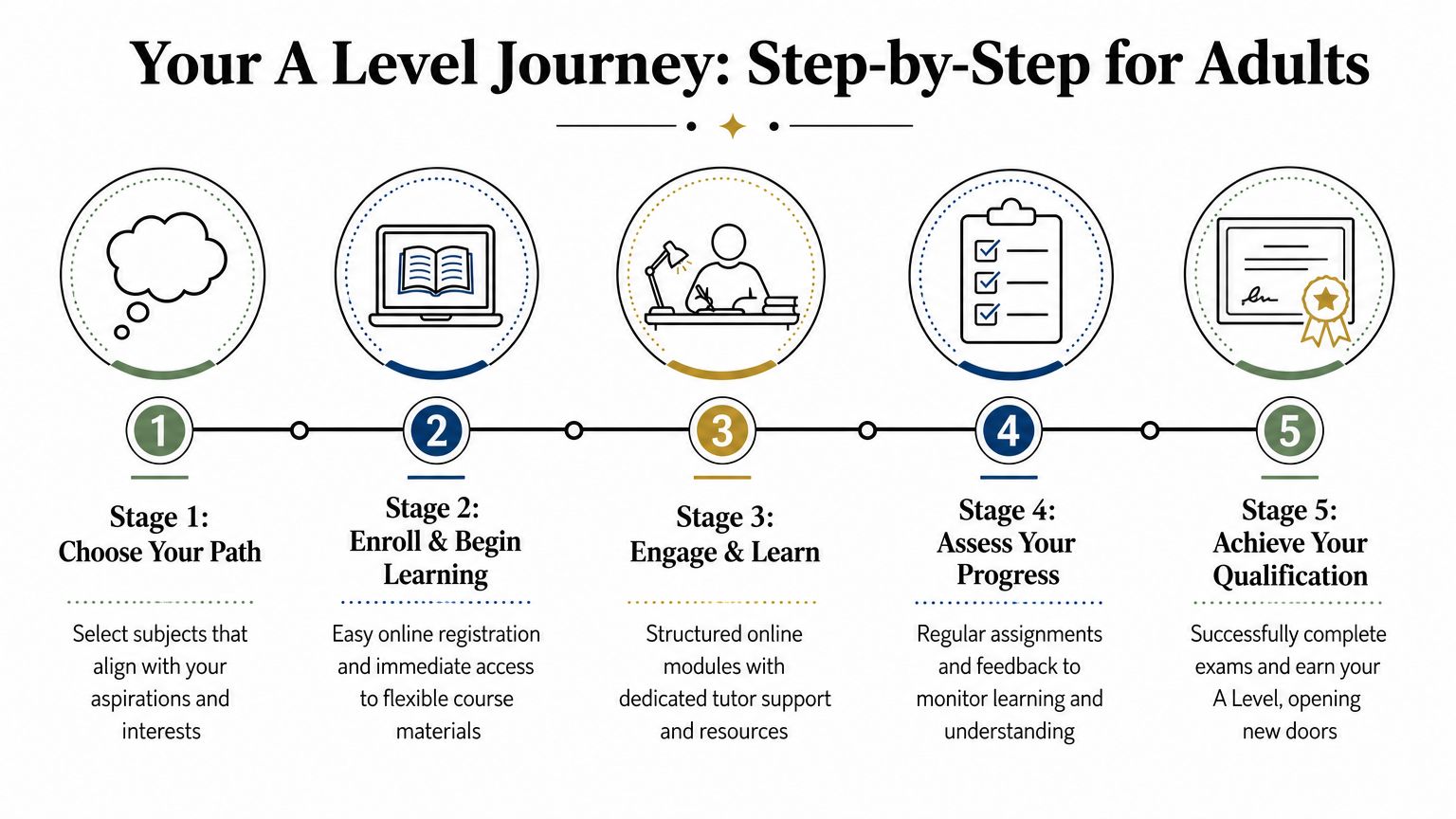
A Level courses for adults usually follow a clear pattern. You choose subjects that match your goal, study the syllabus in guided sections, complete assignments to check your progress, prepare carefully for exams, and then sit those exams at an approved centre. Some adults take the traditional two-year pace. Others study more quickly or more slowly, depending on work, family life, and university deadlines. That flexibility is one reason A Levels remain a realistic route to higher education and career change in 2026.
Step by step from starting to sitting exams
For many adults, the process makes sense once they can see the order of it.
Choose the right subjects
Start at the finish line and work backwards. If your goal is nursing, psychology, business, teaching, or another degree route, check what universities ask for first. Subject choice is a bit like choosing the right key for a lock. The wrong key may still look close, but it will not open the door you want.Check your starting point
Many providers ask for GCSEs or an equivalent level of prior study, especially in English and sometimes maths. That is not there to put you off. It helps make sure you can cope with Level 3 work. If you need to strengthen your foundation first, you are building properly, not falling behind.Study in guided units
Good adult courses do not hand you a pile of textbooks and wish you luck. They break the subject into lessons, topics, and assignments so you can move forward one section at a time. That matters for confidence as much as progress.Use feedback to improve
Marked work shows you where you are doing well and where you need another pass. This is one of the biggest differences between drifting through content and preparing for exam success. Feedback gives you direction.Prepare for final exams and book them correctly
A Levels are still mainly assessed through final exams. If you study online, you will usually sit those exams as a private candidate at a registered exam centre. That part can sound intimidating, but it is no more than the final administrative step in a process thousands of adult learners complete every year.
What studying often feels like week to week
A good course should feel steady, not chaotic.
In practice, that often means reading or watching lesson material, making notes, answering questions, submitting assignments, and returning to weaker topics before they pile up. Some weeks will feel smooth. Others will feel slower because life gets busy. That is normal. Adult study works best when you treat it like training for a long event rather than a last-minute sprint.
Support matters here. A lot.
Many adults worry that success depends on being naturally academic. In reality, success usually comes from structure, feedback, and consistency. If you're comparing study routes, distance learning for A Levels with a structured online format can suit adults who need flexibility without losing guidance.
Look for support that includes:
- Tutor guidance: Clear explanations when a topic does not click the first time
- Marked assignments: Feedback that shows how to improve, not just whether an answer is right or wrong
- A usable study schedule: A plan you can keep alongside work and home life
- Exam preparation: Practice papers and help with exam technique, not just content delivery
A short video can also make the journey feel more real and less abstract:
The part many guides skip
Adults rarely ask only, “How do I study?” They are also asking, “Will this lead somewhere worth the cost and effort?”
That question matters. A Levels are not just academic credentials. They are often the bridge between your current circumstances and a university place, professional training, or a role with stronger long-term prospects. The day-to-day process may look ordinary. One lesson, one assignment, one exam booking. Yet those ordinary steps can change your options in a very real way.
If you have been away from education for a long time, try to judge the course by its process, not by your nerves on day one. Confidence usually grows after action, not before it.
Paying for Your Course and Getting Support
Money is one of the biggest reasons adults hesitate. That makes sense. When you have rent or a mortgage, food costs, family responsibilities, and maybe childcare too, education has to be judged carefully.
The course fee is only part of the picture. That's where many guides fall short. They talk about tuition, then leave out the practical extras that can shape your real decision.
Think about the full cost
One important point raised in CloudLearn's discussion of A Level costs for adults is that many pages don't properly address the total end-to-end cost beyond tuition, including exam fees, resits, and textbook costs. That matters because adult learners often need the whole picture before they can commit.
When you compare courses, ask about more than the headline price.
- Tuition fees: What teaching and materials are included?
- Exam fees: Are exam entries included or separate?
- Resit costs: If you need another attempt, what happens financially?
- Study materials: Will you need books or extra revision resources?
- Practical life costs: Can you protect study time without causing stress at home?
Payment plans can make study possible
A large upfront payment can make a good course feel out of reach, even when the long-term value is clear. Monthly payment options can make the decision more manageable because they spread the cost in a way that fits normal adult budgeting.
If you're weighing up affordability, it helps to compare finance plans for adult learners and ask exactly what is included.
Support is part of the value
Cost isn't only about money. It's also about what helps you stay on the course and finish successfully.
A cheaper course with very little support may end up feeling expensive if you're left confused, isolated, or overwhelmed. Adult learners often need more than content. They need encouragement, clear answers, and someone to turn to when life knocks their routine off course.
Practical rule: Don't judge a course by price alone. Judge it by the help you'll have on the hard weeks.
Useful support may include:
| Type of support | Why it matters |
|---|---|
| Academic tutor help | You can ask questions before problems grow |
| Pastoral or wellbeing support | It helps when confidence dips or life gets messy |
| Clear admin guidance | Exam booking and deadlines feel less stressful |
| Flexible pacing | You're more likely to keep going when life changes |
For adults returning to education, support is not an extra luxury. It's often the thing that turns a hopeful start into a finished qualification.
Your Path to a Brighter Future with A Levels
Adults rarely ask about A Levels just because they enjoy collecting qualifications. They ask because they want a different future. They want university to become possible. They want a stronger career. They want proof that their life can still change direction.
That's why the big question matters so much: do A Levels still lead somewhere meaningful for adults? The answer is yes, but the outcome depends on choosing the right subjects and understanding how they connect to your goal.
A useful point raised in this guide to taking A Levels as an adult is that many pages focus on flexibility and age, but miss the practical progression question. Adults want to know whether A Levels can really support a move into university or a career change later in life, and they need clear guidance on subject choice and UCAS relevance.
What progression can look like
Take a few simple examples.
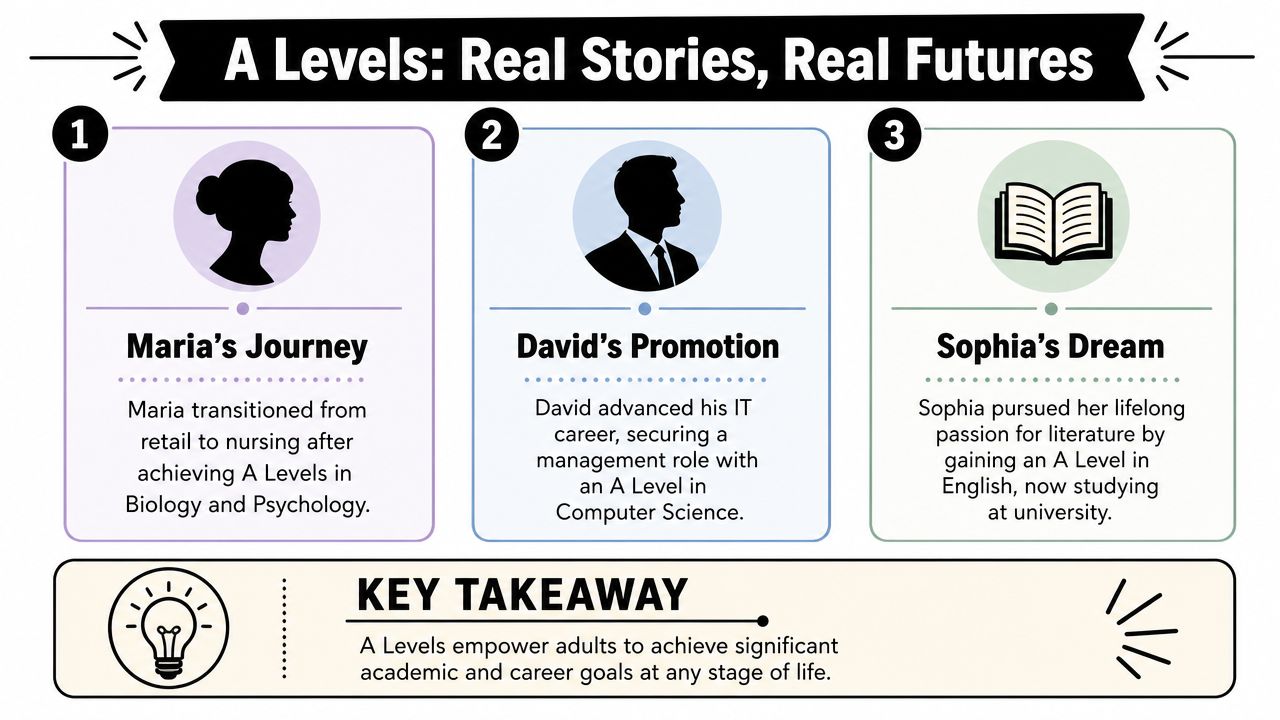
A learner who wants to apply for nursing might choose subjects that support health-related university entry. Another adult hoping to move into business or management might pick a subject that strengthens analytical and commercial thinking. Someone who has always loved literature may choose English because it connects directly to a degree they once thought was out of reach.
These aren't fantasies. They are the kinds of practical decisions that shape what happens next.
UCAS points in plain English
UCAS points can sound confusing, but the basic idea is simple. They are a way of showing the value of qualifications for university applications. Universities may ask for particular grades, particular subjects, or a certain points total.
That means your subject choices matter. The right subjects can support a clear application. The wrong mix can make things harder.
A helpful way to think about it is this:
- First choose the destination: What degree or career do you want?
- Then check the entry rules: Universities may prefer or require certain subjects.
- Then choose your A Levels carefully: Don't pick only what feels easiest. Pick what moves you forward.
If university is part of your plan, guidance on how to get into universities as an adult learner can help you connect subject choice, entry requirements, and application strategy.
The strongest subject choice is the one that fits both your ability and your future plan.
A new identity, not just a new qualification
One of the most powerful parts of adult study is personal change. You start out wondering if you're capable. Over time, you begin to see yourself differently.
You become the person who keeps going.
The person your children see studying at the table.
The person who follows through.
That shift matters just as much as the certificate at the end. A Levels can help you move towards university or a better career, but they can also help you reclaim pride in yourself. For many adults, that is where the transformation really begins.
Your Next Step Starts Today with Next Level Online College
By this point, one thing should feel clear. Studying as an adult is not a silly dream, and it's not too late. A Levels are a recognised route, they can fit around real life when chosen carefully, and they can support serious goals like university entry and career change.
The fear you may feel now doesn't mean stop. It usually means the decision matters.
What adult learners often need most
Most adults returning to study need the same core things:
- Flexibility: Study has to work around jobs, children, and everyday responsibilities.
- Clarity: You need to know what to do first, what comes next, and how the course leads somewhere useful.
- Support: Motivation can dip. Confidence can wobble. Good support keeps you moving.
- A real pathway: The qualification needs to mean something in the wider world.
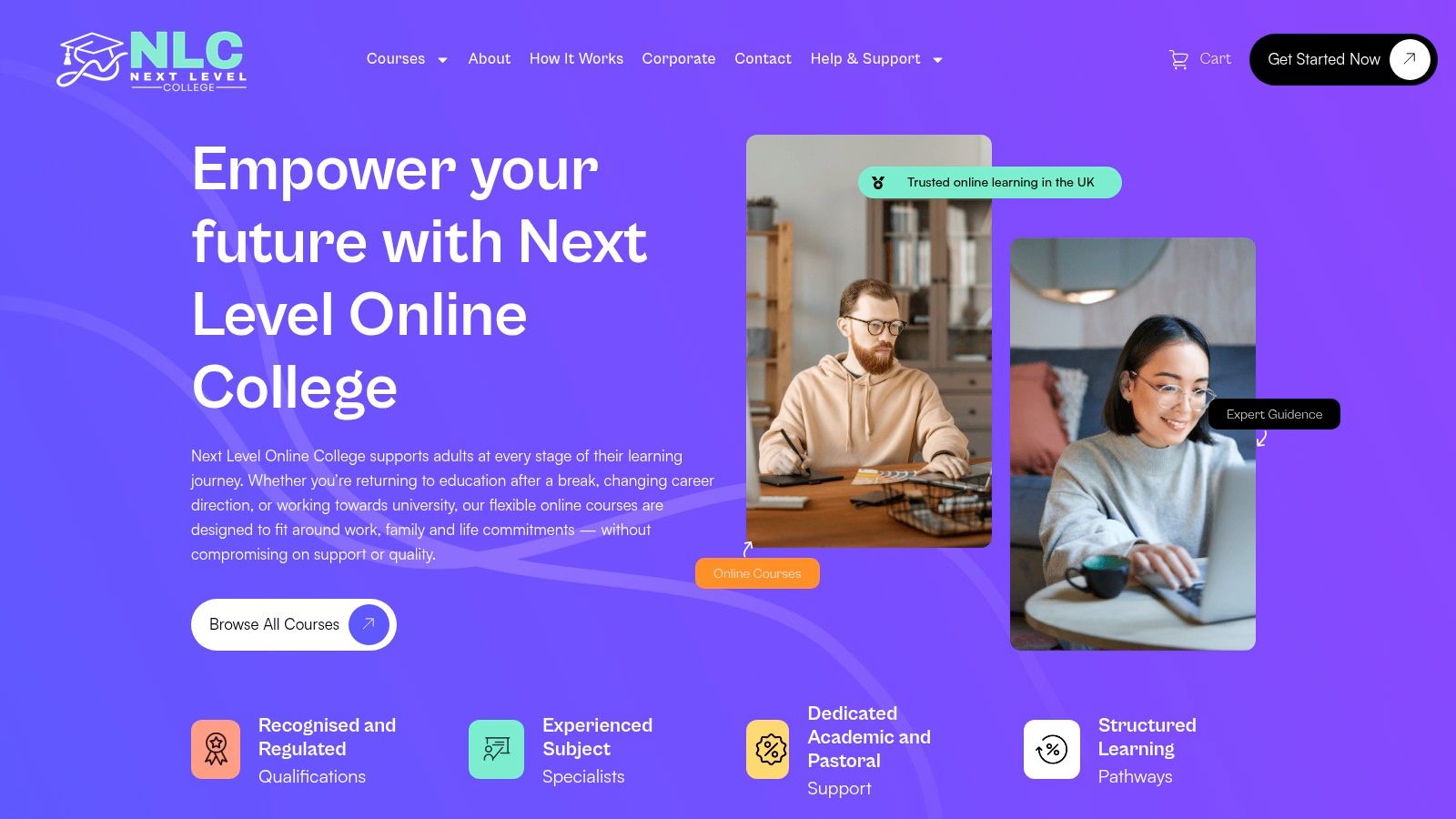
Next Level Online College offers online courses for adults who need that kind of structure and support. As described by the college, its programmes are built around flexible study, recognised qualifications, and academic and pastoral guidance for adult returners.
You don't need to feel ready for everything
A common mistake is thinking you must feel completely confident before you begin, but such confidence rarely exists beforehand. Confidence often comes after starting, not before.
So give yourself permission to begin before you feel perfect.
You can start by doing something small:
| Next step | Why it helps |
|---|---|
| Look at subject options | It turns vague hope into a real plan |
| Check entry requirements | You'll see where you stand now |
| Ask about support and exam arrangements | Practical details reduce fear |
| Explore payment choices | Cost feels easier when it's clear |
You may be closer than you think. And if you need to build up in stages first, that still counts as progress. Adult education is not a race. It's a decision to keep moving forward.
The future you want won't arrive all at once. It starts with one brave choice, followed by another. For many adults, enrolling on an A Level course is the moment life begins to open up again.
If you're ready to turn “maybe one day” into a real plan, take a look at Next Level Online College. You can explore flexible courses, check your options, and take the first step towards university, a better career, and the pride that comes from proving to yourself that you can do this.