
You might be reading this after work, with a cup of tea going cold beside you, wondering if life is meant to stay the same forever. You want something better. Something steady. Something that makes you feel proud when your children ask what you do, or when your family sees you trying again.
At the same time, you might feel nervous. Lots of adults do. You may be thinking, “What if I'm too old?” “What if I'm not academic?” “What if I start and can't keep up?” Those worries are real, and they can feel heavy.
A gym instructor course can be a very practical place to begin. It gives you a clear skill, a respected starting point, and a route into work that helps other people live healthier lives. For many adults, it's not just about fitness. It's about confidence, purpose, and proving to yourself that your next chapter can be stronger than your last.
Your Time to Build a Stronger Future
Some adults reach a point where they know they need change, but they don't yet know what shape that change should take. Maybe your current job pays the bills but leaves you drained. Maybe you've spent years caring for others and now want to build something for yourself as well. Maybe you've always loved fitness, movement, or helping people, but never thought that interest could become a real career.
That feeling matters. It often shows up before the plan does.

Starting again can feel scary
Returning to study as an adult can stir up old doubts. School may not have gone well the first time. You may have been told, directly or indirectly, that education was for other people. Years later, those messages can still sit in the background, even when you badly want to move forward.
You don't need to have everything worked out before you begin. You only need a first step that makes sense.
A gym instructor course often makes sense because it leads to something real. You're not studying for the sake of it. You're learning how the body works, how to keep people safe, and how to support clients in a gym setting. That's useful knowledge with a clear purpose.
Why this step can mean more than a job
This kind of course can become part of a much bigger story. It can show your children what persistence looks like. It can help you build a career that feels active, social, and worthwhile. It can also help you see yourself differently.
Many adults don't need empty motivation. They need proof that change is possible.
Here's what that first step can represent:
- A fresh identity. You stop seeing yourself as someone who missed their chance and start seeing yourself as someone building a profession.
- A stronger example at home. Children notice effort. They notice when a parent studies, keeps going, and grows.
- A future with direction. You're not drifting. You're working towards a role with responsibility, skill, and progression.
If your confidence is low, that doesn't mean you can't succeed. It usually means you need the right path, the right pace, and the right support. Plenty of capable adults begin with doubts. The difference is that they start anyway.
Understanding Your First Step on the Ladder
A lot of people get confused by qualification levels. The names can sound formal, and it's easy to think you should already know the difference. You don't need to. The path is simple when it's explained clearly.
Building a house provides a useful analogy. Level 2 Gym Instructor is the foundation. Without a solid foundation, the rest won't stand properly. Level 3 Personal Trainer is the next stage you build on top. It gives you more responsibility and a wider range of things you can do.
Why Level 2 comes first
A Level 2 gym instructor course teaches the basics you need to work safely in a gym. You learn how to support people on the gym floor, show them how to use equipment, carry out inductions, and help them exercise with good technique.
You don't need to know everything on day one. In fact, you're not meant to.
Level 2 is where you learn the core skills that fitness professionals rely on every day. Once that base is strong, moving to Level 3 feels far more manageable.
A simple comparison
| Feature | Level 2 Gym Instructor | Level 3 Personal Trainer |
|---|---|---|
| Main focus | Supporting clients safely in a gym | Working more independently with clients and goals |
| Who you can help | Gym members using equipment and basic programmes | Clients needing more tailored plans and deeper support |
| What you learn | Gym safety, exercise technique, anatomy, inductions | More advanced programming and client-focused planning |
| Work setting | Gym floor, leisure centre, health club | Gyms, studios, self-employed work, wider coaching roles |
| Where it leads | Entry into the fitness industry | A step towards broader career growth and specialisation |
What this means in real life
If someone joins a gym and feels nervous, a gym instructor helps them get started. You might show them how to adjust a machine, explain how to warm up, and guide them through a safe beginner routine. That's valuable work. You're often the person who helps someone feel welcome enough to come back.
Practical rule: Don't compare your beginning to someone else's middle. Every confident trainer once had to learn the basics too.
If your long-term goal is to become a personal trainer, that's great. But don't let the end goal make the first step feel small. Foundations matter. Strong foundations make later progress easier, safer, and more professional.
For many adults, this is good news. It means you don't have to rush. You can start where people are meant to start, grow your confidence, and build upwards one level at a time.
What a Real and Respected Qualification Looks Like
A good course should leave you with something solid in your hands. Not just a certificate you can print, but a qualification employers understand and trust.
For many adult learners, this part can feel confusing at first. Course pages use terms like Level 2, RQF, awarding body, and CIMSPA, and it can seem like a different language. The simple question underneath it all is this: if you put in the work, will this qualification count?
In the UK, a respected gym instructor course usually leads to the Level 2 Certificate in Fitness Instructing (Gym) on the RQF. That matters because the RQF is a recognised framework. It works like a map of learning levels, so employers and colleges can see where your qualification sits and what it can lead to next.
That last point matters more than many people realise. A gym instructor course is not only about getting your first role. It is also the first rung on a learning ladder. Once that rung is secure, it becomes much easier to step up to Level 3 personal training and, over time, into broader study and more advanced fitness, health, or coaching pathways.
You should also see a recognised awarding organisation named clearly. Common examples include Active IQ, YMCA Awards, and City & Guilds. If a provider avoids naming the awarding body, that is a warning sign. Clear providers explain exactly what you are studying and who awards it.
Why CIMSPA matters
You will also come across CIMSPA, the Chartered Institute for the Management of Sport and Physical Activity. In plain English, CIMSPA sets professional standards used across much of the fitness sector.
A high-quality Level 2 Gym Instructing course should show how it aligns with those standards. Employers often look for that kind of recognition because it gives them confidence that a beginner has been trained in safe, professional practice. That is especially important in a role where members rely on you for guidance, reassurance, and safe use of equipment.
Signs of a course you can trust
The strongest providers are clear, specific, and easy to check. They do not hide behind vague promises.
Look for signs like these:
- A full qualification title. You should be able to see the exact course name, not just broad wording like “fitness diploma” or “gym training course”.
- A named awarding body. Active IQ, YMCA Awards, and City & Guilds are examples employers are likely to recognise.
- Clear accreditation details. A provider should explain what recognition the course holds and what that means in practice. This guide to accreditation for online courses can help if you want to make sense of the terms before enrolling.
- Links to professional standards. The provider should show how the course matches the standards used in real gym settings.
What to avoid
Be careful with courses that promise speed but say very little about the qualification itself. If the sales page focuses on quick success, high earnings, or dramatic transformation, slow down and read the details.
A respected qualification should stand up to simple questions. What level is it? Who awards it? Is it recognised within the fitness sector? Where can it lead next?
If a course answers those questions clearly, you are looking at more than a short-term purchase. You are building a foundation your family can be proud of. And if you choose well now, your first qualification can become the starting point for years of growth, study, and better opportunities.
How to Make Your Course Fit Your Life
One of the biggest worries adult learners have isn't ability. It's time. You might be working, raising children, helping family, or trying to keep a home running. Study can feel like one more demand in an already full week.
The good news is that a gym instructor course can often fit around real life if you choose the right study format.

Different ways to study
Some learners do best in a classroom. They like fixed times, face-to-face teaching, and the routine of turning up each week. Others need flexibility because their life doesn't run on a simple schedule.
The main options are usually:
- In-person learning. This can suit you if you want direct contact and can commit to set sessions.
- Online learning. This is often best for adults who need to study in the evening, early morning, or at weekends.
- Blended learning. This mixes home study with practical sessions, giving you both flexibility and hands-on experience.
Choosing what works for your week
If you have children, the best course isn't always the one that looks fastest. It's the one you can keep showing up for. A flexible structure often helps adults stay calm and consistent instead of trying to squeeze everything into impossible time slots.
A simple way to think about it is this:
| Your situation | Format that may help |
|---|---|
| Full-time work | Online or blended |
| Childcare responsibilities | Online with flexible study hours |
| You prefer structure and routine | In-person or blended |
| You want both flexibility and practical support | Blended |
A course should fit around your life as it is now. You shouldn't have to build a perfect life before you're allowed to study.
If flexibility matters most to you, it's worth exploring distance learning courses in the UK so you can see how adult learners often study around jobs and family life.
Think of cost as long-term value
It's normal to worry about paying for study. Adult learners often feel guilty spending money on themselves. But education isn't just a bill. It can be an investment in a more secure future.
Before enrolling, ask practical questions:
- What support is included if I get stuck?
- How are practical elements arranged?
- Can I study at times that suit my household?
- Is the qualification recognised and regulated?
A course that works with your life is far more likely to be finished. And finishing is what changes things.
What You Will Actually Learn and Do
On your first day of study, you are not expected to sound like a sports scientist or remember every muscle in the body. You are learning how to help ordinary people feel safe, welcome, and supported in a gym. That is a very different task, and a much more human one.
For many adults, that is a relief.
A gym instructor course teaches the building blocks. It works like the first solid rung on a learning ladder. You start with the practical knowledge needed for a Level 2 role, and that foundation can later support higher study, broader fitness qualifications, and even routes into health and education. The goal at this stage is not to know everything. The goal is to understand enough to do the job well and grow from there.
The main topics, in plain English
Most Level 2 gym instructor courses cover the same core areas, but the language can make them sound harder than they are. Once you translate the course terms into everyday meaning, the picture becomes clearer.
You will usually study:
- Anatomy and physiology. You learn the basics of muscles, joints, bones, and body systems so you understand how exercise affects the body.
- Health and safety. You learn how to reduce risk, check equipment, keep the training space safe, and respond appropriately if something goes wrong.
- Client inductions. You learn how to welcome new members, explain gym rules, demonstrate equipment, and help someone feel less nervous in an unfamiliar space.
- Programme design. You learn how to put together a simple, safe exercise plan based on a person's starting point and goals.
- Professional behaviour. You learn how to communicate clearly, keep boundaries, work responsibly, and understand what sits inside your role.
A useful way to understand this is to compare it with learning to drive. Before anyone sets off on a long journey, they need to understand the controls, the rules, and how to keep people safe. A gym instructor course gives you that same kind of groundwork. You are building judgement, not just memorising terms.
That matters because confidence usually comes after understanding, not before. If self-belief is something you want to strengthen alongside your studies, these courses to improve confidence for adult learners can be a helpful extra step.
What the work actually feels like
The day-to-day learning is usually more practical than people expect. Yes, you may read course materials and answer knowledge questions. You will also spend time applying what you learn to real gym tasks.
That can include:
- showing how to use cardio and resistance machines safely
- observing posture and basic exercise technique
- carrying out a simple client induction
- planning a beginner-friendly gym session
- explaining why a warm-up and cool-down matter
- adjusting an exercise to suit someone's ability level
The learning environment encourages many returning learners to settle down a bit. The course is not asking you to become an expert overnight. It is asking you to build one layer at a time, then practise using it.
Assessment usually feels more manageable than people fear
Tests worry many adults, especially if school did not feel like a place where they succeeded. A good course design helps with that by checking your progress in smaller stages instead of relying only on one high-pressure final moment.
You may complete short quizzes, written tasks, workbook activities, and practical observations. Those smaller checkpoints often make learning feel steadier because you can correct misunderstandings early and build confidence as you go. As noted in this technical overview of trainer assessment, practical competence matters alongside theory in fitness training.
Small checkpoints often help adults learn better than one huge test at the end.
By the end of the course, you should be able to guide a new gym user safely, explain basic exercise choices clearly, and carry yourself like a professional. That may sound simple, but it is a serious achievement. It shows you have started climbing the ladder properly, with skills you can use now and build on later.
Your Future Beyond a Job on the Gym Floor
A year from now, you could be the person who almost enrolled, or the person whose children watched them go back to learning, finish a qualification, and keep climbing.
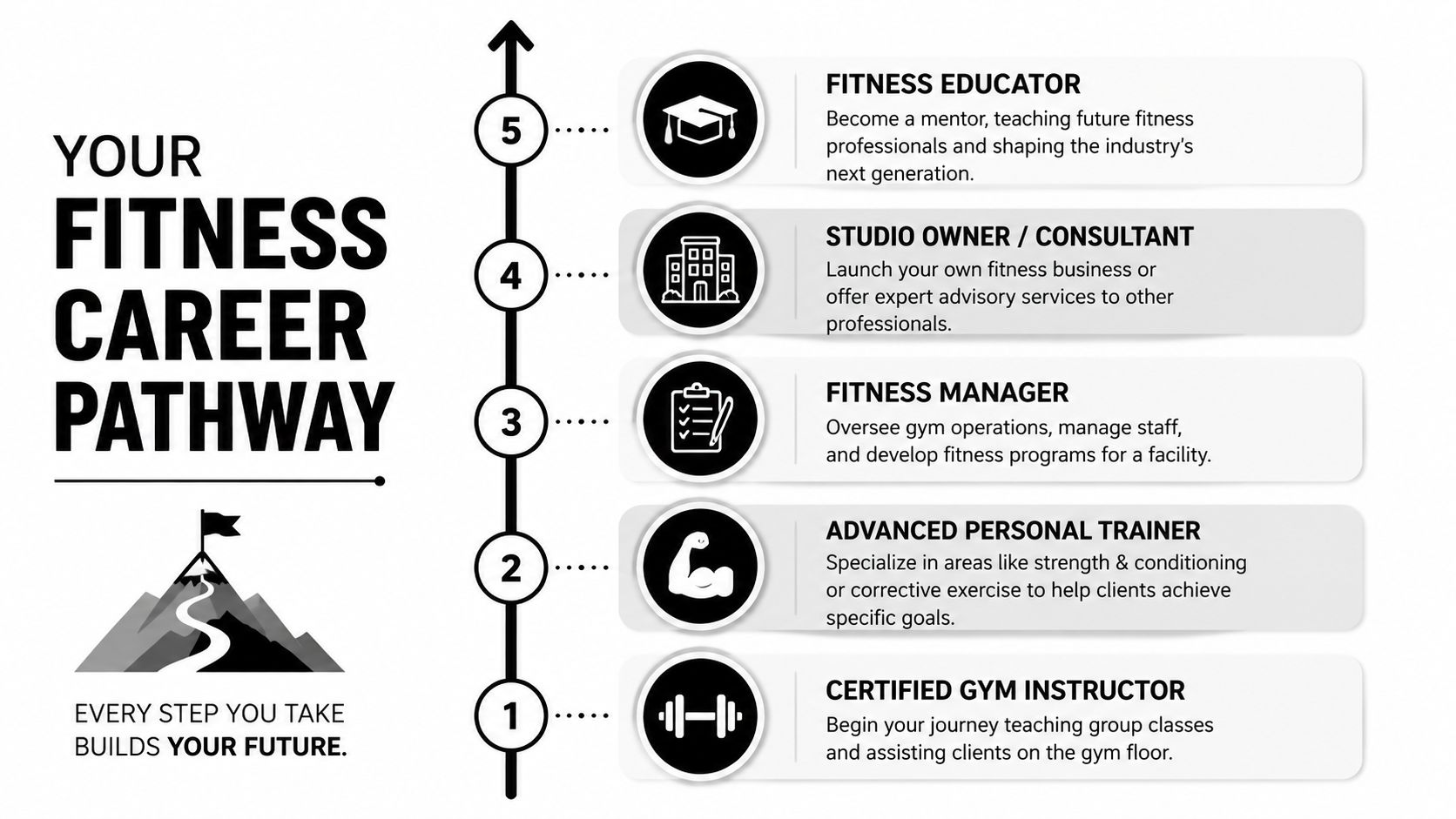
That is why this stage matters so much. A gym instructor course can lead to an entry role in fitness, but it can also become the first clear rung on a learning ladder that keeps rising as your confidence, income, and ambitions grow.
A learning ladder with room to grow
A sensible route often starts with Level 2 Gym Instructor and then moves to Level 3 Personal Training. After that, some learners choose specialist study, supervisory responsibility, or work that connects fitness with health, wellbeing, or education.
The helpful thing about this pathway is its structure. Each step builds on the one before it, much like adding floors to a house that already has solid foundations. You do not need to decide on every future step now. You only need a first qualification that gives you something real to stand on.
For some adult learners, that first vocational course later sits alongside English, maths, or an Access to HE Diploma. That combination can support applications to broader health-related study in the future. It is best understood as a possible route rather than a guaranteed outcome, but it can open doors that once felt closed.
Careers often widen as skills and confidence grow
Your first role might involve welcoming new gym users, showing them how to use equipment safely, and helping them feel less intimidated in an unfamiliar space. Over time, that can grow into much more.
Some instructors move into personal training. Some take on team leadership or management. Others go into teaching assistant roles in education, community wellbeing projects, or specialist support for people who need a more thoughtful approach to exercise.
That matters because fitness is never only about machines and reps. Good instructors often become translators. They turn confusing advice into clear steps. They help nervous beginners feel capable. They give people structure at a time when life feels unsteady.
The impact reaches beyond work
Adult learning changes the atmosphere at home as well as your prospects at work.
Your family may see you studying after a long day, showing up even when you feel rusty, and proving that starting again is something to be proud of. For many adults, that example carries just as much weight as the certificate itself. It shows that progress is still possible, even after setbacks, long gaps in education, or years spent putting other people first.
If rebuilding self-belief is part of your journey, support in that area can help steady the whole process. Resources on courses to improve confidence can be useful alongside career planning, because confidence and learning often strengthen each other.
A gym instructor course can lead to paid work. It can also lead to a stronger sense of who you are becoming. For many adult learners, that is the true beginning.
Take Your First Step Today You've Got This
Starting can feel like the hardest part because it asks you to believe in a future you haven't seen yet. That takes courage. It takes even more courage when you've had setbacks, lost confidence, or spent years putting everyone else first.
But it's simple. You do not need to become a different person before you begin. You begin, and then you grow.
A gym instructor course can offer a practical starting point. It gives you a route into a respected area of work, a chance to build confidence through learning, and a first step on a bigger ladder if you want more later on. That “more” might mean better pay, further study, university, or a role where you help others live healthier lives.
Three gentle next steps
You don't have to decide everything today. Just do one small thing that moves you forward.
- Go back to the part that stayed with you most. If one section made you feel hopeful, read it again and notice why.
- Write down your reason. Keep it honest and simple. It might be “I want my children to see me finish something” or “I want work that feels meaningful”.
- Look at a course page calmly. Don't pressure yourself to enrol on the spot. Just explore what the first module involves and whether the qualification is properly recognised.
Keep this thought close
You are not behind. You are not too late. And you are not the only adult who has ever doubted themselves before doing something brave.
The first step doesn't need to be perfect. It only needs to be real.
Your family doesn't need you to have all the answers today. They need to see you believe that your future can improve. That belief can begin with one decision, one application, one hour of study, one course that opens a door.
You've got more in you than fear would like you to think. Start there.
If you're ready to turn hope into action, Next Level Online College offers flexible online learning designed for adult learners across the UK. Whether you want to rebuild confidence, gain recognised qualifications, or create a path towards further study and a better career, it's a supportive place to take that first step.