
You might be reading this after the kids have gone to bed, or in a quick break at work, wondering if education still has a place in your life. Maybe you've told yourself for years that you'd go back “one day”. Maybe you want better work, more choices, and the pride of showing your children that it's never too late to grow.
That feeling matters.
I've met many adults who thought the door had closed on university, a new career, or a qualification they missed first time round. They weren't lazy. They were busy surviving, raising families, working long hours, and putting everyone else first. If that sounds like you, you're not behind. You're carrying a lot, and the fact you're looking into this now says something powerful about you.
Your Time to Shine Is Now
A lot of adult learners arrive at this point. They don't usually make a big announcement. They just start searching. They look up courses on their phone. They read about funding. They wonder if they're clever enough, young enough, or organised enough.
Those doubts are common. They're also wrong.
Returning to study isn't about proving that your past was perfect. It's about deciding your future can be better. For many adults, that choice is personal. It's about being able to say to your children, “I didn't give up on myself.” It's about walking into work knowing you're building towards something bigger. It's about opening the path to university, a fresh start, or a career that feels meaningful.
Why this matters for your family
When adults go back to education, the change often reaches far beyond the course itself. Home feels different. Children notice when a parent studies, keeps going, and finishes what they started. Your example can shape how they see effort, resilience, and ambition.
That doesn't mean the journey is easy.
There may be evenings when you feel tired, days when confidence dips, and moments when you wonder if you can really do this. You can. Not because every step will feel simple, but because ordinary people do brave things every day, and this is one of them.
Going back to study as an adult isn't a sign that you fell behind. It's a sign that you're ready to move forward.
A comeback can start very quietly
Sometimes a comeback begins with one small act. Reading about your options. Asking a question. Filling in a form. Looking at a course page and thinking, “Maybe this could be me.”
That matters more than you think.
You don't need to have perfect confidence before you begin. Confidence usually grows after you take the first step, not before. Education can help you gain qualifications, move towards better paid work, and build a future that feels more secure. It can also give you something many adults have been missing for a long time. Belief in yourself.
If part of you still worries that it's too late, hold onto this instead. Your life experience is not a weakness. It's one of your strengths. You know why you're doing this. You know who you're doing it for. That gives your effort real power.
What Is an Advanced Learner Loan Really
A lot of adults reach this point with the same quiet question. “If I say yes to studying, how would I pay for it?”
An Advanced Learner Loan is a way to pay the fee for an eligible course without finding the full amount upfront. For many adults, that changes the conversation from “I can't afford to start” to “I may be able to do this after all.”

A different kind of borrowing
This loan is built for adult education, not everyday spending. It can be used for approved qualifications in England at Level 3, 4, 5, or 6. The loan pays the course fee, so the support is focused on getting you into learning and helping you gain a qualification that can change what comes next.
That distinction matters.
A bank loan or credit card can feel personal and risky, because it often depends on your wider finances. An Advanced Learner Loan works differently. It is designed around study. For adults who have put learning on hold while raising children, working, or dealing with life's setbacks, that can make returning to education feel far more possible.
Some learners use it to take a first step into a new field. Others use it to finish something they had to leave behind years ago. If your goal is university, professional progress, or a fresh start, the loan supports the course that helps get you there. Many adults begin with an Access to HE Diploma online course because it gives them a realistic route back into higher education.
What the loan can cover
The loan covers tuition fees for the eligible course itself. It is not extra money for rent, bills, or day to day costs.
A few points make that clearer:
- It can support a wide range of course fees. The minimum loan amount is £300, as set out in the 2025 to 2026 Advanced Learner Loans funding rules.
- Some learners can study more than one qualification. You can have up to four Advanced Learner Loans at the same time.
- A Levels have extra flexibility. In some cases, learners taking A Levels can have up to eight loans.
The simplest way to read this is: the loan is there to remove the upfront course fee barrier, so you can focus on learning.
Why this matters so much to adult learners
People usually look into this loan because they want a different future. They want to qualify for work in healthcare, education, business, social care, or another field where recognised training opens doors. They want better options, steadier income, and work that feels more secure.
There is also something deeper going on.
Returning to study can help repair confidence that has been chipped away by time, setbacks, or responsibilities that came first for years. A qualification can raise your prospects, but it can also change how you see yourself. You stop being the person who kept putting the dream off. You become the person who went back, kept going, and built something better.
For many families, that example lasts long after the course ends.
Checking If This Key Is for You
A lot of adults reach this point with one hand on the door and the other pulling back.
You might be thinking about retraining after redundancy. Or after years spent raising children, caring for family, or staying in work that pays the bills but no longer feels like your future. The question can feel bigger than a loan application. It can feel like, “Am I really allowed to start again?”
For many learners, the answer is yes.
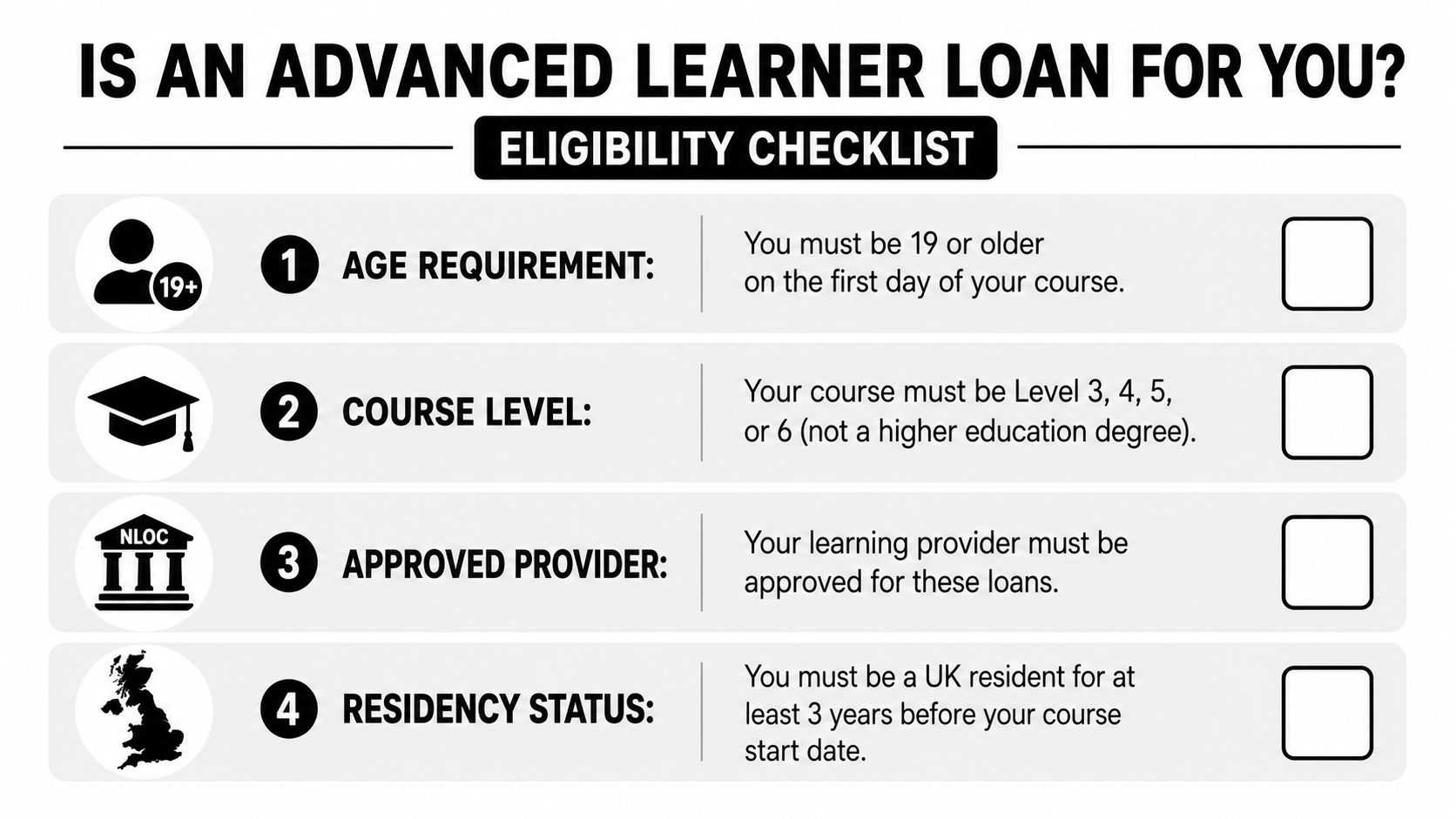
The simple checklist
The easiest way to check is to look at four practical points first.
- Age: You need to be 19 or over on the first day of your course, according to this Advanced Learner Loan key facts guide.
- Residency: You need to meet the residency rules before your course starts.
- Course type: Your course must be an eligible Level 3 to 6 qualification.
- Provider: The course must be with an approved college in England.
If those points sound close to your situation, that is a strong sign to keep going rather than talk yourself out of it too early.
The worries that stop good people from applying
Adults often assume the barrier will be money, past credit problems, or the fact that life has not followed a tidy plan. Those fears are understandable. I have seen them hold back learners who were fully capable of succeeding.
As noted earlier, household income and credit checks are not the deciding factor people often fear here. What matters most is whether you meet the learner, course, and residency rules.
That can be a huge relief.
It means this support is designed around access to study, not around judging whether your life has looked perfect up to now. For someone rebuilding confidence, that matters more than people realise.
If you are an adult returning to an approved Level 3 to 6 course in England, this route may fit you far more closely than you think.
Which kinds of courses often fit this path
Different learners come back for different reasons. Some want A Levels to reopen options they missed earlier. Some want a vocational qualification linked to a clearer job path. Others want a route into university after years away from the classroom.
That last group often looks at an Access to HE Diploma online course, because it gives adults a recognised way to prepare for higher education without pretending they are starting from the same point as an 18-year-old school leaver.
That matters for families too. Children notice when a parent goes back to study. Partners notice. Even your own view of yourself starts to shift. You are no longer only thinking about what went wrong, what got delayed, or what had to wait. You are building proof that a second chance can become a new direction.
Ask yourself these questions
If you are unsure, use these questions as a quick self-check.
| Question | Why it matters |
|---|---|
| Am I 19 or older? | Adult learner funding starts there |
| Do I meet the residency rules? | Residency is part of eligibility |
| Am I applying for an approved Level 3 to 6 course? | The loan supports eligible further education study |
| Am I ready to back my future with one practical decision? | This is often the moment people stop waiting and start rebuilding |
Plenty of adults do not need more potential. They need a clear reason to believe this path is still open.
If that sounds like you, let this be the moment you say yes to yourself.
How Repaying the Loan Works for You
You finish your course. A few months later, your new qualification helps you get better-paid work or puts you on the path to university. That is the point at which repayment may begin. Until then, this loan is designed to give you room to study first and sort repayment later.
For many adults, that changes everything.
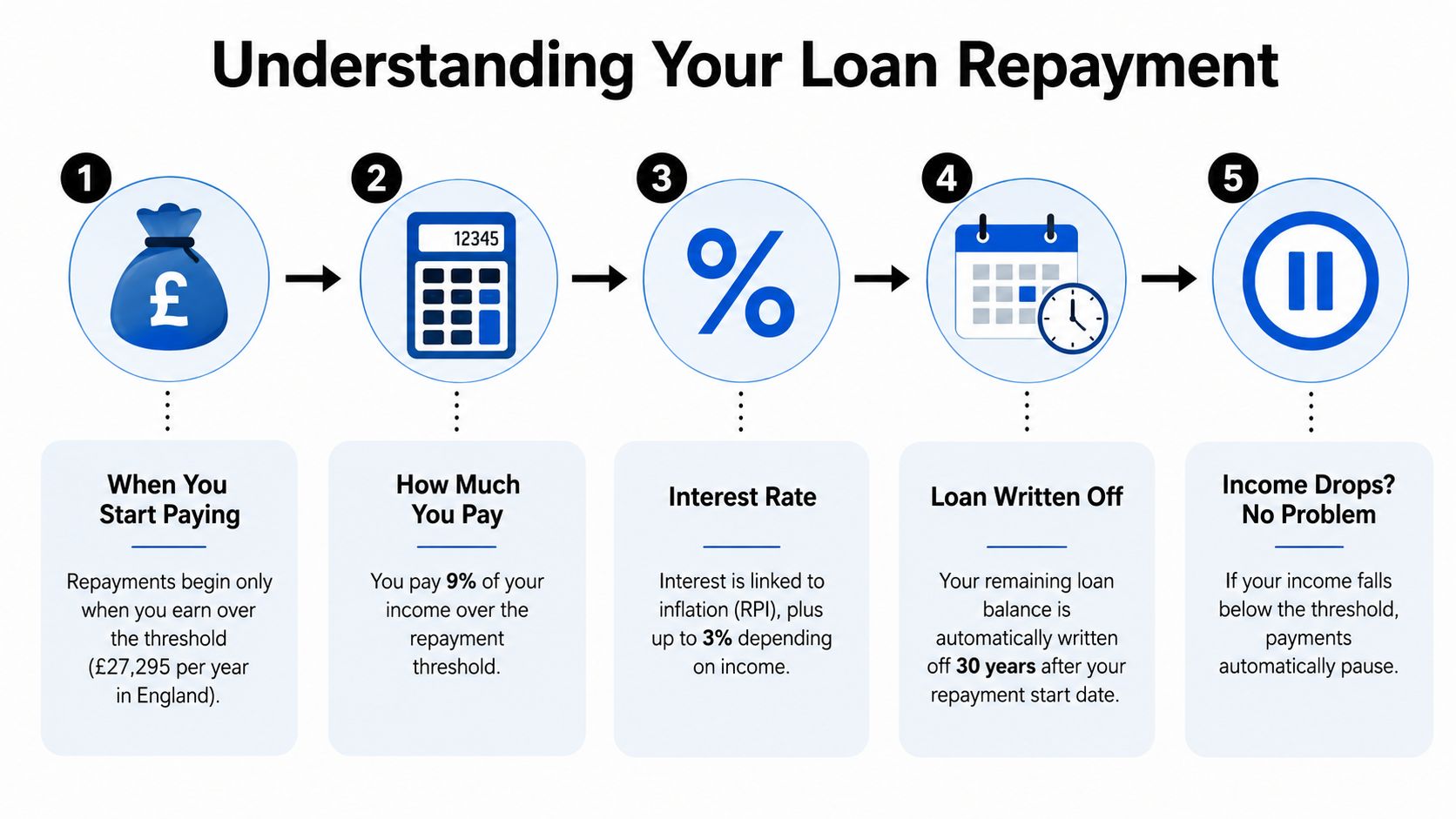
Repayment is based on what you earn, not on a fixed monthly bill that arrives no matter what else is happening in your life. As noted earlier, you only start repaying after your course ends or after you leave it, and only if your income is above the repayment threshold. If your earnings are below that level, repayments do not start. If your income later drops under the threshold, repayments stop.
The rule that matters most
The easiest way to understand repayment is to picture a line. You only repay on the part of your income above that line.
At the time of writing, the threshold is £25,000 a year. You repay 9% of anything you earn above £25,000, not 9% of your whole salary. The same threshold is often shown as £2,083 per month or £480 per week, which can feel more real when you are budgeting around wages, rent, food, and childcare.
You repay from the slice above the threshold. If income falls below it, repayments stop.
That detail matters because it helps many adults stop treating the loan like a credit card or bank loan. It does not work that way. It follows your income.
A plain example
Let's make the numbers less abstract.
If your income stays below the threshold after your course, you do not make repayments at that stage. If your earnings rise above it, only the amount over the threshold is used to work out what you repay.
That structure gives people breathing space while they rebuild. For a parent returning to study, or someone changing direction after years in the wrong job, that can mean the difference between staying stuck and finally choosing a qualification that leads somewhere better.
What about interest
Interest starts from the date the first loan payment is made to the learning provider and continues until the balance is repaid. For courses starting on or after 1 August 2023, the interest rate is RPI only, rather than the earlier RPI plus 3% model, according to the Student Loans Company key facts sheet.
If the word “interest” makes you tense, pause there for a second. What usually worries people is the fear of immediate pressure. The main point is that repayment still depends on income, so the loan is built to support study first and repayment later.
How much can you borrow
The amount available depends on the fees for your approved course, within government limits. The minimum you can borrow is £300. There are also rules about how many loans you can hold, as noted earlier.
If you want to weigh up this route alongside other ways to pay for study, these finance plan options for adult learners can help you compare what may suit your situation.
Why this structure reassures so many adults
A lot of fear around student finance comes from assuming repayment starts straight away and keeps going whatever happens. That is not how this system is set up.
It gives you time to learn, time to grow, and time to turn study into better opportunities. Then, if your income rises enough, you begin repaying in a way linked to what you earn.
For many adult learners, that is more than a funding arrangement. It is a practical way to back a comeback. You get the chance to train for work that fits you better, show your children what persistence looks like, and prove to yourself that one decision can still change the direction of your life.
Your Step by Step Guide to Applying with Us
Applications feel much easier when you stop seeing them as one huge task. In practice, it's a series of small actions. You choose a course, get the right information from the college, and submit your loan application with the details the Student Loans Company needs.
That's much more doable than it first sounds.
Step one: choose the course that matches your goal
Start with the outcome you want.
Do you want to reach university. Change career. Gain A Levels. Complete an Access to Higher Education Diploma. Improve your options at work. Your course choice should connect to a real next step in your life, because that will help you stay motivated when study gets challenging.
Step two: get your Learning and Funding Information Letter
This is the document that matters most. To apply, the key document you need is the Learning and Funding Information Letter from your college, as explained on the Advanced Learner Loan guidance from New College Durham.
That letter contains the details the loan company needs for your application.
Keep this practical: before you apply, create a small folder for your documents so everything is in one place and easy to find.
Step three: gather the basic information
You may be asked for items such as:
- National Insurance details: This helps confirm your identity and record.
- Residency evidence: You may need proof linked to your right to live and study in the UK.
- Immigration documents if needed: Some learners may need extra paperwork depending on their status.
- Course details from your letter: This is why the college letter is so important.
The process feels less stressful when you treat it like preparation, not paperwork punishment.
Step four: understand how the loan matches the course
Some course types are handled slightly differently.
- A Levels: You can get a separate loan for each subject.
- Access to HE Diploma: You get one loan to cover the whole course.
That difference can help when you're deciding what route suits your plans best.
Step five: submit the application and keep going
Once the application is sent, stay organised. Check your messages, respond if anything is requested, and keep your course plans moving forward. Don't wait until you “feel ready enough”. Most adults never get a magical moment of total certainty.
They move ahead while still feeling nervous.
That's often what courage looks like in adult education. Not the absence of fear, but the decision to act anyway. One form. One document. One course. One new chapter.
Building Your Brighter Future Beyond the Loan
The loan can remove one big barrier, but adult learners know there can be other costs around study too. Travel, childcare, internet access, materials, and the general pressure of keeping life running don't disappear just because you've enrolled.
That's why it helps to be honest about the full picture.
The loan covers course fees only, not living costs, and the Student Loans Company guidance on Advanced Learner Loans makes that clear. Many adult learners worry about this, but planning ahead and choosing flexible online study can make a real difference with costs such as transport and childcare.
Smart ways to make study feel manageable
A brighter future usually grows from practical decisions, not perfect ones.
- Choose flexibility where possible: Studying online can cut travel time and help you work around family life.
- Build a simple weekly budget: Even a basic plan can help you spot pressure points early.
- Tell your family your study times: When people around you know your plan, they're more likely to support it.
- Look at your long-term gain: The short-term effort makes more sense when you connect it to university, a better role, or a more fulfilling career.
Why the bigger picture matters
Education is not only about passing assessments. It's about identity. It's about becoming the person who follows through. The one who grows. The one who shows their children that setbacks don't get the final word.
If university is part of your dream, there are routes into higher education that don't depend on your old school story. Many adults are surprised to learn more about getting into university without A Levels.
That can be the moment hope becomes a plan.
Your qualification can do more than change your CV. It can change the way you see yourself and the example you set at home.
You don't need to fix your whole future this week. You only need to take the next right step. Ask the question. Explore the course. Check your eligibility. Start the application. Adult learners often underestimate how much life can change once they stop waiting for confidence and start moving with purpose.
Next Level Online College supports adults across the UK who want a fresh start through flexible online learning. If you're thinking about A Levels, GCSEs, Functional Skills, or an Access to HE Diploma, have a friendly look at Next Level Online College and take one small step towards the future you want.