You might be reading this after the kids have gone to bed, after a shift at work, or in that small quiet gap where you finally have a moment to think about yourself. You want better options. You want qualifications that open doors. You want to prove, to your family and to yourself, that your story isn't finished.
The cost can feel like the part that stops everything before it starts. That's where bursaries matter. They can take some of the pressure off and make study feel possible again. If you're trying to apply for online bursaries for GCSEs, A Levels, or an Access to HE diploma, the process can feel confusing at first, but it is manageable when you break it into small steps.
Your Dream Career Is Closer Than You Think
A lot of adult learners sit with the same private worry. They can see the future they want, but the money side makes it feel out of reach. You might be thinking about nursing, teaching, social work, business, or a university course you once believed was only for other people.
That dream matters. It matters because better qualifications can lead to better pay, more choice, and work that feels meaningful. It also matters because when your children see you study, keep going, and pass exams, they see what courage looks like.

The part most guides miss
Most bursary advice is written for university students. That leaves many adult learners feeling invisible. As UCAS explains in its guidance on low-income household bursaries, many low-income bursaries rely on household income data collected for university students under 25 by student finance bodies, which often excludes adult learners on courses like GCSEs or A Levels.
That's a big reason the search feels harder than it should. The system often fits traditional university students better than adults returning to education.
Adult learners on pre-university courses often need a different funding plan, not the same advice given to an 18-year-old going straight to university.
Your route can still work
A funding gap doesn't mean there's no funding. It means you need to search in the right places and apply with care. Some learners use bursaries. Some combine bursaries with fee-free study routes or other support. Some start with the qualification that gets them to the next stage.
If your long-term aim is higher education, it helps to understand the full path from today's course to tomorrow's application. This guide on getting into universities as an adult learner can help you see how GCSEs, A Levels, and Access courses fit into the bigger picture.
You don't need to have everything sorted today. You just need a plan for the next step.
Finding Bursaries That Actually Want to Help You
The bursary search gets easier when you stop looking everywhere and start looking where you fit. Consider it matching, not begging. You are looking for funders whose rules, purpose, and priorities line up with your life.
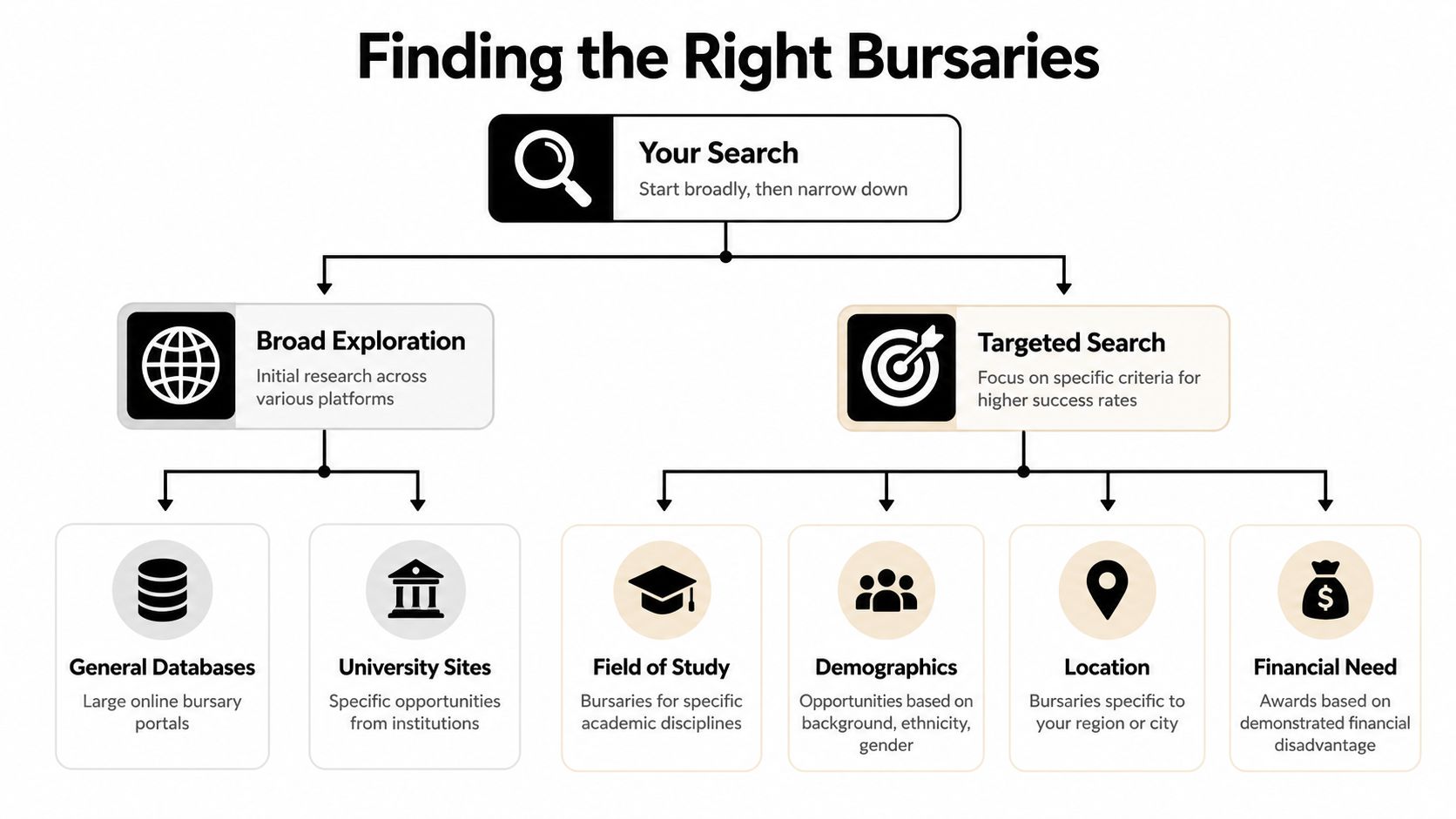
Start with the funding types
Some support is called a bursary. Some isn't, but it still helps you pay for study.
Here are the main places adult learners usually need to check:
- Charitable trusts. These often support people from certain backgrounds, family situations, regions, or work sectors.
- College or provider hardship support. Some providers have their own small funds or can point you to local help.
- Industry-linked support. Some trusts help people connected to a certain trade or profession.
- Government-backed finance. This isn't a bursary, but it can be the practical route that gets you enrolled.
One of the most important options for adult learners is the Advanced Learner Loan. The House of Lords Library overview of adult education funding in England notes that this loan is available for those aged 19 and over studying qualifications at Levels 3 to 6, including A Levels and Access to HE diplomas. That matters because it fills a real gap for adults returning to study.
If you want to understand whether this option fits your course, this guide to Advanced Learner Loans is a useful next read.
Use a narrow search, not a desperate one
A weak search sounds like this: “I need money for study, so I'll apply for everything.”
A strong search sounds like this: “I'm an adult learner in the UK, studying online, aiming for university, with a specific background and a clear reason for support.”
That second approach saves time. It also gives you a better chance because you're applying where your story makes sense.
A simple search filter list can help:
| Search area | What to look for |
|---|---|
| Background | Adult learners, returners to education, carers, parents |
| Qualification | GCSE, A Level, Access to HE, Level 3 |
| Geography | Your town, county, region, or devolved nation |
| Industry link | Grocery, pharmacy, travel, care, trades, public service |
| Financial situation | Hardship, low income, household strain |
This short video may also help you think about bursary searching and application planning in a calmer, more organised way.
Don't ignore free study routes
Sometimes the best answer isn't a bursary at all. Some adults can study English or maths up to GCSE level free of charge. Some adults aged 19 and over can also take certain Level 3 courses free through the Free Courses for Jobs scheme if they are unemployed or earning below £25,000 a year, as set out in the verified policy information above.
Practical rule: Look for free entitlement first, then bursaries, then loan options. The cheapest route is usually the strongest route.
That approach protects your energy. It also helps you apply for online bursaries only where they are relevant.
Getting Your Documents Ready Without the Stress
Lack of ambition is rarely the reason for struggle. They struggle because paperwork feels heavy, boring, and easy to get wrong. The good news is that documents are just proof. They show that what you've said is real.
Why this step matters
Some bursaries change value based on household income. At the University of York, its bursary research and impact evaluation shows that students from households earning under £16,000 receive £2,000. The same report also sets out other tiers, including £1,500 for household income between £16,001 and £25,000 and £1,000 for household income between £25,001 and £35,000.
That tells you something important. Good income evidence can affect how much support you receive.
Build one simple folder
Create one folder on your laptop and one paper folder at home. Give them clear names so you can find things quickly.
Your checklist might include:
- Proof of identity. A passport, driving licence, or other accepted ID.
- Proof of address. A recent bill, council letter, or official document with your name and address.
- Income evidence. This could be wage slips, benefits letters, tax paperwork, or other documents the funder asks for.
- Course evidence. An offer email, enrolment confirmation, or college letter.
- Personal notes. A short summary of your situation and goals, so your answers stay consistent.
Make the admin easier on yourself
Don't leave this until the final evening. That's when panic starts.
Use this quick routine:
- Read the eligibility rules first so you don't collect papers for the wrong bursary.
- Check dates on your documents because some providers want recent evidence.
- Scan or photograph everything clearly and save each file with a simple name.
- Keep one backup copy in cloud storage or email.
If a bursary asks about income, answer carefully and match your documents to your wording. Small mismatches can slow things down.
Treat this stage as quiet progress. Every document you gather is one less barrier between you and your course.
Writing a Personal Statement That Shines
Many adults freeze at this point because they think they need to sound formal. You don't. A bursary reader doesn't need a performance. They need a clear, honest picture of who you are, why you're studying, and what this support would change.
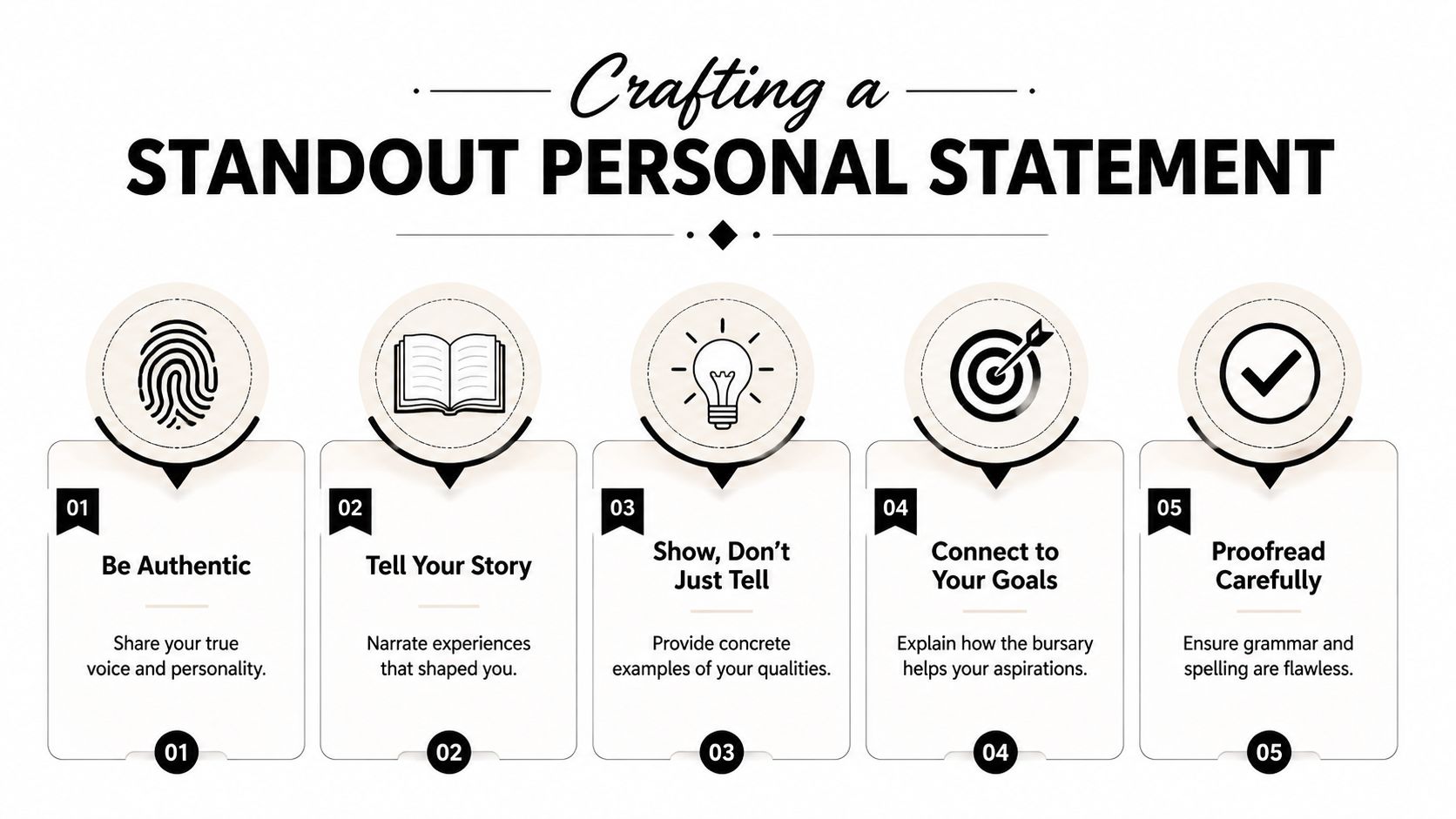
The strongest statements do more than describe need
Financial pressure matters, and you should say so. But a strong statement also shows direction. Verified guidance linked to the Leverhulme Trade Charities Trust says 78% of successful adult learner bursary applications include a clear progression plan, such as a pathway to university entry, in addition to financial need. You can see that in the funding guidance linked here.
That's why “I need help with money” is rarely enough on its own.
A simple three-part structure
You can build your statement around three questions.
Your why
Why are you returning to education now?
Be plain. Be human. Maybe you want to move into a better-paid role. Maybe you want work with purpose. Maybe you're tired of feeling stuck. Maybe you want your children to see you finish something important.
The barrier
What problem is the bursary helping you solve?
Explain the pressure. You might be balancing rent, food costs, travel, childcare, or reduced working hours while studying. Keep it factual and calm.
The future
What happens next if you get this support?
This part is where many people hold back, but it's often the part that makes your application memorable. Show the path. Explain how the course leads to the next qualification, university, or career move.
For extra help shaping that journey on paper, this guide on writing a university personal statement can help you organise your ideas clearly.
A model you can adapt
Try something like this:
I am returning to education to gain the qualifications I need for university and a long-term career in a field where I can support others. Studying as an adult means I am balancing education with family and financial responsibilities. This bursary would reduce that pressure and help me stay focused on completing my course successfully. My goal is to progress from this qualification into higher study and build a stable future that makes my family proud.
That doesn't need fancy words. It needs truth, structure, and purpose.
What makes a statement feel convincing
- Specific goals. Name the qualification and what it leads to.
- Real-life context. Explain your situation without overloading it.
- Forward movement. Show that the bursary supports a plan, not just a moment.
- Your voice. Write like a sincere person, not a brochure.
A good statement says, “This support will help me move forward, and I know where I'm going.”
Submitting Your Application and What Comes Next
Pressing submit can feel nerve-racking, but it's also a big achievement. A lot of people stop before this point. You didn't.
Check the form one last time
Before you send anything, slow down and look for small mistakes. These are the errors that can creep in when you're tired.
Run through these questions:
- Have you answered every required question?
- Do your dates match your documents?
- Have you uploaded the right files?
- Does your personal statement fit this funder, not just any funder?
Read your application once for sense and once for detail. Those are two different checks.
If you're invited to interview, that's good news
Some bursary guides act like the form is the end. It isn't always. The City & Guilds Foundation application guidance states that shortlisted applicants are invited to an interview, either in person or online, before grants are approved.
That interview is not a sign you've done something wrong. It usually means they can already see your potential.
Shortlisting means you're in serious consideration. The conversation is your chance to make your application feel real.
How to prepare without overthinking
You don't need a speech. You need a few clear answers you can say calmly.
Prepare to speak about:
- Why you chose this course
- Why funding matters in your situation
- What you want to do after the course
- How you'll make good use of the opportunity
Say the answers out loud before the interview. If possible, practise with a friend. The goal isn't perfection. The goal is to sound clear, steady, and genuine.
Common Pitfalls and Your Final Checklist
Most bursary mistakes aren't about ability. They happen when people rush, apply for the wrong thing, or assume one application can be copied everywhere. When you apply for online bursaries with care, many of these problems are avoidable.
The mistakes that catch people out
Some learners apply for bursaries that were never designed for them. Others write one personal statement and send it unchanged to every funder. Some forget that smaller bursaries can still matter because several forms of support together can make study affordable.
Another common problem is weak alignment. A funder wants to know why you match their purpose. If your application talks only about your struggle and not about your plan, your fit can look unclear.
Your final application checklist
Use this before you submit anything:
- Check eligibility first. Make sure the bursary is open to your course type, age group, location, or background.
- Match your evidence. Your documents should support what you've written.
- Tailor every statement. Keep your core story, but adapt it to each funder's aims.
- Explain your next step. Show what this course leads to for you.
- Prepare for contact. Watch your email in case they ask for more information or invite you to interview.
- Keep copies. Save your form, statement, and documents in one place.
If you get a no
A no can sting, especially when it took courage to apply in the first place. But it doesn't mean you aren't capable. It usually means that one funder, on that round, made a different choice.
Keep going. Adjust your search. Improve your statement. Try the next fit.
The adult learners who move forward aren't always the ones with the easiest path. They're often the ones who keep taking the next step.
You are doing something powerful. You are choosing growth instead of settling. You are building a future your family can see, respect, and believe in. That matters far beyond one application form.
If you're ready to turn that ambition into action, Next Level Online College offers flexible online courses for adult learners across the UK, including Functional Skills, GCSEs, A Levels, and Access to HE diplomas. If you want a study route that fits around work and family life, with support designed for adults returning to education, it's a strong place to start.