
You might be staring at a blank screen after work, with the kettle on, wondering how on earth you're meant to sum up your whole life in one short university personal statement.
That feeling is normal.
For many adult learners, this part feels more frightening than the course itself. You may be thinking, “I left school years ago”, “My path hasn’t been straightforward”, or “Surely younger applicants will sound better than me.” But that isn’t the full truth. A personal statement is not about sounding fancy. It’s about showing who you are, why you’re ready, and why this next step matters.
If you’re learning how to write a university personal statement, start with this: universities are not asking for perfection. They’re asking for a clear, honest explanation of your interest in the course and the strengths you’ll bring to it. As an adult learner, you already have something valuable. You have perspective. You have responsibility. You have reasons for returning to education that are often deeper and stronger than you realise.
Your First Step to a Bright New Future
A personal statement is a short piece of writing you send with your university application. Its job is simple. It helps admissions tutors understand why you want the course and why you’re ready for it.
That means you don’t need to tell your whole life story. You need to choose the parts of your story that prove you can succeed.
For UK university applications, UCAS keeps this very tight. Your personal statement is limited to 4,000 characters, which is around 500 to 600 words, and 47 lines, as explained in the UCAS personal statement guide for mathematics and statistics. A limit like that can feel harsh at first, but it helps. It gives you a clear boundary. You are not writing a book. You are writing a focused argument for your future.
If you’re still sorting out your route into higher education, this guide on getting into university without A Levels can help you see the bigger picture.
What admissions tutors want to see
Most readers are looking for a few core things:
- A clear course choice. Why this subject, not just “university in general”?
- Evidence of readiness. What have you done that shows you can cope with study?
- Genuine motivation. Why now?
- Self-awareness. What have your experiences taught you?
You don’t need dramatic stories. You need honest links between your life and your chosen subject.
Practical rule: Don’t ask, “What sounds impressive?” Ask, “What proves I’m ready?”
A simple way to think about it
Treat your statement like an answer to one big question:
Why am I a strong candidate for this course at this point in my life?
That question keeps you focused. It stops you drifting into long background detail that doesn’t help your application. If a sentence doesn’t support your answer, cut it.
A blank page can feel heavy. A clear purpose makes it lighter.
Your Life Experience is Your Secret Weapon
If you’ve had a break from education, raised a family, worked in demanding jobs, changed direction, or rebuilt your confidence from scratch, that is not something to hide. It is often the very thing that makes your application stronger.

Many adults worry that a gap in education will count against them. In reality, mature applicants can benefit when they reflect well on life beyond the classroom. For mature applicants over 21, personal statements that show reflection on non-academic experiences can boost offer rates by as much as 23%, according to this Uni Guide summary of UCAS-based personal statement advice.
That matters because reflection is different from listing. Universities don’t just want to know what you did. They want to know what you learned from it.
Turn life into evidence
Think about the roles you’ve held, even if they were unpaid or informal. Each one may hold proof of skills that matter at university.
A few examples:
| Experience | What it may show |
|---|---|
| Working in retail or hospitality | Communication, teamwork, calm under pressure |
| Raising children | Organisation, resilience, time management |
| Caring for a relative | Patience, responsibility, problem solving |
| Changing careers | Adaptability, motivation, willingness to learn |
| Returning to study after years away | Courage, discipline, long-term commitment |
You are not trying to make ordinary life sound grand. You are showing how ordinary life built real strengths.
Questions that help you dig deeper
Use these prompts before you write:
- What challenge have I handled well? Think about what it taught you.
- Where have I shown commitment? This might be at work, at home, or in study.
- What have I done that links to my course? Maybe you solved problems, supported people, wrote reports, handled data, or managed schedules.
- Why does this goal matter to me now? Your reason may be career progress, stability, pride, purpose, or being a role model for your children.
Your experience does not need to be unusual. It needs to be relevant and well explained.
How to frame a gap positively
You don’t need to apologise for a non-linear path. Keep your wording calm and forward-looking.
Instead of writing:
“I’ve been out of education for a long time and I know this may put me at a disadvantage.”
Try:
“Time away from education has helped me develop maturity, focus, and a clearer sense of direction, which I’m now ready to bring to degree-level study.”
That shift is powerful. It replaces shame with evidence.
Building Your Statement Paragraph by Paragraph
Once you’ve gathered your ideas, the next step is shaping them into a statement that feels clear and steady. Many people freeze at this point. They have the right material, but they aren’t sure how to organise it.
A strong personal statement usually works best when it stays mostly focused on the course itself. A common approach is an 80/20 balance, with about 80% on your subject and academic readiness, and 20% on skills from work, hobbies, or life experience. That guidance is often used in UCAS-linked advice for applicants.
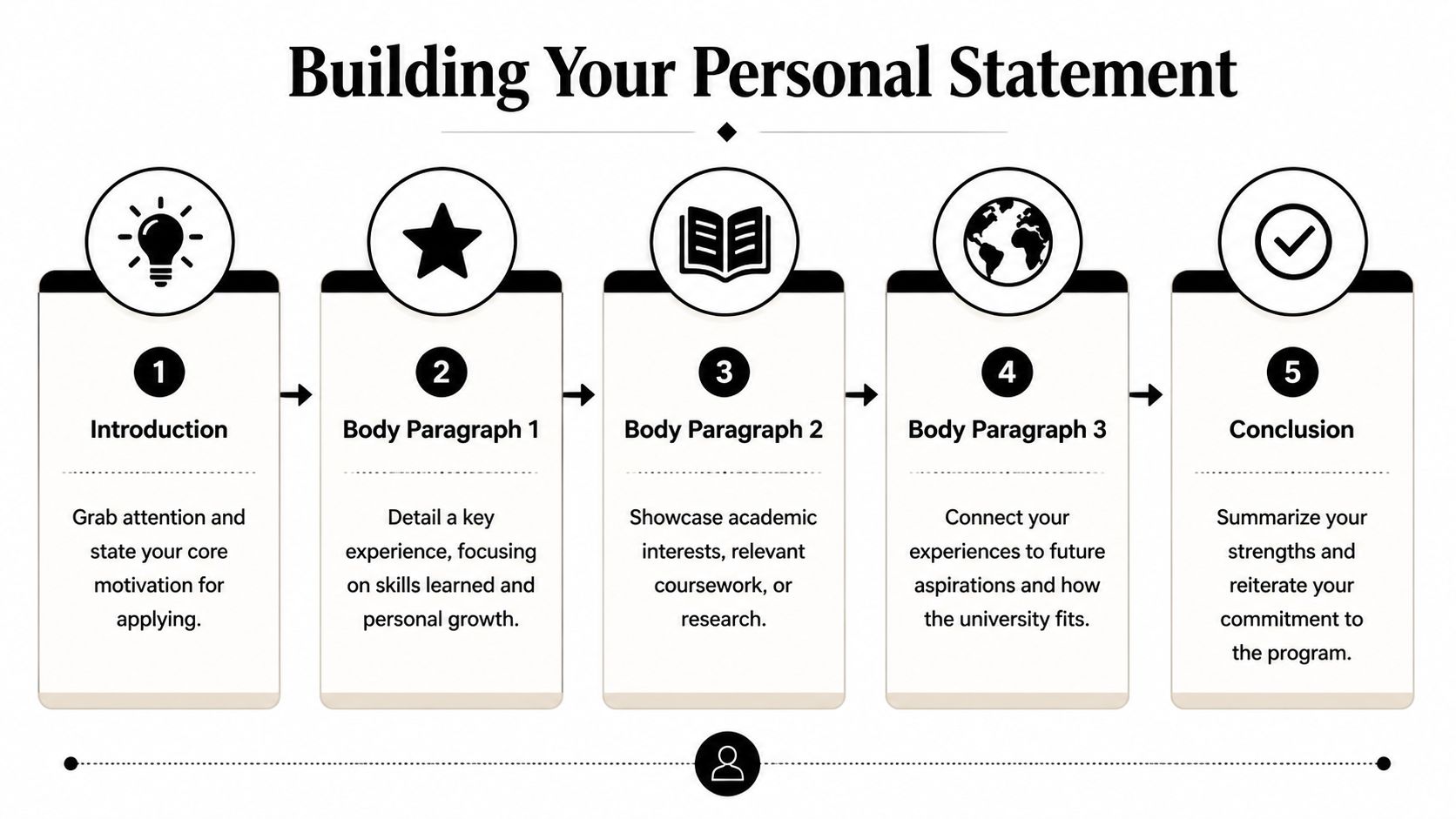
Paragraph one starts with purpose
Your opening should make your course choice clear. Don’t waste half the paragraph trying to sound poetic. Start with your reason.
Here are some useful opening patterns:
- “I want to study social work because I’m drawn to supporting people through difficult situations with care and practical action.”
- “My decision to apply for adult nursing comes from both personal experience and a growing interest in patient care.”
- “I’m applying for psychology because I want to understand how people think, cope, and change.”
Keep it direct. One or two sentences is enough to set the direction.
The middle paragraphs do the heavy lifting
Your middle paragraphs should prove your fit by connecting your background to your subject.
A simple structure works well:
- What you did
- What you learned
- How it connects to the course
For example:
“My experience in customer service taught me how to listen carefully, stay calm under pressure, and respond to different needs. These skills strengthened my interest in mental health support and showed me the importance of clear, compassionate communication, which I’m keen to develop further through studying counselling.”
That is much stronger than just saying, “I worked in customer service and learned many skills.”
Include academic readiness
Universities want to know you can handle study. Mention the learning you’ve done recently, especially if you’re returning after a gap.
You might refer to:
- Current study such as GCSEs, A Levels, Functional Skills, or an Access to HE Diploma
- Course-related reading that sparked your interest
- Written work or assignments that built confidence
- Independent learning such as watching lectures, keeping notes, or researching topics
A simple sentence starter is:
- “Studying [qualification] has strengthened my ability to…”
- “Through recent coursework, I’ve improved my…”
- “Learning more about [topic] confirmed my interest in…”
Writing tip: Every paragraph should answer either “Why this subject?” or “Why are you ready?”
End with confidence, not apology
Your final paragraph should leave the reader with a sense of direction. Keep it short and positive.
You might write something like:
“I’m now ready to take the next step into higher education with focus, maturity, and a strong commitment to the subject. I believe my life experience, recent study, and clear motivation would help me contribute positively to the course.”
That kind of ending works because it sounds grounded. It doesn’t beg. It doesn’t boast. It shows readiness.
A quick paragraph map
If you want a simple writing plan, use this:
| Paragraph | Main job |
|---|---|
| Opening | State your subject and motivation |
| Middle one | Show relevant experience and what it taught you |
| Middle two | Show academic preparation and interest in the subject |
| Final paragraph | Confirm readiness and future direction |
Write your first draft plainly. You can make it smoother later. Clear always beats clever.
Making Your Statement Shine with a Final Polish
A first draft is only the starting point. True strength often appears during editing, when you trim weak phrases, fix unclear sentences, and make your ideas sound more like you.
This stage matters because strong ideas can lose impact if the writing feels rushed. Read your statement out loud. If you run out of breath, the sentence is probably too long. If something sounds stiff or unnatural, rewrite it in words you’d use.
Academic honesty matters too. Your statement must be your own work. If you want a clear guide to staying honest while getting support, read about academic integrity.
A simple editing checklist
Go through your draft slowly and check:
- Course focus. Is the subject named clearly and discussed throughout?
- Relevant detail. Does each example earn its place?
- Reflection. Have you explained what you learned, not just what you did?
- Clear language. Have you removed vague phrases and repetition?
- Wording. Does it sound like an adult who is thoughtful and ready?
- Limit check. Does it fit the UCAS character and line limit?
A good final draft often feels shorter, sharper, and more confident than the first one.
Use another pair of eyes carefully
Ask someone you trust to read it. Don’t ask them to rewrite it. Ask them questions like:
- What stands out most about me?
- Is anything confusing?
- Does this sound genuine?
- Do I explain clearly why I want the course?
That kind of feedback helps without taking away your own voice.
This short video can also help you think about refining your statement before you submit it.
Read it once for meaning, once for tone, and once for mistakes. Each reading has a different job.
Common Mistakes that Can Hold You Back
Many people think a personal statement has to sound formal to sound impressive. That idea causes problems. Writing that is too stiff often hides the very strengths universities need to see.
One common mistake is using empty phrases. Lines like “I have always had a passion for learning” are weak because almost anyone could say them. A stronger version is specific: “Studying biology has made me curious about how the body responds to illness and treatment.”
Another mistake is listing achievements without reflection. Saying “I completed a course, worked full-time, and raised a family” is only half the job. The better version explains the meaning: “Balancing study with work and family responsibilities strengthened my organisation and showed me that I can commit to demanding goals over time.”
Watch for these traps
- Trying to sound like somebody else. Clear and honest beats over-polished.
- Apologising too much. Explain gaps calmly, then focus on what you bring.
- Repeating the same point. If you’ve already shown resilience once, move on.
- Being too general. Give one real example instead of three vague claims.
There is one mistake that deserves special attention. Statements with avoidable grammatical errors can reduce an applicant’s chance of success by up to 30%, according to UCAS-linked analytics reported in the earlier Uni Guide source. That doesn’t mean you need perfect literary style. It means basic proofreading matters.
Better replacements for weak lines
| Weak phrase | Better approach |
|---|---|
| “I’m passionate about this subject” | Explain what specifically interests you |
| “I work well under pressure” | Give a brief example that proves it |
| “My journey has not been easy” | Show what you learned and how you grew |
Your statement doesn’t need big words. It needs clear evidence.
Your Journey to University Starts Here
At some point, this stops being just an application task. It becomes a decision about the life you want next.
You may be doing this for better career options. You may want to show your children what persistence looks like. You may want to prove to yourself that your story isn’t finished. All of those reasons matter. They belong in the quiet determination behind your statement, even when every sentence stays focused on your course and readiness.

A university personal statement is not a test of whether your path was neat. It is a chance to show that your path has prepared you. Your work, your setbacks, your family responsibilities, your return to study, and your decision to keep going all say something important about the kind of student you can be.
Keep this in mind as you write
- You already have material. Your life has given you more to work with than you think.
- You don’t need to impress with style. You need to communicate with clarity.
- You are allowed to feel proud. Pride is not boasting when it is backed by effort.
- You can learn this. Writing a strong statement is a skill, not a gift people are born with.
If you’re still working out your next steps after application stage, this guide on getting into universities can help you think ahead.
The strongest adult applicants often aren’t the loudest. They are the clearest about why they’re ready now.
Start with notes. Turn those notes into a rough draft. Shape that draft into something focused and honest. Then send it with your head held high.
If you’re ready to build the qualifications, confidence, and support you need for university, Next Level Online College can help. With flexible online learning for adult students, recognised courses, and guidance designed around real life, it offers a practical route forward for learners who want a better future for themselves and their families.