
You can be at the kitchen table, half-listening for the kettle, with a child asking for help with homework and your own GCSE English book open beside a pile of washing. That's a very normal starting point for an adult learner, and it's exactly why how to pass GCSE English needs to be explained in plain, calm language, not school jargon.
You do not need to be “naturally clever” to succeed. You need a clear route, steady practice, and a way to fit revision around real life, which is why this guide speaks like a tutor sitting next to you, not a lecture from the front of a classroom. If you want a course designed for adult returners, the kind of flexible support many learners look for is available through GCSE English for adults.
Starting Your GCSE English Journey
The first step is simple, even if it doesn't feel simple yet. Start by accepting that this exam is not a test of your worth as a person, it's a test of a few teachable skills, and those skills can be rebuilt at any age.
A lot of adults come to GCSE English after years away from study. They may have work shifts, children, caring duties, or the kind of tiredness that makes reading feel harder than it did at school. That does not mean you're behind forever. It means you need a plan that respects your life instead of pretending your life is on pause.
What progress can look like at the start
Progress may begin with small wins, like understanding one question better than you did last week, or writing one paragraph without freezing. Those small wins matter because confidence grows the same way a plant grows, one bit of care at a time.
Practical rule: start with what you can do for 15 minutes, not what you wish you could do for two hours.
That shift helps adult learners stay in the game. It also matters emotionally, because many people are not just studying for themselves, they're studying to set an example for their children, to open doors to better work, and to feel proud walking into a room knowing they kept going.
If you have ever thought, “I should have done this years ago,” put that thought down. The question is what you can do now, and the answer is enough to begin.
GCSE English Exam Structure and Grading
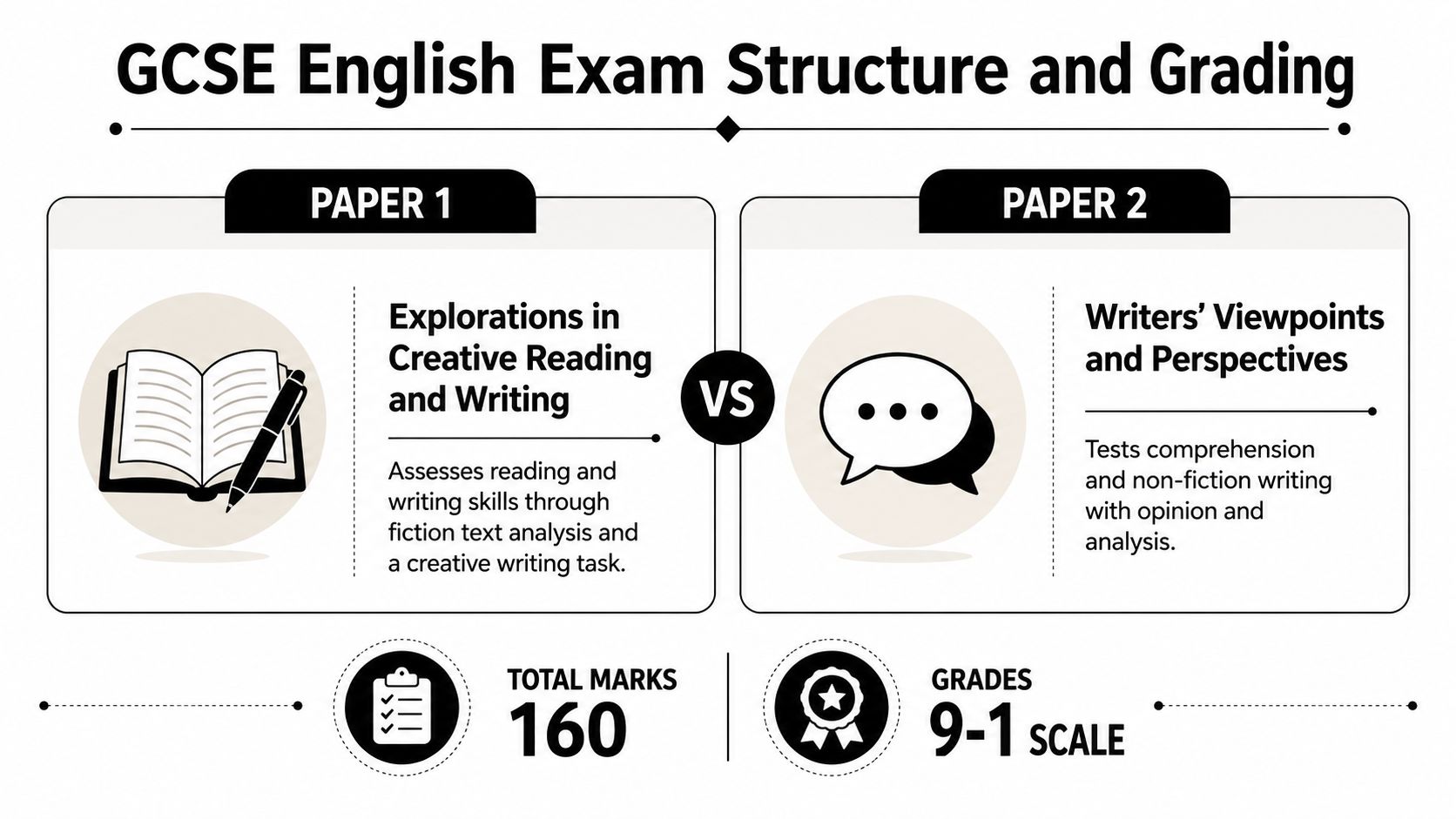
A lot of adult learners feel calmer once the exam stops being a blur and starts looking like a clear map. GCSE English Language has a fixed shape, and knowing that shape helps you plan around work, children, and everything else that fills the week. For AQA GCSE English Language (8700), there are two papers, each worth 80 marks, giving 160 marks in total, and each paper lasts 1 hour 45 minutes. Paper 1 is fiction and imaginative writing, while Paper 2 is writers' viewpoints and perspectives plus transactional writing, so you are not preparing for one single “English test”, you are preparing for two different tasks with two different moods and purposes, as set out in the AQA specification at a glance.
Two parts of the same route. One part asks you to read a story-like text and write creatively. The other asks you to compare opinions, spot viewpoints, and write more practically or persuasively. If you only practise one part, the other can still catch you off guard, especially when you are fitting revision around work, family routines, or late evenings after everyone else is settled.
What a pass means
There is no fixed pass mark sitting there every year. GCSE English Language uses grade boundaries that change each exam series, so the number of marks needed can move. Ofqual explains that grade 4 is a standard pass, while grade 5 is a strong pass, which matters because colleges, employers, and universities often ask for one of those grades rather than just saying “GCSE English” Ofqual guidance on English Language grading.
A pass is not a mystery prize hidden at the end of the course. It is a moving boundary, and your job is to work steadily enough to cross it. That is encouraging for adult returners, because it means progress comes from clear habits, not from being naturally “good at English”.
How to read the exam without panic
Paper 1 asks you to notice how a writer builds a story, then write your own story or description. Paper 2 asks you to spot viewpoints, compare texts, and write in a more practical or persuasive way. The papers are different, so your revision needs to stay split as well.
That split can help confidence. If reading long texts feels tiring after a day of family demands or work, you do not need to master everything at once. You need to know which paper is asking for which skill, like knowing which key opens which door.
You are not learning “all of English”. You are learning how to handle two paper types, a reading section, and a writing section, each with its own job.
Once the structure is clear, the exam feels less like a wall and more like a set of tasks you can practise one by one. That gives adult learners a practical way forward, and it makes room for the bigger reason many people keep going, showing children and family that steady effort does pay off.
Diagnose Your Reading and Writing Gaps
Before you revise hard, you need to know what is holding you back. A lot of adults assume they are “bad at English”, when the issue is much smaller and much more fixable, like weak vocabulary, slow reading, shaky spelling, or not knowing how to finish an answer in time.
A simple self-check
Ask yourself these questions and answer them truthfully:
- Do I understand the question, but struggle to get my ideas onto the page?
- Do I read slowly and lose the meaning of a paragraph?
- Do I know what I want to say, but my spelling and punctuation get in the way?
- Do I run out of time because I write too much on low-mark questions?
- Do I freeze when I see an unfamiliar text?
If the answer is yes to one or two of those, good. That gives you a target. A target is useful because it stops you wasting time on revision that doesn't match your real need.
The strongest UK guidance for secondary literacy points towards explicit vocabulary instruction, disciplinary reading, and structured writing practice as priorities for improvement, while wider inspection evidence has repeatedly highlighted weak reading fluency and vocabulary as barriers for older learners. That means a “just do more past papers” approach is too thin on its own. The fix needs to match the weakness.
Match the problem to the practice
If comprehension is the issue, read shorter passages and explain them out loud in simple words. If vocabulary is thin, keep a word list and reuse the words in your own sentences. If spelling and grammar are the problem, write less at first, but write more carefully.
For adults, that self-check is powerful because it removes shame. You are not lazy, and you are not starting from zero in every area. You are identifying the next step.
Good revision starts with diagnosis. A learner who knows the weak point can improve faster than someone who keeps revising everything equally.
Build Strong Reading and Writing Skills
Once you know the gaps, fill them with small daily habits. The aim is not to turn your evenings into school lessons. The aim is to make English feel more familiar, one short session at a time.
Read like a detective
Choose a short text and read it with one question in mind, “What is the writer trying to make me think or feel?” Underline one strong word, one image, and one sentence that changes the mood. Then say, in plain language, why those choices matter.
That habit trains your brain to spot meaning instead of only spotting techniques. It also helps if you're returning to study after a long break, because your confidence grows when you can explain something clearly in your own words.
Build a vocabulary bank that feels useful
Write down words you meet often in English texts, especially words that help you describe ideas, feelings, and change. Keep the list short enough to review, and use each new word in a sentence of your own. If a word feels too big to use naturally, leave it for later and focus on words you'll remember.
You can also practise by rewriting simple sentences. For example, change “The room was scary” into something more precise, like “The room felt tense and empty.” That's not about showing off. It's about becoming clearer.
Write in short, steady bursts
A useful pattern is one paragraph, then one check, then one rewrite. Read what you wrote and ask whether the sentence makes sense, whether the punctuation helps, and whether the point is clear. That kind of careful repetition builds real control.
If you want extra support with this part of the process, how to improve writing skills is a natural place to look for structured help that fits around adult life.
Small writing wins add up. A neat paragraph you can repeat is more valuable than one impressive paragraph you can't control twice.
Plan Revision and Past Paper Practice
Adult learners rarely need a perfect timetable. They need a plan they can return to after a late shift, a family illness, or a week that did not go to plan. Revision works best when it is plain, realistic, and built around one or two clear tasks each time.
The scale of adult demand is real. The Department for Education reported 188,900 learners aged 19+ in GCSE English and maths in 2023/24, which shows that adult returners are not unusual at all, they are part of a large national group of learners trying to gain the qualification in a way that fits adult life Department for Education GCSE participation data.
A weekly pattern that fits family life
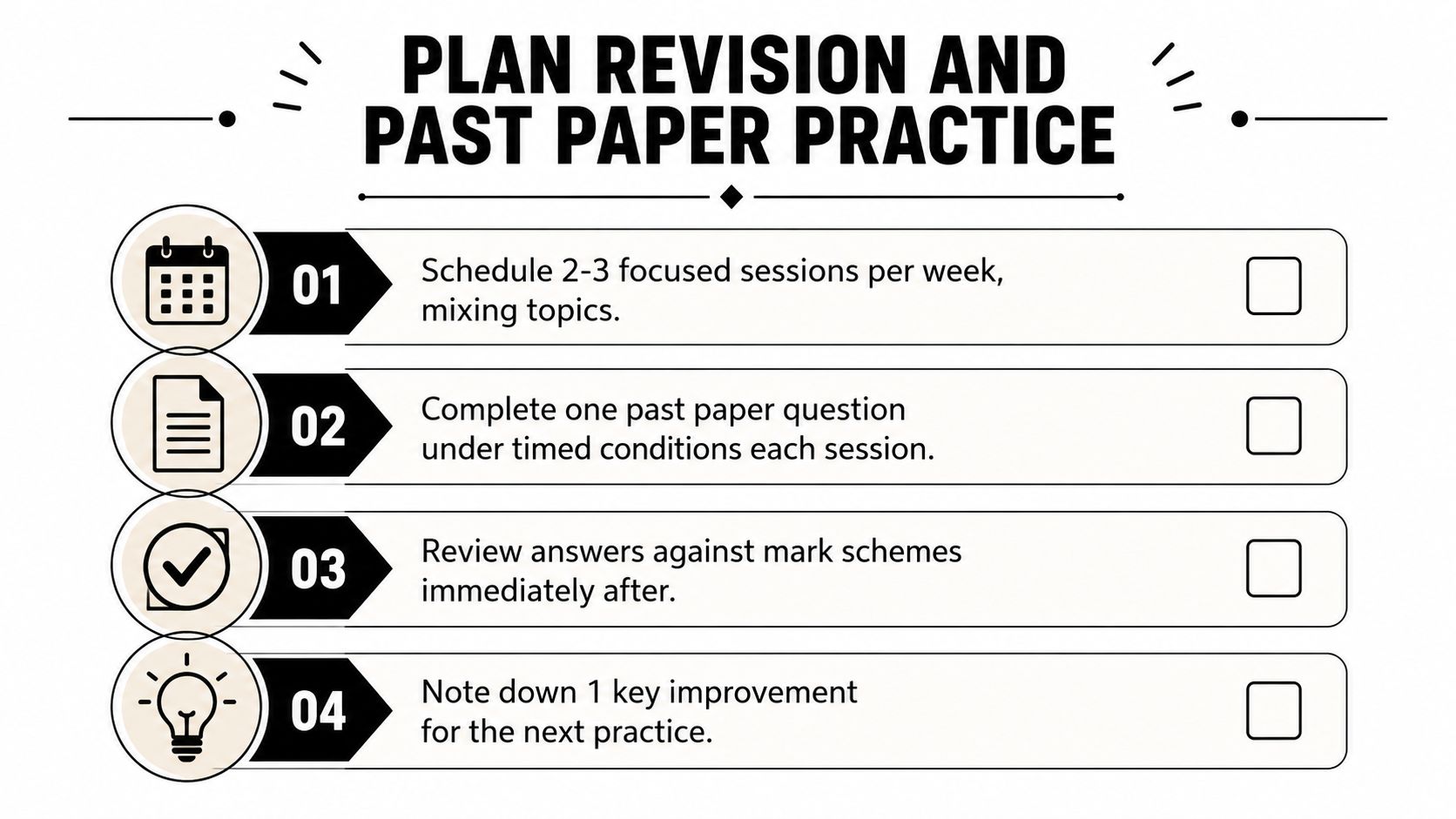
A workable week might include one session for reading, one for writing, and one timed question. Keep each session short enough to fit around work, childcare, and evening routines. If the week goes off course, leave the plan behind and restart at the next available session. That is how steady progress is made.
A simple rhythm helps more than a crowded schedule. One useful pattern is to choose one skill to focus on, such as inference, comparison, or writing a clear paragraph, then do one past paper question under time pressure. After that, check the mark scheme to see what earns marks, and write one improvement note for next time. This keeps revision practical and stops it becoming a pile of loose notes.
The point is not to collect papers. The point is to build habits you can repeat even when family life is busy.
Keep the practice close to real exam conditions
Use short, focused sessions that feel manageable, then raise the pressure gradually. If you always practise without a clock, the exam clock can feel sharp and unfamiliar. If you always compare your answers with the mark scheme, you begin to see what examiners reward instead of guessing. GCSE revision techniques can help you shape that practice into a routine that suits adult study time.
You can also use a flexible online course, a teacher, a tutor, or a study partner. The best choice is the one you will keep using when life gets busy, because consistency matters more than perfect conditions.
Exam Technique and Time Management
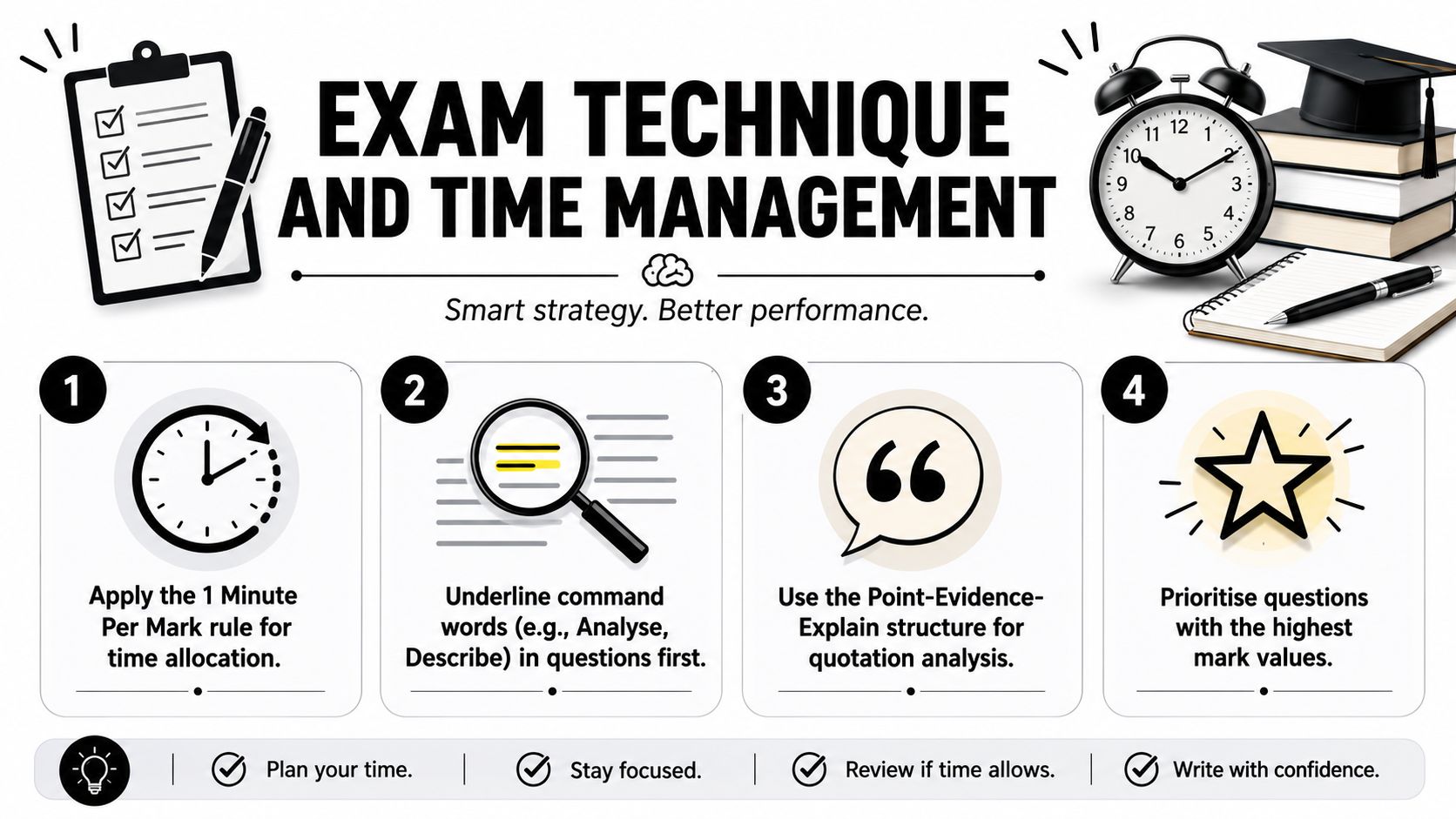
Good exam technique is not about writing faster for the sake of it. It is about spending your energy where the marks are. One widely repeated rule is to allow roughly 1 minute per mark, so a 20-mark question gets about 20 minutes, which keeps you from overspending time on short questions and starving the bigger ones of attention time-management advice video.
Start with the question, not your panic
Read the command word first. Words like analyse, describe, compare, and evaluate tell you what kind of thinking to do. If you miss that clue, you can write something decent and still miss the point.
A quick mock example helps. If the question asks you to analyse how a writer creates tension, do not tell the whole plot. Pick a short quotation, explain the effect of one word, then link that effect to the reader. That is enough to show control.
Use evidence with purpose
Quote only what you need. A short quotation is usually stronger than a long chunk because it keeps your answer focused. Then explain the effect in plain language. The evidence is the middle of the sandwich, but the explanation is what fills the meal.
Practical rule: if you can't say why the quotation matters, you're not done yet.
A calm rhythm in the exam room
For harder questions, give yourself a tiny pause before writing. Jot two or three ideas, then start. That stops rambling and helps you keep your answer moving. If you get stuck, move on and come back later, because blank space never earns marks.
The aim is not perfection. The aim is a controlled response that shows the examiner you understood the task and used the time well.
Avoid Pitfalls and Boost Your Confidence
Many adults do not fail because they are incapable. They lose marks because they revise in a scattered way, ignore the mark scheme, or panic and abandon questions they could have tackled. Those are fixable habits, not fixed identities.
Common traps to leave behind
- Ignoring the mark scheme: You need to see what the examiner rewards, not just what feels like a good answer.
- Doing too much at once: A small, regular routine beats an exhausting burst that ends in burnout.
- Writing without checking the question: The wrong text, wrong form, or wrong focus can waste good effort.
- Skipping the review stage: If you never look back at mistakes, you keep repeating them.
The good news is that confidence grows in visible steps. You can feel it when a question that once looked impossible becomes readable. You can feel it when you finish a timed response without freezing. You can feel it when your child sees you revising and understands that learning never really stops.
That matters in families. Passing GCSE English is not just a line on a certificate. It can become part of how your children see resilience, effort, and self-respect.
In England, 65.1% of pupils in state-funded mainstream schools achieved grade 4 or above in both GCSE English and maths in 2022 to 23, but the same dataset shows wide differences by background and local authority, including 88.6% for pupils from the Chinese ethnic group, 16.2% for white Gypsy and Roma pupils, and 82.5% in Sutton, London ethnicity and local authority GCSE attainment data. That spread is a reminder that support, setting, and circumstance matter a great deal, so adults should not judge themselves only by effort.
Leave with a steady mindset
Treat each week as proof that you're still moving. A few careful sessions, one reviewed mistake, and one improved answer can change the way you feel about the subject.
If you want structured support that understands adult life, work pressure, and family commitments, Next Level Online College offers flexible online GCSE study with dedicated support for learners who need a clearer path back into education.
If you're ready to build confidence step by step, Next Level Online College can help you study GCSE English in a way that fits around work and family. Their online courses are designed for adult learners who want recognised qualifications, steady support, and a realistic route towards better opportunities, whether that means college, university, or a stronger career.