
You're tired after work, the kids need attention, and the blank page still feels harder than it should. Maybe you know what you want to say, but the words come out tangled, too long, or not confident enough for the form, email, or assignment in front of you. That feeling is common, especially for adults who are rebuilding skills after a long break, and it does not mean you're bad at writing.
How to improve writing skills starts with something kinder than perfection, a clear routine and a few small wins. The most useful progress often comes from steady practice, simple structure, and calm self-review, not from trying to sound clever on the first draft. For adults who want to support their families, qualify for better work, or move closer to university, that shift can be life changing.
Discover the Path to Better Writing
Returning to writing after time away can feel awkward. You may second-guess every sentence, worry that your grammar has gone rusty, or feel embarrassed that others seem to write more easily than you do. That's exactly why confidence needs to be part of the process, not something you wait for.
One overlooked truth is that adult learners often need more than “write more”. They need a way to rebuild trust in their own writing and produce clear, assessment-ready work under time pressure, because generic advice rarely deals with the confidence gap or the support adults need after a long break (WritetoDone). If you're balancing work, family, and study, the goal is not to become perfect overnight. The goal is to become clear, steady, and less afraid of the page.
Practical rule: small, repeatable progress beats dramatic effort that collapses after a few days.
That matters because adult writing improvement is rarely a single event. It is more like learning to cook a family meal properly, you start with simple ingredients, follow a clear method, and improve the result each time you make it. If your child sees you revising an email, checking punctuation, or finishing a study task with care, that example carries real weight.
The most encouraging part is that writing skills are trainable. You do not need a literary gift to write well. You need a plan, a little patience, and a way to measure what is getting better.
Assess Your Current Writing Skills
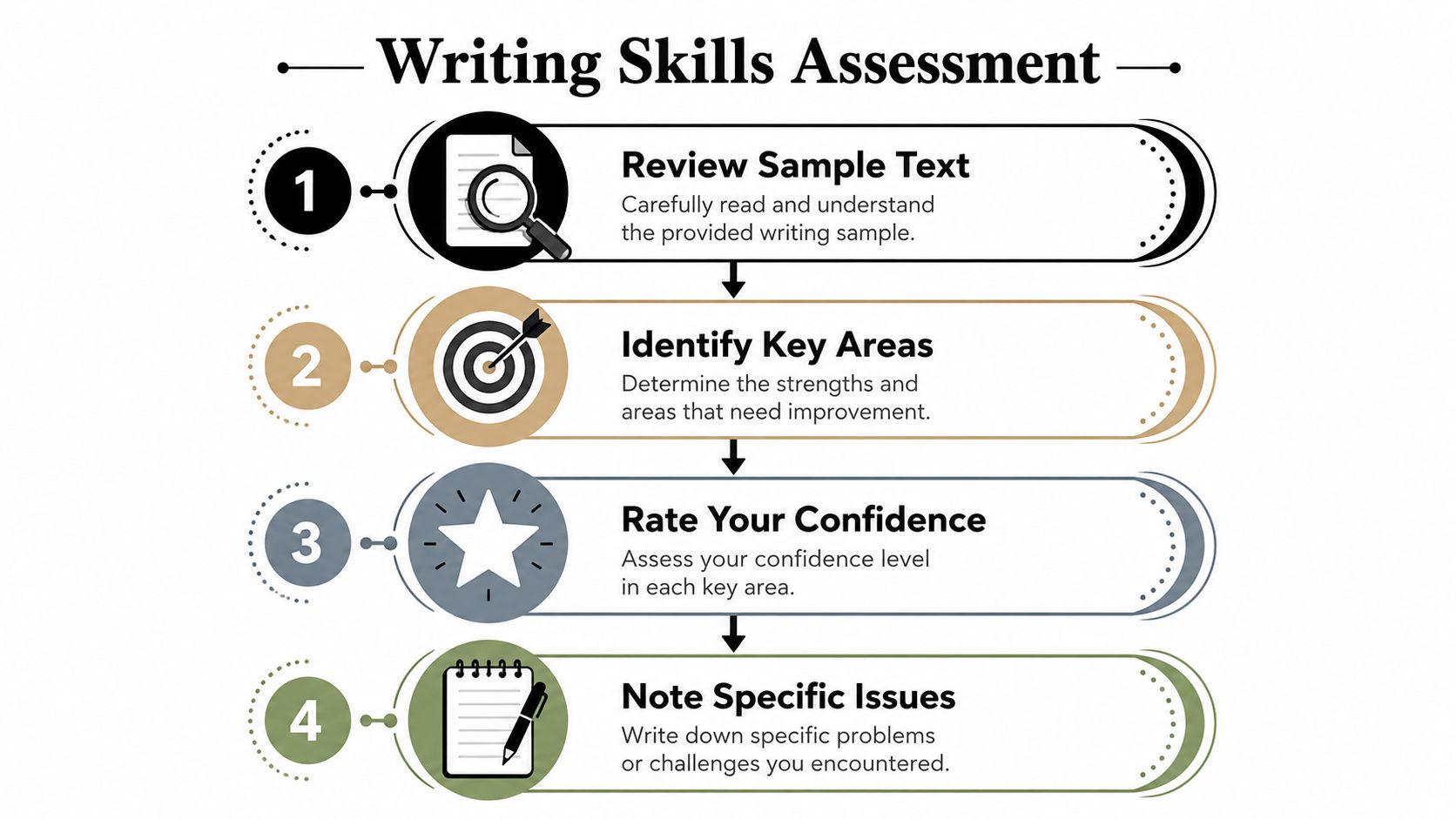
A strong start is to diagnose, not guess. Many learners jump straight into exercises and waste energy on areas they already do well, while missing the problem, such as sentence control, paragraph structure, or tone. A short self-check gives you direction and saves time.
Use one real piece of writing
Choose a recent email, short essay, form response, or work message. Read it once for meaning, then a second time with a simple lens. Ask whether the writing is accurate, easy to follow, and suitable for the reader.
The UK context matters here because assessment standards are usually practical, not decorative. Functional Skills English, GCSE English Language, and workplace writing all reward clarity, accuracy, purpose, and control. A draft that sounds “impressive” but loses meaning will not help you as much as one that is direct and well organised.
Use these four questions:
- Grammar accuracy: Are the sentences complete and correct?
- Sentence structure: Do some sentences run on or feel awkward?
- Vocabulary precision: Are the words exact, or too vague?
- Tone: Does it sound right for the reader, formal or friendly as needed?
The National Literacy Trust reports that the government's 2011 Skills for Life Survey found 5.1 million adults in England had very poor literacy skills, and 12.6% of adults were functionally illiterate (National Literacy Trust via Coursera). That scale is a reminder that struggling with writing is not rare, and it's another reason to use structured practice instead of hoping one lesson will fix everything.
Turn the review into a plan
After marking your sample, choose just two priorities. For example, you might decide to work on sentence boundaries and paragraph control, or on tone and vocabulary precision. Keeping the focus narrow helps you improve faster because your brain knows what to look for on the next draft.
A useful habit is to keep the marked sample. Compare your next piece with it after a week or two, and you'll see whether your changes are real. If you want a bank of practice materials for that kind of review, these Functional Skills English past papers can give you a clear benchmark.
Practice Key Writing Exercises
A short practice session works best when it targets one weakness at a time. If a sentence keeps tangling itself up, work on sentence fixing. If your paragraphs drift across too many ideas, practise one-idea paragraphs. If your word choice feels flat, practise swapping vague words for ones that fit the purpose more closely.
Grammar and structure drills
Start with one messy sentence and reshape it until the meaning is easy to follow. For example, change “I went to the shop and I got milk and then I saw my neighbour and we talked and I came home” into a tighter version such as “I went to the shop, bought milk, spoke to my neighbour, and came home.” The message stays the same, but the reader no longer has to wade through extra turns and repeated bits.
For structure, write a draft with 4 to 6 paragraphs, with one main idea in each paragraph. That suits assessed writing, where clear communication and control matter more than length. A good draft is not the finished piece. It is the raw material you shape in the next pass, just as a potter smooths clay after the first form is made (practical drafting advice).
Simple rule: draft first, edit second. Trying to do both at once slows you down and leaves problems half-finished.
Vocabulary and tone practice
A quick swap exercise can sharpen your word choice. Replace general words like “nice”, “good”, or “thing” with something that fits the situation better. In a work email, “good” might become helpful, clear, or efficient. In a GCSE introduction, plain and direct wording is usually stronger than dramatic phrasing.
Tone changes with audience, and this often catches adult learners out at first. A message to a teacher, employer, or tutor should sound polite and organised. A social post for a professional page should sound confident, but not over-familiar. If the tone feels wrong, read it aloud and ask whether you would say those words to that person face to face.
A useful practice block looks like this:
- Rewrite one run-on sentence.
- Build one paragraph around a single main idea.
- Swap three vague words for precise ones.
- Adjust one message for a formal audience.
Then pause and reflect. What became easier? What still felt clumsy? That reflection matters because you are training your eye, not just filling pages.
If you want more guided practice, these Functional Skills English past papers can help you compare your work with realistic exam-style tasks.
Build Daily Writing Habits
Writing gets better when it becomes normal. A short, regular session is more useful than a long burst once a fortnight, because the mind stays closer to the skill and fear has less room to grow. That's especially important for adults who are trying to fit study around work, children, and household life.
Attach writing to something you already do
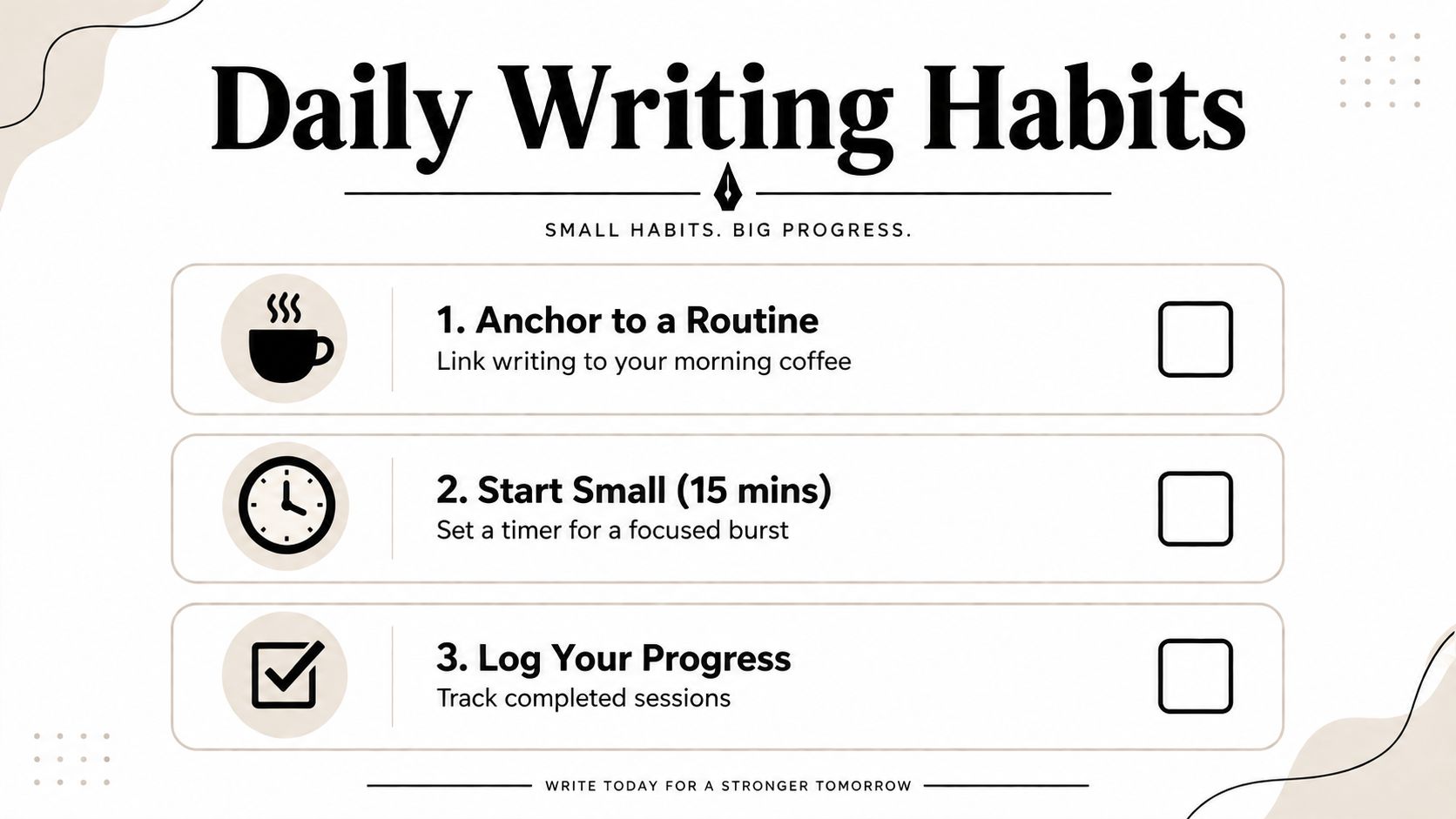
Use a real-life anchor. Write for a few minutes after morning coffee, during a commute, or before bed. The point is not to create a perfect routine straight away, it's to make writing easy to start.
One evidence-based recommendation is to write on a consistent basis, with regular scheduled writing time each week and as few interruptions as possible. The same guidance also recommends breaking tasks into parts, tackling easier sections first, and revising multiple times rather than expecting the first draft to be final (PMC study). That is useful for tired adults, because it turns writing into smaller jobs instead of one large scary task.
Try this simple structure:
- Set a timer: Aim for a short burst, not a marathon.
- Protect the space: Turn off notifications if you can.
- Write one thing only: An email, a paragraph, or a response.
- Stop while it still feels manageable: That makes it easier to return tomorrow.
Keep momentum visible
A checklist helps more than people think. If you can see completed sessions, your brain starts to trust the habit. Use a notebook, calendar, or phone note to mark each session, then keep going even on low-energy days.
If time is tight, voice-to-text can help you capture rough ideas before you forget them. You can also pair writing with something pleasant, like a cup of tea or a quiet playlist, so the habit feels less like punishment and more like a small act of care for your future.
A few organised study tools can also make the habit stick, especially when you're trying to keep family life and learning in the same week. These study planner templates can help you track short sessions without making the process feel heavy.
Use Structured Study Plans
A study plan gives your effort a clear direction. Without one, adults can spend time revising the same weak spot again and again, or hop from one task to another without building towards a clear outcome. With one, even a short session has a clear job to do.
Match your plan to the qualification
Functional Skills, GCSE, A Level, and workplace writing each ask for different things, so the plan needs to match the target. For Functional Skills, the focus is often on clarity, everyday communication, and accuracy. For GCSE, paragraph control, sentence variety, and response to the task usually matter more. For A Level, the writing tends to demand stronger organisation, tighter precision, and deeper development.
Plain-language guidance is a useful benchmark here. It encourages sentences of about 15 to 20 words, one idea per paragraph, and main messages first (government communication guidance). That gives you something concrete to work with while you plan. If a paragraph tries to do too much, split it. If a sentence wanders, shorten it. If the main point is buried, move it up.
A plan also helps returning adults who want structure without pressure. A clear target, such as a Functional Skills route, can make practice feel more manageable, especially when family life, work, and study all need space in the same week.
Build a simple weekly rhythm
A practical plan might use one week for diagnosis, a few weeks for focused drills, and later weeks for review and timed practice. Keep the pattern realistic. If your household is busy, two short study sessions can work better than one long session that keeps getting interrupted.
Use feedback with a narrow focus. Ask a tutor, mentor, or trusted reader to comment on one or two points only, such as tone or paragraph control. That keeps the response useful instead of overwhelming.
A few helpful planning habits can keep the work steady:
- Set one writing goal per week: Keep it small and clear.
- Link each session to a skill: Grammar, structure, vocabulary, or tone.
- Review with a criteria sheet: Compare the draft with the marking points.
- Keep one portfolio: Save drafts so improvement is visible.
If you want a more formal route, this Functional Skills English online route can help you connect regular practice with recognised study goals.
Track Progress and Plan Next Steps
Progress feels more real when you write it down. A small log, a folder of drafts, or a simple self-rating scale can show whether your writing is becoming clearer, more accurate, and easier to finish. That is important for confidence, because many adults improve steadily before they believe it.
Use feedback as evidence, not judgement
When someone comments on your writing, focus on the pattern, not the sting. If more than one reader says your sentences are hard to follow, that is a useful clue. If they say your ideas are strong but the structure needs work, then you know where to aim next.
To make feedback easier to use, compare it with the criteria for your goal. For UK qualifications, that usually means checking purpose, audience, accuracy, and organisation. You are not trying to write like someone else. You are trying to meet the standard in a way that still sounds like you.
Choose the next step with confidence
Once your habits are in place, the natural next move is structured support. That might mean a course, a qualification pathway, or a study route that helps you keep momentum when life gets busy. For adults who want to support their children, earn more, or move towards university and a more fulfilling career, the next step should feel achievable, not intimidating.
Keep one question in mind. What would make the biggest difference to your writing over the next few months, confidence, accuracy, or exam readiness? Your answer will tell you what to do next.
If you're ready to turn small writing wins into a bigger change, Next Level Online College offers flexible, fully supported courses that fit around work and family life, including Functional Skills, GCSEs, A Levels, and Access to Higher Education diplomas. Visit Next Level Online College to find a route that helps you build confidence, gain recognised qualifications, and move towards the future you want for yourself and your family.