
You might be sitting at the kitchen table after a long shift, looking at a school letter or an apprenticeship form, and thinking, “I should know this by now.” That feeling is far more common than people admit. The good news is that adult math courses are built for moments like this, for people who are working, raising children, changing careers, or ready to have another go.
Coming back to maths is not a sign that you've failed. It's a practical step towards better pay, new training, university access, and the quiet pride of showing your family that learning doesn't stop when school does. If you've been out of education for years, you don't need to start by being perfect. You just need a route that fits real life and helps you move forward with confidence.
A Fresh Start with Adult Math Courses
A lot of adults return to maths after a nudge from everyday life. It might be a parent helping with homework and realising the old confidence has gone, or a shift worker needing a qualification for the next job. Sometimes it's the simple wish to set a different example for the children at home. That first thought can feel heavy, but it usually comes from a hopeful place.
Adult learning is designed around that reality. It's not school again, with teenagers, uniforms, and lessons that race ahead before you've caught your breath. These courses are meant for adults who've had gaps in learning, people who want clear steps, friendly support, and a path that respects work and family commitments.
Why this feels so personal
Maths has a way of attaching itself to self-esteem. If school was hard, the subject can start to feel like a judgement instead of a skill. That's unfair, because maths is something people build again, piece by piece, not a fixed talent you either have or you don't.
Practical rule: if you can count, budget, measure, and check time, you already use maths every day. The course is there to make those skills stronger, clearer, and easier to prove.
For many adults, the question isn't “Am I good enough?” It's “Which qualification gets me where I want to go?” That's the right question to ask. A course should help you earn more, qualify for study, open doors to better jobs, and give your family a reason to feel proud.
If you're carrying nerves, keep them. They mean this matters to you. What matters most is choosing a route that matches your goal, rather than trying to do everything at once.
Understanding the UK Maths Qualification Ladder
Think of the maths pathway like a staircase. You don't have to climb every step, and you don't have to start at the bottom if you already know some of the ground. The key is to choose the rung that gets you to the next door you want to open.
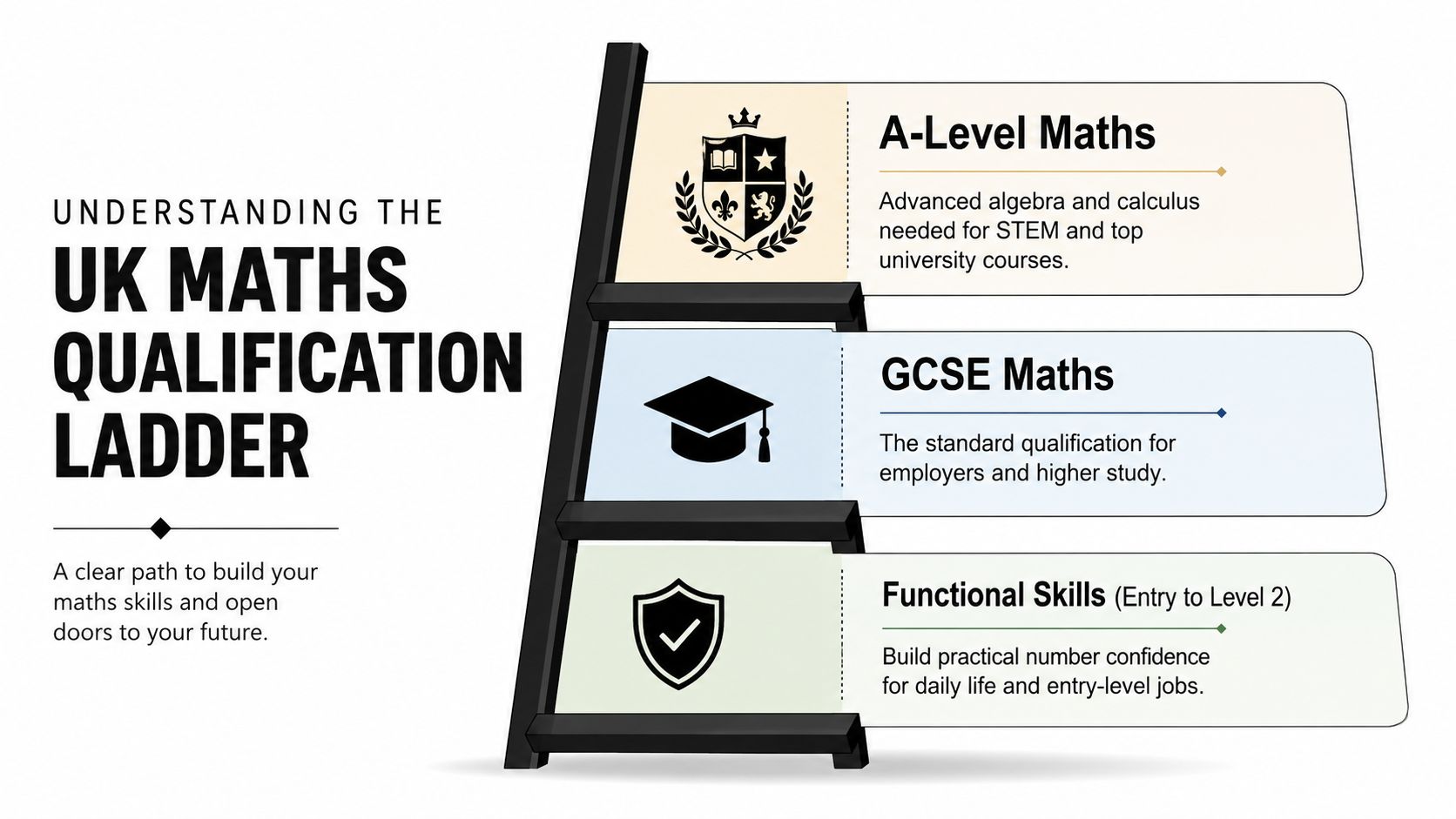
At the most practical end is Functional Skills Mathematics. Government guidance states that adults can study it at Entry Levels 1 to 3 and Levels 1 to 2, and Level 2 is broadly equivalent to GCSE grade 4/C for progression purposes. That matters because many adults need a maths qualification for work, apprenticeships, or further study, but they don't need a full school-style course to get there.
The three main rungs
Functional Skills focuses on real-life maths. It asks whether you can use numbers in everyday situations, handle data, work with measures, and convert units. The formal qualification is structured across the four domains of using numbers and the number system, handling information and data, using measures, shape and space, and using common measures and converting units see the qualification guide.
GCSE Maths is the more familiar school qualification. It goes wider and deeper, and many employers, colleges, and universities recognise it very clearly. Adults often choose it when they need a grade that is widely accepted for progression, or when they want a stronger base before moving on.
A-Level Maths sits at the top of the ladder. It's for learners who need advanced mathematical study, often because they want STEM degrees or a very maths-heavy academic route. It's not the right first step for most adults returning after a break.
Simple way to choose: if you need maths for daily life, an apprenticeship, or a job requirement, Functional Skills may fit. If you need the most widely recognised school qualification for study or career progression, GCSE is often the safer target.
If you want a plain-English explanation of how Functional Skills compares with GCSE level, this guide is useful: Functional Skills equivalent to GCSE. The main point is straightforward. Pick the rung that matches the next door, not the hardest ladder in the building.
Functional Skills vs GCSE Maths for Adults
Adults often want the same thing from maths courses, a quicker route, less stress, and a qualification that counts. The best choice depends on what comes next, not on which one sounds more impressive.
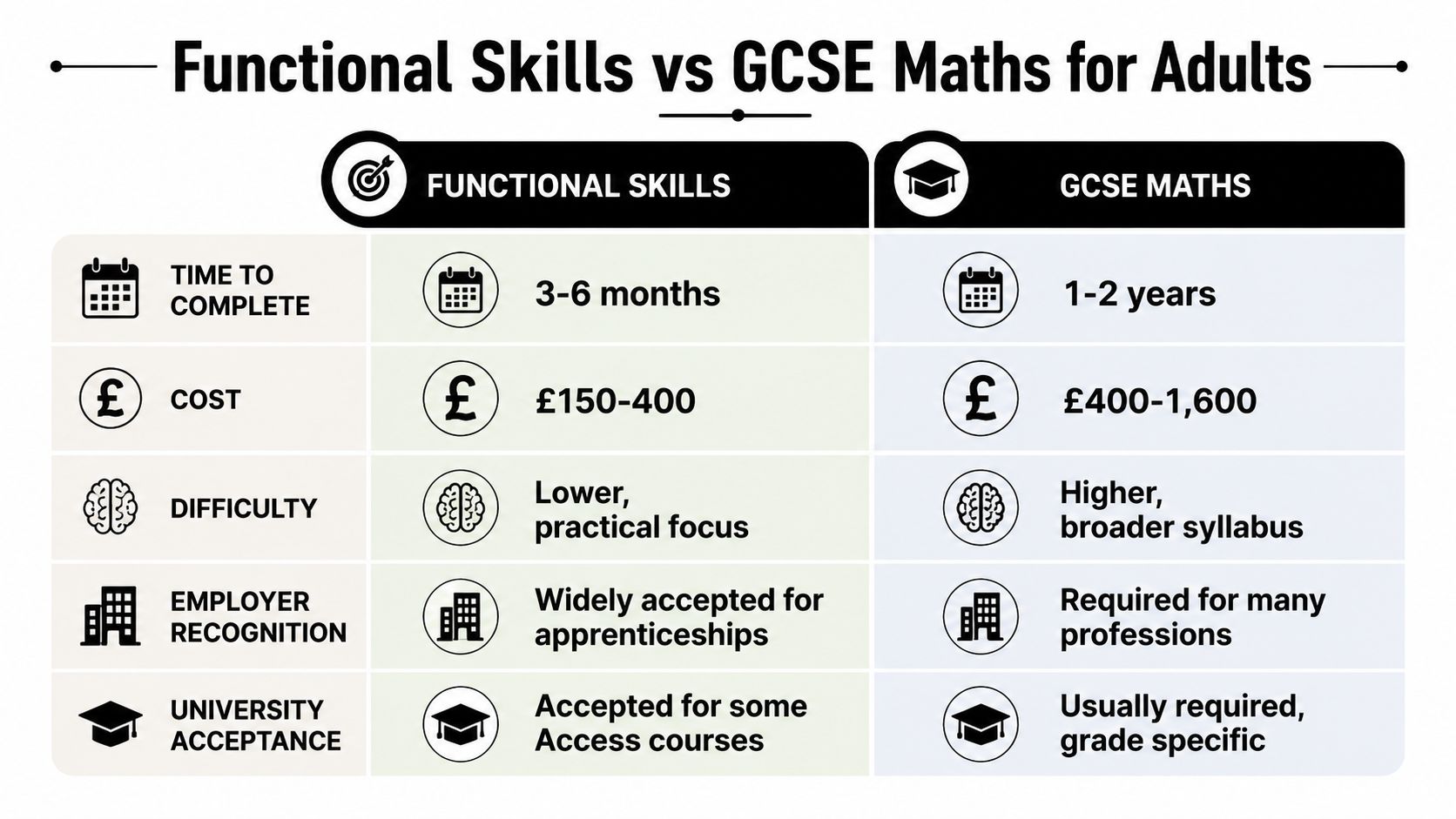
| Factor | Functional Skills | GCSE Maths |
|---|---|---|
| Best for | Practical progress, work, apprenticeships, and many returners | Wider recognition for study and many professions |
| Style of learning | Applied maths in everyday contexts | Broader school-style syllabus |
| Assessment focus | Real-life use of maths | Wider written exam content |
| Confidence for returners | Often feels more manageable | Can feel more demanding after a long break |
Functional Skills Mathematics is assessed on the ability to apply mathematics in real-life contexts, not just do isolated procedures. That makes it a strong fit for adults who want to handle budgeting, time, measurement, and data in practical settings. GCSE still matters because it is more widely recognised in many places, especially where a school-equivalent grade is asked for.
Which one is smarter for your goal
If you want to get into an apprenticeship quickly, Functional Skills can be the sharper route. If you're aiming for university entry, a teaching course, or a profession that names GCSE Maths as a requirement, GCSE may be the better investment of time. If you're unsure, ask one question first. Which qualification will the next course, employer, or training provider accept?
A quick scan for busy adults
| Factor | Functional Skills | GCSE Maths |
|---|---|---|
| For adults who struggled at school | Often a better confidence start | Possible, but more demanding |
| For direct job progress | Strong option | Strong option where GCSE is specified |
| For university routes | Sometimes accepted through wider pathways | Often required more directly |
A lot of adults do best by taking the route that gets them moving sooner. That's not settling. It's making a sensible choice that fits work, children, and energy levels. If you want a course that fits around life, one provider that offers that kind of structure is Next Level Online College, which delivers online study routes for adults.
How Flexible Online Maths Study Actually Works
Flexible online study suits adults because it doesn't ask you to pretend life is on pause. You can fit learning around school runs, late shifts, family dinners, and tired evenings. It's a bit like learning to drive with a qualified instructor beside you, not being left alone in a car park and told to hope for the best.
A sensible week usually has a rhythm rather than a rigid timetable. You log in when you can, work through short lessons, and get support when you get stuck. A platform such as Next Level Online College's online course access is built around that sort of flexibility, so adults can keep going without needing to be in a classroom at a fixed time every week.
What a normal week can feel like
A learner might spend a few short study sessions across the week, rather than one long marathon at the weekend. That might include watching recorded teaching, doing practice questions, and checking mistakes straight away. The point is consistency, not cramming.
Support matters just as much as content. Good adult courses give you access to tutors who understand where adults get stuck, especially with topics that need step-by-step thinking. If motivation dips, or the technology feels awkward, a quick message to a tutor or support team can stop one bad evening from turning into a lost week.
You are not meant to work everything out alone. A good online course gives structure, feedback, and a clear next step whenever you need one.
Some adults worry they'll feel isolated online. That's a fair concern. It helps when the course includes live help, recorded teaching, practice tasks, and clear check-ins, because those things replace the uncertainty of “I hope I'm doing this right” with actual guidance.
What usually helps most
- Short study bursts: Ten or twenty focused minutes can work better than waiting for a perfect free afternoon.
- Tutor contact: Questions get answered before they pile up.
- Practice with feedback: You see where the gaps are, then close them one by one.
- A fixed start point: Enrolment feels less scary when you know what happens next.
For many adults, the biggest relief is realising they don't need to become a different person to study again. They just need a course that respects the life they already have.
Progression Routes into University and Better Careers
Maths is often the gatekeeper qualification, not the destination. An adult doesn't usually study it for its own sake. They study it because it leads to something else, a course place, an apprenticeship, a promotion, or a proper fresh start.
The door maths can open
If your goal is university, the maths requirement depends on the course. Many Access to Higher Education routes, nursing courses, and teaching routes ask for maths evidence, and GCSE Maths is commonly the qualification people are asked to show. For some adult learners, Functional Skills Level 2 is enough to move into an Access route or meet entry expectations where a provider accepts it.
If your goal is an apprenticeship, Level 2 Functional Skills can be a very practical target. Many apprenticeship vacancies want proof of basic maths, and this route can get you there without sending you back through the whole school system.
If your goal is promotion or a career change, maths can be the missing piece rather than the main challenge. Construction, healthcare, finance, and data-related roles all rely on number confidence in different ways. In those cases, the qualification is less about “being good at maths” and more about proving you can handle the numerical parts of the job.
Real-world takeaway: the fastest route is the one that matches the entry rule for your next step. Don't study a higher level than you need unless a future course clearly asks for it.
Matching the level to the goal
- First job or apprenticeship: Functional Skills Level 1 or Level 2 can be enough, depending on the employer or training provider.
- University entry: GCSE Maths is often the cleaner route when a course asks for a school-equivalent qualification.
- A career change with more responsibility: GCSE or Level 2 Functional Skills can show you've reached the right standard for progression.
- Top academic routes: A-Level Maths is for learners aiming at advanced study where maths is central.
Adults save time by being strategic. A qualification is not just a certificate on paper, it's evidence that a next stage is realistic. If you're working towards better pay, a more fulfilling role, or a path that makes your children proud, maths can be the one step that turns “almost there” into “ready now.”
Costs, Funding and Access Rules You Should Know
Money matters when you are fitting study around work and family. Some adults expect every course to cost a lot, while others assume funding will cover everything. Truth sits between those two views, and it depends on where you live, what level you need, and how you plan to study.
In England, the Adult Education Budget has supported adult learning in basic skills and qualification study, including maths through funded provision. Official Department for Education information on adult education participation shows that funded provision continues to reach large numbers of adult learners, and many of those learners are studying at level 2 or below showing the continued importance of foundational study. That does not mean every maths course is free. It does show why adult returners remain an important part of the system.
What adults usually pay
Some providers offer fully funded places if you meet the rules. Others charge fees, and some let you pay in instalments. Adults usually pay more when they want a quicker route, a more flexible timetable, or a course that sits outside the funding rules in their area. The amount varies by provider, level, and location, so it is sensible to ask before you sign up.
Funding rules also differ across the UK. England, Scotland, Wales, and Northern Ireland each have their own arrangements, and that can feel confusing if you are comparing courses online. A course that is funded for one learner may not be funded for another, even if both are taking the same subject in the same format.
Why access can get messy
Online adult maths study can run into problems when funding rules do not match a learner's location or study setup. Recent reporting has shown that some adults ready to learn remotely still face barriers because their local funding does not support that option according to coverage of the issue. That matters for working adults, because online learning is often the only practical choice around shifts, childcare, and travel.
Before you enrol, check three things.
- Your postcode and nation: Funding can change depending on whether you live in England, Scotland, Wales, or Northern Ireland.
- Your target level: Some support is easier to access at lower levels, especially for basic skills.
- Your study format: Remote, blended, and classroom options may be treated differently.
A provider should be able to tell you, in plain English, what help is available before you start. Ask early, and ask directly. A clear answer at the beginning saves stress later, and it helps you choose a course you can stay with. If you are comparing study approaches as well as costs, this guide to active learning strategies for adult study can help you judge what will fit your routine.
Study Tips and Confidence Habits for Returning Adults
Maths confidence grows like muscle strength. You don't build it by doing one huge workout and hoping for the best. You build it with small, regular reps that feel manageable even on a busy week.
Start with short sessions. Ten focused minutes on a weekday evening is often more useful than a tired three-hour catch-up on Sunday. Adults keep going when the work feels possible, and progress sticks better when the brain gets repeated practice instead of one-off overload.
Keep it connected to real life
Use shopping, bills, cooking, and travel as practice spaces. Fractions, decimals, percentages, and proportion make more sense when they're linked to real things like splitting a recipe, checking a receipt, or working out journey time. That kind of teaching fits adult learners well because it ties new learning to familiar tasks, which is why contextualised instruction is so important in adult numeracy.
If you get stuck, ask early. Adults often wait too long because they don't want to seem rusty, but maths anxiety usually gets worse when questions pile up. One small query answered today can save a lot of confusion next week.
Confidence habit: write down one thing you understand after each study session. It trains your brain to notice progress instead of only noticing mistakes.
A simple weekly routine
- Pick one topic: Don't try to fix everything at once.
- Do a few questions daily: Repetition matters more than drama.
- Mark errors calmly: A mistake tells you what to practise next.
- Use worked examples: Seeing the steps helps rusty topics feel less mysterious.
- Revisit old ground: Algebra, ratio, and proportion come back faster with spaced practice.
If you want more practical ways to learn by doing rather than by staring at notes, this guide can help: 10 best active learning strategies. The key is to keep maths ordinary, not intimidating. When you treat it like a skill you can train, you give yourself room to improve.
If you're ready to give maths another try, Next Level Online College offers flexible, fully supported online courses for adult learners who need Functional Skills, GCSEs, A Levels, or Access to Higher Education routes. If you want a structured way to study around work and family life, visit Next Level Online College and choose the path that fits your next step.