
You're sitting at the kitchen table after the school run, looking at a nursing degree on your laptop. The course feels exciting, but the questions arrive quickly. What if your old qualifications aren't enough? What if your writing is rusty? What if you don't fit in at university?
Many adults feel this way before returning to education. You might have spent years caring for children, working in retail or hospitality, or managing the demands of everyday life. The Access to Higher Education Diploma can provide a recognised bridge into university for adults who don't have the traditional A-level route.
Returning to study is an emotional decision as well as a practical one. You may want to build a better career, earn more, become a positive role model for your children, or prove to yourself that an old dream is still possible. The right course should give you more than lessons. It should give you structure, guidance and the confidence to keep going.
This guide will explain access to HE in clear language, from the qualification itself to assessment, funding and online support. You can also explore adult education courses online if you're comparing flexible ways to restart your learning.

Starting Your Journey Back to Education
The first step often happens in private. You might read about a nursing course while your children are asleep, search for psychology degrees during a lunch break, or look at teaching careers after years in another job. The dream feels close enough to touch, but your confidence may tell you to stop before you begin.
That doubt doesn't mean you're not ready. It usually means the decision matters to you.
You may not have recent qualifications. You may have forgotten how to plan an essay, take notes or revise for an exam. You might worry that younger students will understand everything faster, or that family responsibilities will make study impossible. These concerns are common, but they aren't proof that university is beyond your reach.
The Access to HE Diploma is a UK Level 3 qualification designed to prepare adults without traditional A levels for higher education. Think of it as a sturdy footbridge. You don't need to swim across a wide river of school-based qualifications. Instead, you take supported steps across, building the knowledge and study habits you need for the university side.
A useful reminder: Being out of education for years can make the first step feel unfamiliar, but unfamiliar doesn't mean impossible.
An Access course can help you reconnect with learning while you work towards a clear goal. You might study health subjects before applying for nursing, or explore psychology and social science before a related degree. Your life experience matters too. Caring for people, managing a home, solving problems at work and supporting your family have all helped you develop skills that formal education doesn't always measure.
You don't need to feel completely confident before enrolling. Confidence often grows after you attend your first session, complete an early task and receive helpful feedback. The next question is simple: what exactly is the Access to HE Diploma, and how does it lead towards university?
What the Access to HE Diploma Actually Is
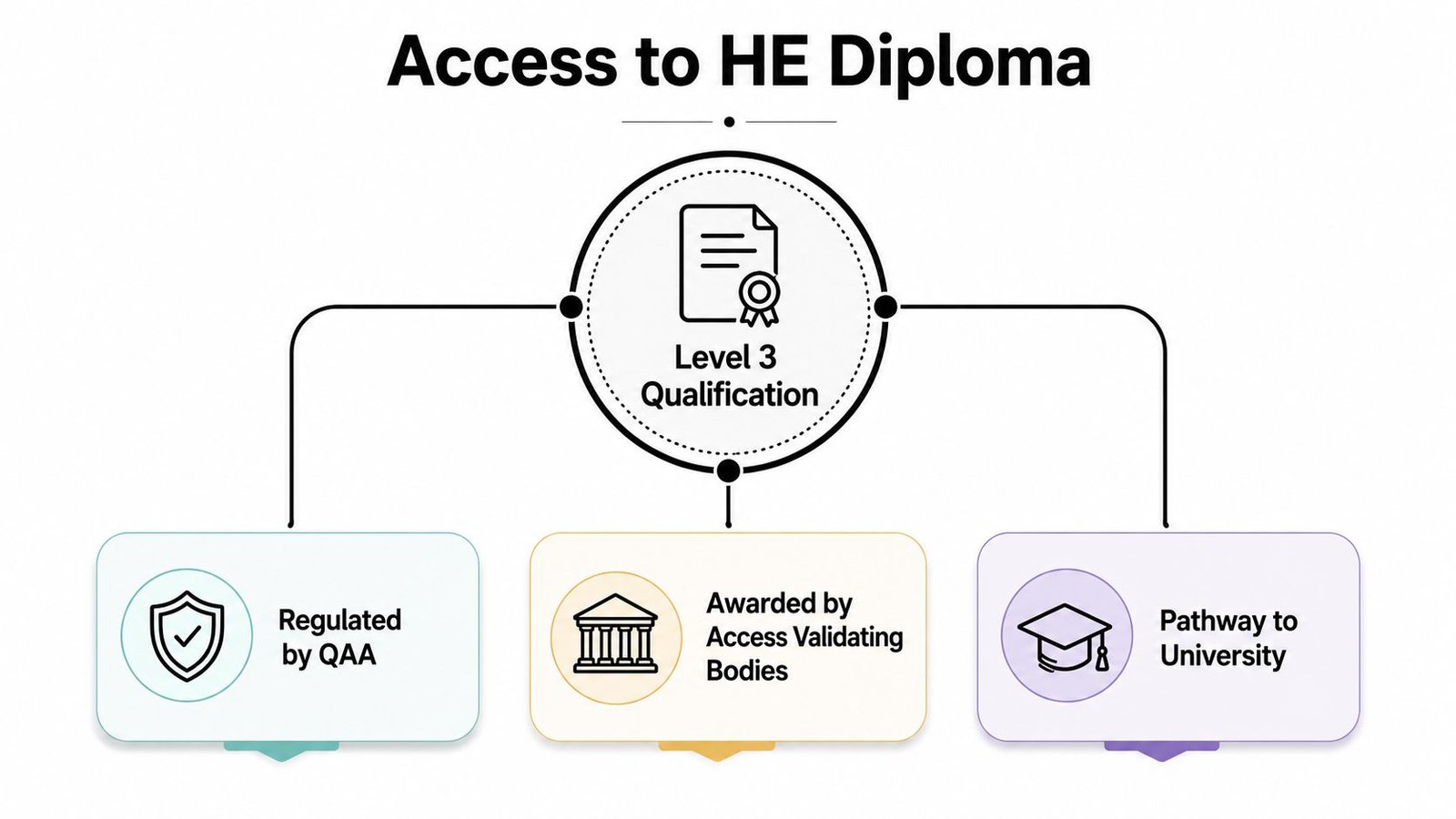
The Access to Higher Education Diploma is a regulated Level 3 qualification for adults preparing to enter higher education. It's normally completed in one year, although some learners choose a longer route to fit around work, health or family commitments. The qualification is regulated by the Quality Assurance Agency for Higher Education, often called the QAA, and awarded through Access Validating Agencies.
A simple way to understand it is to compare it with a stepping stone across a stream. A levels are one route across. The Access Diploma is another route, built for people who may have left school years ago or who didn't take the qualifications they now need. Each completed step gives you knowledge, skills and evidence that you're ready for degree-level study.
The diploma sits within the UK qualifications system alongside other Level 3 routes, including A levels and T levels. It carries UCAS tariff points, and many universities accept it instead of A levels when the subject content and grades meet the course requirements. You should always check the entry conditions for the particular degree you're considering, especially for subjects such as nursing, midwifery, medicine or teaching.
Understanding the parts
People sometimes use “Access module”, “Access Diploma” and “unit” as if they mean the same thing. They don't.
- A unit is one part of the course, focused on a topic or skill.
- A module is a group of related learning activities or units.
- The full diploma brings the required units together into one recognised qualification.
A complete diploma typically contains 60 credits at Level 3. Some credits cover academic subjects, while others develop study skills such as research, referencing, writing and preparation for university learning. Those skills can feel just as important as the subject knowledge when you've been away from education.
The course isn't a shortcut or an informal preparation class. It has a clear structure, recognised regulation and assessed learning. You can learn more about the qualification through this guide to what an Access course is.
For a visual explanation of how the qualification supports university progression, watch the video below.
Who the Access to HE Diploma Is Really For
The Access Diploma is often chosen by people whose lives don't fit the school-leaver pattern. That's one of its strengths. Your reason for starting may be different from another learner's, but the need is often similar, you want a practical route into higher education and a second chance to show what you can do.
Different starting points
A school-leaver who didn't take A levels may feel locked out of university. An Access course gives that learner a chance to build a new academic record rather than being defined by old results.
A parent returning after raising children may worry about rusty writing and limited study time. The course can provide a planned routine, with learning broken into manageable tasks instead of expecting you to remember everything immediately.
A career changer might be working in retail, hospitality or administration while hoping to move into nursing, teaching or psychology. The right subject pathway can introduce the science, social science or academic skills needed for a degree application.
A mature learner in their 40s or 50s may wonder whether university is still realistic. There's no upper age limit for beginning a new educational chapter. Your work and family experience can give you useful examples when you're writing, reflecting and solving problems.
Typical entry expectations often include being 19 or above, living in the UK and having a genuine plan to progress to higher education. Some university courses also ask for English and, where relevant, maths at GCSE grade C/4 or an equivalent qualification. Entry rules vary, so check both the Access provider and the university you hope to attend.
Access to HE is especially important for adults without A levels. The Office for Students found that 55% of students who began Access courses without A levels or equivalent qualifications progressed to degree-level study within four years, compared with 71% of Access students who already had A levels. Overall, 62% progressed to degree-level study within four years, with 47% entering within one year and a further 15% entering in years two to four. These figures are reported in the Office for Students analysis of Access course progression.
Your motivation, patience and life experience matter alongside your certificates. If you're unsure how university is possible without A levels, this guide to getting into university without A levels can help you understand the available routes.
Modules, Credits and How You Are Assessed
The word “credits” can sound complicated, but the idea is straightforward. Credits are a way of showing how much learning you've completed. A full Access Diploma usually adds up to 60 credits, made from units that may carry 3 or 6 credits each.
Around 45 credits normally relate to academic content, while 15 credits focus on study skills and preparation. The exact subjects depend on your pathway. A health course may include biology, while other routes can include psychology, sociology, law or related areas.
What assessment looks like
You won't be judged through one giant final test. Tutors may assess you through different types of work, such as:
- Essays, where you explain an argument using evidence.
- Reports, where you organise information and reach a reasoned conclusion.
- Presentations, which help you communicate ideas clearly.
- Timed exams, designed to test how you respond under set conditions.
- Academic portfolios, which collect pieces of work and show your progress.
Some units are graded and others are ungraded. Graded work is usually marked against published criteria, so your tutor isn't just deciding whether they like your writing. They check how well you understand the topic, use evidence, organise your answer and meet the task requirements.
A graded unit may use pass, merit and distinction standards. The plan notes for many Access courses refer to 75% on graded units for a Distinction profile, but the exact grading rules can depend on the qualification and validating agency. Ask for the current grading information before you enrol.
A normal assignment week
You might begin with a question about how the body responds to exercise. First, you read the assignment brief and underline the action words, such as “explain”, “compare” or “evaluate”. Next, you review your learning materials, choose suitable sources, plan a beginning, middle and end, and write a first draft.
Your tutor then gives feedback against the criteria. You may need to explain one idea more clearly, improve your references or connect your conclusion to the question. That process teaches you how to improve, not just how to receive a mark.
Practical rule: Read the assessment criteria before you start writing. They're your map, so you don't have to guess what the tutor expects.
Access to HE Compared With A Levels and GCSEs
Choosing the right qualification depends on where you're starting and where you want to go. A school-leaver with plenty of time may prefer A levels. An adult who needs a focused university route may find Access to HE more suitable. GCSEs can be the right foundation when you need to strengthen English, maths or another subject before moving to Level 3 study.
| Feature | Access to HE Diploma | A Levels | GCSEs |
|---|---|---|---|
| Typical duration | Often around one year, depending on the provider and study pattern | Commonly studied over two years | Often completed over a shorter or longer period, depending on the subject and provider |
| Main purpose | Prepare adults for higher education | Provide advanced school-based subject study | Build or refresh secondary-level knowledge |
| Subject depth | Focused on a pathway linked to university progression | Detailed study of selected subjects | Broad foundation or individual subject preparation |
| University recognition | Widely accepted when the course, tariff and subject requirements match | A traditional university entry route | Usually supports entry requirements rather than replacing Level 3 study |
| Best suited to | Mature learners, career changers and adults without the required A levels | School-leavers with a clear subject plan | Learners who need to gain or improve essential qualifications |
A levels can remain the sensible choice for a learner who has recently completed GCSEs, knows which subjects they need and can follow a traditional timetable. They may also be expected for some highly competitive degree routes, so checking university requirements early matters.
Access to HE can be more practical for an adult returner. The course brings relevant subjects and study skills together, rather than asking you to recreate a full school timetable. It also recognises that your aim is often clear, you may already know that you want nursing, social work, psychology or another professional direction.
There's no upper age limit for applying. Universities don't assess every applicant in exactly the same way, so you should contact admissions teams and check the course page before making plans. Some degrees require specific GCSEs, subject content or grades alongside the Access Diploma.
Your choice isn't a judgement about ability. It's a decision about the bridge that fits your current life, responsibilities and destination.
Duration, Study Mode and How to Fund It
An Access course needs to fit into your real life, not an imaginary timetable with no work, childcare or appointments. Many Diplomas take 9 to 12 months part-time, while intensive routes can run in six months and stretched routes can take 18 months. The exact schedule depends on the provider, pathway and your available study time.
You may study face to face at a college, through a blended course or fully online. Face-to-face learning gives you a physical classroom. Blended learning combines campus sessions with online work. Online study can remove travel and make it easier to learn around shifts, school collections and family routines.
Understanding the money side
Funding rules depend on your circumstances, previous qualifications, location and chosen course. Many eligible adults aged 19 or above can use an Advanced Learner Loan for an Access to HE Diploma. The loan is written off when you complete an eligible higher education course, subject to the rules in force at the time, so read the official terms carefully before applying.
Other support may include:
- University bursaries, which can help with costs after you progress.
- Employer sponsorship, if your workplace benefits from your new skills.
- Disability Students' Allowances, for eligible learners who need support connected with a disability or learning difficulty.
- Payment plans, where a provider offers staged payments rather than asking for the full fee at once.
Avoid making up a budget based on a headline course fee. Ask the provider for the actual tuition cost, payment dates and any extra charges. Then check what an Advanced Learner Loan would cover and whether you meet the eligibility rules.
For example, one learner might have an eligible course fee covered by an Advanced Learner Loan, meaning they don't make an upfront tuition payment. Another learner might not qualify for that loan and could agree a provider payment plan, dividing the confirmed fee into regular instalments. The monthly amount depends on the actual course price and the plan, so admissions should give you the figures in writing.
Support with money can reduce fear, but it shouldn't replace careful checking. Make a list of your course fee, internet access, books, travel if needed and childcare. Then ask for help before you enrol, not after a problem has grown.
Studying Your Access to HE Diploma With Next Level Online College
Online learning works best when it feels organised and human. A course page alone won't carry you through a difficult assignment, especially when you're also caring for children, working shifts or managing a busy household.
Next Level Online College offers a fully online Access to HE option with a flexible timetable, structured induction and academic and pastoral support. The induction helps you return to study skills gradually, including planning work, using sources, referencing and preparing for assessments.
Your week might begin with a recorded lecture during a quiet morning. Later, you could download the learning resources, join a peer discussion forum and work through an assignment plan after the children go to bed. A personal tutor can help you break a large task into smaller steps, while weekly one-to-one check-ins give you a regular point of contact.
Support that prevents isolation
Good online study includes more than recorded content. A supported approach may include:
- Virtual classroom sessions, where you can ask questions and hear explanations.
- Assignment feedback loops, so you know what to improve before the next task.
- Small group sizes, which can make discussion feel less intimidating.
- Planning workshops, helping you turn a question into a clear structure.
- Exam technique sessions, for learners who feel nervous about timed work.
- Wellbeing support, because confidence, stress and study often affect one another.
If typing feels slow or your hands are tired, a tool offering voice dictation for note-taking may help you capture ideas before organising them properly. It shouldn't replace checking your notes or completing your own work, but it can make the first stage less frustrating.
The virtual classroom, recorded lectures, downloadable resources and submission portal give your week a visible shape. You can study in short blocks, attend support sessions and submit work without travelling to a campus. That flexibility doesn't remove the need for commitment, but it can make commitment possible.
Regular tutor contact gives you somewhere to turn when you're stuck. You're practising the independence university expects while still having guidance nearby. For an adult learner who has lost confidence, that balance can help education feel achievable again.
Your Next Step Towards University and a Brighter Future
The Access to HE Diploma can open a route to university, but the meaning of that route is personal. For one learner, it may lead to nursing and a career built around caring for others. For another, it could support a move into psychology, teaching, social work, business or a different professional direction.
Your future may include a degree, professional registration, a business apprenticeship or a promotion after gaining new knowledge. It may also include something quieter but just as important, your children seeing you study, persist through a difficult task and finish what you began. That example can change how your family thinks about education and what they believe is possible.
The need for adult progression routes remains substantial. In 2022–23, 38,220 students registered to study an Access to HE Diploma, and 19,320 were accepted for September 2023 entry to higher education, according to the official Access to HE key statistics. The same series records 40,855 registrations and 23,290 higher education entrants in 2021–22, showing continued national demand even as yearly totals change.
Mature learners are a meaningful part of that picture. In 2024, learners aged 30 and above made up 25% of those accepted to higher education with an Access qualification, while the 35+ group was the largest single age band at 25.87%, as reported in the UK Parliament briefing on higher education participation. The wider history is striking too. UK higher education participation rose from 3.4% in 1950 to 8.4% in 1970, 19.3% in 1990 and 33% in 2000, according to the same briefing.
Adult learning still faces pressure. The Institute for Fiscal Studies reported that spending on adult education and apprenticeships fell by 38% between 2010–11 and 2020–21, while spending on classroom-based adult education fell by 50%. It also reported falls in adult learner numbers at Level 2 and below and at Level 3, with low-level adult learning declining from around 2.8 million in 2010 to around 1.5 million in 2020. You can read the Institute for Fiscal Studies analysis of adult education for the wider context.
Start by checking the entry requirements for your preferred degree and its UCAS tariff information. Then review the Next Level Online College application page, send a course enquiry, attend an open event or speak directly with admissions. Ask about the pathway, study hours, assessment, funding and support before you commit.
You don't need to solve your whole future this week. Choose one low-risk action, write down the degree you're interested in and ask the provider whether the Access route matches its requirements. Thousands of adults begin again each year, and your first step could show your family that a new future can start at any age.
Next Level Online College offers flexible, fully supported online Access to HE courses for adults balancing work, family and other responsibilities. Visit Next Level Online College to explore your options, ask about entry requirements and take your first practical step towards university.