
You're sitting at the kitchen table after the children have gone to bed. Your work bag is still by the door, the washing needs doing, and one thought keeps returning: you need GCSE maths to move forward. Perhaps you want to apply for university, enter nursing or teacher training, secure an apprenticeship, or qualify for a better job. Perhaps an old grade still feels like a label you can't escape.
It isn't. Retaking maths GCSE for adults is a fresh learning journey, not a replay of everything that went wrong at school. With the right qualification, a clear plan and support that fits around real life, you can rebuild your confidence, make your family proud and become the person your children see choosing courage over giving up.
You Can Do This Why Retaking Maths GCSE as an Adult Is Different

Take Sarah as an example. She left school believing she was “just bad at maths”. Years later, she needed a maths qualification for the next step in her career. She still felt nervous, but she also understood why she was studying. Her goal was no longer to please a teacher or complete homework. It was to open a door for herself and create a better future for her family.
That difference matters. Adult learners often bring stronger motivation, practical experience and a clearer reason to succeed. You know how to manage bills, work, childcare, appointments and unexpected problems. Those skills don't disappear when you open a maths book. They can help you organise study and keep going when a topic feels difficult.
England's post-16 resit system also explains why so many adults return to this qualification. Since 2014, 16 to 18-year-olds who don't achieve grade 4 in GCSE maths have been required to continue studying it, creating a recurring resit group of about 160,000 students each year. That policy helped make repeat entry normal, and adults now join the system through colleges and private-candidate routes. The Sixth Form Colleges Association explains the background to the GCSE maths resit system.
Adult learners are not one single group
National results show why age and preparation need to be considered together. In summer 2025, 206,732 learners aged 17 and over sat GCSE maths resits in England, and 17.1% achieved grade 4 or above, compared with 21.2% before the pandemic. Yet candidates aged 20 and over recorded a 34.0% pass rate, while 17 to 19-year-olds recorded 15.3%, according to FE Week's report on the summer 2025 resit data.
These figures don't promise an easy pass, but they do challenge the belief that older learners are automatically at a disadvantage. Mature returners may perform better because they're more focused, more patient and more connected to their reason for studying.
Your past result describes one exam experience. It doesn't decide what you can learn next.
You may still feel embarrassed, rusty or worried that everyone else will understand faster. Those feelings are common, but they aren't evidence that you can't succeed. A steady plan can turn fear into small wins, such as solving a percentage question, understanding an equation or completing a timed paper without panic.
Learning also looks different for adults. Some people need diagrams, others learn by talking through a problem or practising it several times. Exploring personal growth through learning styles can help you think about the methods that make study feel more natural.
This guide will help you choose the right qualification, find a suitable course, book your exam, revise actively and keep moving when life becomes busy. Your children may remember the certificate, but they'll also remember seeing you study, persist and believe in yourself again.
Choosing Your Best Route GCSE Resit Functional Skills or Equivalency
The first decision isn't “Which course should I buy?” It's “What exactly does my next employer, university or training provider require?” A GCSE resit may be the right answer, but Functional Skills Level 2 or an equivalency test may fit your goal better.
A GCSE Maths resit gives you the full GCSE qualification and a graded result. Choose it when the requirement specifically names GCSE maths, when a course expects the actual qualification, or when you want the broadest academic route for future study. It can also suit someone who wants to improve beyond a basic pass and has time for wider exam preparation.
Functional Skills Level 2 focuses more on practical maths used in work and daily life. It may suit an adult who needs a Level 2 qualification or a GCSE grade 4 equivalent, especially when speed and flexibility matter. However, never assume that “equivalent” is accepted everywhere. Ask the university, employer or course provider for written confirmation before enrolling. This guide to qualifications equivalent to GCSE can help you prepare the right questions.
Equivalency tests can be useful when a particular institution accepts them for a defined purpose. Their value depends on the organisation you're applying to, so check the exact entry wording rather than relying on a general statement that a qualification is “accepted”.
| Qualification | Best For | Recognised By | Time to Complete | Study Style |
|---|---|---|---|---|
| GCSE Maths resit | University courses or jobs asking for GCSE maths | Awarding bodies, employers and education providers, subject to their entry rules | Usually planned around an exam series | Broad syllabus, graded exam preparation |
| Functional Skills Level 2 | Practical progression where Level 2 or an equivalent is accepted | Many employers and providers, but confirmation is essential | Often more focused than GCSE study | Practical tasks, targeted learning and assessment |
| GCSE equivalency test | A specific institution that names equivalency as acceptable | The organisation that accepts the test | Depends on the provider and deadline | Focused preparation for a defined test |
Match the route to your real goal
If you want to apply for nursing, teaching or a university course, check whether the requirement says “GCSE maths” or “GCSE maths or equivalent”. The difference may decide your route. If you need a qualification for promotion and your employer accepts Level 2 equivalents, Functional Skills may be worth considering. If you're unsure, contact admissions or human resources before paying for a course.
Adults often choose GCSE because it feels like the safest option, but the longest route isn't always the most useful. A qualification only helps when it meets the rule attached to your next step. Write down the exact requirement, the deadline and whether an equivalent is accepted. Then choose the route that protects your time, money and confidence.
How to Choose a Course and Book Your Maths GCSE Exam
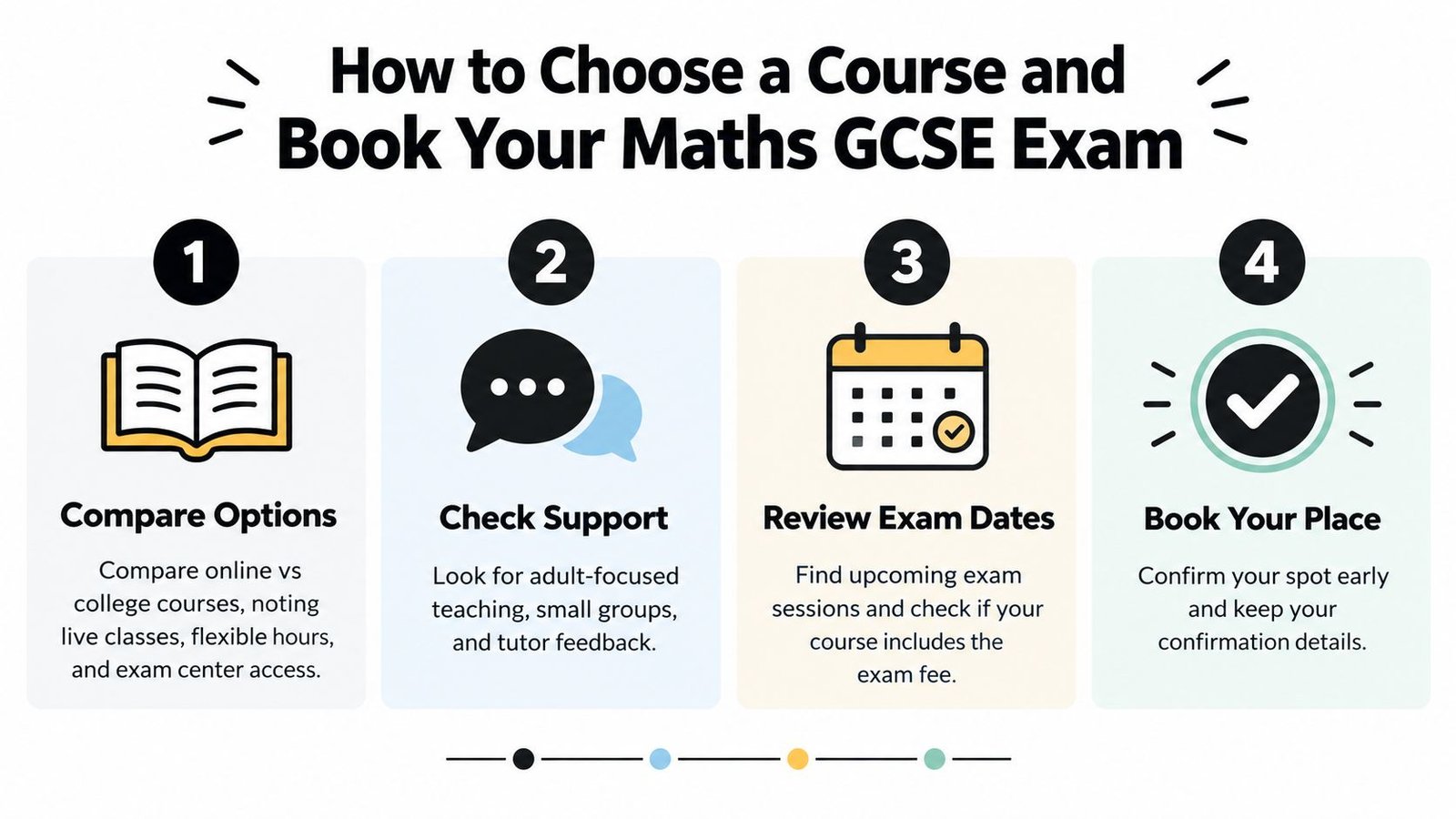
You may study at home after the children are in bed, then sit your GCSE maths exam at a separate centre. That arrangement is common for adult learners, but it can be confusing. A course provider teaches and supports you. An approved exam centre enters you and hosts the exam. Check which organisation handles each part before enrolling.
Choose support that fits your life
Start by checking the awarding body and exam specification named by the course. Ask whether the package includes tutor marking, model answers, mock papers and explanations for fractions, algebra, ratio, proportion and graphs. A polished sales page cannot show how carefully someone will explain an error when you are stuck.
Online study can suit changing shifts, family duties and long journeys. If you are considering studying GCSE online, learn what self-paced learning is and decide whether shorter study blocks match your routine. A local college may suit you better if fixed lessons, a classroom and regular face-to-face contact keep you working.
Next Level Online College provides online GCSE maths study for adults, including structured course content, assessment preparation and academic support. Compare this with a college, private tutor or self-study materials. Choose the option whose support you are likely to use, not the one with the most attractive advert.
Use this booking checklist
Confirm your target qualification. Ask the organisation receiving your result for the required subject, grade and exam board. This prevents you from preparing for a qualification that does not meet its rule.
Ask who enters you for the exam. Find out whether exam entry is included or whether you must contact a separate private-candidate centre. Also ask where you will sit the paper and what identification you need.
Check the exam series. GCSE maths may be available in the summer and autumn series, depending on the awarding body and centre. The National Careers Service guidance on resits confirms that adults can resit GCSE maths and English in either series.
Get deadlines in writing. Confirm when your application, identification documents and payment must arrive. Keep the confirmation email, centre details and candidate information together.
Fit study around home life. Choose study times you can protect and check how quickly a tutor replies. A convenient course with no help when motivation falls may become harder to finish.
Ask about exam entry before you feel fully ready. You need time to learn the specification, practise papers and correct weak areas. A supportive provider should explain the process in plain English and make clear what you must arrange yourself.
Your Simple Study Plan and Revision Strategies That Work
Many adults revise by watching videos, highlighting pages or reading a guide from start to finish. Those activities can feel productive, but they don't always show whether you can answer an exam question independently. Maths improves when you attempt, mark, correct and try again.
Find the gaps before you fill them
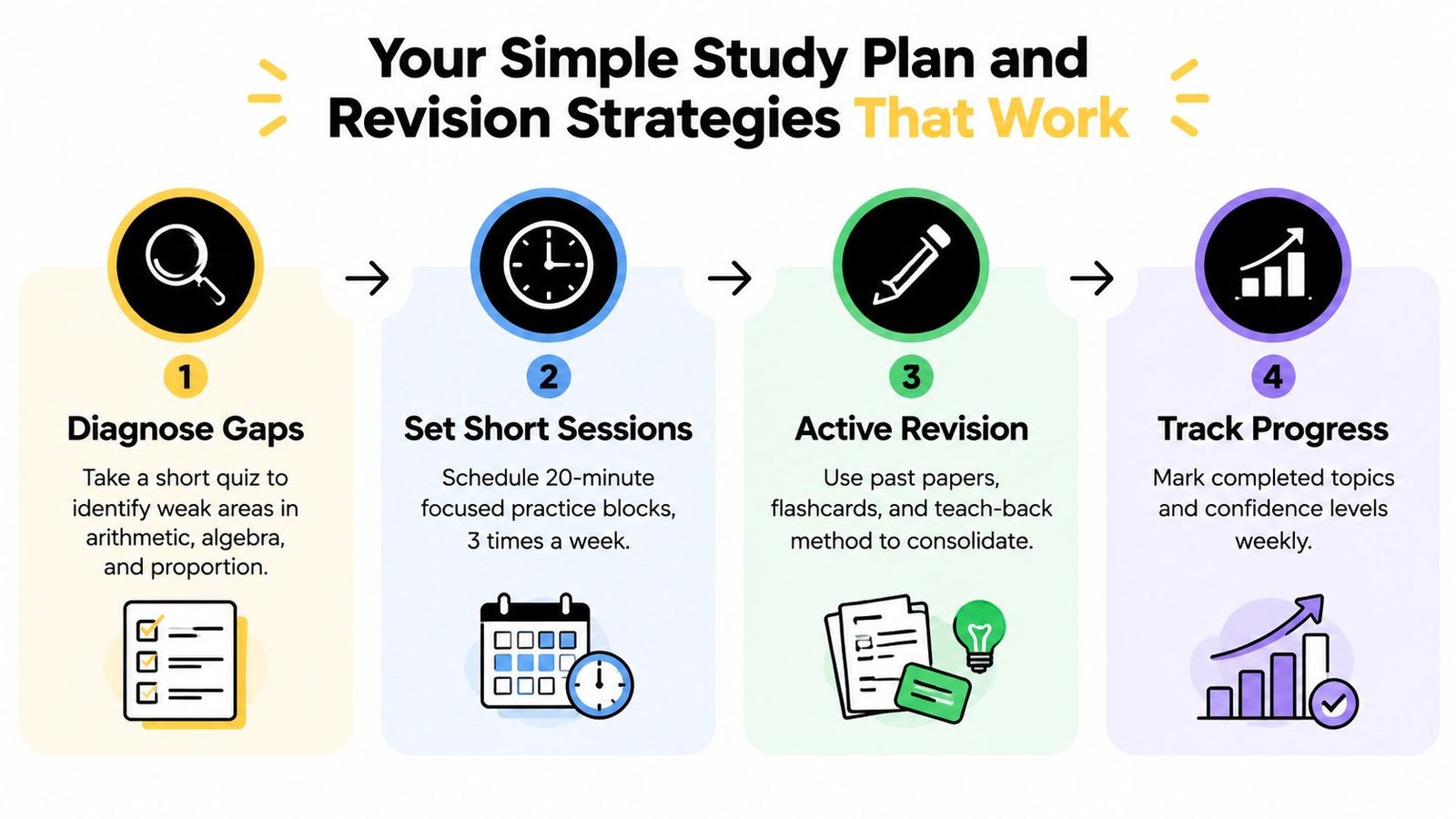
Begin with a short diagnostic quiz or a few questions from different parts of the specification. Don't guess what you need to revise. Check whether your difficulty is with arithmetic, algebra, proportion, geometry, graphs or reading the question.
Keep an error notebook. For each mistake, write:
- The topic: For example, simplifying expressions.
- Your error: You combined terms that weren't alike.
- The correct method: Show each step in order.
- Your reminder: Write a short sentence you'll understand later.
This turns a wrong answer into a useful lesson. It also stops you from repeating the same mistake without noticing.
Use short, regular practice
A busy adult doesn't need a perfect study room or a free afternoon. Set aside a small block of focused time several times a week. Put your phone away, choose one topic and decide what “finished” means before you start, such as completing a set of ratio questions and marking every answer.
A simple week might look like this:
- Session one: Review a weak topic and complete worked examples.
- Session two: Answer exam-style questions without looking at the method.
- Session three: Mark the work, correct errors and explain one question aloud.
- Weekend check: Revisit the errors and choose the next topic.
If a child needs help or a shift changes, reduce the session rather than abandoning the whole plan. Consistency matters more than making one long, exhausting effort.
Active practice gives you information. Passive reading often gives you reassurance without proof.
Past papers become most useful after you understand the main method. Start with individual questions, then practise sections, and later complete a full paper under timed conditions. Use the mark scheme carefully. If an answer is wrong, find the first step where your method changed direction. Copying the correct answer won't teach you how to reach it.
Build exam confidence alongside knowledge
Adults sometimes know the maths but lose marks because they rush, miss a unit or stop after one difficult question. Practise writing clear steps, checking whether your answer makes sense and moving on when a problem is taking too long.
Track progress in a simple table with the topic, date, confidence level and next action. Celebrate specific progress, such as “I can now solve a two-step equation”, rather than waiting for a perfect mock result. For more ideas, use these GCSE revision techniques and adapt them to your life.
The evidence behind targeted preparation is important. In the November 2025 England resit dataset, candidates aged 20 and over achieved a 28.2% grade 4+ pass rate, compared with 26.1% for 17-year-olds and 17.2% for 19-year-olds. The same report recorded a fall for the 20-plus group from 34.1% in November 2024 to 28.2% in November 2025, showing why preparation quality and exam conditions matter. FE Week reports the November resit results and age differences.
Support Funding and Help to Keep You Going
Studying while working and caring for a family can make every task feel like one more responsibility. You shouldn't have to rely on willpower alone. Good support joins together academic help, practical planning and emotional encouragement, so you can keep learning when confidence dips.
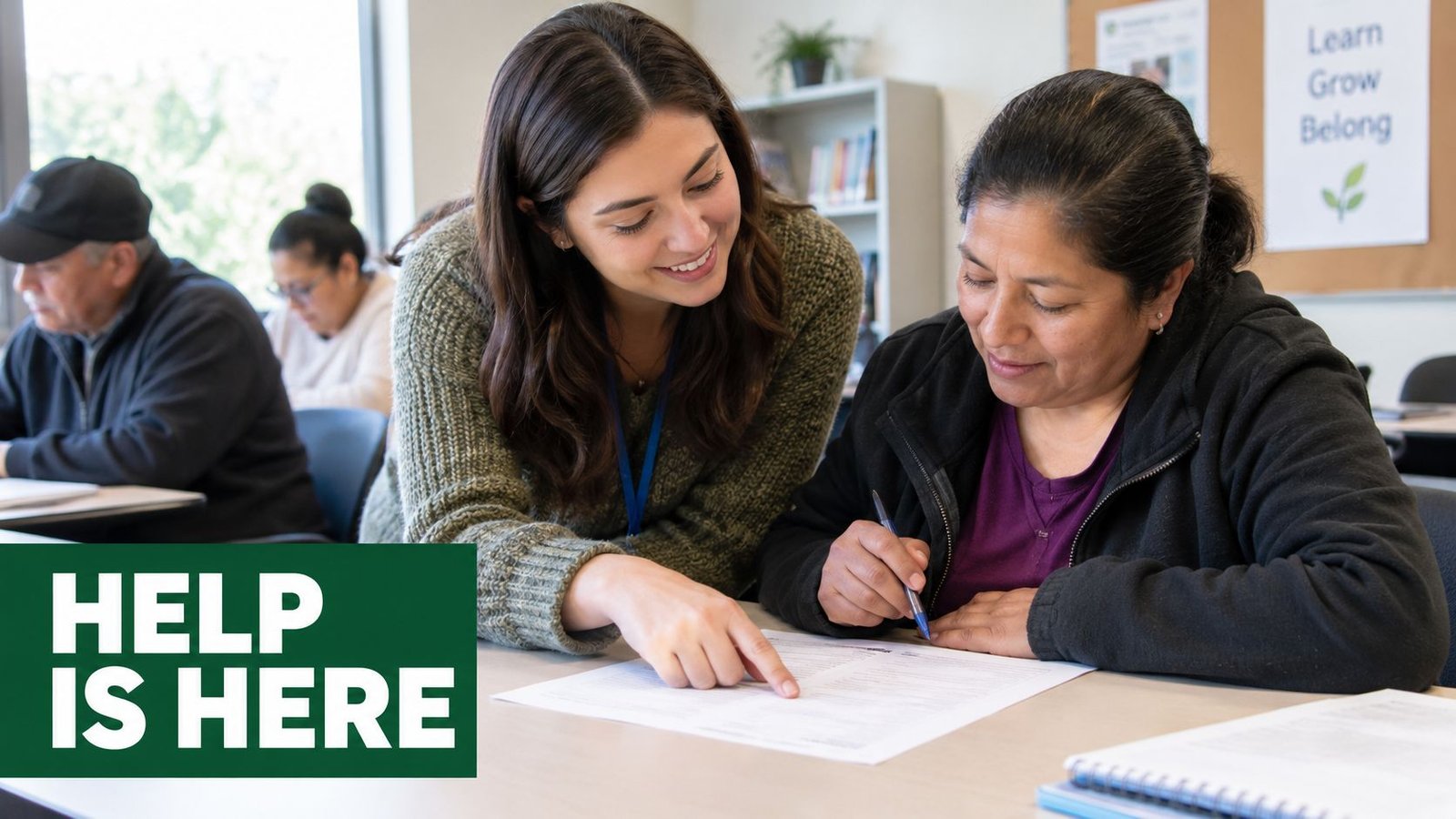
A tutor should help you understand a method, not just tell you whether an answer is right. Ask how quickly tutors reply, whether they mark written work, how they explain difficult topics and what happens if you miss study time. Some adult learners also benefit from a mentor who helps them set goals, while a wellbeing adviser can help when anxiety, tiredness or family pressure affects progress.
Funding is another question to ask early. Contact local colleges and adult learning services to ask whether free or supported places are available for eligible learners. Ask course providers about payment plans, the full cost of tuition, exam entry and any separate centre charges. Never assume the advertised course price includes every part of the qualification.
Make support practical
Your study plan should include real life, not ignore it. Tell your family when you're studying and ask for a protected period, even if it's short. Keep books and a calculator in one place so you don't waste energy preparing. If work becomes busy, contact your tutor before you fall behind.
A supportive course community can also change how you speak to yourself. Instead of “I failed maths”, try “I need more practice with algebra”. That small change moves the problem from your identity to a skill you can develop.
Summer 2026 results show why individual support matters. 219,135 learners aged 17 and over sat GCSE maths resits in England, while 15.3% achieved grade 4 or above. The FE Week coverage of the summer 2026 results also reports that the 20-plus group performed better than younger post-16 learners, with a grade 4+ rate of 32.51% in one dataset. Adults need support that recognises their different responsibilities and learning needs, rather than treating every resitter in the same way.
Asking for help early is a study skill, not a sign that you're failing.
What Happens After You Pass Your Next Steps to Success
Results day may bring relief, pride and a strange feeling that the task is finally over. Save your result safely, check the grade and ask your next education provider or employer how they want you to submit proof. Then use the qualification straight away while your goal is clear.
A grade 4 can help you meet an entry requirement for further study, an apprenticeship or a career change, but the exact rule belongs to the organisation you're applying to. If your plan is university, check whether you also need an Access to Higher Education diploma, A levels or another subject. If your plan is promotion, ask which role, training programme or application should come next.
Turn the result into movement
Use this simple order:
- Update your applications. Add the qualification to your CV and online job profiles.
- Contact your next provider. Send evidence and confirm that you've met the maths requirement.
- Choose the next skill. This might be English, an Access course, digital training or a subject linked to your new career.
- Tell your family. Let your children see that effort can lead to change.
The result can improve more than a form or application. It can change what you believe is possible. Your children may see that education doesn't belong only to people who found school easy. They'll see a parent who returned, practised, faced fear and kept going. That example can stay with them for years.
A narrow miss isn't the end either. Ask for your marks, speak to your tutor, identify the topics that cost you marks and decide whether another GCSE attempt or a different accepted qualification fits your goal. Summer 2026 data recorded 33,598 passes from 219,135 entries, according to Leading Tuition's analysis of the national resit figures, so preparation needs to be deliberate rather than passive.
You're not too late. You're not too old. You're an adult with a reason, a future goal and the ability to learn one step at a time.
Next Level Online College offers flexible online GCSE maths courses for adults, with structured lessons, tutor guidance and preparation designed to fit around work and family life. Visit Next Level Online College to compare your route, ask about support and take the first step towards the qualification you need.