You may be reading this after putting the children to bed, finishing a shift, or clearing the kitchen table so you can open a revision book. Perhaps you remember school as a place where you felt behind, nervous, or never quite good enough. Now you're thinking about GCSEs again, while managing work, family and bills, and wondering whether you can really do it.
You can. Learning how to pass GCSEs as an adult isn't about becoming a teenager again. It's about using your present experience, choosing a sensible plan and taking control of the opportunities ahead. A GCSE can help you move towards further study, a better career and the future you want your family to see.
Your Time to Succeed It Is Never Too Late
Feeling nervous is normal. If school gave you difficult memories, opening a workbook can bring those feelings back quickly. You may worry that you're too old, that you've forgotten everything, or that other learners will understand more easily.
Those thoughts don't prove that you'll fail. They show that this matters to you.
Adult learners bring strengths that younger students are still developing. You know how to manage responsibility, solve practical problems and keep going when life becomes difficult. You may already organise a household, care for children, work with customers, handle money or make important decisions under pressure. Those abilities can support your study.
Your reason can carry you through
Your reason for returning to education may be personal. You might want to become a positive role model for your children, show them that learning can begin again at any stage, or create more choices for your family. You may want to qualify for a fulfilling career, earn more in the future or finally complete something you once thought was out of reach.
Write your reason down in one clear sentence:
I'm studying because I want to create more opportunities for myself and my family.
Keep it where you study. On a tired evening, you don't need to feel inspired for hours. You only need to remember why the next small step matters.
Advice about passing GCSEs often targets 16-year-olds, yet adults face different barriers, including limited time, exam anxiety and the challenge of rebuilding forgotten foundations. In Ofqual's 2025 data, 20.9% of post-16 English GCSE candidates achieved grade 4 or higher, a result that highlights why adult learners need focused support rather than generic revision advice, as reported by FE Week's coverage of the November resit results.
Progress matters more than an old school experience
You don't need to prove that you were good at school. You need to build the skills you need now. A missed lesson, a difficult topic or a low practice mark isn't a judgement on your intelligence. It's information that tells you what to practise next.
Your children may notice you studying after work. They may see you ask questions, make mistakes and continue. That example can be more powerful than telling them that education matters. You'll be showing them that confidence grows through action.
Passing GCSEs won't solve every problem overnight, but it can open a door that has stayed closed. You're not going backwards. You're choosing a new direction, and you can take that first step today.
First Steps to Your GCSE Success
Starting feels easier when you replace a large goal with a few clear decisions. Don't begin by buying every revision guide or downloading every resource. Begin by deciding what you need and why.
Choose the subjects that support your next goal
For many adults, GCSE English Language and GCSE Maths are the most useful starting points. They often form part of entry requirements for college, apprenticeships, training and employment. If a particular career or university course interests you, check its requirements before enrolling, because some routes may ask for additional subjects or a higher grade.
Ask yourself:
- What do I need next? Write down the job, course or qualification you're working towards.
- Which GCSEs does it require? Check the provider's current entry information.
- What can I manage now? One subject may be a sensible beginning if work and family already take much of your time.
- What support will I need? Look for structured lessons, tutor feedback and exam preparation.
You can choose another subject later, but a clear first target will stop the process from feeling too big.

Understand the exam board
An exam board creates the specification, papers and mark schemes for a GCSE. Common boards include AQA, Edexcel and OCR. The subject content may be similar, but the paper structure and question wording can differ.
Before you revise, find out:
- which board you're studying with
- how many papers you'll sit
- what topics each paper includes
- how long each paper lasts
- where to find the correct past papers and mark schemes
An online course provider can help you identify the right specification and organise your preparation. You shouldn't practise with random papers if they belong to a different board.
Set a realistic grade target
In England, GCSEs use a 9 to 1 grading scale. Grade 4 is officially a standard pass, while grade 5 is a strong pass, as explained in this BBC guide to GCSE grades.
A grade 4 may be the right first target if you need a qualification for progression. A grade 5 or higher could be useful for a more selective course. Your target should challenge you without making you feel that anything below the highest grade is failure.
Write down your subject, exam board, target grade and exam session. That simple page turns a wish into a project.
Creating a Study Plan That Fits Your Life
A useful study plan doesn't pretend that you have empty evenings. It starts with the life you already have. Work out when your attention is most reliable, then protect small periods of time for learning.
A parent working during the day might study during a lunch break, review flashcards while travelling, and complete a longer task after the children are asleep. Someone with changing shifts may choose weekly study goals rather than fixed daily appointments. Both approaches can work if they're honest and regular.
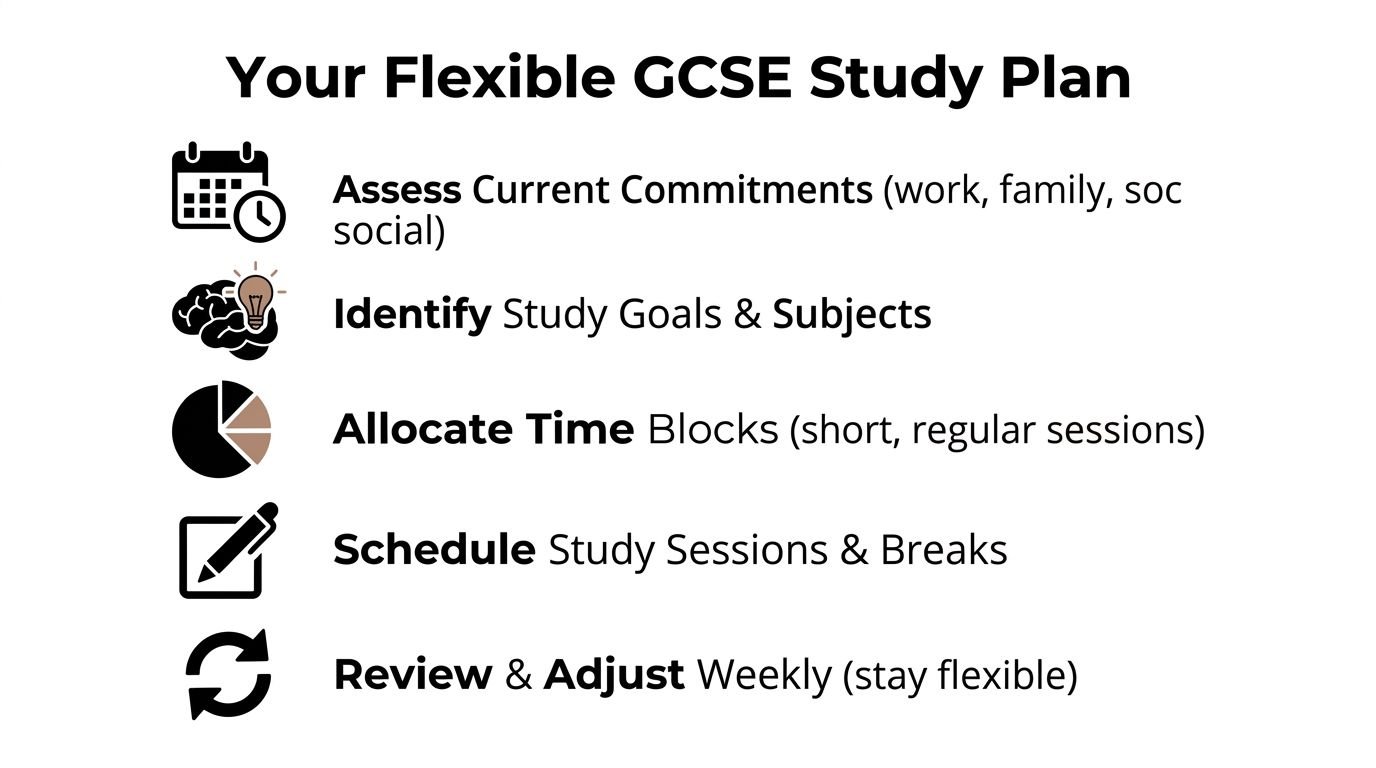
Build your week around real commitments
Start with a blank calendar. Add work, school runs, meals, appointments and rest. Then mark short study blocks in spaces you can protect.
A sample week might look like this:
| Day | Study focus |
|---|---|
| Monday | Review one Maths skill after the children go to bed |
| Tuesday | Read an English text during a lunch break |
| Wednesday | Complete practice questions |
| Thursday | Rest or catch up if family needs change |
| Friday | Review mistakes from the week |
| Saturday | Complete a longer lesson or past-paper task |
| Sunday | Check progress and plan the next week |
This is a guide, not a rule. If a child is unwell or work becomes demanding, move the session. A flexible plan keeps you learning instead of making you feel guilty.
Break the syllabus into small wins
Don't write “revise Maths” on your list. That task is too large to start. Write “practise fractions”, “review percentages” or “answer questions on equations”. For English, choose a specific activity such as analysing a short extract, planning a description or checking punctuation.
Use three simple columns:
- To learn: topics you haven't studied properly yet
- To practise: topics you understand but still find difficult
- To review: topics you can answer with confidence
Move topics between columns as your knowledge grows. This gives you visible proof that you're progressing.
Practical rule: A short session you complete is more useful than a perfect timetable you keep postponing.
Leave space for breaks and sleep. Tired learners often read the same page without remembering it. Your plan should help you protect your energy, not use every spare moment.
Smart Revision Techniques That Actually Work
Reading a page again can feel productive because the material looks familiar. Familiarity isn't the same as being able to recall an answer in an exam. Adult learners with limited time need methods that make each session active.
Make your brain retrieve the answer
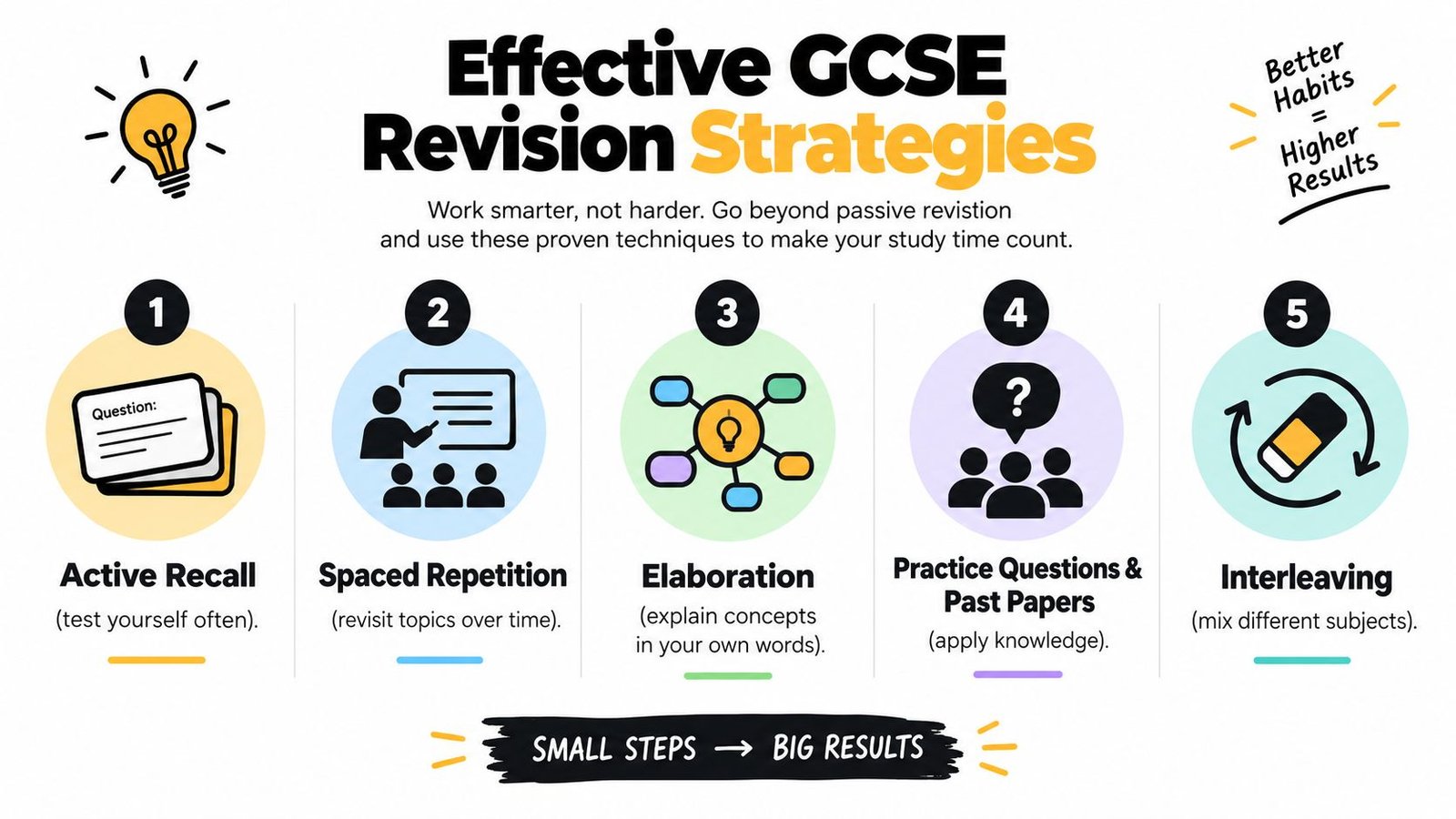
Active recall means closing the book and testing yourself. After studying a Maths method, cover the worked example and solve a similar question. After reading about an English technique, explain its effect without looking at your notes.
Use flashcards, short quizzes or a blank sheet of paper. Mark your answer accurately, then return to the point you missed.
Spaced repetition means revisiting a topic over time instead of studying it once and forgetting it. You might review a topic soon after learning it, then return to it later in your plan. Each review should include a test, not just another reading.
Elaboration means explaining an idea in your own words. Try the Feynman Technique by pretending that you're teaching a child. If you can't explain a rule clearly, you've found the part that needs more work.
Use practice papers as a learning tool
Past papers are not only for the final stage. Begin with individual questions and use the mark scheme to understand what a successful answer contains. Later, complete a paper under timed conditions so you can practise managing pressure.
After each task, record:
- the question type
- what you did well
- where you lost marks
- the exact action you'll take next
For English Language, check whether you answered the question asked, used evidence carefully and explained the writer's methods. For Maths, identify whether the problem came from understanding the method, making a calculation error or misreading the question.
Read these GCSE revision techniques for further ideas that can fit around adult responsibilities.
Interleaving means mixing related skills rather than completing one type of question for a long time. For example, you might practise fractions, equations and percentages in the same week. This makes you choose the right method, which is closer to what happens in an exam.
The standard-pass benchmark has stayed broadly consistent. 67.1% of all GCSE results were at grade 4 or above in 2025, compared with 67.4% in 2024, according to the Department for Education's 2025 GCSE performance data. That doesn't promise an easy result, but it gives you a clear target. Smart revision helps you prepare for that target without relying on last-minute cramming.
Booking Your Exams and Finding Support
Exam logistics can make a prepared learner feel unsettled. You may wonder where to sit the exam, what information you need or whether you'll miss an important deadline. Deal with these questions early so they don't distract you from learning.
Find an approved exam centre
Ask your course provider which private exam centres accept adult candidates, or search for centres in your area and check that they offer your subject and exam board. Contact the centre directly and ask about:
- available exam sessions
- booking deadlines
- the qualification and specification code
- identification requirements
- fees and payment arrangements
- access arrangements if you need them
Keep every confirmation email in one folder. The centre, rather than your online course, usually manages the actual exam booking, so check who is responsible before you assume anything.
For adults in England aged 19 or over who haven't achieved grade 4 or above in GCSE English and maths, funded study may be available. The support normally covers a full course of learning, not merely paying to sit the examination, as outlined in this guide to adult GCSE resits and funding.
Prepare for the exam day
Visit the centre information in advance and plan your route. Pack the items allowed by the centre, arrive with time to spare and avoid trying to learn a whole topic immediately before the paper.
If anxiety rises, slow your breathing and read the first question carefully. Start with what you understand, show your working in Maths and leave time to check your answers. A difficult question doesn't mean the entire paper is going badly.
Ask for support before you feel stuck
A tutor can explain a confusing method, mark your writing and help you see the next useful step. A mentor can help you keep going when work or family responsibilities interrupt your plan. Asking for help isn't weakness. It's a practical way to protect your progress.
If you're considering flexible learning, read whether you can study GCSEs online and compare the course structure, assessment support and contact with tutors before choosing.
Your Next Chapter After Passing Your GCSEs
Passing a GCSE is not only a result on a certificate. It can be evidence that you kept a promise to yourself while managing responsibilities that younger learners may not understand. Your achievement can change how you see your own ability, and it can show your children that a difficult beginning doesn't have to decide the ending.
Turn the qualification into a route forward
Start by checking the next requirement for your chosen path. You might apply for a college course, explore an apprenticeship, study A Levels or consider an Access to Higher Education Diploma. Each route has its own entry conditions, so contact the provider and ask what your specific grades will allow.
English and Maths are especially important for higher education. Most UK universities require at least grade 4 in both subjects, while some competitive courses ask for grade 5, according to this guide to GCSE requirements for university entry.
Those grades can also support applications for career changes, promotions and further training. They won't guarantee a job, but they can remove an entry barrier that has held you back.
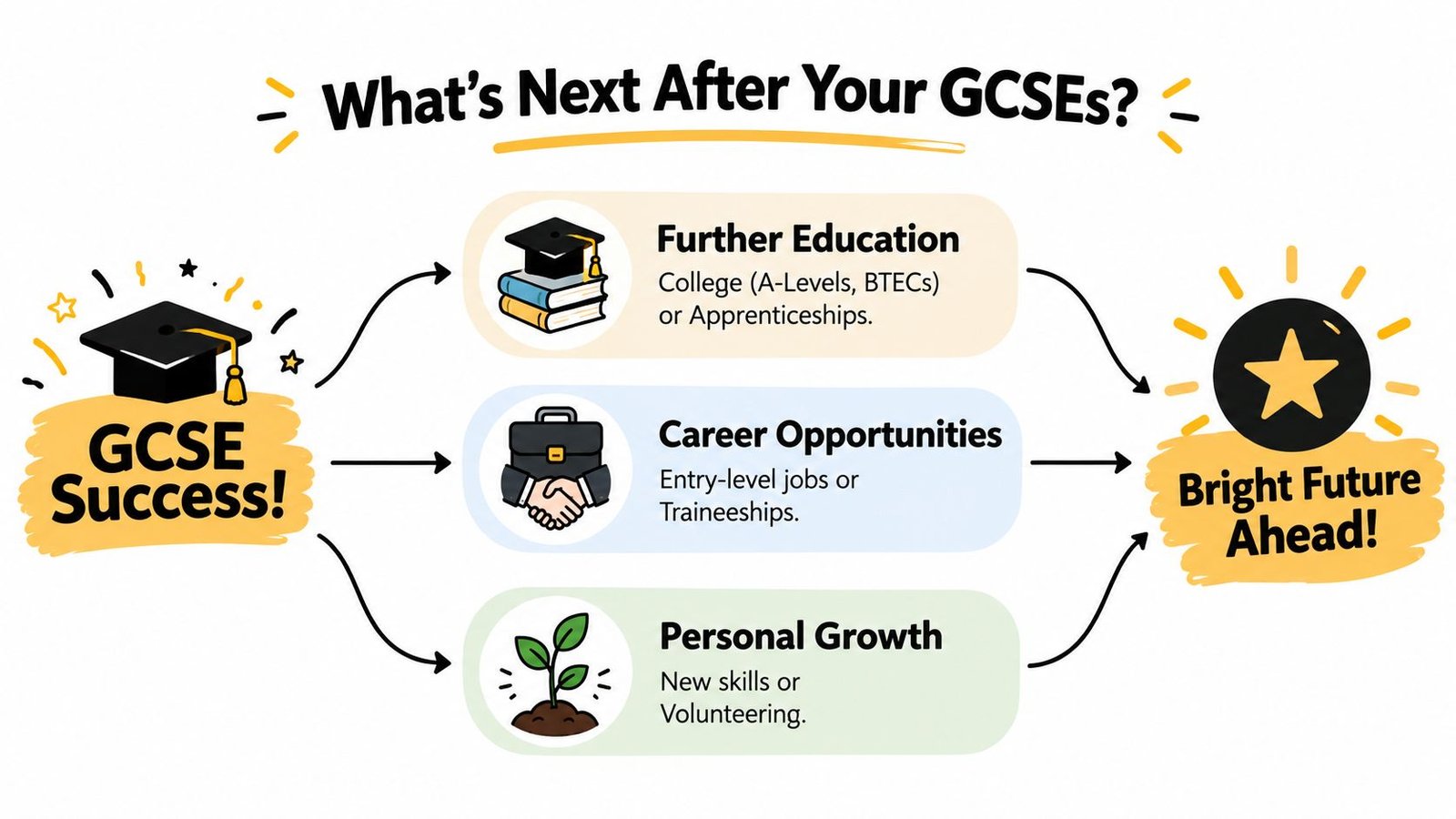
Let your experience guide your next choice
Your life experience can become an advantage in a new profession. Someone who has cared for relatives may bring patience to health or social care. Someone who has managed a busy home may already have planning and communication skills that matter in many workplaces. A GCSE gives you a foundation, while later study and training help you develop the specialist knowledge your chosen role needs.
Write a future note to yourself:
- What kind of work would make you feel useful?
- What qualification would move you closer to it?
- What would your family notice if you reached that goal?
- Which small action can you take this week?
Your answer doesn't need to be perfect. Careers develop as you learn more about yourself and the options available.
Make your success bigger than a grade
Your children may remember the certificate, but they're also likely to remember the effort behind it. They'll see you study when you're tired, ask for support when you need it and continue after a disappointing practice result. That example can help them believe that education belongs to them too.
You may be starting with one GCSE, but you're building confidence, choices and a stronger foundation for your family's future. University, a new career and greater financial security can begin with a decision that seems small today.
Find out how to get into university and compare the entry steps for the course you hope to study.
Next Level Online College offers flexible online GCSE courses for adults, with structured learning, subject guidance and academic and pastoral support around work and family life. Visit Next Level Online College to explore your GCSE options and take the first practical step towards your next chapter.