

Yes, you can study for your GCSEs online, but the final exams must be taken in person at an approved exam centre. GCSEs now use the 9 to 1 grading scale, with first teaching of the reformed courses beginning in 2015 and first results in 2017, so any online course you choose needs to match the modern system.
If you're reading this, you may be carrying a quiet hope that life could look different. Maybe you want a better job. Maybe you want to apply for university. Maybe you want to stop feeling held back by old grades or by not having the qualifications you need.
That hope matters.
For many adults, the question isn't only can you do GCSE online. The deeper question is, "Can I really go back and do this now?" The answer is yes. You can. And you don't need to have everything figured out today. You just need to understand how online GCSEs work, especially the part that often confuses many: how the exam itself is booked and sat.
It Is Never Too Late to Open New Doors
A lot of adult learners start from the same place. They work hard, look after other people, and keep going. But somewhere in the background, there is still that feeling that one missing qualification is closing doors.
You might have left school years ago and never got the grades you needed. You might have done well in life in many ways, yet still feel nervous when a job asks for GCSE Maths or English. You might even be thinking about university and wondering whether that dream has already passed you by.
It hasn't.

Your goals still count
Going back to education as an adult is a brave decision. It takes courage to admit you want more. More options. More confidence. More security for your family. More pride in yourself.
Some adults keep putting it off because they think they are too old, too busy, or too rusty. In truth, adult learners often bring strengths that younger students are still building. You understand responsibility. You know why your studies matter. You are doing this for a reason.
You don't need to be the person you were at school. You only need to be the person who is ready now.
That matters because adult learners are becoming more recognised in the UK. New support for flexible post-18 study, including the Lifelong Learning Entitlement, shows a clear shift towards helping adults return to education through study that fits around real life, as noted by Oxbridge Home Learning's guide to studying GCSEs and A levels online.
The example many adults know well
Think of a parent who wants their child to believe that education opens doors. They help with homework, encourage revision, and talk about aiming high. But privately, they worry that they never finished their own journey.
That feeling can hurt. It can also become a turning point.
When an adult goes back to study, children notice. They see effort. They see resilience. They see that learning doesn't stop at school. Even if your main goal is practical, such as getting into a course, changing career, or meeting job requirements, the example you set can be powerful.
Here are a few reasons adults decide to return:
- Career progress: Some jobs still ask for GCSEs as a basic entry requirement.
- University plans: GCSEs can be an important stepping stone before Access to HE, A levels, or degree study.
- Personal pride: Passing a subject that once felt impossible can change how you see yourself.
If you've been doubting yourself, take this as your reminder. Wanting better is not unrealistic. It's a healthy sign that you're ready for your next chapter.
How Online GCSEs Really Work for You
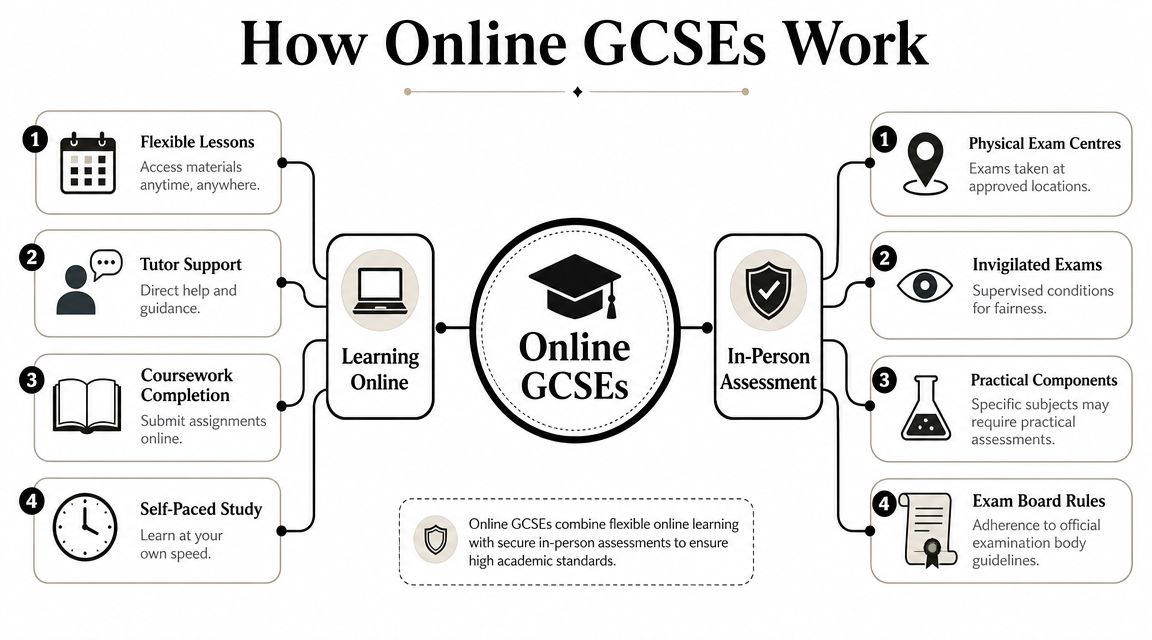
The easiest way to understand online GCSEs is to split them into two parts. First, there is the learning. Second, there is the official assessment.
The learning can happen online. The official exams cannot.
The learning part can fit around your life
This is the part most adults find encouraging. You can study from home, around work, childcare, and everyday commitments. Depending on the course, that might include recorded lessons, live teaching, assignments, feedback, revision help, and exam practice.
A simple way to think about it is learning to drive. You can revise the theory at home, watch videos, practise questions, and build confidence in your own time. But for the official test, you still go to a test centre. GCSEs work in a similar way.
The exam part must happen at a centre
GCSEs are regulated qualifications, so the final exams must be sat in person at an approved exam centre under supervised conditions. For private candidates, this usually means registering with a centre by February for the summer exam series, according to Save My Exams' explanation of doing GCSEs online.
Practical rule: Online study is flexible. The final GCSE exam is not. It happens in a real place, on set dates, under official rules.
This point matters because many people search for can you do GCSE online when what they really mean is, "Can I get the whole qualification from home?" The honest answer is no. You can do the preparation online, but not the final exam itself.
What this means for you day to day
Once you know that, everything becomes clearer. You stop looking for a magical fully online GCSE that doesn't really exist, and you start planning properly.
A typical journey often looks like this:
- Choose your subject such as Maths, English, or another GCSE you need.
- Start learning online through a course or your own study plan.
- Build exam skills with practice papers, marked work, and revision.
- Book an exam centre in good time.
- Sit the exam in person when the exam series arrives.
That may sound formal, but it can be reassuring. There is a clear path. You are not guessing. You are following a recognised route towards a real qualification.
Your Two Main Paths to GCSE Success
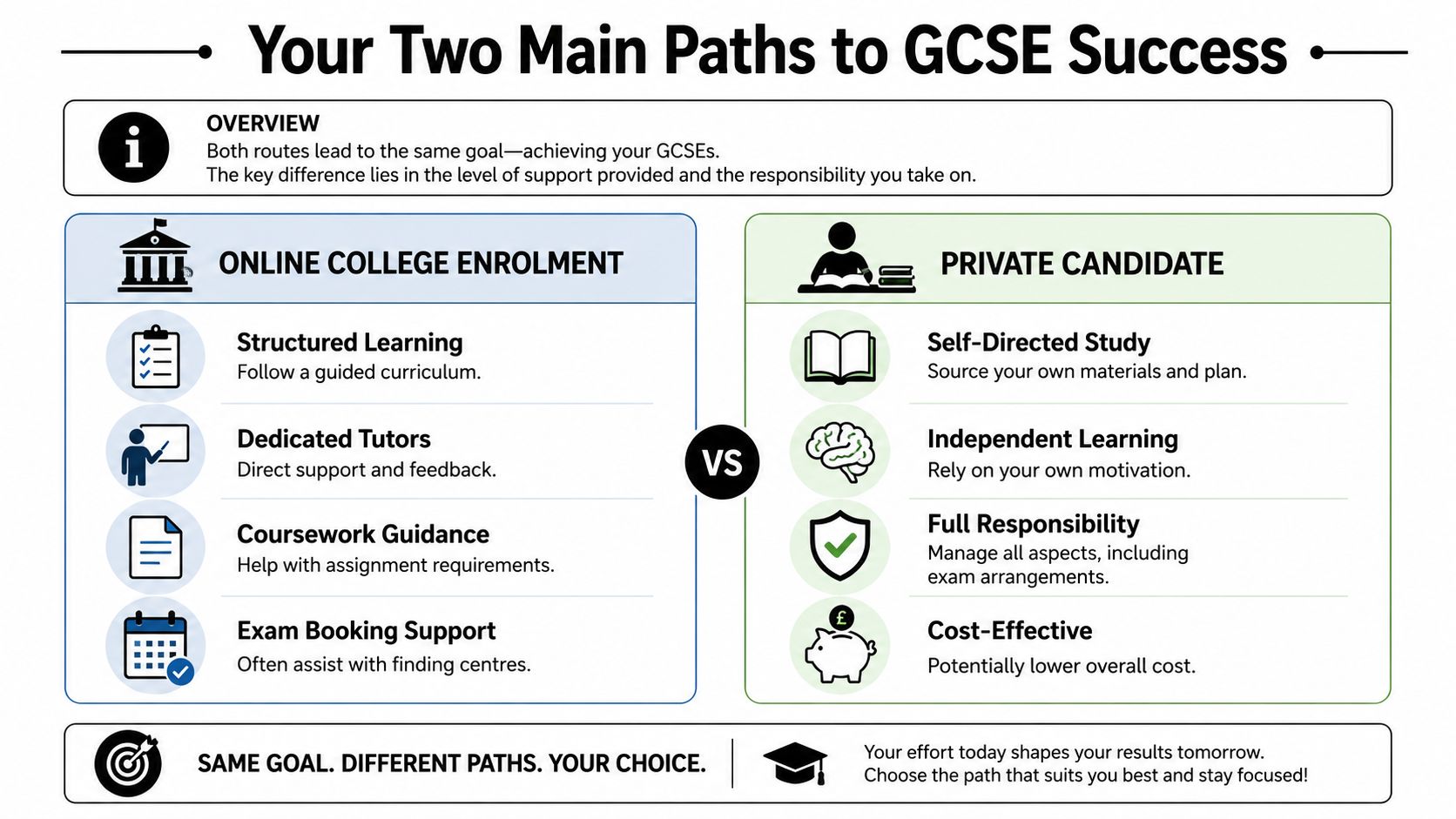
Adults usually reach GCSE success in one of two ways. Both can lead to the same qualification. The difference is how much support you get along the way.
Path one with structured support
This route means enrolling on an online GCSE course with tutors, planned study, and proper feedback. Today, online GCSE study is much more than just watching a few videos. Some tutor-led courses include recorded lessons, graded assignments, exam technique practice, homework marking, individual feedback, and mock exams. One UK provider lists a fee of £500 per term for its GCSE Statistics course, showing how formal and structured online preparation has become, as described on Home Made Education's GCSE Statistics course page.
For many adults, this is the calmer option because you don't have to build everything yourself. Someone has already organised the learning in the right order.
Support can help with things like:
- Keeping momentum: A timetable or study plan helps when life gets busy.
- Fixing mistakes early: Marked work shows what you understand and what needs more practice.
- Preparing for the actual exam: Mock exams and exam technique reduce nasty surprises.
If you're weighing up your options, GCSE resits for adults can be one route to explore if you want a more guided path.
Path two as a private candidate
The second route is to study mostly on your own and enter for the exam as a private candidate. This can suit independent learners who are confident finding their own textbooks, revision resources, and exam practice.
There is nothing wrong with this path. For some people, it works well. But it asks more of you.
Here is a simple comparison:
| Option | What you manage yourself | What support you may receive |
|---|---|---|
| Online course | Less of the planning and tracking | Tutors, feedback, structured materials |
| Private candidate | Most of it, including study planning | Limited or no teaching support |
A private candidate route can save money, but it can cost confidence if you feel unsure, isolated, or out of practice.
Which path suits you best
A good question to ask yourself is not "What is the cheapest?" but "What will help me finish?"
If you've been away from study for a long time, feel nervous about exams, or need accountability, support often makes the difference. If you are highly organised, already know the subject fairly well, and feel comfortable working alone, private entry may suit you.
The right choice is the one that helps you keep going when motivation dips.
Finding an Exam Centre and Booking Your Place
This is the part many adults worry about most. Not the learning. The booking.
That makes sense. If you search can you do GCSE online, lots of pages say yes, but then go quiet regarding the actual exam. Yet this practical step is one of the most important parts of the whole process.
Why early planning matters
Online GCSEs are not fully online qualifications. You still need an approved place to sit the exam, and private candidates usually have to arrange that themselves. This matters even more because exam capacity is a real issue. Ofqual data show GCSE entries at over 5.5 million and A level entries at over 800,000, which is why Nisai's guide to studying GCSEs online and sitting exams in the UK stresses early planning and approved venues.
So don't leave this until the last minute. The earlier you start, the more choices you'll usually have.
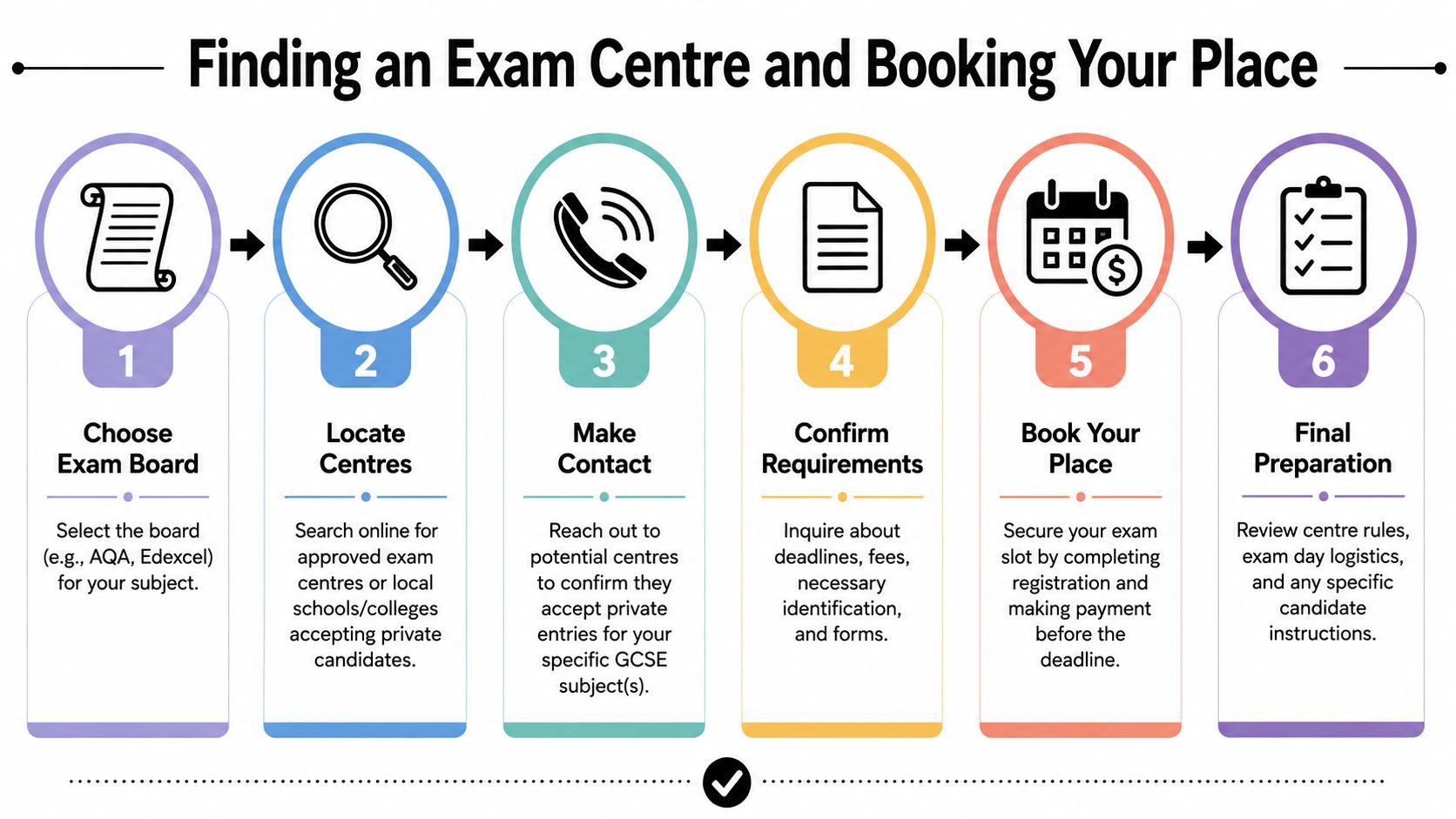
A calm step by step checklist
Start simple. You do not need to solve everything in one afternoon.
Choose your subject and exam board
Make sure you know exactly which GCSE you are taking.Search for private candidate exam centres
Use clear search terms based on your area and subject.Contact centres directly
Ask whether they accept private candidates for your subject.Check the practical details
Ask about deadlines, paperwork, identification, and fees.Book as soon as you are ready
A booked place brings peace of mind.
A helpful starting point for adults looking at core subjects is GCSE maths and English for adults.
Here is a quick list of questions to ask a centre:
- Do you accept private candidates for my GCSE subject?
- Which exam board do you use for this subject?
- What is your registration deadline for the next exam series?
- What documents do I need to complete my entry?
- Are there any extra rules I should know before exam day?
This short video may also help you feel more familiar with the process before you start contacting centres.
What often trips people up
The biggest problems are usually practical, not academic. Adults sometimes revise well but delay the exam booking because it feels confusing. Then the deadline comes closer and stress rises.
Book the exam centre as part of your study plan, not as an extra task for later.
Once your place is booked, the whole journey starts to feel real. It becomes less like a wish and more like a date in the diary that you are working towards.
What a Great Online GCSE Course Gives You
Not all online GCSE courses feel the same. Some leave you alone with a pile of resources. Others give you a proper route from your first lesson to exam day.
That difference matters, especially if you haven't studied for years.
It should match the modern GCSE
GCSEs were reformed to the 9 to 1 grading scale, with first results in 2017, and a credible course needs to align with the modern specification rather than the older A* to G system. Pearson's GCSE guidance also shows that the qualification is built around defined teaching time and guided learning hours, which is why adults usually do better with a course that follows a clear structure instead of random revision, as explained in Pearson's GCSE Statistics FAQ.
If a course feels vague, that is a warning sign. Adults usually need clarity, not clutter.
The features that build confidence
A strong course doesn't just hand you content. It helps you understand what to do next.
Look for things like:
- A clear study plan: You should know what to learn first, what comes next, and how to revise.
- Tutor feedback: Questions need answers. Marked work helps you improve.
- Exam practice: You need to get used to the style and pressure of GCSE papers.
- Flexible delivery: Lessons should fit around work and family life, not fight against them.
Why support matters more for adults
Adult learners are often balancing a lot at once. A child may be ill. Work may suddenly become busy. Confidence may dip after one bad practice paper. That doesn't mean you can't succeed. It means your course should support real life.
Some adult learners look through online GCSE courses for adults because they want a structured option that fits around existing responsibilities.
A good course gives you more than information. It gives you rhythm. It helps you keep moving, even when life gets messy. And that steady progress is often what turns a nervous beginning into a pass result and then into the next goal after that.
Your Next Step Towards a Brighter Future
You don't need to sort out your whole future today. You only need one sensible next step.
By now, the answer to can you do GCSE online should feel much clearer. Yes, you can study online. No, the final qualification isn't completed entirely at home. And once you understand that, the path stops feeling mysterious.
Keep the goal close and the first step small
You may be doing this for a job application. You may be doing it so you can move on to Access to HE or university. You may be doing it because you want your children to see that effort matters and that it's never too late to grow.
All of those reasons are good enough.
Try not to think of GCSE study as one huge mountain. Think of it as a series of small actions:
- Pick the subject you need most.
- Choose your study route based on how much support you want.
- Find out the exam arrangements early.
- Start learning steadily rather than waiting for the perfect moment.
The adults who succeed are not always the ones who feel most confident at the start. They are often the ones who keep taking the next small step.
This can change more than one result
A GCSE pass can open up practical opportunities, but it can also change how you speak to yourself. It can replace old labels with new evidence. Evidence that you can return, rebuild, and achieve something meaningful.
That matters in your home as much as on paper. When your family sees you studying, persevering, and reaching a goal, they learn something powerful about what is possible.
You are not behind. You are beginning from where you are. That is enough.
If you're ready to explore a flexible study route, Next Level Online College offers online courses for adult learners who want recognised qualifications with structured support that fits around work and family life.