
You might be reading this after a long day. The children are settled. The washing still needs doing. Work starts again in the morning. And somewhere in the middle of all that, there's a quiet thought you can't shake.
Maybe school didn't go the way it should have. Maybe life got in the way. Maybe you've spent years telling yourself you're “not academic”, even though deep down you know that isn't the full story.
If that sounds like you, please hear this. Your old results do not decide your future. Adults return to study every year, and many do it while working, parenting, caring, and carrying far more responsibility than they ever had at school. gcse courses for adults online exist for real people with real lives. They are built for flexibility, support, and second chances.
It's Your Time to Shine with Online Adult GCSEs
There's a special kind of pain in feeling left behind. It can show up when your child asks for help with homework, when a job asks for English or maths, or when you look at a course you'd love to do and see GCSE entry requirements standing in the way.
That feeling is real. But it isn't the end of your story.

Your past doesn't get the final say
Many adults think going back to education means stepping into a classroom that feels made for teenagers. It doesn't have to be like that. Online adult GCSEs give you a different route. One that fits around your life instead of asking you to stop your life.
If you're unsure what these qualifications are, this simple guide on what a GCSE is can help make the whole thing feel clearer.
For adults, this journey often means much more than passing an exam. It can mean:
- Showing your children what courage looks like by trying again
- Opening the door to better work when old qualifications have held you back
- Building self-respect by finishing something you once thought was beyond you
- Creating a new family story where learning becomes something to be proud of
You don't need to be fearless to start. You just need to be willing to take one small step.
Why online learning feels different
Online study can feel gentler than school did. You're not trying to keep up with a noisy class. You can pause, reread, ask questions, and come back to tricky topics when your mind is fresh. That alone can change how you see yourself.
A lot of adults discover that they were never “bad at learning”. They just needed the right environment.
Here's the truth I want you to hold onto. Studying now, as an adult, can be one of the strongest things you ever do. Not because it's easy, but because you're doing it with purpose. You know why it matters. You know who you're doing it for. And that makes a huge difference.
Opening New Doors with GCSE Qualifications
A GCSE can look like a small piece of paper. In real life, it often acts more like a pass that lets you move into places that were hard to reach before. For adults, that can mean applying for a course, meeting a job requirement, or finally feeling ready to aim higher.
English, maths, and science are the subjects employers and colleges ask for again and again. If you have ever seen a role advertised and felt your heart sink at the words “GCSE required”, you already know how much these qualifications can matter. Gaining them as an adult is not about going back. It is about giving yourself a fair chance now.
The grades that matter most
The grading system can feel confusing at first, especially if you remember letters rather than numbers. That confusion is common.
In England, GCSEs are graded from 9 to 1. For many adults, the two grades that matter most are 4 and 5. A grade 4 is usually treated as a standard pass. A grade 5 shows a stronger pass. If you want it set out clearly, this guide to what GCSE grades mean explains it in plain English.
You do not need to memorise every detail on day one. You just need to know the score you are aiming for, in the same way a sat nav helps more once you know the destination.
| Grade now | Older way many adults remember it | What it often means |
|---|---|---|
| 4 | Roughly similar to C | A standard pass |
| 5 | Above a standard pass | A strong pass |
Where GCSEs can lead
For some adults, one GCSE is the missing piece that allows the next plan to start. For others, it is the first solid brick in a much bigger rebuild.
You might need GCSEs for:
- College or university routes such as A Levels or Access to Higher Education courses
- Apprenticeships that ask for English or maths
- New jobs or promotions where entry requirements are clearly listed
- Personal closure because finishing this chapter matters greatly to you
Some learners only need maths. Some need English and maths together. Some return because they want choices they did not have before. Whatever your reason, the effect is often the same. Life begins to feel more open.
The change reaches beyond the exam
The qualification matters, but the deeper change often happens long before the results arrive.
Each study session sends your brain a new message. You are someone who keeps going. You are someone who can learn difficult things. You are someone who has not given up on your future.
Children notice that. They see a parent revising at the kitchen table, asking questions, trying again after a hard day, and finishing what they started. That example can shape how they see effort, setbacks, and education itself. In many families, one adult returning to study changes the tone of the whole home.
That is why this is bigger than a certificate. It is a personal victory you earn for yourself, and a quiet example your family may carry with them for years.
Making Your Studies Fit Around Your Life
It is 9:30 at night. The children are finally settled, the washing is still waiting, and your phone calendar already looks full. In that quiet moment, many adults ask the same question. Can I really do this as well?
You probably can, if the course fits your life instead of asking your life to stop.
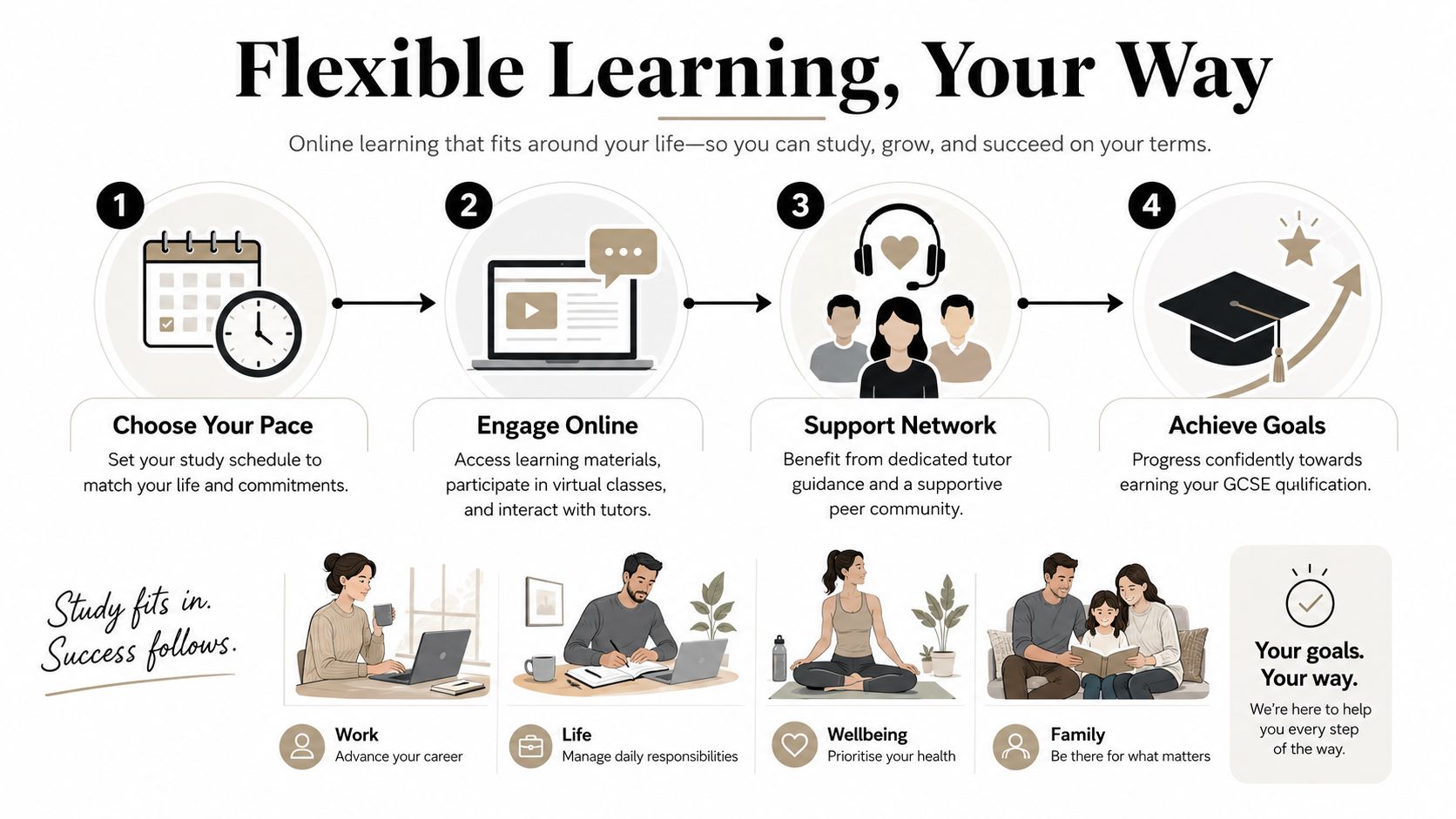
Online adult GCSE study works best when it behaves less like a school timetable and more like a flexible training plan. You do not need long empty afternoons. You need a routine that can bend around work, family, and ordinary tiredness. According to Oxbridge Home Learning's GCSE course page, many GCSE courses can be completed over 9 to 24 months, and some learners choose a faster route.
Online study still needs human support
A common fear is being left alone with a screen and a stack of tasks.
Good online learning usually includes structure, regular check-ins, and clear teaching. That matters because adult learners are often balancing a great deal at once. Freedom helps, but too much freedom can feel like standing in a kitchen with ingredients and no recipe. A clear weekly pattern gives you something solid to return to, even after a busy or difficult week.
What studying can look like in real life
Your week does not need to copy anyone else's.
For one learner, it might mean twenty minutes of revision after the school run, one evening session after work, and a longer catch-up on Sunday. For another, it might mean early mornings before the house wakes up. Small, repeated sessions often work well because they keep the subject fresh without exhausting you.
A realistic routine might include:
- Short study blocks during quieter parts of the day
- One set time each week for focused learning
- Brief recap tasks to help ideas stick
- Tutor comments or marked work so you know what to improve
This is how progress becomes manageable. One hour here, twenty minutes there, a lesson at the weekend. It may not look dramatic, but it adds up.
Steady routines build belief
Many adults come back to education carrying old doubts. They worry they have been away too long, forgotten too much, or missed their chance.
Flexible study helps lower that pressure. You can reread a lesson. You can pause and return. You can spend longer on fractions, essay structure, or algebra without feeling embarrassed that someone else has moved on. That slower, steadier pace often gives confidence time to catch up with effort.
Your family may notice that change before you do. They see you making notes at the table, showing up again the next day, and keeping a promise to yourself. Children learn a great deal from that. They learn that adults can start again. They learn that hard things can be done in small steps.
That is one reason this matters so much. Fitting study around your life is not only about convenience. It is about making success realistic, so the course becomes something you can finish, feel proud of, and let your family witness from the front row.
Finding a Provider Who Believes in You
You may already picture the hard parts of studying again. What many adults do not expect is how much the right provider can steady their nerves from the start.
A good course provider does more than hand over lessons. It gives structure, clear answers, and support that feels respectful. That matters when you are rebuilding confidence one assignment at a time, often while managing work, children, and a busy home.
Start with the awarding body
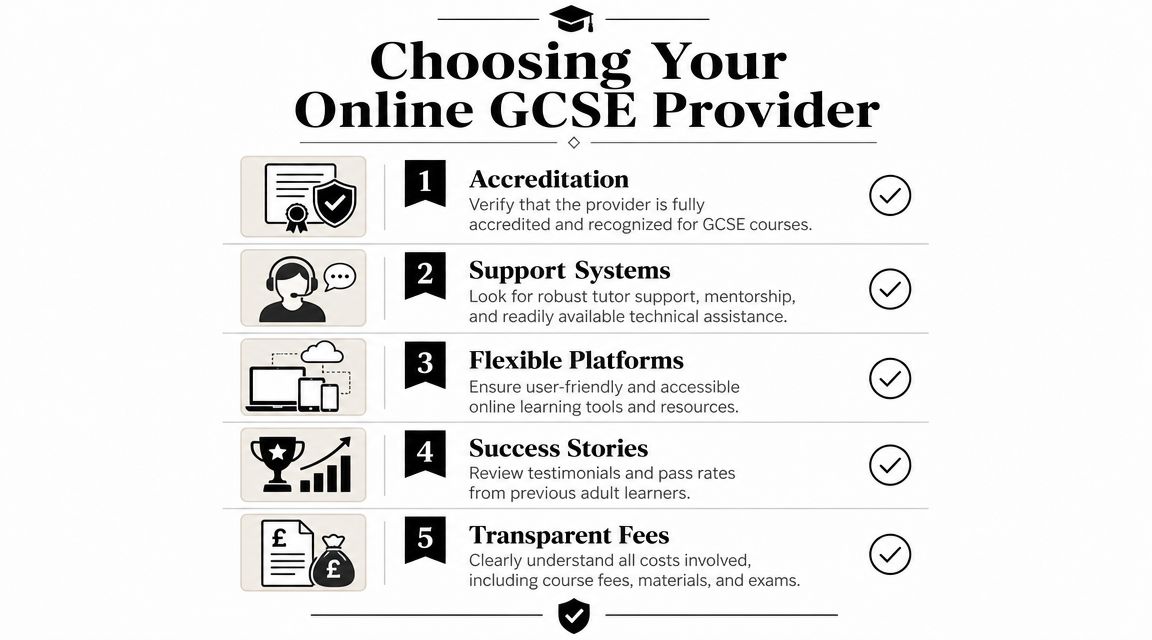
One of the first things to check is the awarding body. This is the organisation that sets and awards the qualification. It works a little like the name on a driving test certificate. People want to know who issued it, because that helps them trust what it represents.
NEC states that its online GCSE and IGCSE courses are accredited by recognised awarding bodies including AQA, Pearson Edexcel and OCR, and says that most subjects have no formal entry requirements, although stronger maths is recommended for some technical subjects. You can read that on NEC's online GCSE courses page.
Checking this early can save stress later. Employers, colleges, and universities often look for recognised awarding bodies. It also helps you confirm whether the course is a GCSE or an IGCSE, which can matter depending on what you want to do next.
Questions worth asking before you enrol
You do not need special knowledge to ask sensible questions. In fact, a supportive provider should make those answers easy to understand.
Ask about:
- Which awarding body is used for the subject
- Whether the course is a GCSE or IGCSE
- How tutor support works if you get stuck
- How exams are arranged, including help with booking
- What study materials are included and how long you can access them
These details may sound small now. Later, they can affect how confident and prepared you feel. A course can look fine on the surface but still leave you chasing answers when you most need help.
Look for human support, not just course access
Online learning should still feel human.
Adults returning to study often need more than information. They need someone who can explain a topic plainly, mark work in a helpful way, and remind them that one difficult week does not cancel their progress. Good support works like a handrail on stairs. You still climb the steps yourself, but it is much easier to keep going when something steady is there.
That support matters at home too. When your child sees you ask for help, keep trying, and improve bit by bit, they learn something powerful. They learn that struggle is not failure. They learn that growth belongs to adults as well as children.
Choose a provider that helps you feel safe enough to continue on ordinary, tired, distracted days. That is often what carries people through to the finish line and turns a qualification into a personal victory your family will remember.
Investing in Your Future Without Breaking the Bank
A lot of adults pause here.
You may feel ready to study, then look at the family budget and think, "I cannot add one more cost right now." That reaction makes sense. Rent, food, travel, school uniforms, and energy bills do not wait politely while you rebuild your future.
A GCSE can still be one of the wisest ways to spend money on yourself. It gives you access to roles, courses, and next steps that may have felt out of reach for years. Equally significant, it changes the story at home. Children notice when a parent chooses growth, keeps going, and finishes something that matters.
Start by checking whether help with costs is available
For adults who need English or maths, funding is often the first thing to ask about. As noted earlier in the article, some providers offer funded places for eligible learners, especially if you are 19 or over and do not already hold the required pass grade in English or maths.
That is why a short conversation with an adviser can save a lot of worry. Ask what support is available, whether exam costs are included, and what you would pay yourself if funding does not apply.
Look at the full cost, not just the headline price
Course fees are only one part of the picture. A low price can feel reassuring at first, but it helps to ask what is included.
Check for:
- tuition or course access
- marked assignments and tutor feedback
- exam entry or separate exam fees
- access length for materials and lessons
- any extra costs for resits or extensions
This works like checking the full cost of a car before you buy it. The price on the windscreen is only the start. Insurance, fuel, and maintenance affect what you can really afford. Courses are similar. Clear information helps you make a calm decision.
Ask whether the return matches your reason for studying
Try to connect the cost to one clear outcome.
If GCSE maths is the subject that lets you apply for nurse training, teaching support work, an apprenticeship, or a college course, the fee means something very different. It is no longer "money spent on a course." It is money spent removing a barrier.
If you are worried about keeping up once you enrol, these GCSE revision techniques for adult learners can help you study more efficiently and make better use of every pound you invest.
A steady way to make the decision
You do not need to figure it all out in one evening.
A practical approach is to choose the subject that creates the clearest next opportunity, check funding first, then ask for a full breakdown of costs before you commit. If payment options are available, see whether they fit your household budget without adding strain.
That calm, careful approach matters. Adults often tell themselves they should wait until life is less busy or money is less tight. For many people, that perfect moment never arrives. Starting with good information, and a plan you can afford, is often what turns hesitation into progress.
And progress spreads. When your family sees you invest in your education wisely, they learn that building a better future does not always begin with a dramatic leap. Sometimes it begins with one sensible decision, made with courage.
Your Step-by-Step Guide to Getting Started
Starting often feels bigger than studying. Once you begin, the path usually becomes clearer.
If you want to move forward, keep it simple.
Step one: choose the subject that unlocks the next stage
Don't pick a subject just because it sounds useful. Pick the one that removes the barrier in front of you.
If a university route or college course asks for English and maths, start there. If your job plans need a science subject, look at that next. One clear reason is enough.
Step two: ask questions before you commit
Speak to an adviser or course team and ask what you need to know. Adults sometimes feel embarrassed doing this, but there's nothing silly about wanting clarity.
You might ask about support, exams, entry expectations, workload, or how the course fits around work. If revision worries you, these GCSE revision techniques for adult learners can help you see that studying effectively is a skill you can learn.
Small actions build momentum. Reading course details, sending one message, or asking one question all count as progress.
Step three: make your first week easy
Don't wait until everything feels perfect. It won't.
Your first week can be very simple:
- Set up your study space with a notebook and quiet corner
- Choose two or three regular study times you can protect
- Tell your family what you're doing so they can support you
- Aim for consistency, not long heroic sessions
Step four: let yourself be a beginner
Adults often expect themselves to be instantly organised, focused and confident. That's a heavy burden.
You are allowed to take time to settle in. You are allowed to ask basic questions. You are allowed to build your confidence one lesson at a time. Starting doesn't require perfection. It requires willingness.
The First Step to a Proud New Future
There's something powerful about deciding that your story isn't finished.
Choosing an online GCSE as an adult is not a small thing. It says you still believe your future can change. It says your children will see what persistence looks like. It says your goals matter, even if you had to put them on hold for years.
What this journey can give you
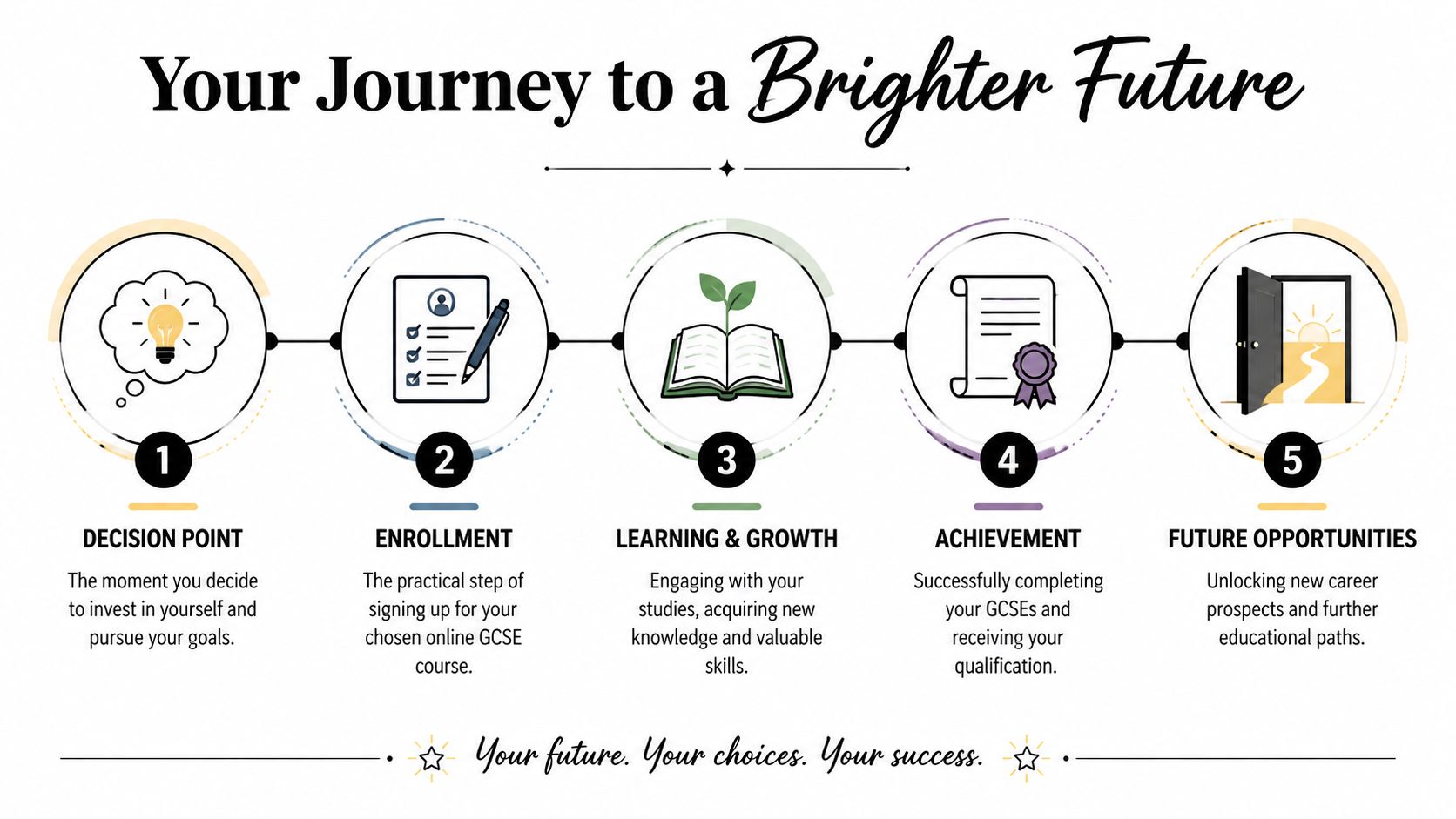
Yes, it can give you a qualification. But it can also give you much more.
It can give you:
- Pride because you finished something important
- Belief because you proved you can learn and grow
- Opportunity because more doors can open afterwards
- Example because your family sees you choosing courage over fear
Children notice these things. They notice when you keep going. They notice when you do hard things. They notice when learning becomes part of family life, not just something that happened at school.
You do not need to wait for the perfect moment
Many adults delay this decision because they want life to calm down first. Life rarely suddenly becomes quiet and simple.
The better question is this. Can you take one step while life is still busy?
That one step could be checking your options, asking about funding, or choosing the subject you need most. It doesn't have to be dramatic. It just has to be real.
A new future often begins with one ordinary decision made on an ordinary day.
You are not too old. You are not too late. You are not starting from nothing. You're starting with life experience, determination, and a reason that matters profoundly to you.
That counts for a lot.
If you're ready to take that first step, Next Level Online College offers flexible online courses for adult learners who want recognised qualifications with support that fits around real life. If you've been waiting for a sign to begin, this could be it.