
Some adults read the words what is GCSE and feel a knot in their stomach. They think of school, old report cards, or a time in life when support was thin and confidence was thinner. They may be working hard, raising children, paying bills, and still carrying the quiet feeling that they missed their chance.
If that's you, you're not behind. You're at a turning point.
A GCSE isn't about going backwards. It's about building forwards. It can help you apply for a better job, meet an entry requirement for further study, or show your children that learning doesn't stop when life gets busy. That matters. Children notice when a parent keeps going. Families feel the change when someone at home starts believing in themselves again.
It's Never Too Late to Open New Doors
Sarah is the kind of person many adults recognise straight away. She works, keeps the house moving, remembers school as something she “was never good at”, and still feels a sting when job forms ask for English and maths qualifications. She wants more. Not only for herself, but for her family too.
That feeling is painful, but it can also be the start of something powerful.
A lot of adults don't want to “go back to school”. They want a fair chance. They want qualifications that open doors, not another reminder of what didn't happen years ago. That's why choosing to study now is such a brave step. You're not replaying the past. You're taking charge of the future.

Why this step matters so much
For many adults, getting a GCSE means more than passing an exam. It can mean:
- Better job options with fewer closed doors when employers ask for English or maths
- A route into further study such as A Levels, Access courses, or university preparation
- More confidence at home when helping children with homework or talking about education
- Personal pride from finishing something important and proving to yourself that you can do hard things
You don't need to be naturally academic. You don't need perfect spelling, neat handwriting, or a “school brain”. You need a reason, a plan, and support that fits around real life.
You can feel nervous and still be ready.
Many adult learners carry shame that doesn't belong to them. Maybe school moved too fast. Maybe home life was difficult. Maybe money, health, work, or caring duties got in the way. Those things are real. But they don't decide what happens next.
You can start from where you are
Some people begin with one subject. Others return because a career in nursing, teaching, or another profession asks for GCSE English or maths. Some want to stop feeling stuck. Every one of those reasons is valid.
You don't have to know everything today. You only need to understand one thing clearly. GCSEs are a recognised way to prove your skills, and adults across the UK take them every year. That means this path isn't strange, and it isn't only for teenagers.
If you've been waiting for the “right time”, this may be it. Not because life is suddenly easy, but because your future is worth making room for.
What a GCSE Really Is and Why It Matters to You
GCSE stands for General Certificate of Secondary Education. In simple terms, it's a recognised qualification in a subject such as English, maths, science, history, or business. In the UK, it's one of the main ways to show that you have a solid level of knowledge and skill.
A helpful way to think about it is this. A GCSE is like a passport for your next step. It doesn't do the journey for you, but it helps you get through gates that might otherwise stay closed.
A simple definition in plain English
When employers, colleges, training providers, or universities ask for GCSEs, they're usually asking for proof that you can work at a certain level. That often matters most in English and maths, because those subjects support so many parts of work and study.
A GCSE can help show that you can:
- Read and understand information
- Write clearly
- Use maths in everyday and workplace situations
- Study at a recognised standard
For adults, that can make a real difference. Job applications often include qualification boxes. Further study often has entry rules. A GCSE helps you meet those rules with a qualification people across the UK understand.
Why adults often recognise the older system
If you left school years ago, you might remember O-Levels or CSEs. GCSEs replaced those older qualifications to create one unified system. The GCSE was introduced nationally in 1988 to replace the old O-Level and CSE systems, and in 2024 there were over 5.5 million GCSE entries across England, which shows how central they still are in education and work, according to the official GCSE subject content and national statistics publication.
That matters because it means GCSEs aren't a passing trend. They are well known, widely accepted, and still deeply tied to opportunity.
Practical rule: If a course, job, or training route asks for “a recognised qualification”, a GCSE is one of the clearest and most familiar answers.
Why the qualification still carries weight
People sometimes ask if GCSEs are still worth doing as an adult. Yes, they are. A recognised qualification can give structure to your effort. It turns “I think I can do this” into “I have proof I can do this”.
That proof can matter in everyday ways:
| Where it helps | Why it matters |
|---|---|
| Job applications | Employers often ask for GCSE English or maths |
| College entry | Courses may require a pass before you can enrol |
| University pathway | GCSEs can support entry into later qualifications |
| Personal confidence | Finishing a recognised course changes how you see yourself |
A GCSE doesn't define your intelligence. It gives your ability a name, a grade, and a place on paper that others recognise. For adults who have spent years doubting themselves, that can be a major shift.
Understanding the GCSE Grading System From 9 to 1
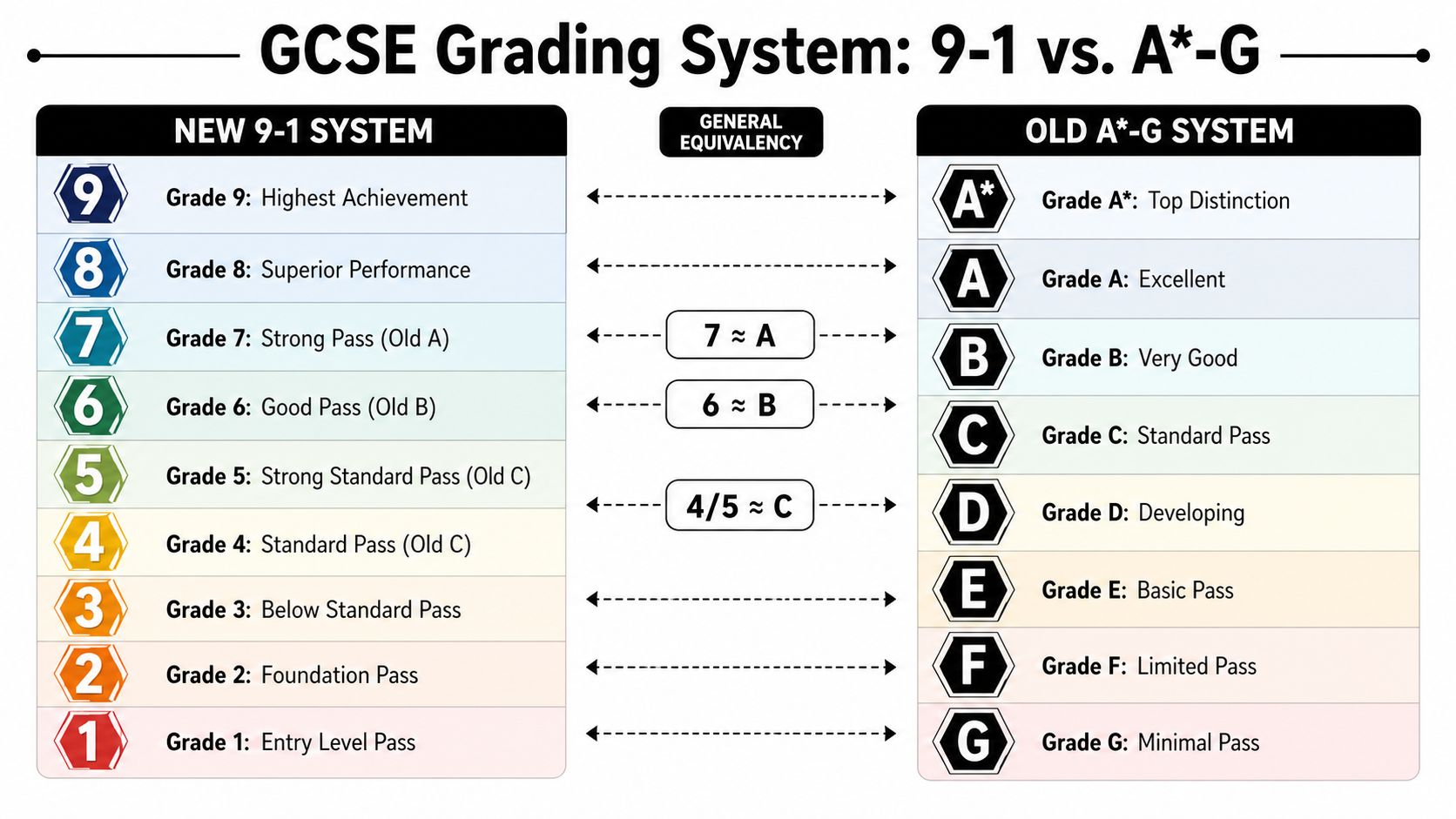
One of the biggest worries adults have is the grading. They remember letters like A, B, and C, then suddenly see numbers from 9 to 1 and wonder if everything has changed beyond recognition. The good news is that it can be understood with ease.
GCSEs sit within the Regulated Qualifications Framework, often shortened to RQF. Grades 1, 2, and 3 are Level 1 qualifications, while grades 4 through 9 are Level 2 qualifications, which is the level most employers and universities usually want, as explained in this GCSE overview on the Regulated Qualifications Framework.
The simple way to read the numbers
You don't need to memorise every detail at once. For most adult learners, the key thing is knowing what counts as a pass for the opportunities they want next.
Here is a simple guide.
| New Grade (9-1) | Old Grade (A*-G) | What it Means |
|---|---|---|
| 9 | A* | Highest achievement |
| 8 | A* to A | Very high performance |
| 7 | A | Strong pass |
| 6 | B | Good pass |
| 5 | High C to low B | Strong pass |
| 4 | C | Standard pass |
| 3 | D to E | Below standard pass |
| 2 | E to F | Basic level |
| 1 | G | Entry level pass |
Many adults focus on grade 4 and grade 5.
- Grade 4 is usually called a standard pass
- Grade 5 is often seen as a strong pass
If a form asks for a pass in GCSE English or maths, grade 4 is often the important benchmark. Some courses or providers may prefer grade 5, so it's always wise to check the exact entry requirement.
Why grades 4 and above matter most
A lot of confusion comes from hearing people say “you need a good pass”. In practice, that usually means you should look closely at the stated requirement, not guess. If the requirement says grade 4 or above, that is the target. If it says grade 5, aim for that.
For a fuller plain-English guide, this explanation of what GCSE grades mean for adult learners can help make the scale feel less intimidating.
Think of grades 4 to 9 as the range that usually opens the most doors.
Don't let the numbers put you off
The number system can look colder than the old letters, but the idea behind it is still familiar. Higher grades show stronger performance. A pass still matters. A recognised result still counts.
What matters most is not whether you instantly understand the whole scale. What matters is knowing your target and working steadily towards it. Adult learners often do better when they stop comparing themselves with school pupils and start asking a more useful question. “What grade do I need for my next step?”
That question brings calm. It turns a confusing chart into a practical plan.
Typical GCSE Subjects and How They Are Assessed
If you're asking what is GCSE in a practical sense, you probably also want to know what you would study. The answer depends on the subject, but the overall pattern is easier to understand than many adults expect.
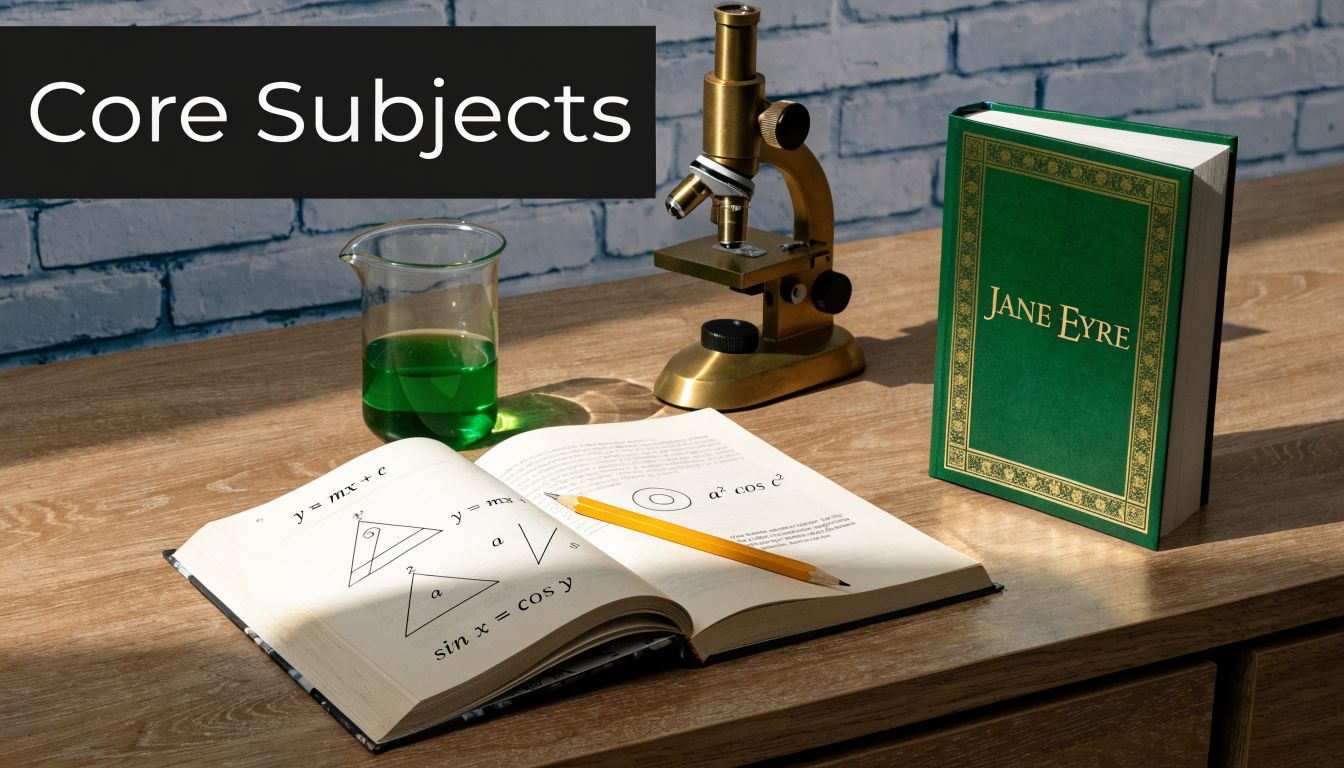
The core subjects are generally introduced first. English, maths, and science sit at the centre of school study and are often the most useful subjects for adults returning to education. English helps with reading, writing, and communication. Maths supports money, problem-solving, and everyday decisions. Science builds knowledge that links to health, technology, and the world around you.
The subjects adults most often ask about
English and maths usually come first because so many jobs and courses ask for them. Adults often choose those subjects to meet entry requirements or strengthen the foundations they missed earlier in life.
Beyond that, there are many other GCSE subjects, such as:
- Science subjects like biology, chemistry, and physics
- Humanities such as history and geography
- Creative subjects including art and design
- Practical subjects like design and technology
- Work-related subjects such as business
If you're mainly interested in career progression, GCSE maths and English for adults are often the first place to start because they enable so many later options.
How GCSE assessment usually works
Most modern GCSEs are linear. That means you study the course and then take the main exam or exams at the end, rather than collecting small pieces of assessment all the way through in the older style many adults remember.
That can sound intense, but it also brings clarity. You know what you're working towards. You can revise with a clear finish line in view.
The exact assessment method depends on the subject. Some are mostly exam-based. Some include coursework or practical work. Some ask you to apply knowledge rather than repeat facts.
GCSE study isn't only about memory. Good courses teach you how to understand, apply, and explain.
A real example from Design and Technology
Design and Technology is a good example because it shows how GCSEs often mix thinking and doing. A modern GCSE such as AQA Design & Technology is assessed through a 2-hour exam worth 50% of the grade and a practical project. In the exam, at least 15% of the marks assess maths skills and at least 10% assess science, according to the AQA Design and Technology specification summary.
That tells you something important about GCSEs in general. They aren't just about writing down what you remember from a textbook. They often test whether you can use knowledge in realistic ways.
Here is a short video that helps make GCSE study feel more real and less mysterious.
What this means for adult learners
Adults sometimes worry that they won't cope because they haven't sat in a classroom for years. But practical, applied learning can suit adults well. Many adults bring life experience, common sense, and problem-solving skills that connect strongly with GCSE work.
Think about it this way:
| Subject area | What you may be asked to do |
|---|---|
| English | Read, write, explain, compare |
| Maths | Calculate, solve, interpret |
| Science | Understand ideas and apply them |
| Design and Technology | Combine theory, maths, science, and practical thinking |
The course becomes much less frightening when you stop seeing it as a giant test of memory and start seeing it as guided learning with a clear end goal.
Your Path to GCSE Success as an Adult Learner
Adult learners need a different path from school pupils. You may be working shifts, caring for family, managing health, or trying to study in the quiet moments between everything else. That doesn't make you less capable. It means your study plan needs to respect your real life.
The strongest starting point is this. You are not unusual. In 2022/23, over 180,000 adults aged 19+ in England took GCSE English and maths resits, which shows how many adults return to these qualifications to move forward in careers such as teaching and nursing, as noted in this guide to GCSEs and adult resits.

The main routes adults usually take
Some adults are resitting a subject they took at school. Others are studying for a GCSE for the first time, especially if they came through a different system or had their education disrupted. The route that suits you best depends on your goal, your schedule, and how much support you want.
Common paths include:
- Online study for flexibility around work and family
- Further education colleges with set timetables and in-person classes
- Private candidate entry if you want to prepare independently and sit the exam
- Alternative stepping stones such as Functional Skills if you need a more flexible first step in English or maths
Online learning appeals to many adults because it removes travel, fixed classroom times, and some of the pressure that can come with starting again in a group setting.
Why flexibility matters more than people think
Adult study doesn't fail because adults don't care. It often fails because life is full. A child gets ill. A shift changes. Energy runs out. Confidence dips after one hard week.
That's why flexible study matters so much. Being able to log in in the evening, learn at weekends, revisit lessons, or work in short bursts can make the difference between giving up and keeping going.
For adults weighing up this route, online GCSE courses for adults show how study can fit around responsibilities instead of competing with them.
A good adult learning plan bends around life. It doesn't pretend life isn't there.
The confidence gap is real, but it can be closed
Many adults aren't held back by ability. They're held back by memory. They remember being told they were “not academic”. They remember embarrassment. They remember not understanding and being too afraid to ask.
Adult learning works best when it replaces shame with structure.
Try these habits:
- Start with one subject if your confidence is low.
- Study little and often instead of waiting for a perfect free day.
- Ask for help early when a topic confuses you.
- Track small wins such as finishing a topic or improving a practice paper.
- Keep your reason visible whether that's your children, your career, or your self-respect.
What success can look like
Success doesn't always begin with feeling ready. Often it begins with being willing.
An adult learner might begin by saying, “I just need maths for a course application.” Along the way, they build routine, improve confidence, and start seeing themselves differently. Another may begin with English to meet a work requirement, then go on to further study because passing one subject changes what they believe is possible.
That shift matters at home too. When children see a parent learning, revising, and trying again after a hard day, they learn something deeper than any school lesson. They learn that effort matters. They learn that setbacks aren't the end. They learn that growth is normal.
You don't need to be fearless. You need a path that fits, support that respects you, and enough self-belief to begin.
How to Choose a Course and Plan for Success
Choosing the right course can make studying feel manageable instead of overwhelming. The wrong course can leave you lost, rushed, or unsupported. For adults, that choice matters even more because time is precious.
One of the clearest facts to keep in mind is this. 70% of adult learners say work and family conflicts are their biggest barrier, and dropout rates can be as high as 40% in less flexible programmes, according to this adult learning overview on GCSE pathways and barriers. That doesn't mean adults can't succeed. It means support and flexibility aren't extras. They are central.
What to check before you enrol
A good course should answer practical questions clearly. If a provider is vague, that's a warning sign.
Use this checklist.
- Recognition: Make sure the qualification is recognised and suitable for your goal.
- Tutor support: Check whether you can ask subject questions and get real guidance.
- Study format: Look for a structure that fits your week, especially if your routine changes.
- Assessment preparation: Find out how the course helps you prepare for exams, not just read content.
- Wellbeing support: Adult learners often need encouragement as much as information.
- Clear costs: Fees, exam costs, and payment options should be easy to understand.
How long should you expect it to take
There isn't one perfect timeline. Some adults move quickly because they have strong prior knowledge. Others need a slower pace because they're balancing work, children, and other duties.
A realistic plan is better than an ambitious one you can't keep.
You may find it helpful to think in stages:
| Stage | What to focus on |
|---|---|
| Early weeks | Build routine and learn how the course works |
| Middle phase | Cover topics steadily and ask questions quickly |
| Revision period | Practise exam-style questions and review weak areas |
A useful reminder: Slow progress still counts. A steady learner often goes further than a rushed one.
How to make your study plan stick
The best study plan is one you will follow. Adults often do well with simple systems rather than perfect ones.
Try this approach:
- Choose regular slots you can protect each week
- Keep materials ready so you don't waste energy getting started
- Study in short sessions when life is crowded
- Use a notebook or tracker to mark topics done
- Plan for setbacks because missed days happen
You don't need a beautifully colour-coded schedule if that isn't you. You need a routine that survives tired evenings and busy weeks.
Support should feel human
A course may look good on paper and still be a poor fit if it leaves you alone when confidence drops. Adults often need providers who understand nerves, family pressure, and the challenge of returning after years away from education.
The right course doesn't make learning effortless. It makes it possible.
Take the First Step to Transform Your Life Today
A GCSE can look small from the outside. One subject. One qualification. One decision to try again. But for an adult learner, it can mark a much bigger change.
It can mean applying for the course you thought was out of reach. It can mean answering job application questions with confidence. It can mean sitting at the kitchen table with your child and knowing that you're both learning, both growing, both building something better.
That kind of change spreads. It touches confidence, income, family life, and the way you talk about yourself. It can turn “I'm not good at education” into “I did it, and now I know what I'm capable of.”
The future can look different
You may want a better-paid career. You may want to move towards university. You may want to feel proud when your children talk about your hard work. Those are not small dreams.
They are practical, honest reasons to begin.
Keep these truths close:
- You haven't missed your chance
- Adults do return to learning successfully
- Confidence grows through action
- One qualification can enable the next step
The first step is rarely the easiest. It is often the most important.
Choose support that fits your life
If you're ready to move forward, it helps to learn with a provider that understands adult learners properly. Next Level Online College offers flexible online study, recognised courses, and support designed for people balancing education with work, family, and everyday responsibilities.
That kind of support matters when you're rebuilding confidence as well as knowledge.
You don't need to promise yourself a perfect journey. You only need to give yourself permission to start one.
Frequently Asked Questions about Adult GCSEs
Is an online GCSE a real GCSE
Yes, if you study through a recognised route and sit the required assessment properly, the qualification is a real GCSE. The key thing is that the course and exam arrangement must be recognised and suitable for your goal. Always check exactly how assessment works before you enrol.
Am I too old to do a GCSE
No. GCSEs are open to adults. Many people return to education long after school because they need qualifications for work, further study, or personal growth. Adult learners are a normal and important part of GCSE study in the UK.
Which GCSE should I start with
For many adults, English or maths is the strongest starting point because those subjects are often requested by employers and further education providers. If your goal is specific, such as entering a certain course, check the entry requirements and start there.
What if I don't pass first time
It isn't the end. It means you now know more about the subject, the exam, and the areas that need work. Adults often improve through a second attempt because they study with better understanding and a clearer plan.
Do I need GCSEs for university
Many university routes expect certain GCSEs, especially English and maths, either for direct entry or as part of the pathway that leads there. The exact requirement depends on the course and institution, so always read the entry criteria carefully.
Is studying as an adult harder than school
In some ways it can be harder because life is busier. In other ways it can be easier because adults usually have stronger motivation. You know why you're doing it. That can make your effort more focused and more meaningful.
How can I stay motivated
Keep your reason in front of you. Make it personal. It might be your children, your career, your confidence, or your future. Then build a routine you can keep, ask for help when needed, and remember that progress doesn't need to be fast to be real.
If you're ready to stop wondering and start moving forward, Next Level Online College offers flexible online GCSE options for adults who want recognised qualifications, caring support, and a study plan that works around real life. A better future doesn't begin when you feel perfectly ready. It begins when you take the first step.