
You're watching your child work through a maths problem, or filling in a job application, when the same thought returns: “I could do more if I had my English and maths GCSEs.” Perhaps school feels like a long time ago. Perhaps a failed exam still affects your confidence. You may be balancing work, family, bills and caring responsibilities, while wondering whether you're too old, too busy or too far behind.
Those worries are common, but they don't decide what you can achieve. An online maths and English GCSE can give you a recognised route into further study, apprenticeships, regulated careers and better opportunities at work. It can also show your children that learning doesn't end when school does.
The important question isn't whether you can study online. It's whether you need a GCSE, whether Functional Skills would meet your goal, how you'll access the exams and whether you can get funding. This guide explains the full picture, so you can choose a route that fits your future and your life.
Why an Online Maths and English GCSE Could Change Everything
Mum is helping her daughter with homework after a late shift. The child asks for help with fractions, then reaches for a school book. Mum smiles, but inside she feels embarrassed because maths was the subject she struggled with years ago. She has thought about returning to education, yet the old fears arrive quickly: being the oldest learner in the room, getting answers wrong, paying for a course and finding time around family life.
Another adult may know the feeling from work. A promotion becomes available, but the application asks for GCSE English and maths. Their experience is strong, their work ethic is clear, but the missing qualifications make the application feel unfinished. They may have borrowed wording on a CV for years, hoping nobody asks about the certificates behind it.
A recognised qualification can remove that quiet barrier. UK universities commonly use GCSE English Language and GCSE Maths at grade 4 as a baseline requirement, even where applicants already hold higher-level qualifications, and some nursing and initial teacher-training routes also ask for grade 4 in both subjects. The university and career entry guidance for GCSE requirements shows why these subjects continue to matter.
A qualification with a family effect
The benefit reaches beyond one application form. English can help you communicate clearly at work, write reports and understand official information. Maths can support budgeting, measurements, invoices and everyday decisions. More than that, completing a course can change the way you see yourself.
A practical truth: Your children won't remember every mark you get. They may remember that you kept going when learning felt difficult.
Online study can remove some older barriers. You may not need to travel to a classroom every day, and you can often study when your home is quiet. You'll still need structure and commitment, but lessons can fit around a job, school runs and family responsibilities.
England's focus on these subjects remains strong. GCSE English and maths attainment by age 19 reached a record 78% in 2022/23, according to the Department for Education's Survey of Adult Skills 2023 national report for England. That figure also shows that a significant group still needs another route. Returning to education isn't a sign that you've failed. It's a decision to create more choices for yourself and your family.
What an Online GCSE Actually Is
Think of a GCSE as an academic passport. It proves that you've reached a national standard in a subject, using an assessment system understood by schools, colleges, employers and universities across the UK.
An online GCSE isn't a separate or easier qualification. The word “online” describes how you learn. Your lessons, activities, resources and tutor support may be delivered through a website or app, but the qualification follows an approved specification and the final assessment remains a formal GCSE examination.
The grade scale in simple terms
GCSEs use grades from 9 to 1, with grade 9 the highest. Grade 4 is generally treated as the standard pass and was previously linked with a grade C. Grade 5 is called a strong pass. Many university, training and employment routes ask for grade 4 or above, although the exact requirement can vary.
The main awarding bodies you'll see for English and maths are:
| Awarding Body | Coverage | Notes for Adult Learners |
|---|---|---|
| AQA | GCSE English and maths | Check the exact specification and assessment format before enrolling. |
| Edexcel, Pearson | GCSE English and maths | Commonly offered by distance-learning providers. |
| OCR | GCSE English and maths | Confirm that your chosen centre supports the relevant exams. |
| WJEC, Eduqas | GCSE English and maths | Specification and exam arrangements may differ, so read the details carefully. |
The awarding body matters because your course needs to prepare you for the right papers, topics and assessment rules. Ask a provider which specification it teaches and whether it arranges exams or expects you to find a centre yourself. Resources such as GCSE preparation for teachers can also help you understand how GCSE learning is organised, even if you're studying as an adult.
Your certificate doesn't become less valid because you studied from home. Once awarded, it's a nationally recognised qualification. The provider delivers the teaching, but the exam board awards the result.
What the exams test
English Language normally involves reading, writing and responding to texts. Maths tests knowledge, methods and problem-solving. You'll need to show working, understand instructions and manage time, rather than watch lessons and remember facts.
That's why an online course should include regular practice. A friendly video can introduce a topic, but questions, feedback and timed preparation help turn understanding into exam marks.
GCSE Versus Functional Skills
A GCSE isn't automatically the right answer for every adult learner. Functional Skills qualifications offer a more practical, staged route, and Level 2 is broadly equivalent to GCSE grade 4 for many purposes. The qualification levels run from Entry Level 1, Entry Level 2 and Entry Level 3 through Level 1 and Level 2, according to City & Guilds' Functional Skills information.
This matters if you've been away from education for a long time. Starting at an appropriate level can help you build confidence instead of facing a sudden jump into GCSE work.
| Factor | GCSE, Grade 4/C+ | Functional Skills Level 2 |
|---|---|---|
| Main purpose | Academic qualification with broad recognition | Practical English or maths qualification for work and progression |
| University route | Often required where a course names GCSE specifically | Accepted for many routes, but check the exact wording |
| Career change | Useful where employers or professional bodies request GCSE | Suitable for many employers, apprenticeships and practical roles |
| Confidence | Better for learners who need the wider GCSE curriculum | Helpful when you want a focused, practical step |
| Progression | Can support A levels, vocational study and higher education | Can lead to further study and may meet a grade 4 equivalent requirement |
| Assessment | GCSE examinations | Functional Skills assessment linked to everyday application |
Choose by destination, not by pride
If a university course, nursing application or teacher-training route specifically asks for GCSE English or maths, take that wording seriously. Some routes accept an equivalent, but others require the named GCSE. Check the course admissions page or contact the organisation before paying for study.
If your employer asks for English and maths at Level 2, Functional Skills may be enough. Functional Skills and GCSE equivalence guidance from National Numeracy explains that Level 2 maths is broadly equivalent to grade 4 and above, while Level 1 is broadly comparable with grades 2 to 3.
A focused Functional Skills course may suit someone who wants a quicker win. A GCSE usually needs a broader study plan and more preparation. Neither route is a shortcut around learning. The right choice depends on the door you're trying to open.
For a direct comparison of the qualifications and their possible uses, read this guide to whether Functional Skills is equivalent to GCSE.
How Online Study Actually Works
A good online course should feel organised from the first day. You normally receive access to a digital classroom through a browser or app, then work through lessons, activities and assessments in a planned order.
Many platforms use short video lessons, often broken into 10 to 15 minute chunks, alongside downloadable notes, interactive quizzes and progress trackers. Short sessions can make a difficult subject feel less heavy. You can pause a lesson, replay an explanation and return to a topic after work or family time.
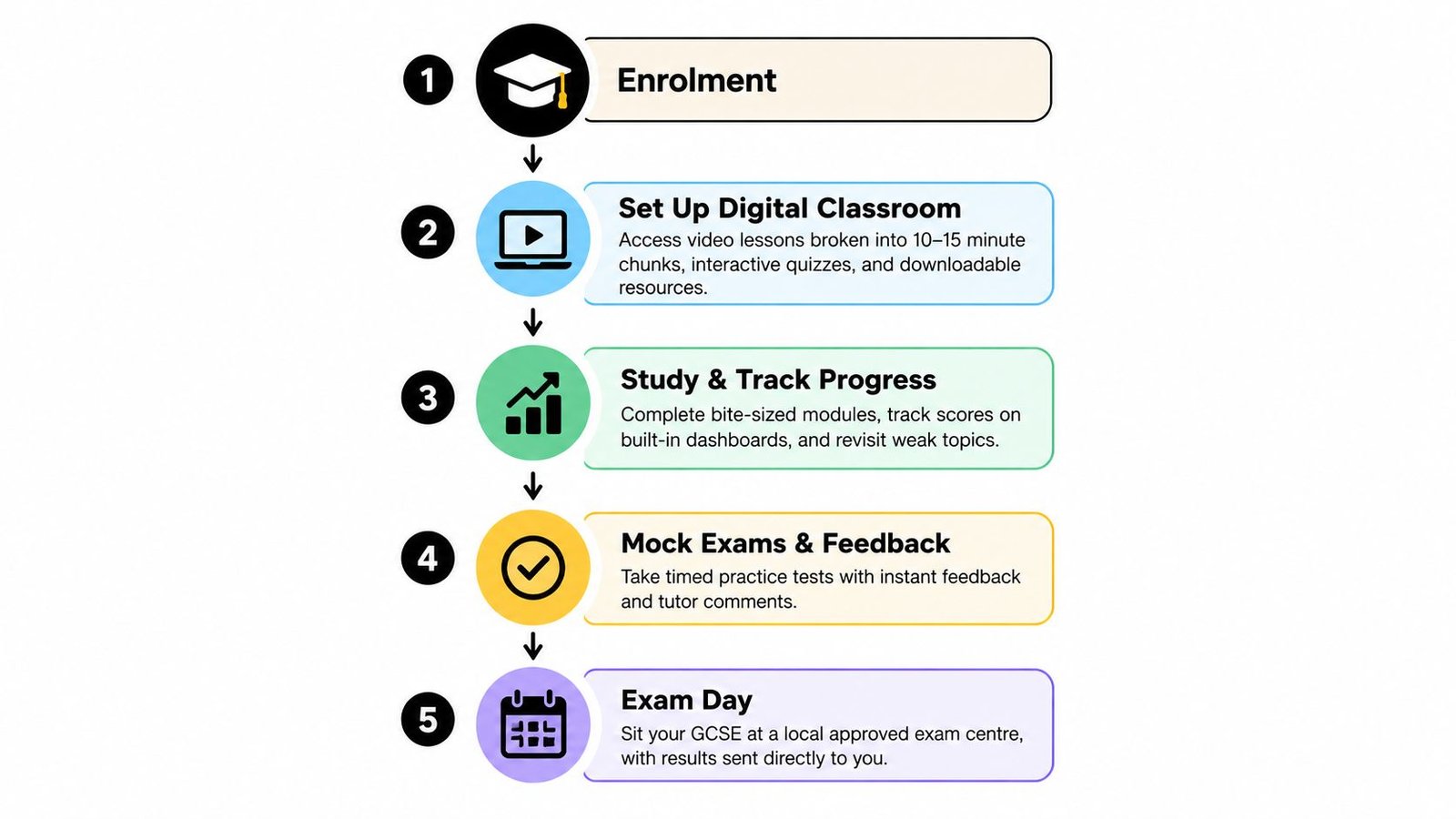
From enrolment to confident practice
Your journey will usually include these stages:
- Initial assessment: The provider checks your starting point and discusses your goal.
- Digital classroom setup: You receive your login, course materials and study plan.
- Regular learning: You complete topics, practise questions and record progress.
- Tutor feedback: Support may come through email, chat, live sessions or webinars.
- Exam preparation: You sit timed mock papers and review mistakes before booking the final assessment.
Study time depends on your starting point and the course design. Many adult learners need a steady part-time routine, rather than trying to complete everything in occasional bursts. Choose realistic weekly slots and protect them in your calendar.
Maths preparation needs particular care. Ofqual's current guidance confirms that GCSE mathematics uses formulae and equation sheets for the lifetime of the current specifications, while the intended total assessment time is no less than four-and-a-half hours, as set out in the latest Ofqual updates. Having formulae available doesn't remove the need to practise timed problem-solving, calculator choices, working and paper familiarity.
The exam access detail people miss
You'll normally sit the GCSE exam in person at an approved examination centre. Online lessons don't mean an online final exam. You may need to travel to a centre, or arrange a private centre that accepts external candidates.
Ask these questions before enrolling:
- Where will I sit the exam? Get the centre name and location in writing.
- Who books it? Some providers arrange exams, while others leave this to you.
- What does the fee cover? Tuition and exam arrangements may be separate.
- What identification is needed? Follow the centre's ID rules carefully.
- When are the deadlines? Book well before the exam entry deadline.
If you're considering distance learning, this explanation of whether you can do a GCSE online can help you separate online teaching from in-person assessment.
If you don't pass first time, resits may be possible, but you'll need to check the exam board timetable, centre rules and additional costs. Keep your identification and booking information somewhere safe.
Realistic Pass Rates and Funding
Adult learners deserve encouragement, but they also deserve honest information. In England's 2025 post-16 GCSE resit cohort, 206,732 learners aged 17 or older sat GCSE maths and 17.1% achieved grade 4 or above. For English, 175,118 learners sat the exam and 20.9% achieved grade 4 or above, according to FE Week's reporting on the 2025 GCSE resit results.
These results don't show that adults lack ability. Many learners are returning after disrupted schooling, a long break from study or difficult personal circumstances. A person who struggled at school may succeed with patient teaching, regular practice and support that recognises adult responsibilities.
Recent results also show the size of the need. BBC reporting on the 2026 results day said people aged 17 and older accounted for 24.3% of maths and English GCSE entries, compared with 23.4% the previous year. In that report, older candidates achieved grade 4 or higher in 19.8% of English Language entries and 15.3% of maths entries. You can read the BBC report on adult GCSE entries and results for the detailed breakdown.
| Subject | School-Aged Pass Rate | Adult Learner Pass Rate | Typical Funding Status |
|---|---|---|---|
| Maths | Results vary by cohort and year | Adult results vary by age and sitting | May be fully funded if eligibility rules are met |
| English Language | Results vary by cohort and year | Adult results vary by age and sitting | May be fully funded if eligibility rules are met |
The funding rules can make a major difference. In England, adults aged 19 or over can be fully funded for GCSE English and maths if they haven't previously achieved grade 4 or above. Funding rules can also cover Functional Skills English and maths from Entry Level to Level 2, including some learners whose current skill level is below grade 4 even if they already hold a certificate. Read the adult GCSE resit funding guidance and confirm your personal eligibility with an approved provider.
Funding may cover tuition and assessment arrangements, but private exam-centre charges or bundled extras may not always be included. Ask for a complete written price before you commit, then check with the National Careers Service or your chosen college.
Choosing a Quality Provider
The online GCSE market includes careful, supportive providers and courses that leave too many important details unclear. Protect yourself by asking direct questions before you pay.
Start with the qualification itself. The provider should tell you which awarding body and specification it uses, how the exams work and whether the qualification matches the requirement you're trying to meet. “Recognised GCSE” should come with specific information, not just a reassuring phrase.
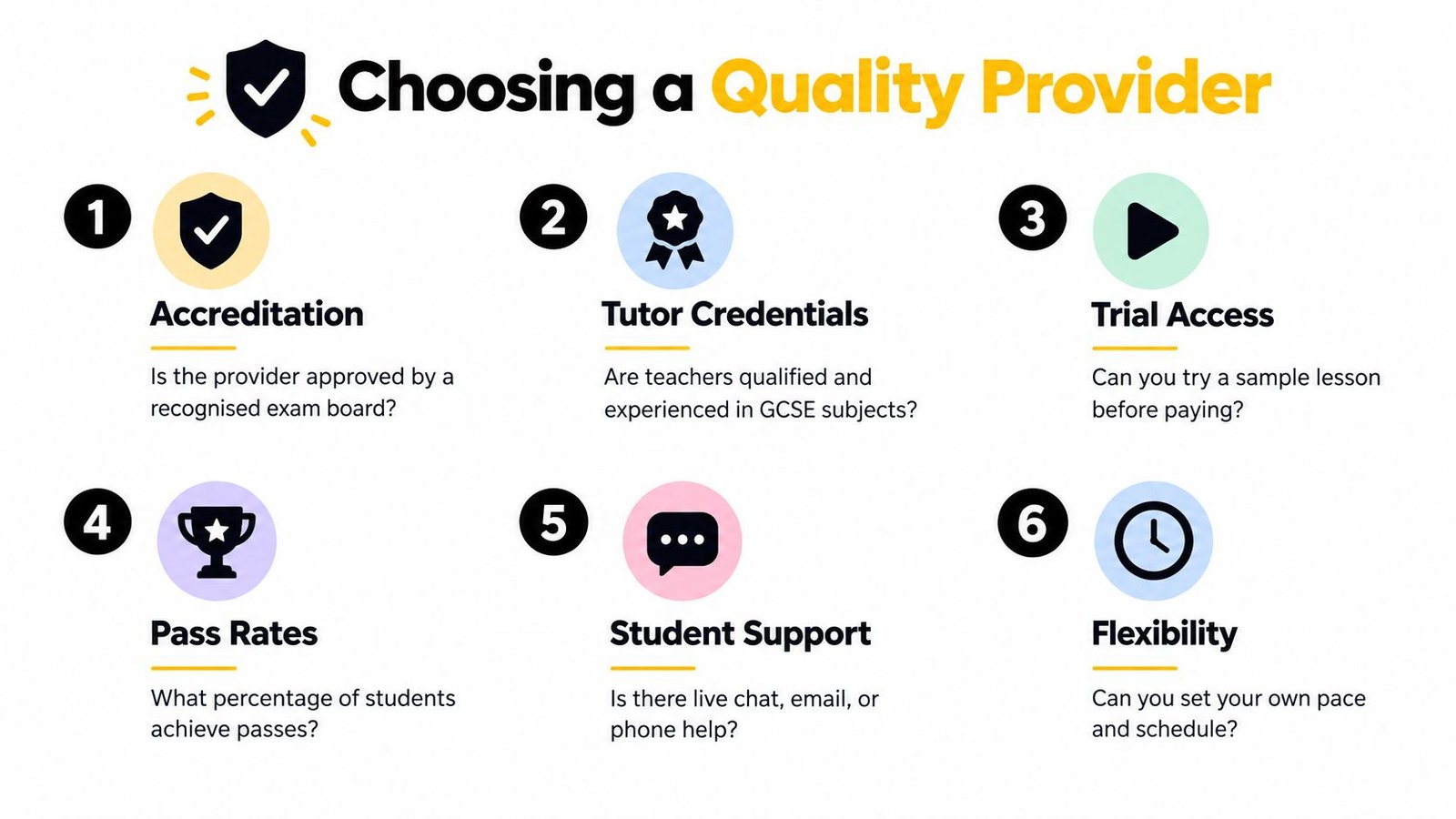
Questions worth asking
- Accreditation: Which recognised exam board awards the GCSE?
- Tutor credentials: Who marks your work, and what subject experience do they have?
- Trial access: Can you see a sample lesson before paying?
- Support: Can you contact a tutor by email, phone, chat or live session?
- Feedback: How quickly are assignments and mock exams marked?
- Exam arrangements: Does the course include an approved centre, or must you find one?
A provider should also explain its approach to safeguarding, accessibility and pastoral support. Adult learners may need help with confidence, motivation or study habits as well as subject content. A course that only gives you a login and a pile of worksheets may not offer enough help when you become stuck.
Be cautious about pressure-selling, unexplained limited-time discounts and promises of a guaranteed pass. No honest provider can remove the need for attendance, practice and exam performance. Independent learner reviews can reveal whether support is responsive, but read them with care and look for specific comments about tutoring, marking and exam access.
You can compare recognised online learning options, including information about accredited online courses in the UK. Treat any provider page as a starting point, then ask for the specification, costs and terms in writing.
Finally, place at least two providers side by side. Compare the actual support, assessment arrangements, timetable and total cost. The cheapest course may become expensive if you later need to arrange an exam centre or pay for extra support.
Where This Qualification Can Take You
English and maths GCSEs can support several different futures. A university applicant may need grade 4 in both subjects before the university considers their other qualifications. A person applying for nursing or initial teacher training may face the same requirement, while another adult may need the certificates for a promotion or apprenticeship.
The value depends on the destination. GCSE English can strengthen applications that involve communication, records and written work. GCSE maths can support roles involving calculations, measurements, data or financial responsibility. Employers may also see recent study as evidence that you can plan work, respond to feedback and keep working through a challenge.
From a certificate to a wider route
Once you meet the basic English and maths requirements, you may be able to progress towards:
- Further education: A levels, BTECs or other Level 3 qualifications.
- Higher education: An Access to Higher Education diploma or a degree application.
- Professional training: Routes in healthcare, teaching and other regulated areas, subject to their exact entry rules.
- Career development: Promotion, apprenticeships or a move into work that previously felt out of reach.
An online course can also change what happens at home. Your children see you create study time, ask questions and continue after a difficult result. That example can make education feel like something your whole family can value, not something that ended at school.
Your next four steps
- Name the goal. Write down the job, course or promotion you want, then check whether it asks for GCSE or accepts Functional Skills Level 2.
- Check funding. Speak to an approved provider and confirm whether your age, previous results and current skill level meet the rules.
- Shortlist two providers. Compare awarding body, tutor access, marking, exam-centre arrangements and total costs.
- Create momentum. Book a trial lesson or enrolment call within the next seven days, while your reason for starting still feels clear.
You don't need to feel completely confident before you begin. Confidence usually grows after the first completed lesson, the first corrected mistake and the first time a topic makes sense.
Next Level Online College offers flexible online GCSEs alongside Functional Skills, A levels and Access to Higher Education courses, with academic and pastoral support for adult learners. Visit Next Level Online College to compare your options, check the route that fits your goal and arrange your next step towards a recognised qualification.