
You're at the kitchen table after a long day. The house is finally quiet, but your Access to Higher Education Diploma work is still open in front of you. One question keeps returning: will these grades really be enough to get you into university?
They can form a clear route into a degree. Access to HE is a Level 3 qualification created for adults returning to education, and it carries UCAS Tariff points based on your graded credits. It's a serious university preparation route, not a second-rate replacement for A levels. Official figures recorded 38,220 students registered for an Access to HE Diploma in 2022-23, while earlier statistics recorded 23,290 students entering higher education in 2021-22. The regulatory body presents these figures as evidence that the qualification continues to help adults progress into higher education and meet skills needs. Read the official Access to HE statistics.
You'll see exactly how the 48 to 144 UCAS points range works, how mixed profiles are calculated, and how to compare your result with a university offer. If you're exploring education routes as a graduate or career changer, this guide to education for graduates may also help you think about your next direction.
Where You Are Right Now and Why Your Diploma Matters
Many adult learners worry that universities will see their Access diploma as less valuable because they didn't follow the usual school route. That fear is understandable, especially if you've been away from education for years or you're balancing study with work, children and home life.
Your qualification tells a different story. You've chosen a focused route that prepares you for degree-level learning. You're developing subject knowledge, writing skills, research habits and the determination needed to keep going when life is busy.
The UCAS part is more manageable than it first seems. Universities can use tariff points to assess whether your qualifications meet their entry requirements, and UCAS explains that only Level 3 qualifications are included in its tariff system. The Access diploma has a nationally recognised points range linked to your graded credits, so you don't need A levels to show academic readiness. Learn how UCAS Tariff points work.
Your route into university can start with the qualifications you can build now, not the qualifications you wish you'd taken years ago.
That matters beyond an application form. You might be studying because you want a fulfilling career, better earning opportunities or the chance to make a real difference in people's lives. Your children may also see you working towards something difficult and important. By continuing, you're showing them that learning doesn't have an age limit.
The sections below will help you read your own grade profile with confidence. You'll learn what each Pass, Merit and Distinction means in tariff terms, then use mixed examples to understand how a real transcript can match a university offer.
How the Access to HE Diploma Is Built
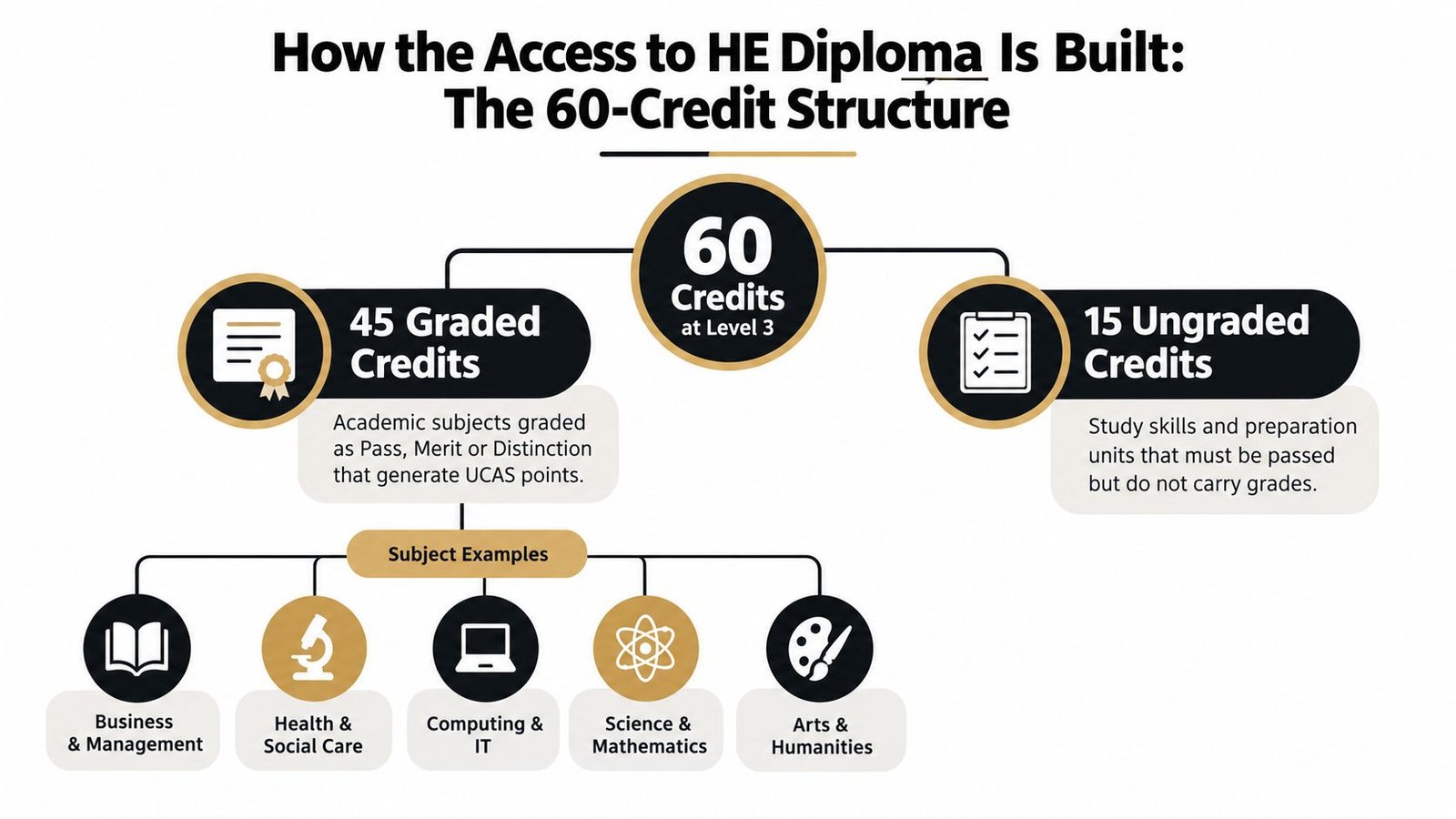
The diploma has a clear structure. According to the Quality Assurance Agency, it contains 60 credits, with 45 graded Level 3 credits and 15 ungraded Level 2 or Level 3 credits. See the QAA explanation of the Access to HE Diploma.
The 45 graded credits
These credits usually come from the academic subjects connected to your chosen pathway. Depending on your course, that might include nursing, business, humanities, health, social science or another university-focused area.
Each graded credit receives one of three results:
- Pass: You've met the required standard for the unit.
- Merit: You've shown stronger understanding and application.
- Distinction: You've produced work at the highest grade level available in the diploma.
These grades create your UCAS tariff total. The calculation looks at the profile across all 45 graded Level 3 credits, rather than counting the total credits on your diploma.
The 15 ungraded credits
The remaining credits are ungraded. They can cover important preparation such as essay writing, research, referencing, communication and study planning. You must complete them to achieve the diploma, but they don't add UCAS Tariff points.
This difference often causes confusion. The ungraded credits still matter because they help you become ready for university work and form part of the full qualification. They aren't used when your tariff score is calculated.
Once you understand this split, the headline range becomes much easier to read. Your final tariff value comes from the grade pattern across the 45 graded credits.
The 48 to 144 UCAS Points Range Made Simple
The Access to HE Diploma can produce between 48 and 144 UCAS points, depending on the grades achieved across the 45 graded Level 3 credits. The official QAA guidance gives examples of full Pass, Merit and Distinction profiles, and the same range is confirmed in published UCAS tariff guidance. Read the QAA admissions toolkit.
The three simple profiles are:
- 45 Passes: 48 points.
- 45 Merits: 96 points.
- 45 Distinctions: 144 points.
A simple way to understand the calculation is to divide each total by the 45 graded credits. The figures are approximate because the tariff is designed around the complete grade profile:
- A Pass profile works out at around 1.07 points per graded credit.
- A Merit profile works out at around 2.13 points per graded credit.
- A Distinction profile works out at around 3.2 points per graded credit.
So, for an all-Distinction result, the worked sum is 45 graded credits multiplied by around 3.2 points, giving 144 UCAS points.
| Grade Profile | UCAS Points | Example Calculation |
|---|---|---|
| 45 graded credits at Pass | 48 | 45 credits at Pass produce 48 points |
| 45 graded credits at Merit | 96 | 45 credits at Merit produce 96 points |
| 45 graded credits at Distinction | 144 | 45 credits at Distinction produce 144 points |
The clean profiles make the range easy to remember, but most learners have a mixture of grades. You might achieve Distinctions in subjects that suit your strengths, Merits in more demanding units and Passes in areas where you're still building confidence.
That doesn't mean your result is weak. A mixed profile can still meet a university's offer, especially when the course looks at both your total points and the grades in relevant subjects.
Don't judge your future by one assignment. Universities consider the full profile and the requirements of the degree you've chosen.
Working Out Your Own Points From a Mixed Grade Profile
Mixed profiles need a little more care. Start with the 45 graded Level 3 credits, then separate them into three groups: Distinctions, Merits and Passes.
For the detailed calculation method, QAA examples show how different grade combinations produce different totals. You can also use a UCAS points calculator for Access to HE courses to check your result.
A practical three-step method
- Count each grade. Write down the number of Distinction, Merit and Pass credits. The three numbers must add up to 45.
- Apply the grade values. Use the tariff values for each credit group. The detailed working method uses Distinction credits at 8, Merit credits at 4 and Pass credits at 2.67, then applies the qualification's conversion to the final UCAS total.
- Add and check. Compare the result with the official tariff guidance and the entry requirements for your chosen degree.
Take the profile requested most often by learners as an example: 30 Distinctions and 15 Merits.
- 30 Distinction credits multiplied by 8 equals 240.
- 15 Merit credits multiplied by 4 equals 60.
- The combined working total is 300.
- Applying the Access tariff conversion gives 128 UCAS points.
That profile is not an all-Distinction result, but it sits high within the available range. It shows why you shouldn't assume that anything short of 45 Distinctions will leave you without options.
Here's another profile: 24 Distinctions, 18 Merits and 3 Passes.
- 24 Distinction credits multiplied by 8 equals 192.
- 18 Merit credits multiplied by 4 equals 72.
- 3 Pass credits multiplied by 2.67 equals approximately 8.
- The combined working total is approximately 272.
- Applying the tariff conversion gives 116 UCAS points.
| Grade Profile out of 45 graded credits | Calculation | UCAS Tariff Points |
|---|---|---|
| 30 Distinctions, 15 Merits | 30 × 8, plus 15 × 4, then tariff conversion | 128 |
| 24 Distinctions, 18 Merits, 3 Passes | 24 × 8, plus 18 × 4, plus 3 × 2.67, then tariff conversion | 116 |
The 15 ungraded credits don't earn tariff points, but you still need to pass them to complete the diploma. Keep your transcript and ask your provider to confirm the final calculation before you submit an application.
How Access to HE Points Compare With A Level Points
UCAS tariff tables give A levels their own point values. The current values are A 56, A 48, B 40, C 32, D 24 and E 16*. A full Merit Access profile is 96 points, while a full Distinction profile is 144 points. Compare A level grades with UCAS points.
There's an important detail here. 96 points equals two A grades at A level, while 144 points equals three A grades at A level, or three A grades at A* level when comparing the stated maximum Access total with the combined tariff value of three A* grades. The safest comparison is always the tariff number, because universities can set their own conditions and may express offers by grade profile rather than a total.
| Qualification Grade | UCAS Tariff Points |
|---|---|
| A level A* | 56 |
| A level A | 48 |
| A level B | 40 |
| A level C | 32 |
| A level D | 24 |
| A level E | 16 |
| Access to HE, 45 Passes | 48 |
| Access to HE, 45 Merits | 96 |
| Access to HE, 45 Distinctions | 144 |
For an adult learner, Access can be easier to connect to a clear career goal. Rather than preparing for separate A level subjects over different courses, you study one diploma built around a pathway such as nursing, business or humanities.
That doesn't mean Access suits every applicant. Some competitive degrees ask for specific A level subjects or specific Access units. Check your target university before enrolling, especially if you're considering medicine, nursing, teaching, science or another course with subject conditions.
The key message is reassuring. Access is a recognised alternative route, and the tariff gives universities a way to compare your achievement with other Level 3 qualifications.
How Awarding Bodies and Subject Choices Affect Your Points
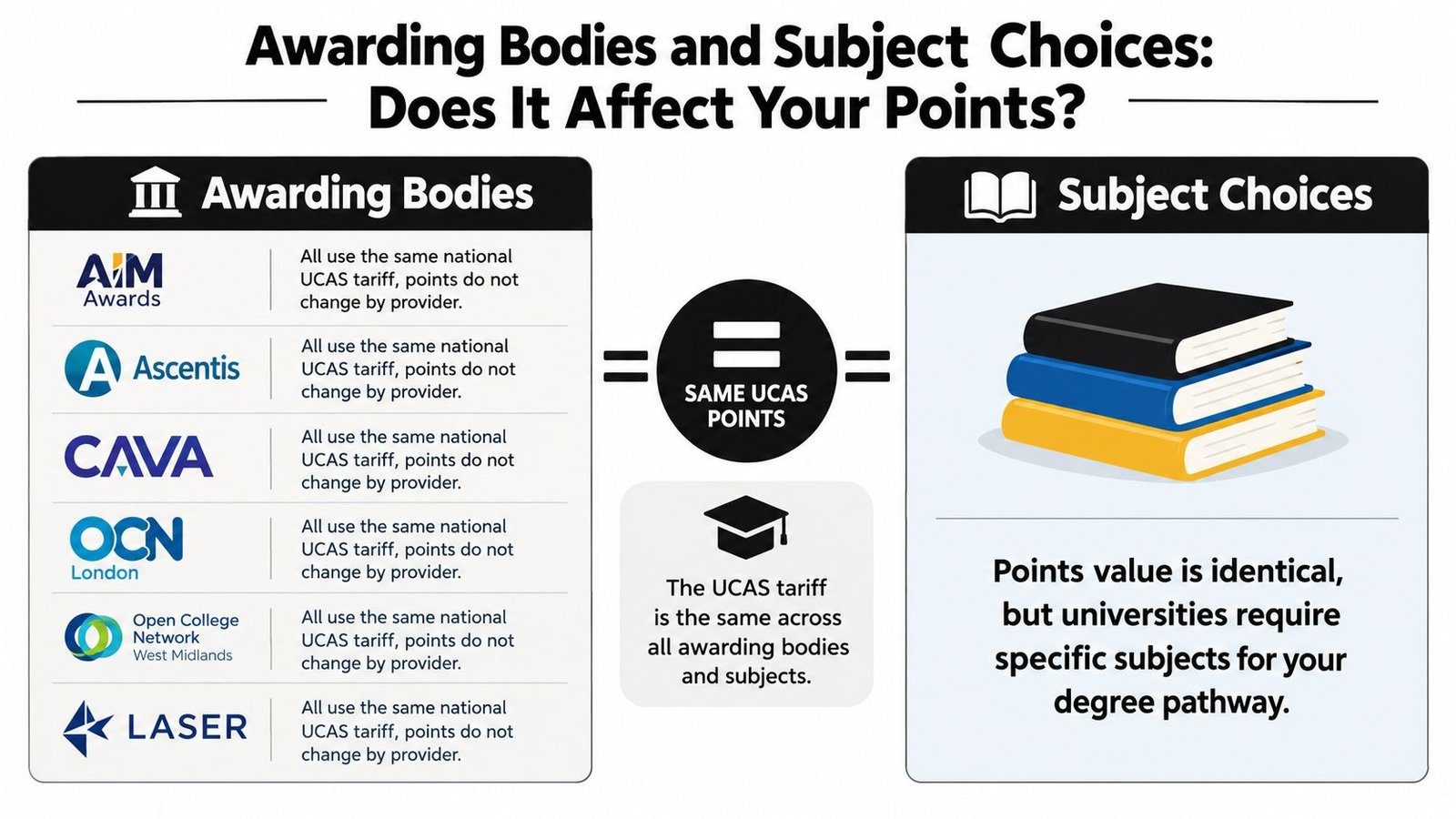
The UCAS tariff value doesn't change because your diploma comes from a different awarding body. AIM Awards, Ascentis, CAVA, OCN London, Open College Network West Midlands and LASER operate within the national Access to HE framework, so the tariff system applies to the qualification rather than rewarding one provider with extra points.
What can change is your grade profile. Different providers organise units, assignments and feedback in different ways. Marking may feel stricter in one pathway than another, although you shouldn't choose a course because you expect easier grades.
Your subject choice also affects what you study and which university courses will accept it. A science or nursing pathway may include units that support a health degree, while a humanities or business pathway may prepare you for a different group of courses.
Before enrolling, ask practical questions:
- Awarding body: Which organisation will issue and quality assure the diploma?
- Pathway content: Do the units match the subject requirements for your chosen degree?
- University acceptance: Does your target university accept this diploma and pathway?
- Assessment style: How are assignments graded, and what feedback will you receive?
- Progression record: Can the provider explain how learners are supported with applications?
University websites remain the final checkpoint. An admissions team may accept the diploma but still ask for particular credits at Merit or Distinction, or evidence of relevant study in a named subject.
The points framework is consistent. Your course content and final grades determine how useful that framework becomes for your chosen degree.
Turning Your UCAS Points Into a Real University Offer
A tariff total is only one part of an offer. Admissions teams may set a points target and add requirements for particular subjects or grades.
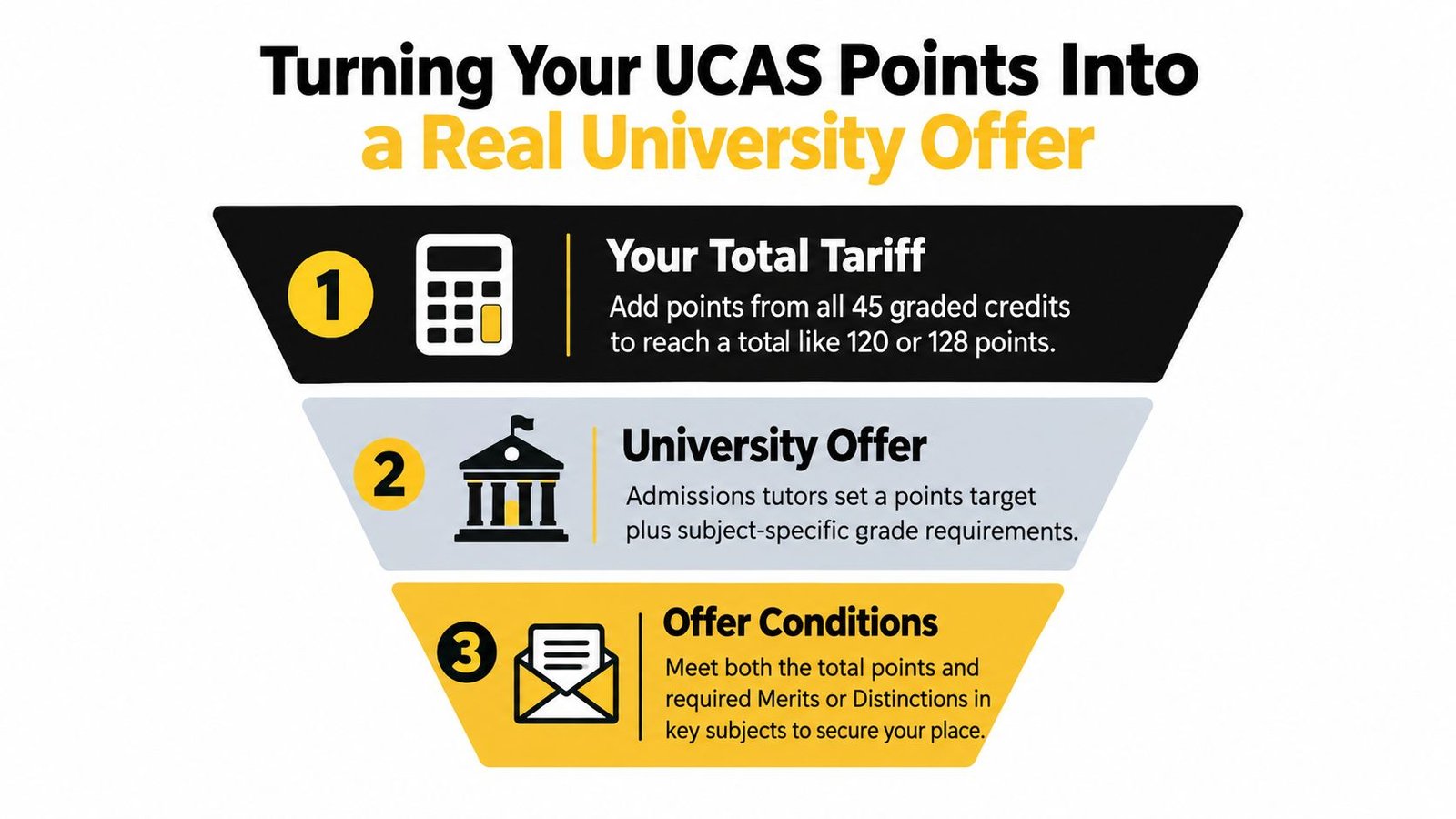
Suppose a course asks for 120 points. A profile of 30 Distinctions and 15 Merits gives 128 points, so the total is above that target. The university might still require certain grades in relevant units, so check the wording carefully rather than relying on the total alone.
A course asking for 144 points sets a much higher condition. The standard full-profile example is 45 Distinctions, although the university may describe its requirement in a different format.
Read every offer as two questions: how many points are needed, and which subjects or grades must appear in your profile?
Universities don't all write requirements in the same way. Some Russell Group institutions may ask for a profile such as 30 Distinctions and 15 Merits, while many post-92 universities may welcome a profile such as 33 Distinctions and 12 Merits. These are examples of how offers can vary, not universal rules. Always check the exact course page.
You may also need GCSE English and maths at grade C or grade 4, plus relevant work experience where the course asks for it. These conditions sit alongside your Access result.
For a clearer overview of the wider requirements, use this guide to university entry requirements in the UK.
Once you receive offers, read the conditions before choosing your firm and insurance options through UCAS. An insurance choice can give you another suitable route if your final results don't meet your firm offer, but it should still be a university and course you'd be happy to attend.
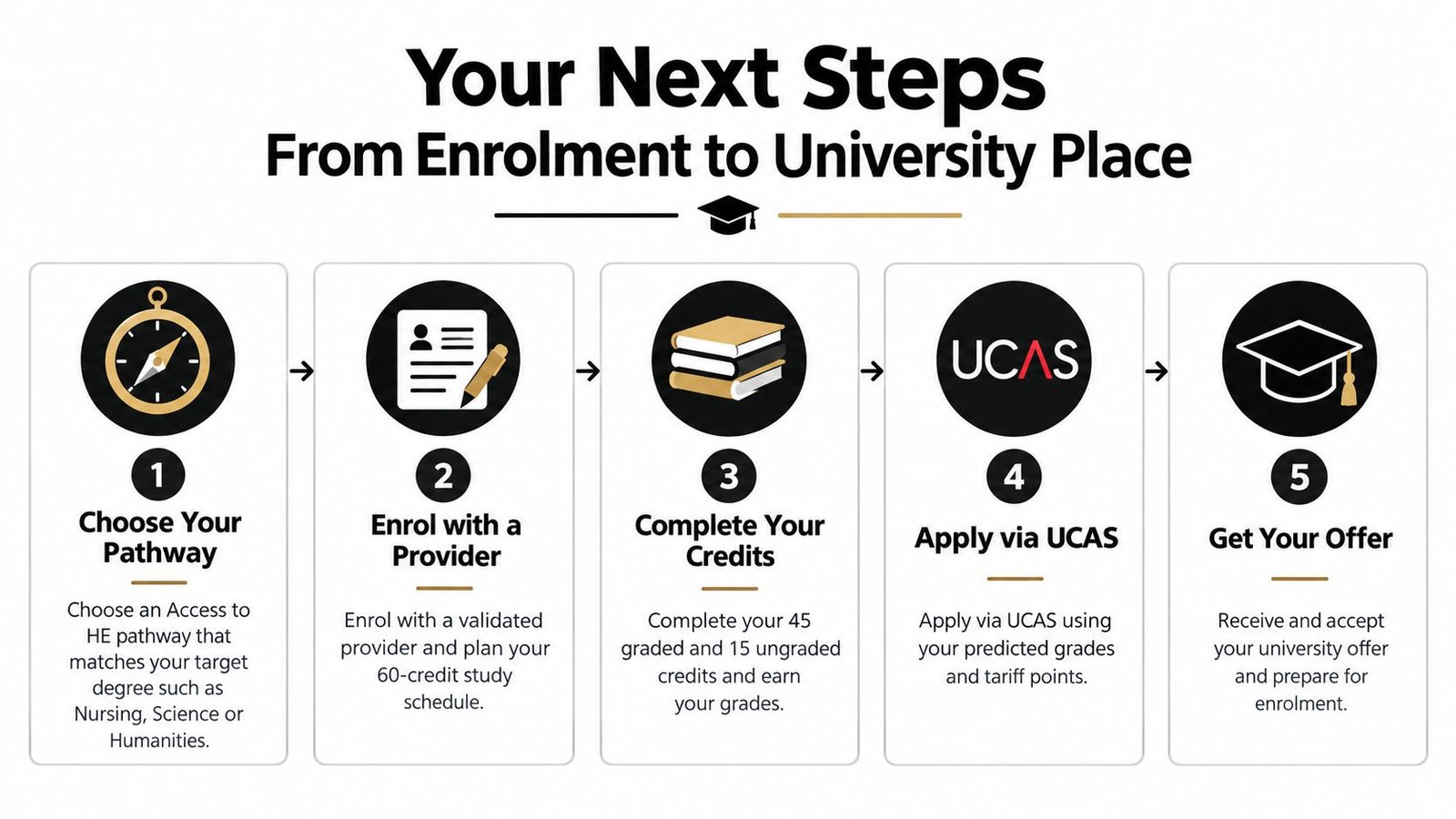
Your Next Steps From Enrolment to University Place
A university place can start with a decision made around work, family and everyday responsibilities. Break the route into clear actions, and each one gives you firmer ground for the next.
- Choose the right pathway. Match your Access subject to the degree you want. Nursing, Psychology and Business can have different entry requirements, so check course pages before enrolling.
- Confirm the qualification. Choose an approved provider and check that the diploma includes 60 credits, with the graded and ungraded credits required by the national framework.
- Build a study routine. Set regular time around your existing commitments. Course plans may suggest around 15 to 18 hours each week, but your provider should confirm the workload and deadlines for your programme.
- Set a clear grade aim. A profile of 30 Distinctions and 15 Merits is worth 128 UCAS points. Use it as a practical target, then improve one assignment at a time.
- Prepare your application. Use your personal statement to explain why you chose the degree, what Access has taught you and how your experience supports your ambition.
- Apply through UCAS. Record the relevant deadline and ask for help with references, predicted grades and interview preparation.
Feedback is part of the route, not a judgement on your potential. Your tutor can explain comments and help you plan stronger work. Your support team can help you keep studying when confidence falls.
Next Level Online College offers online Access to HE diplomas with academic and pastoral guidance, including support with applications, references and interviews. Studying this way can help you build a future that changes what is possible for you and your family.
Your personal statement does not need to sound perfect. Give clear reasons, describe your resilience and show how your studies are preparing you for university. You belong in that conversation.
Quick Reference Guide to Access to HE UCAS Points
Save this table while you're planning your application. It brings the main Access to HE Diploma UCAS points examples together in one place.
| Grade Profile, graded Level 3 credits | UCAS Tariff Points |
|---|---|
| 60 total diploma credits | 60 credits |
| Graded credits used for tariff | 45 credits |
| 45 Passes | 48 |
| 45 Merits | 96 |
| 45 Distinctions | 144 |
| 30 Distinctions, 15 Merits | 128 |
| 24 Distinctions, 21 Merits | 116 |
| 39 Distinctions, 6 Merits | 138 |
| Common university offer range | 96 to 144 |
| Ungraded credits | 15 credits, must be passed but don't affect tariff |
Mixed profiles fall between the main 48 to 144 range. Your provider can confirm your official result, and your university can explain whether it accepts a total tariff score, a specific credit profile or both.
Don't forget the ungraded part. Those 15 credits won't increase your UCAS total, but completing them is still necessary for the full diploma.
Why Access to HE Is a Proud Route Into University
Access to HE isn't a lesser route. It's a deliberate choice for adults who are ready to change direction and work towards a degree.
A full Distinction profile across the 45 graded credits produces 144 UCAS points, the tariff value associated with three A grades at A level. Recent UK-facing progression information records an acceptance rate of 77.3%, rising from 75.9% in 2023, even as the number of applicants progressing with an Access diploma slightly fell to 13,100. Read the Access progression discussion from Open Awards.
You bring more than grades. You bring life experience, motivation, responsibility and a reason to keep going. Your children may see you become a role model. Your future patients, pupils, clients or colleagues may benefit from the career you're building now.
You can see yourself as a future undergraduate, because that's exactly where this route can lead.
Next Level Online College offers flexible online Access to Higher Education Diplomas with tutor, academic and pastoral support for adults working towards university entry. Visit Next Level Online College to explore the right pathway, check your options and take your first step towards a degree.