
An A* at A level is worth 56 UCAS points, an A is 48, B is 40, C is 32, D is 24, and E is 16. If you're trying to work out what those numbers mean for your chances of getting into university, the good news is that they give you a clear target, not a closed door.
You might be reading this after years away from study. Maybe you work full time. Maybe you look after children. Maybe you started searching for university courses and suddenly found yourself facing words like entry requirements, tariff, and UCAS points and felt your confidence dip.
That feeling is common. It doesn't mean you're not capable. It usually means nobody has explained the system in plain English.
A lot of adults think university is only for people who got everything right the first time. That isn't true. Many people return to education later, often with more focus, more purpose, and a stronger reason to succeed. When you're doing this for yourself, your future, and your family, you bring something powerful with you.
This guide breaks down a level grades to ucas points step by step. You'll see how the points work, how to add them up, what common university offers mean, and what your options are if your current grades aren't where you want them to be.
Your Journey to University Starts Here
Karen is a good example of the kind of learner I often think about.
She works hard, keeps the house going, and tells her children to aim high. But when she thinks about going to university herself, a small voice says, "That was for other people. Not me." Then she sees a course asking for 112 UCAS points and feels stuck before she's even started.
If that sounds familiar, pause there for a moment.
Needing information doesn't mean you're behind. It means you're taking your future seriously. University applications can look full of coded language, especially if school was a long time ago. But once you translate the numbers, the path becomes much easier to follow.
The first thing to remember
UCAS points are not a judgement on your worth or intelligence. They are a way of turning qualifications into numbers so universities can compare applications more fairly.
You don't need to know everything today. You only need to understand the next step.
For many adult learners, confidence grows when the fog lifts. That starts happening the moment you realise that a points offer is something you can calculate, plan for, and work towards.
Why this matters emotionally as well as practically
Returning to study is rarely just about a qualification. Often it's about much more:
- Being a role model for your children and showing them that learning doesn't stop when life gets busy
- Opening the door to university so you can move into a more fulfilling career
- Building stability for your family through better long-term opportunities
- Proving something to yourself after years of doubting your own academic ability
Those goals matter.
When you understand a level grades to ucas points, you're not just doing admin. You're turning a vague dream into a workable plan. That's a big shift, and it can help you move from "I wish" to "I can."
What Are UCAS Tariff Points and Why They Matter for You
UCAS Tariff points give universities a common way to compare qualifications.
That matters because applicants do not all arrive with the same route behind them. One person may have A levels. Another may have a BTEC, an EPQ, or a mix of qualifications studied across different stages of life. The tariff turns those results into numbers that are easier to compare, which makes entry requirements clearer for you as well.
If you have been out of education for a while, this can feel more manageable than it first appears. A points offer is not a secret code. It is closer to a shopping list total. Each qualification adds a certain amount, and the university tells you the number it wants to see.
What the tariff helps you do
Once you know how points work, vague worries become clearer questions. Instead of wondering whether university is "for people like you," you can ask practical things such as how many points your grades already give you, how many more you need, and which study route could get you there.
That shift matters.
It turns a distant goal into a plan you can check step by step.
Here is how UCAS Tariff points help:
- They give you a clear target. If a course asks for a set number of points, you know what you are aiming for.
- They help you compare options. Two similar courses may ask for different totals, which can widen your choices.
- They make decisions easier. You can see whether an extra qualification, a resit, or a different course could strengthen your application.
A quick example makes this easier to grasp. If a university asks for 120 UCAS points, the useful question is no longer "Am I good enough?" The useful question is "Which grades or qualifications add up to 120?" That is a much kinder and more practical question to work with.
Why this often matters even more for adult learners
Adult learners sometimes carry extra pressure into this process. You may be balancing work, children, bills, or the memory of a school experience that did not bring out your best. A points system can bring order to that uncertainty because it shows what counts, what you already have, and what gap is left to close.
For many people, that is the moment confidence starts to return.
You can look at your current qualifications and say, 'Right, I know my current standing.' From there, the next step becomes easier to choose. Maybe you already have enough points for some courses. Maybe you need one more qualification. Maybe you need a different route altogether. All of those are workable outcomes.
Practical rule: Use UCAS points as a roadmap. The route becomes easier to follow when the milestones are written down clearly.
Universities do not rely on tariff points alone. Some courses ask for specific subjects or grades, not just a total. Even so, understanding the tariff gives you a solid starting point. It helps you measure progress, set realistic goals, and keep going with more confidence.
And that matters when you are building something bigger than an application. You are building options, stability, and a future your family can see taking shape.
A Level Grades to UCAS Points Conversion Table 2026
For 2026 entry, the current UCAS Tariff values for A levels remain the same. UCAS states that A levels convert as follows: A* = 56, A = 48, B = 40, C = 32, D = 24, E = 16, and AS levels are worth less, with AS A = 20 and lower grades scaled accordingly, as shown in the official UCAS tariff calculator.
Use this as a simple look-up table when checking a level grades to ucas points.
A Level and AS Level UCAS Tariff Points 2026 Entry
| Grade | A-Level UCAS Points | AS-Level UCAS Points |
|---|---|---|
| A* | 56 | n/a |
| A | 48 | 20 |
| B | 40 | 16 |
| C | 32 | 12 |
| D | 24 | 10 |
| E | 16 | 6 |
| U | 0 | 0 |
Where people often get confused
The most common mix-up is thinking AS levels carry the same value as full A levels. They don't. AS levels are worth less.
Another point that catches people out is the old tariff. If you've been away from education for a while, you may remember a different set of numbers. The current system is the one used for modern applications, so make sure you're using the up-to-date values above rather than older tables you may find online.
If you write these values down somewhere visible, you've already made university entry easier to understand.
How to Add Up Your A Level Points Worked Examples
Once you know the conversion table, the maths is simple. You just convert each grade into points and add them together.
Many universities phrase entry requirements as a total points score, so this is one of the most useful things you can learn.
Example one with three A levels
Let's say your grades are BBB.
A B is worth 40 points. So the total is:
- B = 40
- B = 40
- B = 40
40 + 40 + 40 = 120 UCAS points
That matches the standard combination listed in the UCAS Tariff overview on Wikipedia, where BBB = 120 points.
Example two with stronger grades
Now let's try ABB.
- A = 48
- B = 40
- B = 40
48 + 40 + 40 = 128 UCAS points
That same reference shows ABB = 128 points.
Example three with a common target
A lot of adult learners look at BBC because it opens a useful range of options.
- B = 40
- B = 40
- C = 32
40 + 40 + 32 = 112 UCAS points
This is a good example of how a points offer works. You don't need three identical grades to reach a total.
A quick comparison table
| Grade combination | UCAS points |
|---|---|
| AAA | 144 |
| AAB | 136 |
| ABB | 128 |
| BBB | 120 |
These combinations are commonly used by universities when setting offers, and the same source above lists them as standard benchmarks.
How to calculate your own total
Use this quick method:
- Write down each subject grade
- Convert each grade into points
- Add the numbers together
- Compare that total with the course requirement
If you can add three numbers, you can work out your UCAS points.
That may sound obvious, but it matters. Many people build this up in their heads as something complicated. It isn't. Once you've done it once or twice, it becomes routine.
One more reassuring thought
You don't need perfect grades to build a strong plan. You need honest information and a clear target.
That's why this process can be so confidence-building. Instead of guessing whether university is possible, you can put real numbers next to your goal and see what it would take to get there.
Decoding University Offers How Many Points Will You Need
University offers start to make more sense when you translate them into grades you recognise.
A course that asks for 120 points may feel abstract at first. But when you know that BBB = 120, it becomes much more concrete. You can then ask a better question: "Am I close to that, and if not, what would help me get there?"
According to this guide to university point ranges, 120 points often aligns with many respected universities, 96 points can suit post-92 institutions, and 72 points may lead to a foundation course.
What common points offers can look like
Here is a simple way to read some typical totals:
| UCAS points | A level equivalent | What it may open up |
|---|---|---|
| 120 | BBB | Many respected universities |
| 96 | CCC | Post-92 universities |
| 72 | DDD | Foundation courses |
These aren't guarantees. They are general benchmarks that can help you understand where your grades may fit.
Why points offers can be helpful
A points-based offer gives you flexibility. If one subject is your strength and another is harder, you may still reach the total in different ways.
That can be encouraging for adult learners who are balancing study with work and family life. Progress doesn't have to look identical across every subject to be valuable.
If you're looking at totals around this range, this guide to 104 UCAS points in grades can help you picture what different combinations look like.
Keep course type in mind
Some courses are more flexible than others. A foundation route may accept a lower point total and provide a stepping stone into a full degree later. Other courses ask for more because they are more competitive or need strong performance in a particular subject.
A lower starting point doesn't end the journey. It may simply change the route you take.
That matters because many adult learners assume there are only two outcomes: direct entry or no entry. In practice, there are often more pathways than that.
A healthy way to use these benchmarks
Use point ranges to guide your planning, not to label yourself.
If your current grades line up with a foundation course, that is still a valid route into higher education. If your target course needs more, that doesn't mean stop. It means build a plan.
Universities don't just admit a past version of you. They consider the applicant standing in front of them now, with determination, maturity, and a reason for wanting that place.
UCAS Points for BTECs EPQ and Other Qualifications
Many adult learners come back to study with qualifications collected at different stages of life. That is normal. It also means your application may be stronger and more flexible than you first think.
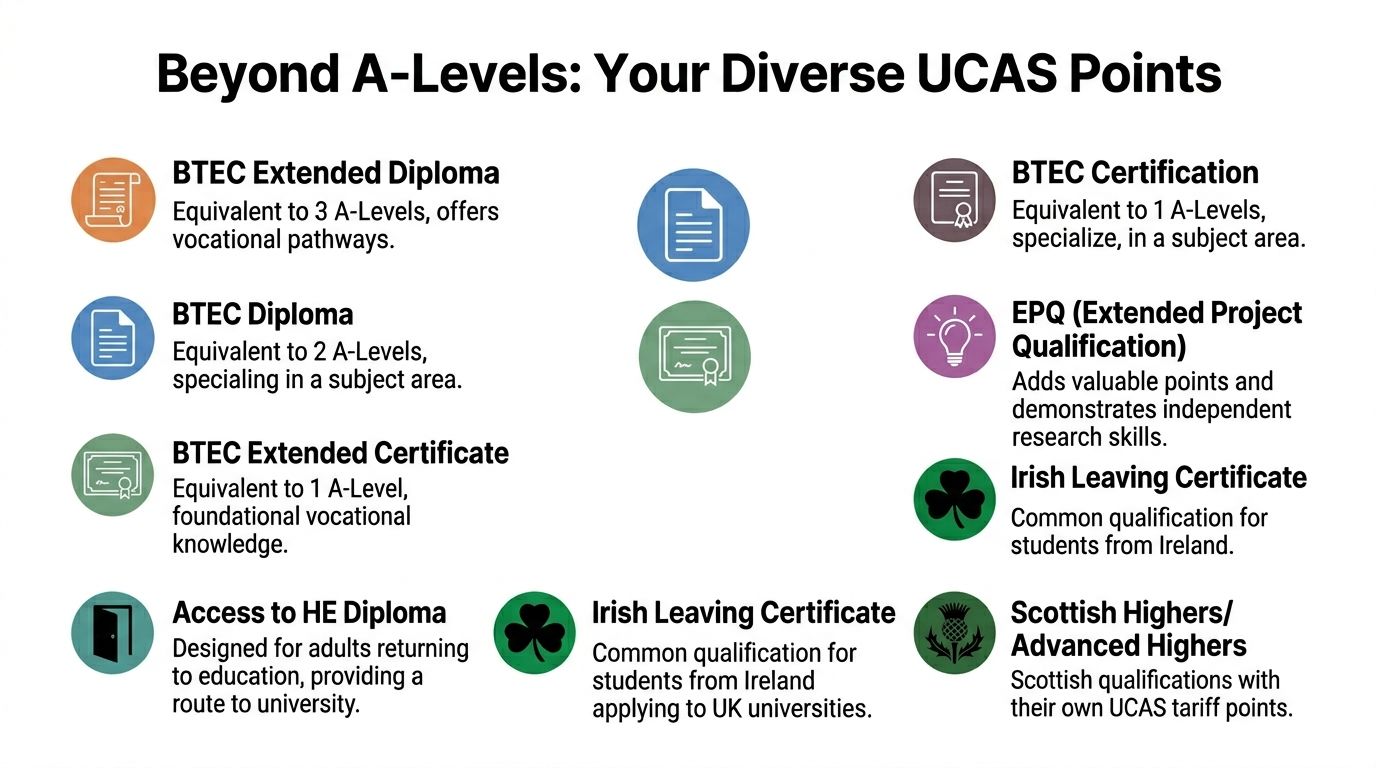
UCAS tariff points give universities a shared way to compare different level 3 qualifications. You can picture the tariff as a common currency. It helps admissions teams place A levels, BTECs, EPQs, Access courses, and other qualifications on the same map so they can judge your academic preparation more fairly.
Qualifications beyond A levels
A mixed qualifications profile is common, especially for adults who have studied around work, parenting, or changing career plans.
You might apply with:
- BTEC qualifications, which many universities accept and convert into tariff points
- An EPQ, which can add points and show that you can plan, research, and complete independent work
- An Access to HE Diploma, a well-known route for adults returning to education
- Scottish or Irish qualifications, which also have tariff values within the UCAS system
That matters because many people harbor concerns that a non-traditional route will be judged more harshly. In practice, universities regularly review applications with blended qualifications. What matters is whether your course accepts them and how they match the entry requirements.
How mixed qualifications can work in real life
A BTEC grade can contribute points in the same overall system as A levels, which makes planning much easier. If you are comparing vocational study with academic study, this guide to BTEC Level 3 UCAS points can help you see how those qualifications fit into university entry.
The EPQ can also help. It usually carries fewer points than a full A level, but it can still strengthen your total and show habits universities value, such as time management, independent reading, and sustained focus.
Access to HE Diplomas work a little differently on some course pages. Universities may describe their requirements in terms of distinctions, merits, or subject-specific units rather than a simple tariff total. That can look confusing at first, but it is still manageable. Read the offer slowly and translate it one line at a time.
What to check before you rely on the points
Tariff points are a guide, not an automatic guarantee of entry.
A course may accept BTECs for one subject area but prefer A levels for another. It may welcome an EPQ as extra evidence of study skills but still ask for a named subject such as Maths, Biology, or English. Some adult applicants miss this detail and focus only on the total.
A careful approach is:
- Check the course page for accepted qualification types
- Read the subject requirements separately from the tariff points
- Contact admissions if your qualifications come from different routes or different years
Different qualifications can still form a clear route to university.
For adult learners, that route often tells a powerful story. It shows persistence, practical decision-making, and a willingness to keep building your future even if your education happened in stages. That is not a weakness. For many universities, it is evidence that you are ready to take your next step seriously.
Beyond the Points What Universities Really Look For
You check a course page, see the tariff points, and feel you finally have a number you can work toward. Then another line appears. It asks for a specific subject and a specific grade. That moment catches many adult applicants off guard.
UCAS points are only one part of the decision. Universities often use them as a first sorting tool, a bit like checking whether you have the right key for the door. After that, they still look at the shape of your qualifications, the subjects you studied, and the evidence that you can handle the course.
Some courses care strongly about exact subjects. Nursing may want a science background. Business may accept a wider mix. A highly competitive course may ask for both a points total and a named grade in one subject. As noted earlier, universities also have rules about which qualifications can be counted together, so careful checking matters.
Why exact grades sometimes carry more weight
A total can look strong on paper and still miss the requirement if the course asks for a particular subject at a particular grade.
That is not a trick. It is the university checking whether you already have the foundation needed for the first year. If a degree builds heavily on Maths, Chemistry, or English, admissions teams want proof that you are ready to start at that level. The points show volume. The subject grade shows fit.
This is why reading the full entry profile slowly can save you stress later. Look for three separate things: the total points, any required subjects, and any wording about preferred qualifications.
What universities may value in adult learners
Adult applicants often bring something hard to show in a simple tariff table. You may have stayed in work, raised children, supported relatives, managed a home, or returned to study after years away. Those experiences can strengthen an application when you present them clearly.
Universities may look for:
- A clear reason for choosing the course
- Relevant work, volunteering, or caring experience
- Proof that you can stay committed over time
- Academic readiness through recent study
- A realistic plan for balancing study with responsibilities
Those points matter because higher education is not only about past grades. It is also about whether you are likely to cope, contribute, and continue. Adult learners often have a stronger sense of purpose than younger applicants, and that can come through powerfully in the application.
A good application tells a joined-up story. Your qualifications show what you know. Your experience shows how you keep going when life is busy. Your personal statement and course choice show where you want that effort to take you.
For wider support with the full application process, including course choices and entry routes, read this guide on how to get into universities.
Keep the right perspective
UCAS points are useful. They give you a target and help you compare courses. But they are not your whole value as a candidate, or as a person building a better future.
If you are returning to education now, you are already proving something important. You can start again with purpose. You can build new qualifications in stages. You can become the person your children, family, or future self will look at and say, "They kept going."
Universities admit applicants with grades, yes. They also admit adults with direction, maturity, and a serious reason for being there.
Dont Have the Points Yet Your Inspiring Comeback Plan
Not having the points yet doesn't mean you've missed your chance. It usually means your plan needs another chapter.
Many adults carry old school disappointment for years. A low grade from the past can start to feel like a permanent label. It isn't. A result is a snapshot from one point in time. It is not the final word on what you can become.

Recent admissions practice also gives reason for hope. This report on low-grade university entry routes says universities have increasingly used contextual offers and Clearing to admit students with grades as low as EEE, which equals 48 points, particularly for foundation courses and to support disadvantaged or mature applicants.
Your options if you're below the requirement
A lower total today doesn't mean there are no routes forward. It may mean one of these options is worth considering:
Resit and improve your grades
If you know you can do better with proper support and more structure, resitting can raise your total and widen your options.Apply for a foundation course
Foundation years can provide a supported route into a degree, especially if your current grades are lower than the standard offer.Use Clearing wisely
Some universities become more flexible when they still have spaces to fill.Look at contextual offers
Mature applicants may be considered more broadly, especially where universities want to support non-traditional routes into higher education.
What a comeback plan can look like
Here is a simple, honest approach:
- Work out your current points total
- Choose a course goal that matters to you
- Check whether the route could be direct entry, foundation, or a resit year
- Strengthen weak subjects instead of trying to fix everything at once
- Keep evidence of your commitment and progress
That is not a lesser journey. For many adults, it becomes the turning point that changes everything.
Keep your reason in front of you
Maybe you want a career with more meaning. Maybe you want more stability at home. Maybe you're tired of telling yourself you left it too late.
Those are strong reasons to keep going.
This short video can help you stay focused on the bigger picture.
Progress counts even before the offer arrives
When adults return to learning, the first win is often internal. You start to trust yourself again. You begin finishing tasks you once avoided. Your children see you studying. Your family sees you trying.
That matters.
Some of the strongest university applicants are people who had to fight their way back into education.
If your grades need work, that doesn't make your dream unrealistic. It makes your next step important.
Taking the Next Step Towards Your Dream Career
At this point, you don't need more confusion. You need a calm, practical list of what to do next.
The best next step is always the one that turns hope into action. Once you know your points, you can start making decisions with much more confidence.
Your simple checklist
Calculate your points carefully
Use the current tariff values and total up your grades properly.Check each course page
Look for whether the university asks for points, specific grades, or both.Read the subject requirements
A course may want a particular grade in a particular subject.Consider every valid route
Direct entry, a foundation year, or a resit can all be sensible paths depending on your current profile.Contact admissions if anything is unclear
Universities can often tell you how they view your qualifications and what route may suit you.

A good way to think about the journey ahead
Don't wait until you feel perfectly confident. Most adult learners don't.
Confidence often grows after you take action, not before. It grows when you make the call, send the enquiry, check the requirement, or enrol on the course that moves you closer to the life you want.
You are allowed to want more for yourself. You are allowed to go back and do this properly. You are allowed to become the person your younger self needed.
Keep the bigger goal in view
A university place is not just an academic target. For many adults, it represents:
- A new career direction
- More choice and independence
- A stronger example for their children
- A future built with intention instead of regret
That future doesn't begin on the day you get accepted. It begins the day you decide your education still matters.
If you're ready to improve your grades, build your confidence, and move closer to university, Next Level Online College offers flexible online study designed for adult learners balancing real life responsibilities. With recognised courses, structured support, and a clear route towards further study, it can be a practical next step for turning your plans into progress.