
You might be reading this after work, with a cup of tea going cold beside you, wondering whether education is something you've missed. Maybe you left school years ago. Maybe life got busy. Maybe your children are doing homework at the table and a quiet part of you wishes you had another chance too.
You do.
Choosing A Level Economics online isn't just about getting a qualification. It's about proving to yourself that your story isn't finished. It's about showing your children what courage looks like. It's about building a future with more choices, more confidence, and a stronger sense of who you are.
If you feel nervous, that's normal. Many adult learners do. They worry they've forgotten how to study. They worry they won't understand the subject. They worry they'll fall behind. But fear doesn't mean you're not ready. It usually means this matters to you.
Economics is a strong subject for people who want to understand the world around them. It connects with business, finance, politics and social science pathways, and it asks you to think about real issues such as inflation, unemployment, trade and growth. In UK teaching, examples often include major economic changes such as UK inflation reaching 11.1% in October 2022, easing to 10.1% by March 2023, while real GDP grew 4.1% in 2022 and average wages fell 3% in real terms in 2022 according to this UK economics teaching overview.
Those aren't just facts for an exam paper. They're part of your life. They affect food prices, bills, wages and job security. That's why this subject can feel so meaningful. You're not learning random information. You're learning how the country works, and how decisions made by businesses and governments shape everyday life.
Your Time to Shine Is Now
There's a moment many adult learners know well. It happens when the house finally goes quiet. You sit down, look at your phone, maybe scroll through course pages, and think, “Could I do this?”
Yes, you could.
Not because it will always feel easy. Not because you'll never have doubts. You can do it because adults bring something powerful to learning. You know why you're studying. You know what responsibility feels like. You know how much better life can be when you keep going, even when things feel hard.
Your past doesn't get the final say
Maybe school didn't go well the first time. Maybe you had other pressures. Maybe nobody told you that you were capable. Adult learners often carry old labels for years. “Not academic.” “Too late.” “Not for people like me.”
Those labels aren't facts. They're old opinions.
You are not going back to become the person you should have been. You are moving forward as the person you are now.
That matters. You're likely more focused than you were at sixteen. You're more aware of time. You understand sacrifice. When you study now, you do it with purpose.
Why online study suits real life
A traditional classroom doesn't fit everyone. Work shifts, school runs, caring duties and household costs can make fixed timetables feel impossible. Online learning gives you another route. It lets you build study around your life instead of forcing your life around study.
That can look different for each person:
- After bedtime study: You read through a topic once the children are asleep.
- Lunch break revision: You use a short break to go over key terms or diagrams.
- Weekend catch-up: You spend a quiet morning working through a tutor-set task.
None of that is small. It's disciplined. It's brave.
A different kind of success
You don't need to become a perfect student overnight. You just need to begin. One lesson. One set of notes. One question asked when you're unsure.
For many adults, the first real win isn't the final grade. It's the first time they realise, “I understood that.” Then confidence starts to grow. Then routine starts to build. Then the goal that once felt distant starts to feel real.
Your family may see a course. What they're really seeing is you choosing more for your life.
What Is an Online A Level in Economics Really
You may have heard the word economics and pictured something cold, complicated, and full of graphs that only experts understand. Then you look at your own life. Food prices go up, wages feel stretched, interest rates are on the news, and every family decision seems to involve a trade-off. That is economics in real life, and you already know more about it than you think.
Economics is about choices made when money, time, and resources are limited. A parent choosing between saving and spending is making an economic decision. A business setting prices is making one too. So is a government deciding how to tax, borrow, or spend.
That matters because the subject is not separate from your world. It gives names and clear explanations to things you have already lived through.
Economics in simple words
A clear way to split the subject is to look at the small picture and the big picture.
| Part of economics | Simple way to see it |
|---|---|
| Microeconomics | Your household budget or one business making decisions |
| Macroeconomics | The whole UK economy, including inflation, growth and unemployment |
Microeconomics looks closely at individual choices. Why does a shop raise its prices? Why do people buy less when something becomes expensive? What happens when a product is in short supply?
Macroeconomics steps back and looks at the wider economy. Why is inflation rising across the country? How does unemployment affect communities? Why do governments care about economic growth?
It works a bit like using two camera lenses. One shows the close-up detail of a single decision. The other shows the wider picture and how many decisions connect.
What the online part actually feels like
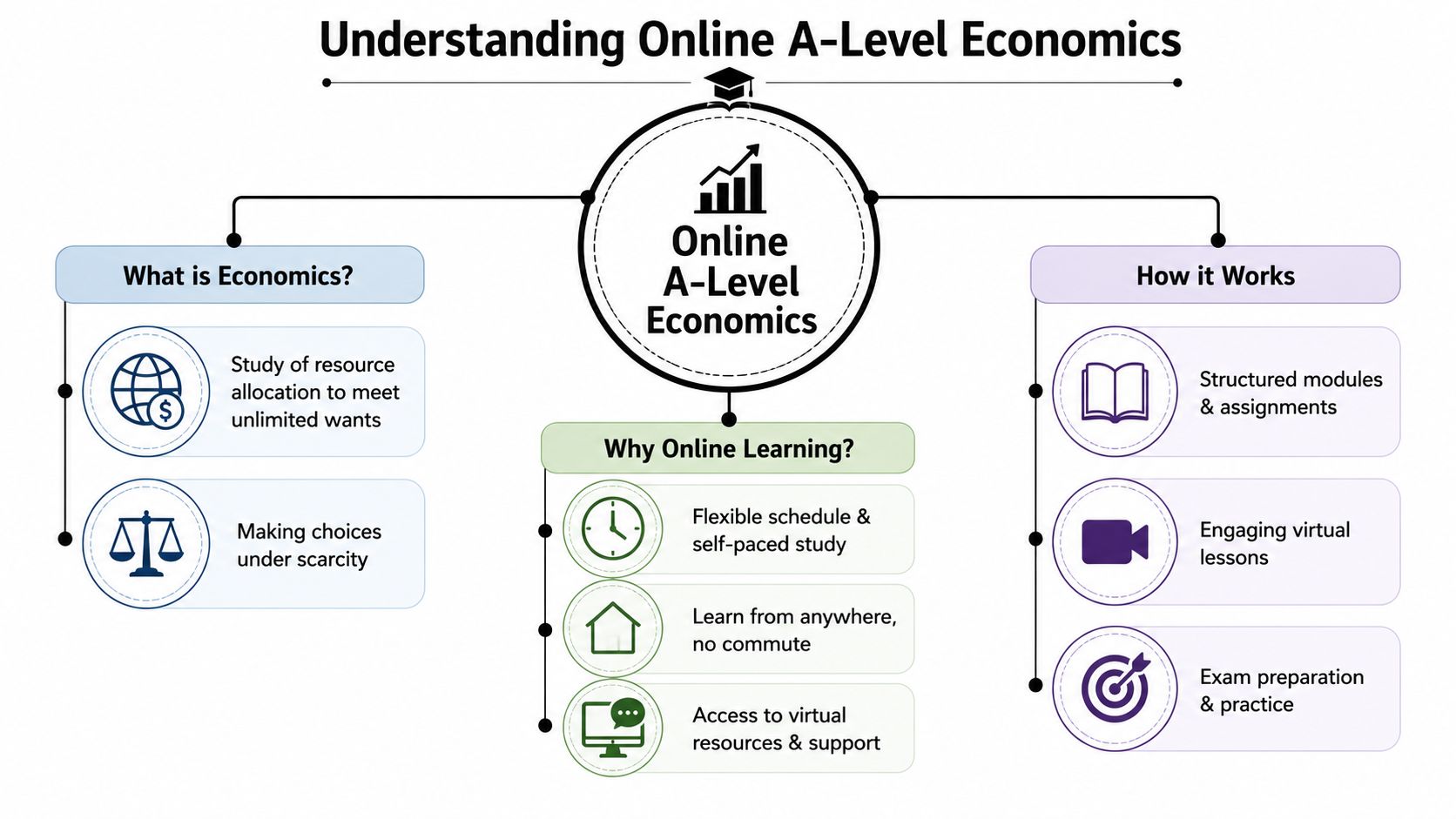
Studying online usually means learning through a digital platform with lessons, activities, assignments, and feedback arranged in a sensible order. You are still working towards the same qualification. The difference is that you can study in a way that fits adult responsibilities.
For you, that might mean reading a lesson before work, making notes at the kitchen table, or revisiting a tricky topic later in the evening. You are not expected to absorb everything in one sitting. You return to ideas, build your understanding gradually, and keep going.
That rhythm suits many adult learners. Life rarely gives you perfect study days. Online learning gives you a practical way to keep making progress anyway.
Why this subject is more than memorising
A Level Economics is not only about remembering definitions. You learn how to apply ideas to real situations, explain what a graph shows, and write clearly about cause and effect. In exams, students are typically asked to work with data, short responses, and longer written answers, so understanding matters far more than reciting facts.
A useful rule is simple.
Practical rule: If you can explain an economic idea in your own words, you are already learning it properly.
Adult learners often find this reassuring. You have seen budgets, bills, taxes, pay, and rising costs up close. So when the course talks about incentives, inflation, scarcity, or opportunity cost, you are not starting from nothing. You are connecting new terms to experiences you already carry.
That connection can be a real confidence boost. The subject starts to feel less like a closed door and more like a language for understanding your life, your decisions, and the future you want to build for your family.
A Powerful Investment in You and Your Family
Some qualifications change what you know. Others change how you see yourself. A Level Economics online can do both.
When you study as an adult, your children notice. They see you reading when you're tired. They see you trying again after a difficult week. They see that learning doesn't stop when school ends. That example stays with them.
The pride your family will feel
Children don't need perfect parents. They need real ones. When they watch you take education seriously, you teach them something bigger than any single subject. You teach them that effort matters. You teach them that setbacks aren't the end. You teach them that grown-ups can grow too.
That's powerful.
A child who sees their parent revise for an exam sees discipline in action. A partner who watches you keep going sees your determination. And you get to feel something many adult learners haven't felt for a long time. Pride that comes from earning something through steady effort.
Confidence grows through action
Low confidence often tells people to wait until they feel ready. But confidence usually comes after action, not before it.
That's why studying can be so healing. Every finished task is proof. Every marked assignment shows progress. Every topic you once feared becomes evidence that you're capable.
Here are some of the emotional gains adult learners often describe:
- Stronger self-belief: You stop seeing yourself through old school memories.
- A clearer identity: You start to think of yourself as someone who can achieve demanding goals.
- A better example at home: Your family sees commitment, patience and resilience up close.
It can support a better future too
This isn't only emotional. Qualifications can also support practical change. Economics is widely valued for pathways linked to business, finance, politics and social science. If you've been thinking about university, a career change, or building toward work with more responsibility, this subject can help create that bridge.
There's also something reassuring about studying a subject that connects directly to everyday life. You're learning ideas that help you understand prices, wages, jobs, growth and government decisions. That makes the effort feel worthwhile because what you learn doesn't stay trapped in a textbook.
Studying as an adult is an act of care. You're caring for your future self, and for the people who depend on you.
Success changes the atmosphere at home
A course can change the mood of a household. Not because every day becomes easy, but because hope enters the room. You're no longer only coping with life as it is. You're building life as it could be.
That's one reason adult education matters so much. It can help you move from doubt to direction. From “I wish I'd done more” to “I'm doing it now.”
Your Economics Learning Journey Explained
One reason adults hesitate is that course information can sound far too complicated. Exam boards, specifications, assessment objectives. It can feel like another language. In reality, the structure is much simpler once you strip away the jargon.
Most online A Level Economics courses follow an official exam-board specification. That means you're studying towards the same kind of recognised qualification as a student in a school or college. The board sets the content and exam style. Your job is to learn the material steadily and practise using it clearly.
The two big halves of the subject
The course usually rests on two main parts.
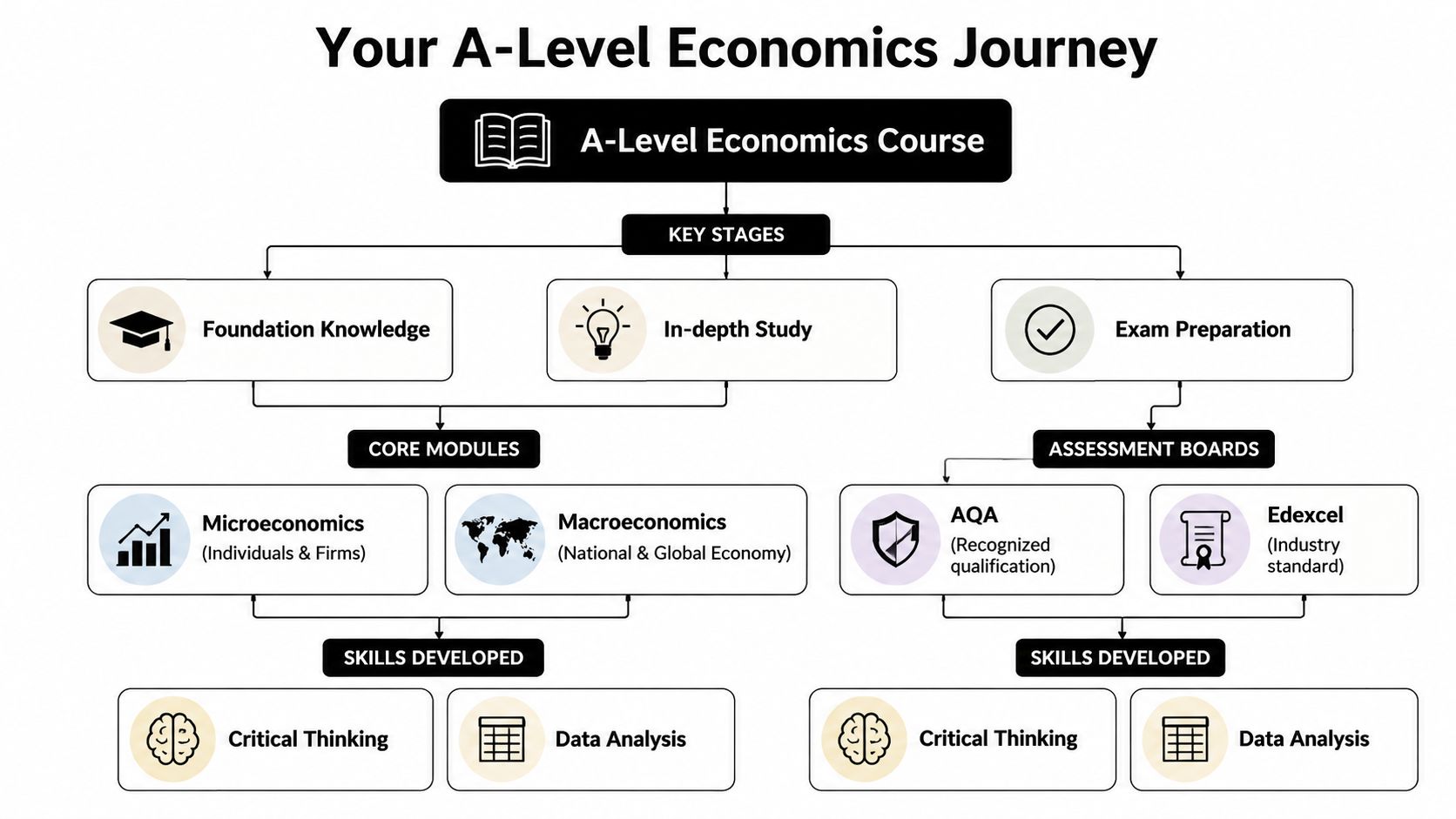
Microeconomics looks closely at individuals, consumers and firms. You might study demand and supply, markets, competition, costs and business decisions.
Macroeconomics looks at the wider economy. You explore growth, inflation, unemployment, trade and government policy.
A simple comparison helps:
| Topic area | What you're really studying |
|---|---|
| Microeconomics | How smaller parts of the economy behave |
| Macroeconomics | How the country's economy works as a whole |
How the learning usually builds
You won't be thrown in at the deep end. Good course design builds knowledge in layers. First you learn the basic terms. Then you apply them to examples. After that, you start writing stronger answers that explain, analyse and evaluate.
Many adults find it helps to think of the course in three stages:
Foundation knowledge
Learn the key words and core ideas. Confusion begins to fade.In-depth study
Connect topics together. You begin to see why one economic change can affect many areas.Exam preparation
Practise using evidence, writing under time pressure and answering the kinds of questions examiners expect.
If you want a clear picture of how online courses are generally organised, this step-by-step guide to how online college study works gives a helpful overview.
Why adults often worry too much about exam boards
There's a genuine information gap here. Public guidance often explains what the course covers but gives less help on who online study suits best, especially for adults returning after a break. There's also not enough neutral, UK-specific guidance on how to compare flexibility with the need for feedback, exam practice and subject support, as noted in this overview of online A Level Economics course guidance.
So if you've felt unsure, that isn't your fault. The information available often leaves practical questions unanswered.
The key thing is this. You don't need to know everything on day one. You need a course with a clear path, strong support, and enough time to build confidence one topic at a time.
How You Are Supported Every Step of the Way
One of the biggest fears adults have about online study is feeling alone. That fear makes sense. If you've been away from education for years, you don't want to sit in silence with difficult material and no help.
Good online learning shouldn't feel like that.
A strong course gives you structure, feedback and a real person to turn to when you're stuck. Support matters even more in Economics because the subject mixes written explanation with data interpretation, diagrams and reasoning.
The workload is more manageable than it sounds
A full A Level in Economics typically involves about 360 guided learning hours, and flexible online study can be spread over up to 24 months according to this A Level Economics online course breakdown. That works out to roughly 7 hours a week over 12 months or 3 to 4 hours a week over 24 months.
For many adults, that changes everything. A qualification feels much less frightening when you can see it in weekly chunks.

What support should look like
You deserve more than a login and a reading list. Look for support that includes:
- Tutor guidance: Someone who can explain tricky ideas in plain English and respond when you get stuck.
- Marked work: Feedback helps you improve, especially for longer answers and essays.
- Flexible pacing: Adult life is unpredictable. A course should allow for that.
- Pastoral encouragement: Sometimes what you need most is reassurance that you're doing better than you think.
If dedicated support matters to you, this expert tutor support page shows the kind of help adult learners often benefit from when studying online.
A steady routine beats a perfect routine. Three focused hours every week can do far more than one exhausting burst followed by silence.
Why online doesn't mean isolated
You might ask a question that feels obvious. Ask it anyway. You might need a topic explained twice. That's normal. Learning is not a performance.
There's also a recognised gap in public advice around exam-board choice and assessment strategy for online A Level Economics. Many people want UK-specific guidance on essay marking, data-response practice and realistic independent study demands, but often find only broad revision advice, as highlighted in this discussion of extra tuition and passing A Level Economics.
That's why proper support matters so much. A helpful tutor can turn confusion into a plan. And once you have a plan, the subject stops feeling like a mountain and starts feeling like a path.
Your Future with an Economics A Level
You might be clearing the dinner table, checking your bank balance, and wondering what the next few years could look like for your family if you had stronger qualifications behind you. That question matters. An A Level in Economics can become part of a real change in direction, especially if you want to build a more secure future and show your children what courage looks like in everyday life.
This qualification can lead in more than one direction. You may want to apply for university. You may want better options at work. You may want to stop feeling as though your future was decided years ago.
University can become a realistic next step
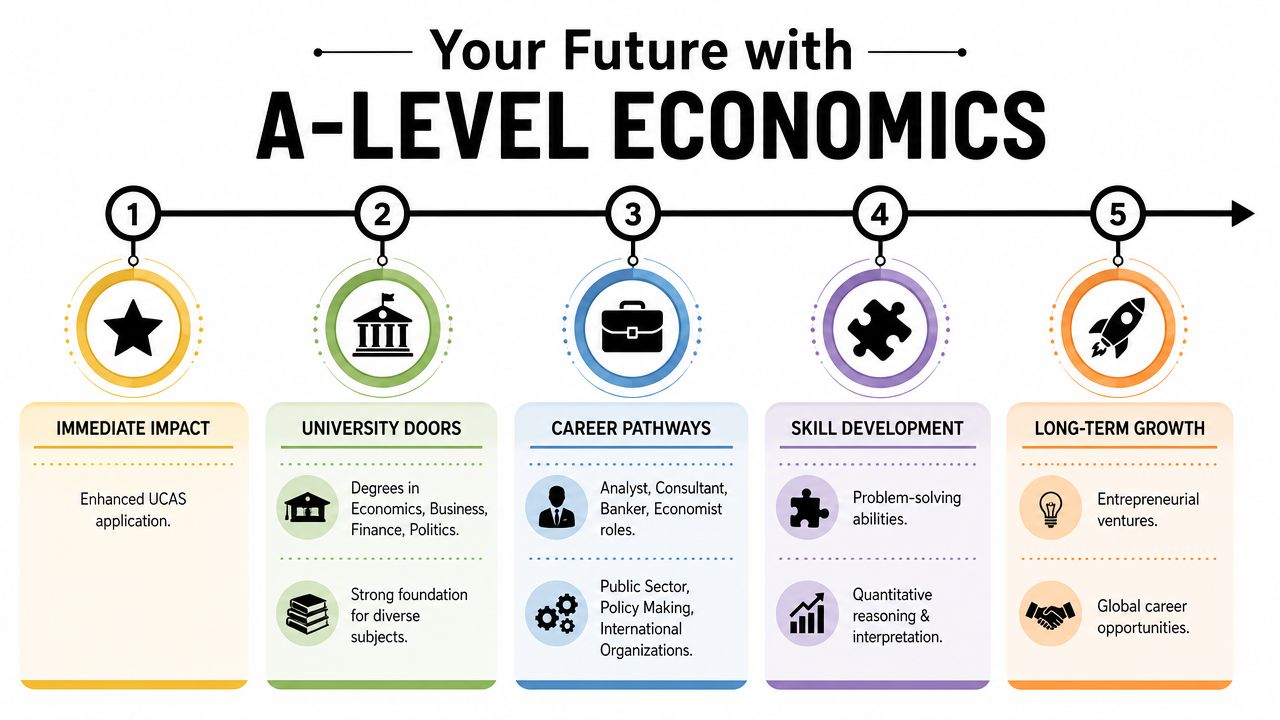
For many adult learners, university is not a vague dream. It is a practical goal tied to better work, better pay, and a stronger sense of possibility. Economics supports applications for degrees such as Economics, Business, Finance, Politics, and related subjects because it shows that you can handle ideas, evidence, and written argument at a high level.
That matters if you want a route that feels concrete, not just hopeful.
If that path appeals to you, this guide to getting into universities as an adult learner can help you see how the bigger pieces fit together.
The subject builds skills employers respect
Economics trains your mind in a very practical way. You learn how to read information closely, notice patterns, weigh different explanations, and make your point clearly. It works a bit like strengthening a muscle. At first, a chart, case study, or written argument can feel dense. With practice, you start seeing structure where you once saw confusion.
Those skills carry into many kinds of work, including roles linked to:
- Business analysis
- Finance-related work
- Government and policy
- Administrative roles with decision-making responsibility
- Further specialist study
The value is wider than a job title. If you can assess evidence and explain your reasoning calmly, you bring something useful to any workplace.
This video gives a useful look at where economics can lead:
You start seeing yourself differently
Adult study often changes your identity before it changes your CV.
You may begin the course thinking, "I missed my chance." Over time, that can turn into, "I am building something." That shift is powerful. It shows up in interviews, personal statements, and ordinary conversations at home. Your children notice it too. They see you keep going when life is busy. They see you choose growth instead of standing still.
That kind of example lasts.
Adult learning does more than add a qualification. It helps you prove to yourself, and to the people you love, that your future can still grow.
How to Make Your A Level Dream a Reality
The hardest moment is often a quiet one. The house is busy, work is tiring, and you are staring at a course page wondering whether this is really the right time to begin. For many adult learners, that moment carries more than doubt. It carries hope too. You are not only choosing a subject. You are choosing to back yourself, and that can change how you see your future and what your children see is possible.
A good first step is to make the path feel manageable.
Choose a provider carefully
Online study works best when the course is built for real life, not for some ideal week where nothing goes wrong. A strong provider gives you structure, support, and a clear sense of what happens next. That matters when you are returning to study after years away.
As you compare options, check for a few practical signs:
- Clear structure: You should be able to see how the course is laid out and what you will study first, next, and later on.
- Tutor access: Find out how you ask questions and how support is given when you get stuck.
- Recognised qualifications: Make sure the course follows an official A Level route.
- Transparent costs: You should understand the full price and any payment options before you enrol.
This is less about finding a perfect course and more about finding one that feels steady and honest. A well-organised course works like a map. It does not walk the road for you, but it helps you stop feeling lost.
Make study fit your real life
You do not need a spare room, expensive equipment, or hours of silence.
You need a plan you can repeat.
That usually means building study into the life you already have, rather than waiting for life to become easier. Adult learners often make better progress with routines that are small and regular. Twenty or thirty focused minutes can do more than a long session you keep postponing.
A few habits can help:
Choose one study space
A corner of the kitchen table is enough if it is the place you return to consistently.Put study time in your week
A written slot in your calendar has a much better chance of happening than a promise you keep in your head.Keep sessions realistic
Short, steady effort builds knowledge the same way regular savings build over time.Expect interruptions
Family life, work shifts, and tired evenings will happen. Missing one session is a pause, not a failure.
Keep your reason close
On difficult days, motivation rarely comes from discipline alone. It comes from remembering why you started.
Your reason might be university. It might be a better job, more financial security, or the wish to feel proud of yourself again. For many adult learners, it is also about family. You want your children to see that learning does not end when life gets busy. You want them to remember that you kept going, even when it felt uncomfortable.
That reason matters because economics asks you to stay curious about the world around you. You study ideas that connect to prices, jobs, business decisions, and the choices families make every day. The subject feels real because it is real. You can hear it in the news, notice it in your payslip, and discuss it at your own table.
Fear does not need to disappear before you begin. Courage often looks much quieter than that. It looks like filling in the form, setting aside an hour, and deciding that your future is worth the effort.
If you're ready to take that first brave step, Next Level Online College offers flexible, fully supported online learning designed for adult learners across the UK. If you want a course that fits around work and family while helping you rebuild confidence and move towards university or a new career, it's a strong place to start.