
Somewhere in the middle of a busy week, this thought can sneak up on you. You're making packed lunches, answering messages, working, cleaning, helping with homework, and still wondering if life could be more than this. You want better choices. You want qualifications. You want to feel proud when your children ask what you do, and proud of the answer you give yourself.
You might also feel nervous. That's normal.
Many adults look at a level study and think, “I've been out of education too long,” or “I was never the academic one,” or “What if I start and can't keep up?” Those worries are real, but they don't mean you can't do this. They mean you care.
An a level english online course can be a strong next step if you want to move towards university, a new career, or prove to yourself that your story is not finished. It gives you a recognised route forward, but it also gives you something harder to measure. Confidence. Routine. Direction. A reason to believe in your own future again.
Your Guide to A Level English Online Courses
It often starts late at night.
You finally sit down, search for A level English courses, and then stare at the screen wondering what any of it really means. Is this the right subject? Will it fit around work and family life? Will you be expected to walk into an exam hall years after leaving school and somehow know what to do?
Those questions matter. Adult learners usually do not need hype. They need a clear picture of what they are signing up for and a reason to believe the process is manageable.
An online A level English course gives you a structured way to study from home while keeping your job, your responsibilities, and your ordinary life in place. That practical side matters, but so does the emotional side. Returning to study can feel a bit like using a muscle you have not used for years. It feels stiff at first. Then, with regular practice, it gets stronger.
What A level English actually means
A level English is not one single subject in practice. For many adult learners, the first real choice is between English Language and English Literature, and that choice shapes both the kind of work you do and where the qualification may fit your future plans.
English Language focuses on how people use words in actual environments. You study how meaning changes with audience, purpose, tone, context, and form. If you are interested in careers linked to communication, teaching, journalism, media, marketing, speech and language, or any role where clear writing and analysis matter, this route often makes more sense.
English Literature is more focused on reading texts closely and building arguments about novels, plays, and poetry. It suits learners who enjoy interpretation, themes, character, and the way writers shape ideas across whole works. That can be a strong fit for degrees and careers linked to humanities, law, education, publishing, and subjects where critical reading is central.
Many adults worry about choosing the wrong one. A simple way to judge it is this. Language asks, “How does communication work?” Literature asks, “How does this text create meaning?” Both are respected. The better choice depends on the kind of thinking you want to practise every week.
That is why a good course guide should do more than list modules. It should help you see yourself in the subject before you commit.
You do not need to arrive fully confident. You need a course that breaks the work into clear steps and shows you how to improve.
For adult learners, that change is often the turning point. Once the course feels clear, the goal stops feeling distant.
Why an English A Level Could Be Your Golden Ticket
There's a reason adults return to study even when life is already full. They want more than survival. They want progress.
An English A level can matter because it helps you move from feeling stuck to feeling capable. It can support university plans, open the door to new forms of work, and help you speak and write with more confidence. That confidence doesn't stay inside the classroom. It shows up in interviews, emails, meetings, applications, and conversations at home.

Your children are watching
One of the most powerful reasons to study is simple. Your children see what you do.
When they watch you read notes at the kitchen table, submit work after a long day, or keep going when something feels hard, they learn something bigger than English. They learn that growth doesn't stop when school ends. They learn that adults can be brave too.
That example can change the mood of a whole home.
It can support university plans
If university is your goal, the right qualification can help you build a proper path towards it. For some adults, A level English is part of meeting entry requirements. For others, it strengthens the skills needed for higher study, especially reading carefully, writing clearly, and building an argument.
These are not small gains. They are the habits that help people cope when university work becomes demanding.
It can help with career direction
The value of English goes far beyond “being good at essays”. Strong communication matters in many workplaces. If your job involves people, ideas, reports, problem-solving, persuasion, or careful reading, English skills matter.
You may want to move into roles connected to:
- Communication-heavy work such as marketing, customer-facing roles, training, journalism, administration, or support work
- Further professional study where reading and writing at a high level are part of the next step
- A fresh start after years in a role that no longer fits the life you want
Practical truth: the certificate matters, but the person you become while earning it matters too.
Finishing a qualification you once thought was out of reach can change how you see yourself. That shift can be the beginning of everything else.
Choosing Your Path English Language vs Literature
A lot of adults search for an a level english online course when they're really asking a deeper question. “Which kind of English is right for me?”
That's a smart question. Not all English A levels feel the same, and the best choice depends on what you want to do next.
The choice matters for future goals. CHS Online notes that English Language is often preferred for communication-heavy careers, while English Literature provides a focused pathway for specific arts and humanities degrees. It also describes flexible two-year online routes for learners balancing work and study.
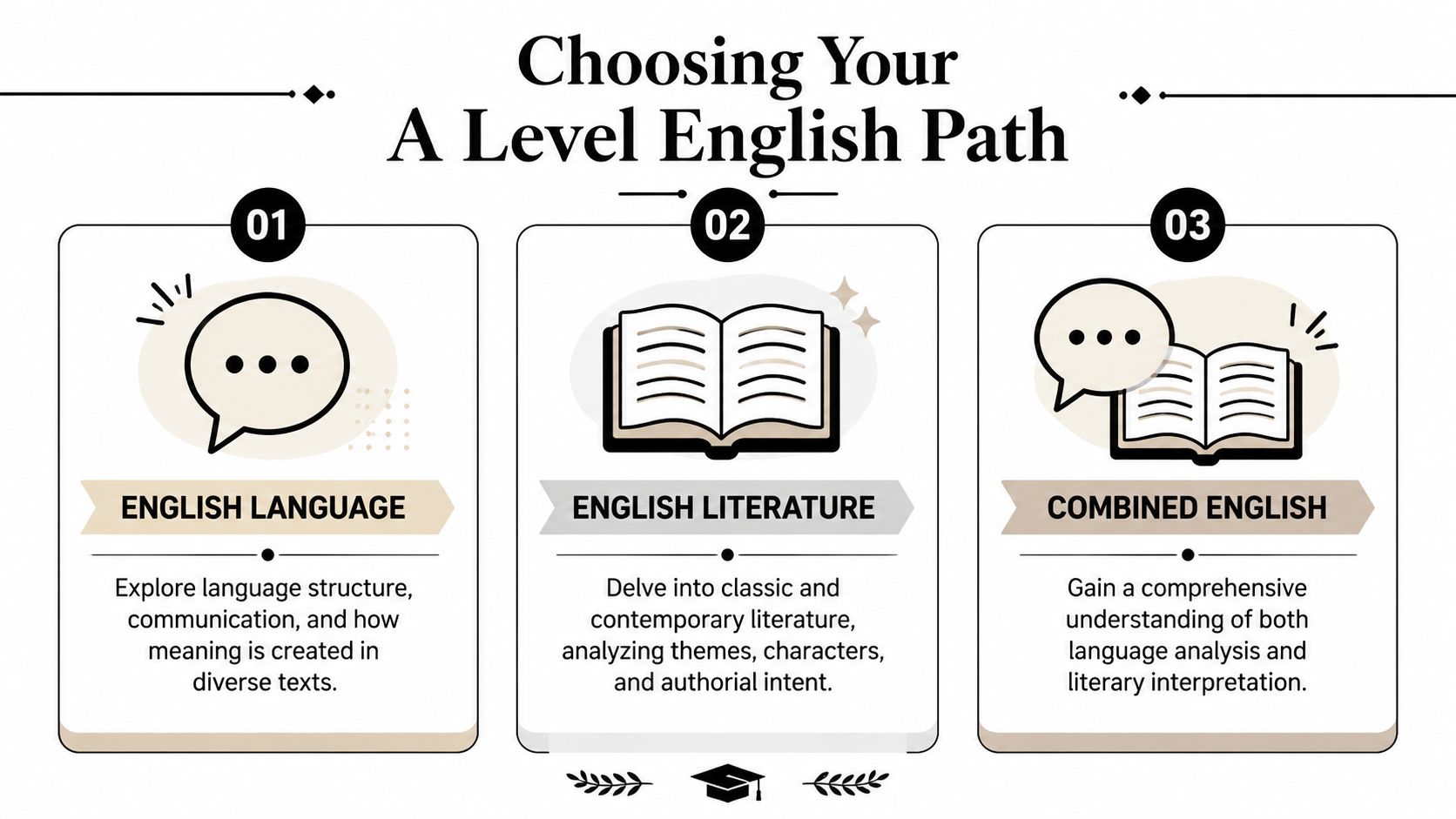
Think of them as different tools
English Language is like a toolkit. You look at how communication works. You study the way people speak and write, how meaning changes in different situations, and how choices in language affect the reader or listener.
English Literature is more like a map through stories. You explore novels, plays, poetry, themes, characters, and the ideas writers build into their work.
Combined English gives you some of both. It can suit learners who enjoy both analysis of language and the study of literature, though availability can vary by provider.
Which A Level English Course is Right for You
| Course Type | What It's Like | Best For You If… |
|---|---|---|
| English Language | Studying how spoken and written English works in real life | You want communication-focused skills and broad analysis |
| English Literature | Reading and analysing plays, novels, poetry, themes, and writers' choices | You enjoy books, ideas, and humanities-style study |
| Combined English | A blend of language study and literary analysis | You want a wider mix and can find a provider offering it |
English Language
This is a great choice if you want to understand how people communicate.
You may look at transcripts of speech, articles, online writing, opinion pieces, interviews, or other non-fiction and real-world texts. You'll think about audience, purpose, tone, structure, and language choices. You'll also produce your own writing for different purposes.
This can fit learners who are thinking about areas such as law, media, marketing, journalism, communications, education, or any path where clear thinking and strong expression matter. If that sounds like you, it's worth looking at an A level English Language course option.
English Literature
This is a great choice if you love reading and want to dive into texts.
You'll spend more time with novels, drama, and poetry. You'll explore meaning, context, character, style, and interpretation. If you enjoy discussing why a writer made certain choices, or how a story reflects human experience, this route can feel very rewarding.
It may suit learners considering humanities degrees or arts-focused progression.
Combined English
Some learners don't want to choose one side of English. They enjoy both the mechanics of language and the richness of literature.
That's where combined study can appeal. It can give you a broader experience, though the right choice still comes back to your progression plans and what kind of study keeps you interested enough to stay consistent.
If you're unsure, don't ask only “Which subject sounds clever?” Ask, “Which kind of work would I still be willing to do on a tired Tuesday evening?”
That question often leads to the best answer.
What Studying an Online Course Actually Looks Like
It is 8:30 at night. The kitchen is finally quiet, your phone is face down, and you are wondering whether your brain still works well enough for A Level study.
This is the point where many adults feel the wobble. The good news is that online study rarely looks like six straight hours of intense academic work. It looks more like steady training. A few focused sessions each week, each one doing a clear job, gradually builds skill and confidence.

A good online course is a structure you can return to, even after a tiring day. You work through guided lessons, read set material, make notes, plan answers, and improve your writing over time. Some learners study before work. Others protect two evenings and part of Sunday. There is no perfect timetable. There is only the one you can keep.
What you will do
English A Level is built on active work. Reading matters, but progress usually comes from using what you read. You test ideas, write responses, spot weak points, then try again.
In plain terms, your week may include:
- Reading with a clear question in mind so you notice language choices, structure, and meaning
- Making short notes that turn a big text into manageable points
- Writing practice where you plan, draft, and improve paragraphs or essays
- Timed tasks so exam conditions stop feeling frightening
- Reviewing feedback and using it in the next piece of work
If you have not studied for years, this can feel slow at first. That is normal. Learning English at this level works a bit like rebuilding fitness. The first sessions feel clumsy. Then you begin to recognise patterns, find your voice again, and trust your own thinking.
A realistic week for an adult learner
Many adults do better with short, repeatable study blocks than with one huge catch-up session.
A week might look like this:
- One short weekday slot for a lesson or focused reading
- Another session for notes and planning
- One evening for writing a paragraph or essay section
- A weekend block for a timed response, revision, or catching up
That rhythm helps study fit around work, children, shifts, and ordinary life. If you want to see how flexible study is usually set up, this guide to distance learning for A levels gives a clearer picture.
A short video can also help make online study feel more real:
What catches people out
The hard part is rarely the reading itself. It is the return to routine.
Adults often lose time in three places. They wait for a perfect free day, they spend too long making notes instead of writing, or they avoid timed practice because it feels uncomfortable. Each one is understandable. Each one can slow progress.
A simpler approach works better:
- Choose study times you can protect most weeks
- Keep sessions short enough to start without a mental battle
- Move from reading to writing quickly
- Treat mistakes as part of training, not proof that you cannot do this
Small, steady effort carries you much further than one burst of panic study.
How You Are Supported From Tutors to Final Exams
Support matters more than many adults realise at the start. When confidence is low, you don't just need course materials. You need people who respond, explain, and keep you moving.

What tutor support should feel like
A tutor is not there to catch you out. A good tutor helps you understand what the examiner is looking for, where your work is already strong, and what needs tightening up.
That can include:
- Marking written work so you can see how to improve
- Explaining mistakes clearly instead of using confusing jargon
- Helping with essay structure when your ideas feel messy
- Keeping you focused when motivation dips
If you want to understand what this kind of academic help can include, expert tutor support is one example of how online providers describe that layer of guidance.
Accreditation and assessment matter
Adults often ask if an online course is “real”. That's the right question.
You should always check who the qualification is awarded by, how assessments work, and whether the course matches the required specification. Some qualifications involve coursework, others are assessed mainly by final exams, and the course should prepare you for that exact structure.
For Functional Skills English, Pearson's specification shows a useful example of how online English provision must match assessment logistics as well as content. It includes an internally set and marked Speaking, Listening and Communicating assessment, plus externally assessed Reading and Writing assessments, offered paper-based and onscreen, as explained in the Pearson Functional Skills English specification. The same document helps show why online providers need to prepare learners not only in subject knowledge but also in assessment method.
The exam centre reality
This is the part many course pages don't explain clearly enough.
For online A levels, learners commonly still need to sit final exams in person at an approved exam centre as a private candidate, as noted by Oxford College's distance learning guidance. For adults, the practical challenge is often not the studying itself. It's finding a local centre, understanding private candidate arrangements, and planning travel or time away from work.
Important question: can you do the learning online, but still need to attend a physical exam centre at the end? In many cases, yes.
That does not mean the course is a bad option. It means you should plan early.
Questions to ask before you enrol
Use this checklist when speaking to any provider:
- Where will I sit the final exam and when do I need to book it?
- What support do you give for exam preparation and timed practice?
- Does the course include feedback on marked work or only self-study materials?
- What happens if I need help after I've enrolled?
- Are there any extra costs beyond the course fee?
When adults know the full picture, they make calmer decisions. Clear answers build trust, and trust helps you commit.
Making Your A Level Affordable
Money worries stop good people from starting courses all the time. That's understandable. If your budget already feels stretched, any new cost can feel heavy.
The best way to handle this is to look at it calmly and in parts.
Break the cost into pieces
With an online A level, you may need to think about more than one type of cost:
- Course fee for the teaching, materials, and support
- Exam fees charged through the exam centre
- Books or materials if they are not included
- Travel costs for the final exam if your centre is not local
Not every provider structures this in the same way, so it's worth asking for a full list before you commit.
Why payment plans matter
A lump sum can feel impossible. A monthly plan can feel doable.
Many adult learners manage study by spreading the cost over time, just as they would for other important household commitments. That doesn't make the course cheap. It makes it easier to plan for. The key is knowing exactly what you'll pay and when.
Think in terms of return, not just price
This isn't only about buying a course. It's about buying a chance.
A qualification can support access to higher study, a more skilled role, or a career move that changes daily life for you and your family. It can also reduce the cost of delay. Waiting another year because you feel unsure often has a price too, even if it doesn't show up on a bill.
Spending carefully matters. So does investing in something that helps you move forward instead of standing still.
If the price worries you, ask questions. A good provider should explain costs plainly, without pressure.
Your Next Chapter Starts Today
If you've read this far, part of you is already reaching for change.
You don't need to have everything sorted today. You don't need perfect confidence, a perfect timetable, or a perfect past. You just need a next step that makes sense. For many adults, an a level english online course is that step. It brings structure to a dream that may have felt vague for years.
You are not “too late”. You are not “not academic enough”. You are not behind in some way that cannot be fixed. You are an adult with responsibilities, experience, and reasons for wanting more. Those things can make you a stronger learner, not a weaker one.
Your children can see you try. Your family can see you grow. You can build a future that feels more stable, more hopeful, and more like your own.
Start by asking honest questions. Which English path fits your goals? What support will help you keep going? Where will you sit the final exam? What payment option feels manageable? Once you answer those, the road becomes much clearer.
The biggest shift often happens before enrolment. It happens when you stop saying “maybe one day” and start saying “I'm ready to look into this properly.”
If you'd like a calm, friendly next step, have a chat with Next Level Online College about your goals, your worries, and which route could fit your life. It doesn't have to be a hard sell. It can just be a simple conversation about where you are now and where you want to go.